Testing Our Hearts

Stethoscope

John 7:17 “If anyone chooses to do God’s will, he will find out whether my teaching comes from God or whether I speak on my own.”

A better translation of the Greek behind, “If anyone chooses to do God’s will,” would be, “If anyone desires to do God’s will” in this verse. Jesus is talking about the condition of our own hearts. Do we want what God wants?

Is it hard to see why this is so important for our test? When we want something to be a certain way, we can work very hard to justify our position. If a person wants to get drunk, he can redefine what it means to be drunk, line up all those Bible passages that tell us it is okay to have a drink, and remind anyone who tries to confront him that the Bible says “Do not judge.” I have listened to people defend their sexual sin with some of the most far-fetched and outlandish interpretations of the Bible passages that condemn the same practices. Jesus says, “Love your enemies.” We’ve got enemies. Do we reinterpret what it means to love them to excuse less than loving behavior?

It’s not just the moral issues. What God says about the only way to heaven can be hard to accept when we know someone who died trying another way, or no way at all. Do we want what God wants then? Scripture warns us that life in this world will be hard, and painful, and full of trouble, and that God disciplines us this way for our good, because he loves us. But when life actually turns out that way, and we are miserable, do we acknowledge that God is simply being gracious to us then? Do we want what God wants?

I could multiply the examples.  The point is this: When we don’t want what God wants, then we don’t listen to his word with an open and receptive heart. We try to read our own ideas into his word. We may go looking for ways to defend our positions, instead of looking in the word to learn God’s positions. We may go looking for people who tell us what we want to hear instead of looking for someone willing to tell us just what God’s word says. That is a heart problem.

What is the status of my own heart? If we are going to desire to do the will of God, God must first call us to repentance. That is why John the Baptist came as the forerunner of Jesus. His preaching or repentance prepared people to desire God’s will and recognize Christ. This is why preaching still needs to confront us today, to break down our self-will that stands in the way of acknowledging God’s will.

If we are going to desire to do the will of God, we need the gospel to give us faith. Desiring to do God’s will does not begin until after we trust in him. And trust in God does not begin until after we have been convinced that he loves us unconditionally and forgives every sin and gives us heaven. Only when we trust God and want what he wants are our hearts in any condition to test teachings and know whether they come from God.


Reliable Sources

Hebrew

John 7:15 “The Jews were amazed and asked, ‘How did this man (Jesus) get such learning without having studied?’”

The question of the Jewish leaders does not suggest that Jesus was illiterate. Like most Jewish boys of his time, he had likely attended a synagogue school where he learned how to read.

But Jesus had never studied in one of the rabbinical schools of his time. These were something like our seminaries. You may remember that the Apostle Paul studied in the school of the well-known rabbi Gamaliel. But Jesus had no college level degree in theology. He was a tradesman, a carpenter by training, who had a brilliant grasp of the Scriptures. His teaching did not come from what he had learned in some theological school.

Likewise, the test of true teachers of God’s word is not about the school they attended or the number of degrees they have earned. These may not be bad things. We don’t want ignorant or lazy preachers and teachers who have not worked at learning Scripture and prepared themselves for serving God’s people. Continuing study is a healthy thing for one’s ministry. But theology degrees from prestigious institutions do not necessarily make a better teacher of God’s word. Many things that could be learned from some theological schools would be serious problems today. In spiritual things, academia has often produced a skepticism that gets in the way of knowing God’s word.

Jesus himself prayed, “I thank you Father, Lord of heaven and earth, because you have hidden these things from the wise and learned and revealed them to little children” (Matthew 11:25). Paul made this observation to the Corinthians, “Where is the wise man? Where is the scholar? Where is the philosopher of this age? Has not God made foolish the wisdom of the world? For since in the wisdom of God the world through its wisdom did not know him, God was pleased through the foolishness of what was preached to save those who believe” (1 Cor. 1:20-21). In the test of the true teacher, the right answer to the question, “Where does his teaching come from?” is not, “From some respected school.”

Where, then? “Jesus answered, ‘My teaching is not my own. It comes from him who sent me’” (John 7:16). With these words Jesus does not deny that he agreed with his own teaching, believed it, and claimed it for himself. He is talking about the source. His teachings were not new teachings he made up independently during his earthly ministry. Truth is never something new, though it may have been forgotten and rediscovered. Truth has a long history behind it. In fact, truth is eternal.

We live in an age that idolizes the new and the trendy. Christians also suffer from this disease. When people make some preacher or teacher popular, because, “Here’s something we haven’t heard before,” we can be too quick to jump on the bandwagon. Has he dusted off some Biblical teaching that has been neglected for too long? Then feel free to follow. But is his teaching some creative new idea spun out of his own imagination? Through Jeremiah God complained about the prophets who “dream their own dreams.” That is the wrong answer to “Where does his teaching come from?” in the test of the true teacher.

Instead, it needs to come “from him who sent me.” Jesus was a true teacher because his teachings agreed with those of his heavenly Father, the one who created the world. His words lined up with God’s revelation to the Patriarchs, and Moses, and the Prophets. Jesus’ claim that his teachings come from the one who sent him was not a claim that defied contradiction because there was no way to investigate it. Everyone present knew the way to check it out: compare Jesus’ teaching with the Scriptures.

When testing to see if someone is a true teacher, “From God through his Holy Scriptures” is still the best answer to the question, “Where does his teaching come from?”

An Unpopular Faith

Protest

Luke 6:22-23 “Blessed are you when men hate you, when they exclude you and insult you and reject your name as evil, because of the Son of Man. Rejoice in that day and leap for joy, because great is your reward in heaven. For that is how their fathers treated the prophets.”

If you had lived in Jesus’ day, would you have sided with the conservatives or the liberals?

On the conservative side were the Pharisees. They were the ones concerned about upholding the whole Bible. They were concerned about promoting good morals. They worked hard at teaching people how to live a godly lifestyle.

On the liberal side were the Sadducees. They were the ones who were progressive in their thinking. They were in tune with the culture. They had a vision for a better society through creative thinking and an acceptance of people and ideas from other cultures.

Does it surprise us that Jesus didn’t become cozy with either one? To be sure, Jesus once said of the Pharisees, “The teachers of the Law and the Pharisees sit in Moses’ seat. So you must obey them and do everything tell you.” But in the next breath he continues, “But do not do what they do, for they do not practice what they preach. They tie up heavy loads and put them on men’s shoulders, but they themselves are not willing to lift a finger to move them” (Matthew 23:2-4). The Pharisees may have gotten the moral issues right much of the time, but theirs was a burdensome and graceless religion. It lacked the power to help people do the right thing. It was devoid of love—either God’s love for us, or true love for one another.

Jesus insisted on sticking with the truth, even if that meant that he was taking a very lonely position. It made him unpopular with the major movements of his day. Eventually, it led to his crucifixion.

Those who follow Jesus still find that sticking to the truth can put one in a very lonely position. More and more, confessing what the Bible has to say brings the disapproval of those around us.

When Bonnie Witherall was murdered in Lebanon for her missionary work fifteen years ago, even fellow Christians criticized her for evangelizing. One Christian leader compared her to a terrorist, complaining, “She was in the habit of gathering the Muslim children of the quarter and preaching Christianity to them while dispensing food and toys and social assistance” (Christianity Today, Feb. 2003).

Is telling people that Jesus is the Way to heaven a form of terrorism? The churchman quoted wasn’t alone in his evaluation. Similarly, the book titled When Religion Becomes Evil lists five signs that religion has become corrupt. Among the five signs: “absolute truth claims.” Apparently the one who said, “I am the Way, the Truth, and the Life,” and “If you hold to my teaching you are really my disciples. Then you will know the truth…” was starting a corrupt religion.

We should not be surprised if faithfulness to our Savior’s words meets with the same kind of disapproval. Jesus warned that those who disturb the peace by defending the truth of the gospel would be unpopular. But then, he promises that those who do so enjoy some fine company. “That is how their fathers treated the prophets.” That’s how they treated Jesus, too.

Our King Incognito

Pilates Court

John 18:33-35 “Pilate then went back inside the palace, summoned Jesus and asked him, ‘Are you the king of the Jews?’ ‘Is that your own idea,’ Jesus asked, ‘or did others talk to you about me?’ “Am I a Jew?’ Pilate replied. ‘It was your people and your chief priests who handed you over to me. What is it you have done?’”

There is a good deal of irony in the first exchange between Jesus and Pontius Pilate. Who was Pontius Pilate anyway? He was a relatively minor official in the Roman government, a man stuck in middle management, if you will. You won’t find any monuments inscribed with his name. Outside of the Bible, only the historians Josephus and Philo make any mention of him, and they describe his administration as rather inept.

Who is standing in front of Pilate? Jesus stands infinitely higher above Pilate’s emperor than that emperor stands above poor little Pilate. Jesus’ empire extends to the farthest stars. He is the Emperor of the emperors, the King of kings. “Are you the King of the Jews?” Yes, and of every other people who have ever existed.

But Pilate’s question wasn’t asked with an open mind willing to entertain the possibility that Jesus was actually a king. By now Jesus was likely covered in dried spit and his face displayed the bruises from his treatment in the Jewish court. His eyes sagged from the exhaustion of a sleepless night. He wore a poor man’s clothes. Pilate could see how Jesus had been treated, and so his real question was only this, “What is it you have done?”

Is Jesus the King? Whatever else our world has to say about him, they still fail to answer this question properly. They may place him alongside leaders of other great world religions, but they have no intention of placing him over them. They may say nice things about some of his ideas, but they have no intention of living under him as their Lord. Like Pilate, like the Jewish leaders, they reject him as King. They aren’t even willing to consider the possibility.

Is Jesus our King? By faith we believe him to be, and we declare him to be. But to whom do we really bow when we cling to resentment in place of love? Who is really leading us when we pursue personal pleasures that make other people nothing more than objects for our personal use, or when we waste the gifts and resources our Lord has entrusted to our care? Does that sound like the life King Jesus promotes?

The world rejects him as King because he doesn’t look the part, his rule conflicts with our desires, and he doesn’t come with some army to enforce his claims. “My kingdom is not of this world. If it were, my servants would fight to prevent my arrest by the Jews. But now my kingdom is from another place” (vs. 36). But it is in just this humility and suffering with which he appears before Pilate, and that will only get worse and end in his death, that we see the true glory of Jesus’ royal work. For Jesus, royalty isn’t about enjoying privileges no one else has, putting on airs of refinement and culture to bolster one’s already inflated ego.

The King protects his people. Their safety and well-being is his only purpose. If that means fighting for them all by himself, that is what he will do. If that means subjecting himself to the world’s humiliation, he is ready to accept it for them. If he must die at the hands of the world so that they might live, he will not shrink from death. Jesus stands before Pilate for us. His rejection as King is another step toward the price he will pay for our sins. Jesus is a King under whom we can happily live, by whom we can be glad to be ruled. His reign is our salvation.

Stop Fighting! Let Him Drink It.

Cup Hands

John 18:10-11 “Then Simon Peter, who had a sword, drew it and struck the high priest’s servant, cutting off his right ear. (The servant’s name was Malchus.) Jesus commanded Peter, ‘Put your sword away! Shall I not drink the cup the Father has given me?’”

To understand Peter better, maybe we can approach this episode a little like a question on Jeopardy. “If the death of God’s Son on the cross is the answer, then what is the question?” Or put it this way: “If Jesus’ death on the cross is the solution, then what is the problem?”

If my salvation, my rescue, required God himself to leave heaven, become a human being, subject himself to his own rules, keep them all perfectly, then permit himself to be unjustly arrested and condemned, submit to beatings and tortures that would have killed many, be nailed to cross and hung there to die, and be forsaken by God the Father (essentially the experience of hell), then my sins are not a minor, insignificant bending of God’s rules. Then they must be unspeakably evil, hurtful and dangerous far beyond my poor ability to measure or understand. My condition must be dead and lost far beyond my powers to help. If Jesus had to do all that, what do I think I am going to add?

It’s a little like my son’s cancer years ago. When the solution is to pump his body full of hundreds of thousands of dollars’ worth of deadly poisons for two years, you know we have a threat that isn’t just about feeling a little sick. This problem isn’t going to be solved with just a slight adjustment to diet and exercise. Similarly, my sins put me beyond all normal expectation of help or survival. Only God’s own miraculous intervention can save me.

Unfortunately, I am not unique. I share the same condition with every other human being. That makes our whole world a lost and dying one. It’s not a house that’s a “fixer-upper,” or a boat that has sprung a leak. It is a building about to collapse under a three alarm fire. It is an ocean liner with gaping holes in the hull heading for the ocean floor.

It would be strange, wouldn’t it, to start remodeling rooms and rearranging the furniture in that burning building? It would be strange to try to upgrade your cabin in that sinking ocean liner. But that is what we are doing when we plan and live our lives as if this world were our real and lasting home. We see no farther than the education plans, the career plans, the family plans we have for ourselves in this place. We need to be more concerned with how we are going to get out with our lives, not so concerned with making our stay a comfortable one.

Jesus cross, and the horror that he suffered there, teaches us this. The solution helps us see the full extent of the problem. But that was just Peter’s problem. He didn’t want to see it. He didn’t want to believe it. He had big plans for that first class cabin on the promenade deck. Jesus’ cross took them all away. The first time Jesus openly mentioned his cross to the disciples, Peter pulled him aside and contradicted him in the strongest terms. You remember: “Never, Lord. This shall never happen to you.” And Jesus replied, “Get behind me Satan. You are a stumbling block to me. You do not have in mind the things of God but the things of men.” Here, when the plan is finally going into effect, Peter has drawn his sword and will fight to prevent it from happening.

Like Peter, we need to put away our swords and stop fighting. Like Peter, we need to let Jesus drink the cup the Father has given him (as if we could prevent it, anyway). Like Peter, we need to learn to stop struggling with the cross and let Jesus lead us to accept all that it means for us. The cross may mean believing that I am sinner who cannot save himself, but it also means forgiveness for every sin and a place in God’s family as his holy child. The cross may mean that all my life and accomplishments in this world are going to come to nothing. But it also offers escape to a new life and a new world infinitely better than the one we are leaving behind.

Sometimes children fight the very things that save them–the shot with the antibiotic their bodies need, the seat belt that makes it possible to survive an accident. Sometimes even God’s children have resisted the very thing that saves them–the cross, and all that means for our sin and for our world. Stop struggling. Let the cross do its work. Life is waiting on the other side.

So Much Power, and Yet…

Creation

John 18:4-6 “Jesus, knowing all that was going to happen to him, went out and asked them, ‘Who is it you want?’ ‘Jesus of Nazareth,’ they replied. ‘I am he,’ Jesus said. (And Judas the traitor was standing there with them.) When Jesus said, ‘I am he,’ they drew back and fell to the ground.”

Imagine the power Jesus had at his disposal to prevent his arrest. Just three little innocent sounding words come out of his mouth and the entire armed mob in front of him is knocked to the ground. But some impressive words those were. In English, we add the word “he,” to the translation, because that is how we would identify ourselves. In the Greek Jesus simply says, “I am.” The last time he said that about himself, back in John chapter 8, the mob picked up stones to stone him. They recognized that he was identifying himself with the “I Am” God who spoke to Moses from the burning bush on Mt. Sinai. If the brute squad sent to arrest him didn’t recognize Jesus’ divinity from the meaning of the words, the force that knocked them all to the ground should have made them think.

Maybe they could have remembered Isaiah’s description of the Messiah as the Branch in chapter 11: “He will strike the earth with the rod of his mouth; with the breath of his lips he will slay the wicked.” Maybe they could have recalled the words of Psalm 46: “He lifts his voice, the earth melts.”

The point is, Jesus was not surrendering because he was faced with a superior force. In Matthew he reminds his disciples that twelve legions of angels stood by ready to defend him if necessary. But what was even their power compared to his own words? Jesus had the power to stop this any time he chose. He chose to let us see it. He chose not to use it.

So what leads Jesus to put away his own sword, so to speak? He accepts his cross, because he is moved by his love. “Again he asked them, ‘Who is it you want?’ And they said, ‘Jesus of Nazareth.’ ‘I told you that I am he,’ Jesus answered. ‘If you are looking for me, then let these men go.’ This happened so that the words he had spoken would be fulfilled: ‘I have not lost one of those you gave me’” (John 18:7-8). Already, the brief demonstration of his power was an act of love for his enemies. It was a warning to them. “Think about what you are doing. Take note of the one you are dealing with. It’s not too late for you to change.”

Jesus accepts this path to his cross alone out of love for his disciples. The day will come when they can risk their lives for him, but not with a show of force and violence. This night he spares them, he arranges for their escape. He hands himself over before there is any mistake about which one he is, or before a real fight can break out.

Jesus put away his sword and accepted his cross out of love for us and the world he came to redeem. In one way this may seem sensible to us, almost expected. The captain of a sinking ship directs the evacuation and goes down with ship. As I am writing this a story of heroism is coming out of a tragic mass shooting in Florida. A football coach used his own body as a shield to protect students under his care from flying bullets. We have come to expect a leader to put his own life on the line to spare those under his care.

But don’t forget that Jesus wasn’t merely risking death. “Jesus, knowing all that was going to happen to him…” gave himself up. He was guaranteed unspeakable tortures and hell’s darkest agony! And for what, for whom? The ship on which Jesus was sailing was not filled with innocent passengers, but guilty criminals. Their crimes were not mere misdemeanors and traffic violations. The people for whom Jesus accepted the cross were rebels, traitors, murderers who had taken sides against God without exception. That reference isn’t limited to the mob who arrested him. When we were in that condition he loved us. When we were in that condition he set his power aside and accepted the cross to take our guilt away and set us free.

Yes, Jesus has almighty power. But that takes second place to his love.

God’s Kind of Payday

Check

Romans 4:4 “Now when a man works, his wages are not credited to him as a gift, but as an obligation.”

Leave church for a moment. Go to your workplace. See how things work there. Whether you punch a clock and work with your hands, or sit behind a desk and push paper, or travel around trying to push a product, what happens every week or two? You get a paycheck. You expect that paycheck. You demand that paycheck, because you earned it. Your employer isn’t doing you any favor by paying you. He owes you. If he were to put on some big display every time he payed you, as though he was going beyond the call of duty by giving you this money, you would think he was being absurd. He has an obligation to pay you for your work.

If our own good works made us righteous in God’s eyes, if we earned heaven by the way we served him, wouldn’t the same be true? God would owe us. Giving us eternal life would be an obligation. He wouldn’t use words like grace, or gift, or free. He would fork over the goods and be quiet about it. He would tell us what a fine job we had done and leave it at that.

It appeals to our pride to try to save ourselves this way. We might even wonder why we shouldn’t go this route. If you go back and read the whole context of the book of Romans up to this point, you will see how impossible Paul makes this to be. In the book of Revelation the Apostle John warns people who are confident about themselves, “You say, ‘I am rich; I have acquired wealth and do not need a thing.’ But you do not realize that you are wretched, pitiful, poor, blind and naked.” We’re not just a little behind when it comes to giving God what he demands. Spiritually, we are flat broke. We aren’t just a little weak. We are crippled, and blind, and even dead.

The attitude that wants to work out our own way to God, our own way to perfection, our own way to heaven only drives us farther away. No one ever gets closer to God by trusting more in himself. No one ever loves God more by believing he has received less from him. The work for your wages method deadens faith.

Then we see the other side of Paul’s illustration. “However, to the man who does not work but trusts God who justifies the wicked, his faith is credited as righteousness.” If we don’t work for our place in God’s heart and in God’s home, there is only one other way to get it. It has to come to us as a gift. We simply trust that God will give it to us.

The God who became a man and died on a cross even “justifies the wicked.” The gift goes to those who have been working for the competition. The Lord credited righteousness to drunks like Noah, murderers like Moses, adulterers like David, cowards like Peter, skeptics like Thomas, and persecutors like Paul. No matter what our great failings may be, he invites us to trust him and be confident that he will credit us as righteous people, just like them.

With the God of grace, everyday is payday. By faith, you and I are on his payroll, too.

Regarded Righteous

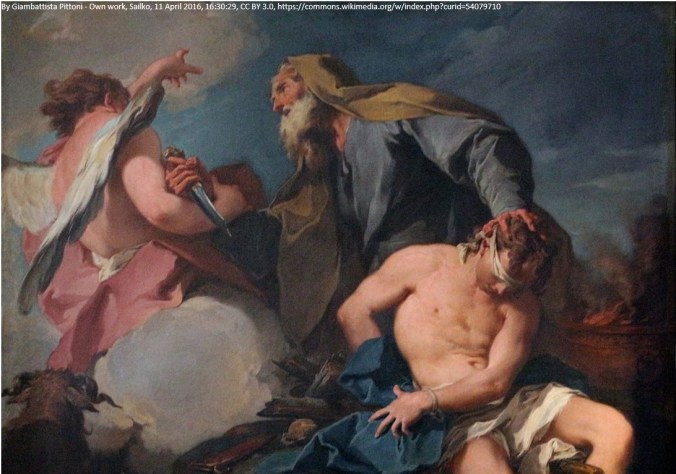
Abraham Isaac

Romans 4:2-3 “If, in fact, Abraham was justified by works, he had something to boast about—but not before God. What does the Scripture say? ‘Abraham believed God, and it was credited to him as righteousness.’”

Some spiritual people indulge in hero-worship as a way of holding out hope for salvation by personal goodness. A friend once told me he thinks Gandhi lived such a good life that God will have to take him to heaven, even if he wasn’t a Christian. In the middle ages some churchmen found the writings of pagan Greek philosophers so moral, so profound, they were convinced these men would be saved. I suspect something similar is going on in a movie like Disney’s Pocohontas. Grandmother Willow looks deeply into John Smith’s eyes and declares, “Oh! He has a good soul!” If we can convince ourselves “good people” like these were good enough to pass muster with God, then maybe there is hope I can be good enough, too. Then I can hold onto the belief that I am a good person. I can avoid the painful and humbling realities of repentance and confession.

Abraham was the Father of the Jewish people. Because the idea had become so ingrained that God saves those who are good and keep his law, the rabbis developed a set of legends around Abraham to emphasize the point. Abraham was said to have passed through ten trials successfully. Because he so faithfully obeyed God through all ten, God accepted him as good and righteous. Abraham’s merits were so great that he had done more than he needed for himself. This “extra-credit” could even be shared with his descendants.

“But wait a minute,” Paul says, “What does the Scripture say? ‘Abraham believed God, and it was credited to him as righteousness.’” The legends about Abraham may have been interesting, but they did not agree with the evidence from his life. For all the good things that could be said about Abraham, he was still a sinner. He was capable of rather astounding lapses into immorality. Twice he passed his wife Sarah off as his sister to save his own skin. He committed adultery with a servant girl to have a son. God could have condemned Abraham for any or all of these.

Instead, God claimed Abraham for himself and declared him righteous. But not because Abraham had been so good. “Abraham believed God, and it was credited to him as righteousness.” Abraham trusted God’s promises. Through that faith he received God’s grace and love. The Lord gave him credit as though he had lived a righteous life. Abraham’s purity and holiness before God was a divine regard he received by faith.

We may be tempted to find Paul’s conclusion about Abraham disappointing. It spells the end for our hopes to win God’s approval for our own attempts at righteous living. But being regarded by God as righteous as a matter of credit instead of actual performance is better. I am inclined to slip and fall. My record is full of examples from the past. I can be certain more of them lie in my future.

But the Lord doesn’t change. His grace is a constant where my behavior is unsteady. His promise is dependable where my commitment is uncertain. This is salvation we can count on. Receiving righteousness Abraham’s way may not make us heroes. But it makes us children—children of Abraham and of the God who declared him just.

Intended to Give Us Rest

Sleep

Mark 2:27-28 “The Sabbath was made for man, not man for the Sabbath. So the Son of Man is Lord even of the Sabbath.”

You have been working 16 hour days, 7 days a week, for several months until you finally collapse in sickness and exhaustion. You go to the doctor. He takes one look at you and says, “My friend, what you need is some rest! Just look at you. And if you are going to sleep properly, you are going to have to get some more exercise. It’s no wonder you haven’t been sleeping. Your body is all out of shape. You are also going to have to eat more carefully. No more Doritos and Coke for meals or pizzas delivered to the office so that you can eat while you are working. You need to take time for three square meals a day. You’ll also rest better if you take some more time to be with your family. A hobby of some sort wouldn’t hurt, either. It helps you reduce your stress. Then you can get some sleep.”

The doctor’s observations may all be good advice. But how much help will they be if the 16-hour work days continue? Then the doctor has added hours of work to an already overburdened schedule. The result will be less rest, not more.

Even in the perfection of Eden, our Lord never designed us to work without end. We need rest. So he prescribed the Sabbath Day, a day to put work aside so that God himself could serve our souls with his grace and love.

The Pharisees of Jesus’ day messed around with God’s prescription in ways similar to the doctor’s well-meaning advice. They added long lists of rules for the Sabbath to make sure people “rested.” But the more people focused on rules to keep, the less rest people got. Even worse, the less they were able to see the Savior to whom the Sabbath points.

God did not create the Sabbath so that we had a rule to keep. He gave this law so that it might keep us. On the Sabbath he led people to hear him speaking to them in his word. They responded with their prayers and praise. He gave their burdened souls rest from guilt and sin. His word of forgiving love kept them close to him in faith. They found God’s Sabbath Rest not by what they did to keep it, but by what the Lord himself did for them when they stopped all their doing, and all their busyness, and he himself had the opportunity to serve them.

Today we know we find our full Sabbath in the person of Jesus. He supplies us with rest from our sins and rest for our souls. The Sabbath Day was the long shadow of Jesus cast across centuries of promises (Colossians 2:16-17). It directed God’s people to the full and final rest which Jesus’ life and death in payment for our sins would provide. We no longer have to set aside all work on Saturday or consider it our holy day. The Apostle Paul tells us not to let anyone judge you in regard to keeping the Sabbath.

But we can still hear echoes of God’s will for us in that law. When we set aside our work to hear about his love, he still keeps us today. It is still God’s will for us to gather with other believers, and do so often. We don’t do it to save ourselves by keeping a rule. We encourage and edify each other with the word. The Lord speaks to us and saves us through that word. “Let us not give up meeting together (Greek, literally “synagoging”), as some are in the habit of doing, but let us encourage one another,” he urges in Hebrews 10. Let us find our Sabbath rest gathered with others for worship. There we still find Jesus, and he will give us rest for our souls.