Not Our Righteousness But His Mercy

Mercy

Titus 3:3-4 “At one time we too were foolish, disobedient, deceived and enslaved by all kinds of passions and pleasures. We lived in malice and envy, being hated and hating one another. But when the kindness and love of God our Savior appeared, he saved us, not because of righteous things we had done, but because of his mercy.”

Sin enslaves. It enslaves us to our own passions and pleasures. Since our passions and pleasures look so appealing, because they are simply what we want, we aren’t even aware of our slavery.  How often doesn’t the advertising we see invite us to make our passions and pleasures the focus of our lives? How often doesn’t the “pursuit of happiness” become people living in slavery to self? How much doesn’t “being hated and hating one another” describe the polarized society in which we live—right vs. left, conservative vs. liberal, people of faith vs. secular elitists, all screaming at each other and writing nasty things about each other online?

This slavery involves more than greedy or hurtful things people do. It taints our good behavior, too. That’s why Paul must exclude “righteous things we have done” from the salvation formula. More than God is concerned with our outward behavior, he is concerned with the attitude behind the action. Keeping his law has more to do with love than keeping in step with the right rules. Look at the “righteous” things people do. If there is not first faith in God, then the actions reveal no love for him, no matter how good they look. “Without faith it is impossible to please God,” the Bible tells us. “Love the Lord your God with all your heart,” is the first and greatest commandment.

Doing good things to win God over further sullies our motives. If we do good to pay for our sins and earn a place in heaven, how does that show any love for the Lord?  How does that show any love for people we may be helping?  Aren’t we just loving ourselves? The crook pays off the authorities so that they will look the other way when he is doing his dirty work. Christians can fall into this same “dealing” with the Authority, trying to trade three good behaviors for permission to keep one evil one. Using God while we are looking out for our own selfish interests isn’t “righteous.” We see, then, that there is no possibility of doing anything truly righteous, moved by pure love for the Lord, until he has taken care of this matter of salvation. Only after his love, grace, forgiveness, and eternal life are an established fact he has given us as a gift, do we stop trying to selfishly earn them on our own.

“But when the kindness and love of God our Savior appeared, he saved us…”  This salvation is all God’s work. It appeared when Jesus did. The Lord has taken everything Jesus did and made it mine. He has taken everything I have done and made it Jesus’ own. Jesus lived the only truly righteous, pure, and loving life the world has ever seen. His life counts for me. To God none of my faults and failings are visible anymore. Jesus died in payment for my sins. I died with him there. His death counts for me, and I will never need to make that payment again.

This salvation is more than a mathematical formula in God’s great accounting system.  Paul says that here God’s kindness and love appeared. He did this because of his mercy. More than cold, hard facts, these are warm and living proof God’s care for us is deep and heartfelt. Here we find the faithful Friend who will never turn away from us. Here we find the Savior whose love is so great, patient, and free nothing could ever stop it. He makes no external demands on us. He sets up no criteria we must first meet. He requires not one single thing to make us worthy. Purely out of his love, kindness, and mercy, he gives us salvation. He gave his very self for it. He left us nothing more to do.

Sin enslaves, but God saves. It is all a matter of his mercy.

Serving Strangers

Suitcase

3 John 1:5-6 “Dear friend, you are faithful in what you are doing for the brothers, even though they are strangers to you. They have told the church about your love.”

We Christians don’t give the Apostle John’s third letter much attention. Chances are, you never memorized any passages from it. The whole thing is only 14 verses long. They form a personal letter from John, the disciple whom Jesus loved, to a dear friend, a lay person named Gaius. It seems Gaius had both a deep concern for the truth and a heart for mission work. If he did mission work himself, we don’t hear anything about it. Rather, John commends him for his faithful service at home. Gaius was supporting travelling missionaries by taking care of their day to day needs.  When they were in the area, he opened his home to them. When they left, he sent them off with food, money, or whatever else he could provide.

Gaius did this for them even though they were strangers. He may have known a few things about them. They had the Apostle John’s recommendation. They were full time workers in God’s Kingdom. He shared a common faith with them. But they were not people he knew deeply on a personal level.

We still work together in God’s Kingdom with this kind of faithful service at home. You likely support missionaries and teachers around the world through your gifts to your congregation, though you have never met most of them personally. They do the Lord’s work in places you and I are unable to go. Sometimes it may pinch a little to support training schools and missionaries. But let’s not become so concerned about the work at home that we forget about spreading the Gospel around the world. Even in our mission work, a selfish spirit can creep in. We want to see big things at home. We want to be served at home. We feel less concern for billions of souls around the world who need the gospel, too. John would still say to Christians who support gospel workers they never met, “Dear friend, you are faithful in what you are doing for the brothers, even though they are strangers to you.”

John would say that especially because of what it reveals. “They have told the church about your love.” The men Gaius’s supported recognized it wasn’t mere duty or obligation that moved him to do so. This wasn’t a stunt to win them as friends or a ploy to make them indebted to him. He wasn’t trying to make himself look good in the church. Gaius’s support was a product of love. His faith was expressing itself in acts of love.

That is not a purely natural thing. Faithful support of the strangers spreading God’s love in other places isn’t the result of heredity. Merely educating people won’t make them so smart they choose to do this. Naturally selfish people don’t fork over their hard earned dollars to support people they have never heard of. They want to know, “What’s in it for me?”

That was never Jesus’ question. He simply loves us. He didn’t live among us because there was something in it for him. He didn’t trade places with us and die for our sins because it was the natural thing to do. It was purely an act of unselfish love. He doesn’t continue to forgiver all our sins every day because he is somehow indebted to us. The debt runs entirely the other way. Yet he freely and willingly loves and forgives.

This love has the power to take hold of us. It transforms and leads us to do things we otherwise would never do. Now that Jesus’ love has set up housekeeping in our hearts by faith, we live for him. Gaius knew Jesus’ love. It gave him such a love for the Gospel that he opened his house to strangers who were leading others to Christ. He supported them from his own pocket.

You and I know Jesus’ love. It leads us to look beyond the narrow confines of our church’s walls. We work together with sister churches across our country and around the world.  In doing so we are participating in a world-wide mission even from home. Serving and supporting such strangers makes us missionaries with them, working together for the truth.

His Testimony In Your Heart

heart key

1 John 5:10 “Anyone who believes in the Son of God has this testimony in his heart. Anyone who does not believe God has made him out to be a liar, because he has not believed the testimony God has given about his Son.”

Every moment of a Christian’s existence his faith is under attack. The attack is unrelenting and takes many forms. It is such a constant feature of our existence that sometimes we hardly notice it. But from time to time something happens to make us feel the attack again. We become deeply aware of how hard it is to hold on to our faith.

This is a major side-story of the Easter account. It is important enough, and urgent enough, that sometimes it may seem as though it is the main issue. Is it possible to believe Jesus rose from the dead? Just hours after it happened Jesus’ enemies were spreading rumors about his disciples stealing the body. They paid good money to make sure that their version of the events got air time around Jerusalem.

Jesus’ own disciples didn’t find it any easier to believe he was alive again. Ten of them refused to believe the women when they came back with the first report from the empty tomb. Thomas held out a week longer in spite of the growing number of witnesses who had seen Jesus alive.

The onslaught against faith isn’t limited to Jesus’ resurrection, or even the Bible’s claims of supernatural events. Those seem to offend against science and reason. People also make moral objections to Christian teachings. Isn’t spanking violence against children? Doesn’t respect for authority contribute to injustice and neglect of the poor? Isn’t traditional marriage teaching unfair, even mean, to those with same-sex attractions?

Then there are the questions and problems with the goodness of God. If God loves everyone, then why are some saved, but others are lost? Why is faith in Jesus necessary? If God is kind and merciful, then why does he allow so much suffering–hunger, disease, poverty, war, or natural catastrophe? These are often not theoretical questions. They come from the personal experiences of our own lives. I am not suggesting that it is wrong to wonder about these things. I am saying that the conclusions to which many people come are hostile to Christian faith.

Can faith survive? The good news about God’s Son is more than an offer of grace. It is the gift of grace. It does more that invite us to believe. It grants, it plants that faith deep within our hearts. I have read many stories I loved because they excited me, moved me, even inspired me to change. Sometimes they play my emotions like a cheap violin. Still, none of them are like the testimony God has given about the life and love of his Son. This has embraced me, possessed me, and now inhabits my heart and soul in a way that has made, and is still making me, a different man.

That is why John can say, “Anyone who believes in the Son of God has this testimony in his heart.” I don’t understand everything God demands or promises. I may still struggle to agree with it all. There are certainly things I would do differently if I were God. But I can’t shake the inner conviction that says, “Jesus is your Savior, and God’s word is true. Trust him. Follow him.” It is not my own inner voice. God’s testimony often contradicts and corrects the voice inside me. It exposes my inner rebel and puts him down. Even more, it invites me, it leads me to the certainty that I live in a perpetual state of forgiveness. Love is always where my Lord stands with me. His way is good, if not always easy or pleasant, and he won’t steer me wrong. Listen. Believe.

This sometimes makes giving my testimony of faith to others frustrating. John also describes the skeptic who does not believe: “…(He) has made (God) out to be a liar, because he has not believed the testimony God has given about his Son.” “Prove it!” the skeptic says. “Prove that Jesus lived, died, or rose. Prove he said this or that. Prove his demands. Prove that he saves.” I would love to. I have only the story, the word, the testimony God has given. The skeptic thinks it is all a lie. But it has conquered my heart, and I know that all of it, all of it, is true. I can only repeat the testimony God has given. I can’t make you believe. “Jesus loves me this I know, for the Bible tells me so.” That’s the sum of the matter.

Our faith is always under attack. But God has given us his word to defend it, to feed it, and to make it live and flourish. Listen like the little children. Believe like them, and keep your heart of faith.

God’s Testimony

Oath

1 John 5:9 “We accept man’s testimony, but God’s testimony is greater because it is the testimony of God which he has given about his Son.”

A number of years ago a friend of mine wanted me to buy into an investment that promised to multiply your money by seven to ten times in just five years. He couldn’t tell me exactly how the investment worked. Part of it involved bank accounts in the Cayman Islands. I even went with him to a presentation by one of the creators of this investment. The place was packed. Many of the people accepted the testimony of the man selling the investment and gave him their money. I kept mine. They lost theirs. Greed is a powerful influence to get people to believe something.

It has become common to hear about some person falsely convicted being released from prison. At their trials experts testified about the evidence from the crime scene, and juries believed them. Witnesses testified about things they had heard or seen, and juries believed them. Lawyers led the jury along carefully guided logical paths. We accept man’s testimony. Now, however, DNA evidence often shows that all the experts and all the witnesses were mistaken.

Even science doesn’t offer the certainty people often believe it does. I have nothing against science. Often it is the best information we have to go on. But it doesn’t always get things right. Scientists were once convinced that heat passed from warmer things to cooler things in some mysterious vapor called caloric fluid. That theory has been discredited. Good medical science once believed that you could cure a fever by letting blood out of a person. Our nation’s first president died that way. In the 1800’s the American Medical Association forbad doctors to wash their hands before surgery. They said there was no evidence that anything so small it was invisible could make a person sick. “But science is better today,” we may believe. I wouldn’t be too sure. It’s still done by fallible humans.

For all their faults, we tend to accept man’s testimony, John says. It doesn’t take a great deal of thought or faith to reach John’s next conclusion, then. “But God’s testimony is greater, because it is the testimony of God, which he has given about his Son.” Ironically, some people want to discount God’s testimony altogether in favor of human ideas about some subject or another. This makes no sense. Many years ago my friend dad disassembled an old mechanical adding machine just to satisfy his curiosity about how it worked. I looked into his workshop. Spread all across the workbench and the floor were the parts of this machine. Who do you suppose would be in a better position to tell you how that machine worked: the inventor, who imagined it and built the prototype, or my friend’s dad, who tried to figure it out by taking it apart? Wouldn’t you go to the inventor?

God is the Inventor of everything. As the Inventor he knows more on every subject than fallible humans who try to figure his creations out by studying them and taking them apart. His testimony is always to be preferred. On no topic is that more true than the testimony he has given us about his Son. This is the subject nearest and dearest to his heart. He may have created the world, but he did not give us a science book to explain it all. God invented social institutions like family and government. He provided no detailed instruction manual for their operation. These things receive passing references in the testimony he gives us. It would be foolish to ignore that. But the theme, the focus, the point of the testimony he has given us is his Son, the one he sent to save us.

This is the topic God spoke about for thousands of years to patriarchs, deliverers, kings, and prophets. It wasn’t all dumped on one man at once, so you need not wonder if it was all just one man’s personal fantasy. As generations rolled along he revealed a little bit more, then a little bit more, expanding the knowledge base, building on what had already been revealed, always supporting, never contradicting, what had come before.

Finally, God’s Son arrived to save us, and God sent angels to announce his birth. He sent his Spirit to empower his ministry. On at least two occasions his own voice announced from heaven that Jesus was his Son. He confirmed Jesus’ ministry with an outbreak of miracles unlike anything the world has seen before or since. In the end he let his Son be captured, convicted, and crucified, so that by his blood he could fulfill all of the old promises, satisfy the demands of justice for the whole world’s crimes, free us all from debt we owed for our sins, and redeem us as God’s own sons and daughters, reconciled and restored to a dear place in God’s own family. By raising Jesus from the dead God has given us proof of this and placed his approval on all that Jesus said and did.

So important is the testimony God has given about his Son, he had it written down in four separate accounts for you and me–four separate accounts! He had those further explained in twenty-three books and letters. We call them the New Testament, the last quarter of our Bible. “Jesus love me, this I know, for the Bible tells me so,” our children sing. “We accept man’s testimony, but God’s testimony is greater, because it is the testimony of God, which he has given about his Son,” is the way that John says it here.

We have God’s testimony, his word. It has been spoken from heaven, sent by his Spirit, embodied in Jesus’ life and death, and recorded on the pages of Scripture. It convinces me of his grace and love.

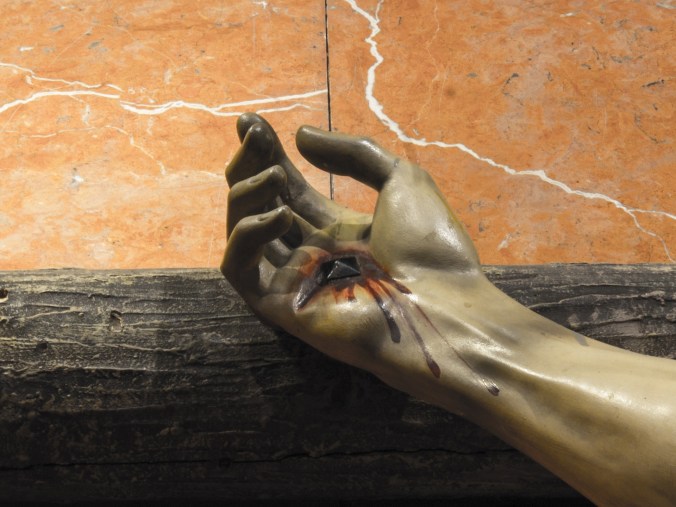
Nothing but Jesus Christ and Him Crucified

Christ Hand

1 Corinthians 2:1-2 “When I came to you, brothers, I did not come with eloquence or superior wisdom as I proclaimed to you the testimony about God. For I resolved to know nothing while I was with you except Jesus Christ and him crucified.”

Not every good missionary is an outstanding public speaker. Paul realized it wasn’t his mastery of rhetoric and grammar and vocabulary, it wasn’t his ability to move a crowd to tears or laughter, that changed hearts. In Paul’s day expert public speakers were highly thought of, especially in Greece and Rome. For many, they were one of the chief sources of entertainment. There was no television, of course, and even a book could cost as much as a house. A gifted speaker could draw an impressive audience and wield a powerful influence over his listeners, more so than today. Paul may have worked hard at it, but he wasn’t counting on superior speaking gifts to win the Corinthians to faith.

We want our message to be interesting and our worship to engage the people. But that is as much as entertainment and winning souls have to do each other. There are those who say we live in an entertainment age, and we need to put on a good show for those who walk through our doors. We certainly want to hold the attention of those who attend our churches, but the message can also disappear under the dazzle of clowns, balloons, and juggling acts. What works for people is a message that offers the straight stuff, not our ability to spiff it up for them.

Paul mentions another thing that appealed to the Greek residents of Corinth: wisdom.  The Greeks were thinkers. They thought about the meaning of life and the best way to live. They thought about the world in which they lived. They loved thinking so much that they actually looked down on those who worked hard for a living. They favored people who did nothing but sit around and think and talk.

Paul knew that in Jesus Christ he had much more to offer than all the solutions the thinkers of his day invented. The Corinthians had the Epicurean philosophers, whose motto was “eat, drink, and be merry.” So do we. This wisdom tells people that if you have problems, you can escape them in leisure, or perhaps a bottle of booze, a pipe, or syringe. These solve nothing, make problems worse, and drive practitioners further away from God and salvation.

Then there were the Stoics. Stoics were realists who believed people should accept the way things are and take responsibility for themselves. They resemble those who think science, education, or self-help books and counseling will solve all our problems. Those may be helpful. They aren’t bad. But they are not the ultimate solution.

You see, we know the difference between good and bad, right and wrong. The problem is that we still make the wrong choices anyway. The problem is sin. It doesn’t just make our lives miserable, it destroys them eternally. Paul’s solution was superior to “superior” worldly wisdom.

“For I resolved to know nothing while I was with you except Jesus Christ and him crucified.” Jesus was the answer. Knowing him is everything people need to experience God’s power in their lives. Paul’s own appearance and life were in many ways rather ordinary. He admits, “I came to you in weakness and fear, with much trembling.” When he came to Corinth he was at a low point in his ministry. He had been chased out of Philippi, Thessalonica, and Berea. They laughed him out of Athens. He suffered health problems that made him weak. Knowing Jesus Christ and him crucified didn’t REMOVE all the problems in Paul’s life.

Nor will it for us. It doesn’t mean our problems suddenly vanish. In some ways our problems may multiply. Remember Jesus words in the Sermon on the Mount?  “Blessed are you when men insult you, persecute you, and falsely say all kinds of evil against you because of me.”

But knowing Jesus equips us to deal with the one great problem: our sin. You and I haven’t stopped sinning. But when we do, we have someone to whom we can go with them. When we confess them to Jesus, he carries them to the cross and disposes them there. We experience God’s power as he replaces sin and guilt with peace and joy. Knowing Jesus Christ and him crucified means knowing he has taken my place, paid for my sin with his blood, reconciled me to God, and carried me to the very doors of heaven.

Jesus Christ and him crucified is power—not the kind that gives me control over other people or all the circumstances in my life; the kind that changes my heart and my eternity. It’s all we really need to know.

He Gives Sleep

Sleeping

Psalm 127:1-2 “Unless the Lord builds the house, it’s builders labor in vain. Unless the Lord watches over the city, the watchmen stand guard in vain. In vain you rise early and stay up late, toiling for food to eat– for he grants sleep to those he loves.”

The world in which we live can give its favorites many things: power, wealth, distinction. The Lord gives sleep to those he loves. Does that sound like a chincy gift? Isn’t sleep free? Or have you lived long enough and experienced enough of life to know that the Lord’s gift of sleep is the real treasure here? If this were a Master Card commercial, “(The Lord) grants sleep to those he loves” would be the “priceless” part at the end. Why?

All of us experience some sleeplessness. A colicky baby, nerves before the big day, or an occasional case of indigestion can rob us of a night’s sleep.

Then there is the chronic sleeplessness that comes because we can find no peace. When we aren’t sure how we are going to make ends meet, sleep can be hard to find. The bills are piling up, job prospects are drying up, collection agencies are showing up, and our stress and anxiety is building up. The future’s uncertainties haunt our thoughts and plague our dreams. Sleep is elusive while we live in a constant state of tension.

But nothing makes it harder to sleep than a guilty conscience. King David once described the misery this way: “I am worn out from groaning; all night long I flood my bed with weeping and drench my couch with tears.” When we can find no peace with God, we can find no peace at all.

What if we could be sure he loves us? What if we could be sure that he forgives our sins? Then our consciences could be quiet. Then our worries about the future would be answered. Then we could lay our heads down on our pillows at night and sleep like a baby, because we could be sure that we were resting in his loving hands.

We don’t have to wonder whether or not we are those the Lord loves, to whom he gives the gift of peace and sleep. He came here to tell us himself– actually became human flesh so that we could see his love in action and hear it from his own lips. Jesus then took the sins that disturb our consciences and let them disturb him instead. He made our guilt his very own and took it all the way to the cross, where he gave his life to rid us of the curse once and for all. Now he lives again to run the universe for our benefit and assure us that when our eyes close in the sleep of death, they will open to a new day of life that never ends.

And do you notice that he does not say, “He grants sleep to those who are really good.” “He grants sleep to those who try really hard.” “He grants sleep to those who are better than others.” No, he grants sleep, he makes it his gift, to those he loves. It is available to all. It is yours right now by virtue of the fact that you are his children by faith. You know your sins are forgiven. You know that God is going to provide. You know the peace that can give you sweet dreams tonight and every night.

So go ahead, and work hard. But know that God gives you peace, and sleep, as a gift of his love.

Slaves or Sons?

Broken chain

Romans 8:15b “For you did not receive a spirit that makes you a slave again to fear, but you received the Spirit of sonship.”

Living a Christian life is more than doing the right things. The Lord is just as concerned with our motives as he is with our actual behavior. Sometimes my children sat at the table with us only because they feared the discipline they would get if they didn’t. Students do certain homework assignments only because they fear the trouble they would be in with parents or teachers if they didn’t. Fear of pregnancy, disease, or ruining a marriage is enough to convince some people to live sexually chaste lives (though fewer and fewer find even these consequences compelling reasons to control themselves). Driving the speed limit, being honest on your tax return–all of us do certain things only because we fear the consequences.

In each case, the behavior may be correct. But this is nothing like living a Christian life.  Paul says, “You did not receive a spirit that makes you a slave again to fear.” People who act out of fear haven’t changed. They are merely controlled. That’s a form of slavery.

Christian life is a life of freedom. It is the product of a new relationship. “But you received the Spirit of sonship.” The word sonship can also be translated adoption. Paul is leading us back to God’s grace. None of us were natural born members of God’s family.  Because he loved us he adopted us. He bought us with Jesus blood. He claimed us and made us his own by faith. He brought us into his family as his children.

Now, we don’t serve him because we are afraid of him. We love the one who so loved us. When we believe the grace, forgiveness, and love he has shown us, when we comprehend how good he has been to us, we can’t help ourselves. We relate to God as his children and serve him in love.

On the outside, living life led by the Spirit may not look much different than a life driven by fear. But these two things are not at all the same. God sees the difference. Our hearts know it, too. Set the slave aside. Be the sons and daughters you are.

A Father and His Children

Father-Child

Romans 8:14-15 “Those who are led by the Spirit of God are sons of God. For you did not receive a spirit that makes you a slave again to fear, but you received the Spirit of sonship. And by him we cry, ‘Abba, Father.'”

Sometimes people see God only as Sovereign, a King. It’s certainly not wrong to think of him as our King. But what if that were the only relationship we had with him? Where would that leave us?  The King is the giver and enforcer of laws. We know God’s laws. He won’t stand to have even a single one broken. We also have to admit that all of us have broken them. If God were only our Sovereign, only our King, perhaps he would seem like the police to us. We would know that it’s good to have him around, but we would spend our entire lives looking over our shoulders, checking our rear view mirrors, hoping he wouldn’t catch us breaking the law. God as policeman is not a comfortable relationship.

Others envision God as some sort of unexplainable, impersonal, unapproachable power we can’t really know anything about. You can’t have a relationship at all with the cold, distant, unfeeling force they describe.

Paul assures us that God is our Father, and we are his sons or children. The word “Father” expresses much more than biological relationship. A REAL father, one who deserves the title, does all he can to provide for his children’s needs. There is nothing he would not sacrifice for the children he loves. Even when those children are ungrateful, or troublemakers who bring shame to the family reputation, a father does all he can for them.

Isn’t that what our heavenly Father has done for us?  Our sins put our souls in mortal danger. They dishonor our Creator’s name. But God our Father has taken those sins away, forgiven them completely. He sacrificed his dearest treasure to do it. He gave the life of his own Son Jesus Christ to pay for our sins. He continues to forgive us daily, freely. He gave us our very lives back again. He guarantees a better life to come. All of this is a heavenly Father’s love for you and me. It’s the most important relationship we have in our lives. It’s the only reason we have a life at all.

Paul makes clear what a useful thing this relationship is when he says, “And by him we cry, ‘Abba, Father.” The word Abba comes from the Aramaic language. It is not exactly the same thing as the word Father. It is a term of endearment, more like “dad” or “daddy.” The point is, our special relationship with God makes him someone we can approach. We can go to him with our problems and expect help. We can go to him with our sins and be sure of forgiveness.

The words of the catechism say it best: “God tenderly invites us to believe that he is our true Father and that we are his true children, so that we may pray to him as boldly and confidently as dear children ask their dear fathers.”

Rescued

Lion hunt

2 Timothy 4:17b-18 “I was delivered from the lion’s mouth. The Lord will rescue me from every evil attack and bring me safely to his heavenly kingdom.”

“The lion’s mouth” is probably less a reference to the later Roman practice of feeding Christians to the lions, and more an allusion to the words of Psalm 22, “Rescue me from the mouths of the lions.” It was a colorful way of saying, “I am not dead yet. My execution has been delayed.”

But it was only a matter of time. Still, Paul understood that even in his death the Lord would rescue him from every evil attack and bring him safely to his heavenly kingdom.

Isn’t that the ultimate deliverance? On the one hand, Luther warns us not to lose our proper respect for death: “I am not pleased with examples which show how men die gladly. But I am pleased with those who tremble and quake and grow pale before death and yet suffer it. Great saints do not die gladly. Fear is natural because death is punishment. Therefore, it is sad.”

But the Savior who never leaves us alone went through death for us to absorb all of its punishment. Death’s stinger has been plucked. Jesus’ return to life means that when we go through death, he will be there with us, too. And now life is waiting for us on the other side. The death that looked like danger ends in heaven’s safety.

You see, Paul felt deserted at his first hearing, but the Lord stood by him. Soon, however, his case would not go so well, humanly speaking. The judge would condemn him. The officers of the court would lead him away. The executioner’s sword would swing. Then the Lord would open an escape hatch between his world and ours. And as Paul stepped through that door, he would see that he was not alone. The great cloud of witnesses that surround us would welcome him (Hebrews 12:1). He would see the face of the Lamb who sits on the throne, who would spread his tent over him (Revelation 22:4 and 7:15). And Paul would be truly safe.

Jesus never stops being the Savior who rescues us. In life he rescues us from sin and fear and guilt and dangers to our bodies we may not even realize. In death he rescues us from this world altogether. We will be truly safe when he brings us home.