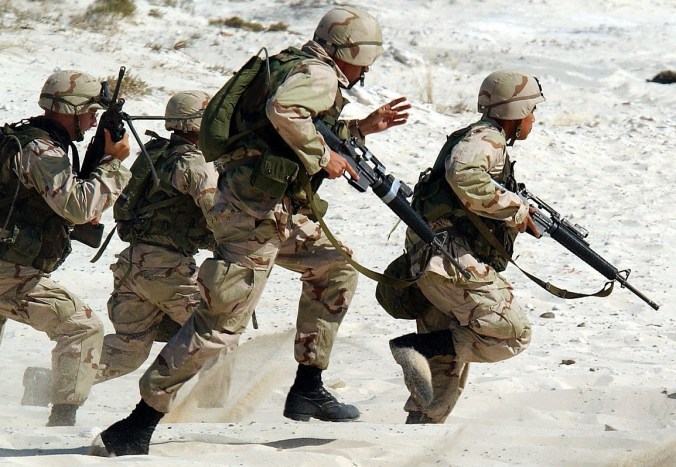
Forward!

street-arrow

Deuteronomy 1:25-27 “Taking with them some of the fruit of the land, they (Israel’s spies) brought it down to us and reported, ‘It is a good land that the LORD our God is giving us.’ But you were unwilling to go up; you rebelled against the command of the LORD your God. You grumbled in your tents and said, ‘The LORD hates us; so he brought us out of Egypt to deliver us into the hands of the Amorites to destroy us.’”

“Backwards” is the opposite of progress. Backwards ways of doing things are inefficient and don’t accomplish what they are supposed to. A backwards person isn’t very intelligent. If you pull your shirt on backwards, it’s on wrong and it looks funny. You need to turn it around and get it on right.

Backwards can be a bad direction for us spiritually as well. “Backsliding” leads us away from God and closer to sin and unbelief. Anyone who puts his hand to the plough and looks back is not fit for service in the kingdom, Jesus says. Don’t forget what happened to Lot’s wife when she looked back.

When the Lord led Israel from Mount Sinai more or less directly to the southern border of Canaan, the Israelites sent spies into the land to get an idea of what they were up against. They didn’t like what they saw. Then the nation rebelled against God’s command to go up and take possession of the land. The Lord had no intention of playing real estate agent. He wasn’t going to show them place after place until they found one with just the features they wanted. This was their new home. It wasn’t optional. God was sending his people forward to take possession of the land, but they were refusing to go.

Today our Lord has broadened the scope of his people’s work. He sends us forward to take possession of the entire world, but not in a political or military way. He is sending us to capture hearts for his kingdom by telling others the good news about Jesus. Our congregations support this world-wide conquest through our gifts and offerings to missions. But part of the campaign goes on right in our back yard. The inhabitants of the land he wants us to conquer live next door to us. They go to work with us and shop in the same stores. God still sends us forward to take possession of hearts and souls that need Jesus.

And that is not an option. Neither as a church nor as individuals does he allow us to shop around for a different mission: “I’m sure that winning souls is great, Lord. But I’m not much into that sort of thing. What else have you got?” No, “You are a chosen people, a royal priesthood, a holy nation, a people belonging to God that you may declare the praises of him who called you out of darkness into his wonderful light.” He has not decreed specific roles we have to take. They may be different according to our individual gifts. But we are not to hide behind the walls of our homes and churches, frozen where we are. God sends us to possess the hearts and souls of our neighbors.

Is that a reason to complain? “You grumbled in your tents and said, ‘The Lord hates us; so he brought us out of Egypt to deliver us into the hands of the Amorites to destroy us.” Compared to the desert they had left behind in Egypt, Canaan was a rich and fertile land. Compared to the slavery they had left behind in Egypt, this was chance to experience freedom and prosperity. For Israel to stare at this rich and undeserved gift from God, and then accuse him of trying to kill them, has to be the worst kind of blasphemy. Imagine how you would feel if you poured yourself into finding an expensive, extravagant, yet completely practical gift for someone you loved deeply. You made sure that it fit them to a “T.” Then your friend not only snubs your gift. He accuses you of trying to hurt him. It’s no wonder the Lord threatened to wipe the whole nation out for the second time since leaving Egypt. Moses had to plead to have them spared.

Do we complain about the privilege of our mission? Here we are, people for whom our Lord sacrificed his only Son to pay for our sins and save us from death. He has graciously shared this good news with us and led us to faith. Now he has equipped us to make our family of faith even bigger, to be surrounded by more people who love us and whom we can love in return. Are we tempted to look at all this grace and mutter, “The Lord hates us. It costs too much to support. It takes too much of my time. He has brought me into this faith and into this church just to drain my resources and deny me the pleasures and treasures I have worked so hard to earn and enjoy”? God give us mercy to see past our own comforts and interests to recognize the incredible gift and opportunity we have been given. Don’t go backwards. Forge ahead. The mission itself is designed to bless you.

Who Is He?

Who

Matthew 22:42 “While the Pharisees were gathered together, Jesus asked them, ‘What do you think about the Christ? Whose son is he?’ ‘The son of David,’ they replied.”

Jesus’ question about the Christ was more than a Bible trivia question about his ancestry. He wanted the Pharisees to think about what kind of person the Christ is. What kind of a being is he? That makes all the difference in what kind of Savior you expect him to be.

You see, if the Christ is a descendant of king David, another man in the royal house of Israel, that limits your options for what kind of Savior he could be. One option was that he could be a political Savior, a national deliverer who saves the country or makes it great. That’s what most of the Jews were hoping for. Then Jesus’ name might be mentioned in the same breath with men like Cincinnatus, Caesar, Charlemagne, George Washington, Admiral Horatio Nelson, Mahatmas Gandhi, and others.

Or the Christ might be a great moral Savior, a man whose charisma and character could inspire people to love their neighbors, control their passions, even form a great world religion. Then his name might be mentioned in the same breath with men like Confucius, Buddha, Socrates, Mohammed, and others. As you know, that is just the group that we often hear Jesus associated with.

But Jesus was asking this question, “Who is the Christ?” “Who is the Savior?” because he knew the answer went deeper still. “He said to them, ‘How is it then that David, speaking by the Spirit, calls him ‘Lord?’ For he says, ‘The Lord said to my Lord: Sit at my right hand until I put your enemies under your feet.’ If then David calls him ‘Lord,’ how can he be his son?” Any Jewish child who paid attention in synagogue school knew that Psalm 110:1 was a reference to the Christ, the Messiah. Any Jewish person understood that the Messiah was a descendant of David. Think of the shouts of the crowds on Palm Sunday, “Hosanna to the Son of David…”

How then could David call a distant grandchild of his, someone who would be born nearly 1000 years later, his “Lord”? How could he speak about him in the past tense, as though he already existed? How could a human descendant of David sit at the right hand of God in heaven, entrusted with divine power and authority? Obviously the psalm Jesus quotes tells us the Christ is something more.

Although Jesus phrased this as a question, he is really giving the answer here. The Messiah, the Christ, the Savior is divine. And that would not be necessary for him if all he did was save a nation from its enemies or become a great moral role model.

But it would be necessary if the Savior were going to provide more than a decent example, but an absolutely perfect fulfillment of God’s law from start to finish. If he came not so much to show us what to do, but to do it for us as our substitute, then he must be something more than human. Our Savior is David’s Lord, who used his divine power to live the life of love God now gives us the credit for.

Divinity was necessary if our Savior were going to give his life to save not just a person, or even a nation, but the entire world from their sins. “No man can redeem the life of another,” the psalmist writes. “No payment is ever enough– that he should live on forever and not see decay.” But God himself, who can do all things, can make that payment with his own life. Our Savior is David’s Lord, who used his divine value to pay the penalty for every sin ever committed with his death on the cross.

And divinity is necessary if we aren’t just going to copy the Savior, or follow him into battle, but entrust him with the fate of our souls for all eternity. Who is Jesus?  God’s own Son, the Savior in whom we can put our faith.

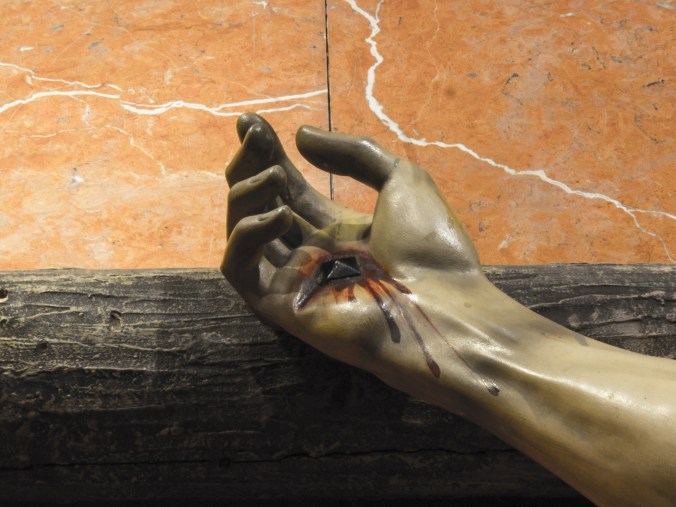
Crucify It!

Crucified Hand

Galatians 5:24 “Those who belong to Jesus Christ have crucified the sinful nature with its passions and desires.”

The New Testament utilizes a variety pictures to illustrate how we deal with the sinful nature warring inside of us. Sometimes the picture is that of taking off dirty, ragged clothes. In one place the picture has to do with throwing out the garbage or shoveling away the manure. In several instances it speaks of putting the sinful nature to death. Here Paul reminds us that our sinful nature has been crucified. All of these things are pictures of repentance. God doesn’t say to the Christian, “Try harder!” He says, “Repent!” And the picture of crucifixion is particularly apt for a number of reasons.

First, crucifixion is something you do to the worst of criminals. It means you have judged the crucificial victim as a horrible, dangerous person. You want nothing to do with him. That is what happens each time we repent of our sins. We no longer see some sin as a good thing we desire. We see it as a crime, and the sinful nature which produced it is a criminal. We find it repulsive and disgusting, and we want nothing to do with it anymore.

Second, crucifixion is a slow, painful way to die. Death doesn’t come in an instant. And the sinful nature which we have crucified hasn’t died immediately, either. It keeps struggling and writhing. We feel the pain as we give up the sins that have captivated us for so long.

Third, crucifixion ends in death. The body of the one crucified is drained of all life and power. Earthly relationships come to an end. The work of our repentance is finished when our sinful nature dies with our body. Then it will finally be drained of every last bit of life and power. Then every last vestige of our relationship with the sinful nature, which we have already condemned as a criminal, will be gone.

Last, crucifixion reminds us of the work Jesus did for us, which is the most important part of winning this war! The message of Jesus’ love for us, dying on the cross to pay for all our sins and rising from the dead to promise us eternal life, sends the Holy Spirit into our hearts. That gives us a new spirit to fight with sin. It makes us different people, people who belong to Jesus Christ. The more we hear about how high and how wide and how deep is the love of Christ, the stronger our faith grows, and the stronger the spirit inside of us becomes. Christ’s love continues to inspire and strengthen our life of love. Living in Jesus’ love is the winning strategy for the inner war we fight in faith each day.

We Have Met the Enemy…

Soldiers Run

Galatians 5:16 “So I say, live by the Spirit, and you will not gratify the desires of the sinful nature.  For the sinful nature desires what is contrary to the Spirit, and the Spirit what is contrary to the sinful nature. They are in conflict with each other, so that you do not do what you want.”

Since the day you became a Christian, you have been involved in a war. On one side we have our sinful flesh, our sinful nature. Some Christians seem surprised that they still have a sinful nature after coming to faith. They thought that sin would now be a thing of the past for them.

Actually, your sinful nature didn’t change at all when you became a Christian. It is the same rascal it has always been. It is 100%, undiluted, pure rebel, and that is the way it will be until the day you die. The only difference is: now it has some competition.

On the other side of this war is the Spirit within you. Whether you take Paul’s words to mean the Holy Spirit, or whether you take him to mean your own believing, converted, Christian, human spirit where the Holy Spirit lives, will make little difference for understanding his urgings to us here. These two are devoted allies. They fight the same battles. At the time we are fighting the urge to sin, we are not able to tell a difference between the impulses of the Holy Spirit and those of our Christian spirit, anyway.

These two, flesh and Spirit, are waging a war within us. They are locked in a battle to the death. Since they are opposites, “the sinful nature desires what is contrary to the Spirit, and the Spirit what is contrary to the sinful nature.” There can be no compromises, no cease fires, and no surrender on either side. This war continues until either the sinful nature drives faith and the Spirit completely out, and we cease to be Christians; or until physical death delivers the final blow to our sinful nature, and we are free of it forever.

In the meantime, if we are going to live by the Spirit, it is important that we acknowledge this battle. It is the reason we continue to sin. “They are in conflict with each other, so that you do not do what you want.” Have you found that you can’t be as good as you want to be? Do you still find yourself slipping up? If that is not the case, check on one of three things: have you lost your faith altogether, giving the sinful nature total control? Do you find it difficult to be honest with yourself? Or, do you still have a pulse?

As we struggle, there is a temptation to look outside ourselves for the reason. “I would live a better life if only Satan didn’t press me so hard and single me out for such unique and difficult temptations.” “I would live a better life if the people around me weren’t always getting me into trouble.” But neither Satan nor our friends put a gun to our heads and force us into sin. They may tempt us, but they don’t force us. To win this war, we need to recognize where it is happening, and who the enemy is.

A second temptation in this battle gives too much credit to our corrupt hearts. Many voices tell us man is noble at his core. Our minds and thoughts may lead us down the wrong path if try to analyze things too carefully. But if we follow our feelings, they won’t steer us wrong. Follow your heart.

After all, God made me this way, and if I am physically attracted to some other person, why should I deny myself the pleasures of their body– no matter that I am already married to someone else, or that we have no marriage commitment to each other, or that we are of the same sex. It just “feels” right. People apply this same kind of thinking to how they vent their anger, rationalize drug use, or selfishly spend their money, to name a few examples.

The heart is not a safe guide. It is often allied with the wrong side. Winning the battle, Paul says, involves “living by the Spirit.” That is more than a matter of personal effort. It requires more than a rededication to Biblical standards of right and wrong. Earlier in this letter Paul asked the people, “I would like to learn just one thing from you: Did you receive the Spirit by the works of the law, or by believing what you heard? Are you so foolish? After beginning by means of the Spirit, are you now trying to finish by means of the flesh?” (Galatians 3:2-3). In other words, go back to the Spirit, where your Christian life started. And you don’t get the Spirit by performing moral acts. He comes to those who hear and believe God’s word.

Specifically, the Spirit comes to those who hear the good news. Listening to and believing the gospel, where we find Jesus dying for our guilt, forgiving every sin, rising to promise us life, seeking us out to claim us as his own by faith, and now ruling the universe for our benefit, is the big weapon for winning the spiritual war within. We can’t live by a Spirit we don’t have. But if the Spirit’s place in our hearts grows with faith in the gospel, his place in our behavior will grow as well. Then more of the spiritual battles will start to go our way.