Increase Our Love

Heart tree

1 Thessalonians 3:12 “May the Lord make your love increase and overflow for each other and for everyone else, just as ours does for you.”

You can’t read Paul’s letters to the churches he founded, like this letter to the Thessalonians, and miss the passion this pastor felt for his people. He genuinely cared. But the love he wanted to see increase and overflow is more than warm feelings.

Our world’s idea of love often has less to do with what is good for someone else, and more to do with possessing the person or thing that I desire for myself. It is a selfish and self-serving thing to which we may become addicted, and it often moves us to take complete leave of our senses.

Paul prayed that the Lord would make a genuine Christian love increase and overflow among these people, but what does that look like? How is it different? A quick walk through the New Testament gives us a rather lovely picture of this love. Jesus’ example of washing his disciples’ feet shows us that it does not balk at performing some of the most menial tasks for others. Later that evening he tells us that it lays down its life for a friend. Among other things Paul’s description in 1 Corinthians 13 reveals that it is not self-seeking. It carries each other’s burdens he writes the Galatians. According to John, it will give up material possessions to help a brother in need. It is in every way epitomized by the sacrifice God has made for us in Christ.

Such a love grows only where faith grows. You can’t separate them. Luther’s rather famous description of faith in his preface to the book of Romans jumps quickly to the way faith reveals itself in love: “Faith is a living, daring confidence in God’s grace, so sure and certain that a man would stake his life on it a thousand times. This confidence in God’s grace and knowledge of it makes men glad and bold and happy in dealing with God and all His creatures; and this is the work of the Holy Ghost in faith. Hence a man is ready and glad, without compulsion, to do good to everyone, to serve everyone, to suffer everything, in love and praise to God, who has shown him this grace.”

And such faith and love grow only where the gospel feeds them. “We love because he first loved us.” “This is love, not that we loved God, but that he loved us and sent his Son as an atoning sacrifice for our sins.” God’s love in sending his Son and offering him for my sins doesn’t shame me into a more loving life. It changes me. Again, Luther on the difference faith makes: “It changes us and makes us to be born anew of God; it kills the Old Adam and makes altogether different men, in heart and spirit and mind and powers.”

A prayer to increase our love is at the same time a prayer for our Lord to flood us with his grace, for Christ to come to us in his word and sacrament, and increase our faith. Then our love will overflow to the blessing of others.

Clear the Way

Road block

1 Thessalonians 3:11 “Now may our God and Father himself and our Lord Jesus clear the way for us to come to you.”

This was more than just a sentimental request Paul was making. It flowed from his concern for the spiritual well-being of these people. Paul had established this church on his second missionary journey. As was so often the case, his time to instruct these people and build them up in their faith was cut short by an outbreak of persecution in that city. He had to flee in the middle of the night to avoid arrest and imprisonment.

That gave Paul a number of doctrinal and moral concerns for these people. They lived in a Gentile environment, and a Greek harbor town, where the idea of sexual purity was a complete novelty. They were having difficulty maintaining sexually godly behavior in that setting. The Thessalonians suffered from some rather serious misunderstandings about Christ’s second coming. Some thought they could quit their work and just sit around and wait for Jesus to re-appear. Others didn’t quite understand the resurrection and lost hope for their believing friends and family who died. It seems these people came from a culture that practiced a certain amount of deceit and craftiness in its business dealings with others. They struggled to give up practices that used to seem normal and prudent.

So Paul prayed for God to clear the way. It was the prayer of a pastor for his people. In verse 10 he says, “Night and day we pray most earnestly that we may see you again and supply what is lacking in your faith.” It was a prayer the people could pray for their pastor. Then Paul could come and better prepare their faith and life for Christ to come.

Could you pray for the Lord to clear the way for your pastor to come to you? “But,” you may think, “we already see him often enough. He lives nearby. Why do we need to pray for the Lord to clear the way for our pastor to come to us?”

Aren’t we also bombarded with wrong ideas from a culture that considers sexual purity a novelty, and is losing its way on matters of ethical business practice? For that we need to pray. Already 10 years ago an article in Newsweek revealed one out of four Americans in this so-called “Christian” nation embraces the concept of reincarnation. We, too, are losing our grip on a faithful Biblical understanding of what happens to people after death as we wait for Christ to come. For that we need to pray. Like Lot, who lived in the godless city of Sodom, our environment causes our own beliefs and morals to slip. Our own sinful natures are all-too-happy to embrace the slide. Like Paul, we need to pray that the Lord will clear the way for pastor and people to see each other again and again, because of the many challenges to our faith.

Most of all, we need the Lord to clear the way so that those who preach can bring us the gospel. The main thing my faith lacks is the same thing that your faith lacks–an unwavering trust in the grace and love of God. That is supplied only in the good news about Jesus. I pray that God will clear the way for pastors to lead people to the side of the manger–not to see an adorable little baby who makes you smile; nor an impoverished little baby who makes your heart break; but to see the God you worship reduce himself to a ordinary, fragile, human baby so that he could suffer what you suffer, and struggle with your struggles, and even shoulder the sins that you have sinned as your substitute.

I pray for pastors to lead people to the foot of the cross, where we can see that same immortal God taste human mortality, and die the death our sins deserve, and pay the price that sets us free from them. God sent this holy child to make you his holy child. By his justifying grace and forgiveness that is who you now are.

Join Paul in praying for Christ to come and clear the way for this good news and those who bring it to us.

Power Over Satan, Not From Him

Jesus vs Devil

Mark 3:22 “The teachers of the law who came down from Jerusalem said, ‘He is possessed by Beelzebub! By the prince of demons he is driving out demons.’”

The teachers of the law were the Bible scholars of their day. They were the experts to whom people turned when they had a question about God. They had rejected the good news and already decided that Jesus was bad news. So when they saw Jesus loving his neighbors by freeing them of demon possession, they needed some way to explain Jesus’ power that didn’t make him look like a hero. Driving out demons was an act of love on Jesus part, but they said it was a trick to cover up the fact that he got his power from prince of demons himself. In essence, they said that Jesus was evil.

People say a lot of things about Jesus today, much of it false. But the circle of people willing to say that Jesus is evil is very small–at least those willing to say it in so many words. Still, there are more subtle ways in which the accusation gets thrown at him. When people call Bible believers mean and intolerant because they hold traditional moral positions, because they don’t approve of various perversions, because they insist Jesus is the only way to heaven, in an indirect way they are saying that Jesus is evil. Why? Because Bible believers haven’t come by their beliefs on their own. They are simply following their leader.

Neither you nor I would say that Jesus was possessed by a demon. We wouldn’t call him evil. But each sin we commit shows that we are not completely convinced of his goodness. When the devil tempted Adam and Eve to sin for the first time, he gave them the implication that God was not good. If God were good, would he set limits on them? Would he forbid them to eat from any tree they wanted? And when we sin, aren’t we suggesting that he is not good in this case, to set this sin off limits for us? We don’t say, “God is evil,” but our actions betray such an attitude lurking around inside of us. We are not immune from criticizing Christ in subtle and indirect ways, either.

When Jesus’ love inspired his enemies to call him evil, to say that he was possessed by a demon, Jesus dismissed the accusation easily enough. First he used a couple of similar illustrations or parables. “So Jesus called them and spoke to them in parables: “How can Satan drive out Satan? (One) If a kingdom is divided against itself, that kingdom cannot stand. (Two) If a house is divided against itself, that house cannot stand. (And three, the interpretation) And if Satan opposes himself and is divided, he cannot stand. His end has come” Mark 3:23-26).

It’s just simple, easy to understand logic that Jesus uses here, isn’t it? Armies don’t win wars by killing their own troops, especially armies that are grossly undermanned and over-matched to start with. Families don’t stay together and prosper if they are constantly battling each other and don’t work together as a team. Satan, frankly, has no chance of winning, but he only makes his final defeat come faster by fighting his own allies and driving demons out of the people they have possessed.

Then Jesus shows them what his power to cast out demons really reveals about himself. “In fact, no one can enter a strong man’s house and carry off his possessions unless he first ties up the strong man. Then he can rob his house” (Mark 3:27). Satan is the strong man in this last little parable. You don’t march into Satan’s kingdom and start taking away the souls he has possessed unless you have first asserted your power over him. Long ago Christ threw Satan out of heaven. At the beginning of his ministry he defeated the devil’s temptations in the wilderness. At the cross he would do more than rob Satan of the souls he had tried to take. He would crush his head. Already Jesus’ power over the demons, his ability to drive them out and take back these people, showed that he is divine, that he is our Savior, and that through Jesus’ work God has broken the power of Satan to control us.

Satan hasn’t stopped trying to collect souls for himself, and he still tempts us to fall, but with Jesus our souls remain safe.

Who Is Jesus’ Family?

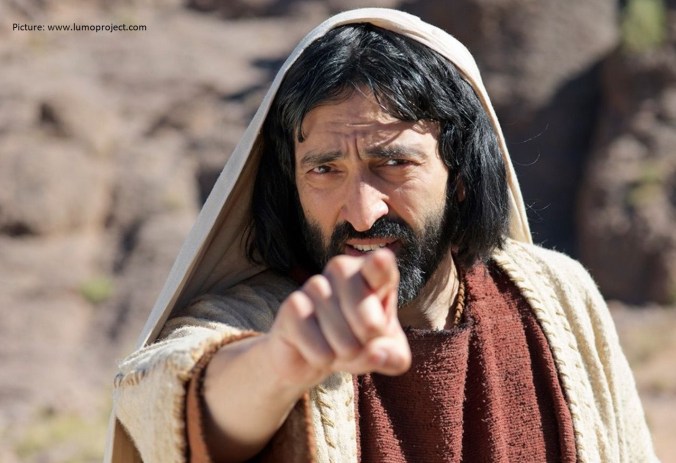
Jesus Points

Mark 3:31-35 “Then Jesus’ mother and brothers arrived. Standing outside, they sent someone in to call him. A crowd was sitting around him, and they told him, ‘Your mother and brothers are outside looking for you.’ Who are my mother and my brothers?’ he asked. Then he looked around him and said, ‘Here are my mother and my brothers! Whoever does God’s will is my brother and sister and mother.’”

A greater question than, “What do people think of Jesus?” is “What does Jesus think of us?” His natural family thought he had lost his mind. Not true. Now Jesus reveals whom he really regards as his family. Jesus claims as members of his own family “whoever does God’s will.”

This is not salvation by works. This is not keeping the 10 commandments so faithfully and so perfectly that our love and perfection rival Jesus’ own. Jesus describes doing God’s will this way in John 6, “The work of God is this: to believe in the one he has sent.”

And what are the people around him doing, the ones about whom he says, “Here are my mother and my brothers!”? They aren’t out turning the world upside down with their charity and kindness, at least not yet. They are sitting around Jesus and listening to his words. They are letting him serve them. They hear Jesus and they believe the good news.

They are Jesus’ family, his mother and brothers and sisters, because the good news is that Jesus came to take away our sins. He lived the perfect life of love and mercy to fulfill God’s law for us. He came to give his life in place of ours as the payment for our sins. By declaring us not guilty, by so removing our sin, he makes for himself a people who are qualified to be claimed as his own family.

Who are his mother and brother and sisters today? They are still the people who are gathered around to hear his words and believe them. They are the people who let Jesus serve them with the gospel. At church, studying the Scriptures, or even reading this little meditation on his words, they are you and me.