The Victorious Christian Life (to come)

1 Corinthians 15:54-56 “‘Death has been swallowed up in victory.’ Where, O death, is your victory? Where, O death, is your sting? The sting of death is sin, and the power of sin is the law. But thanks be to God! He gives us the victory through our Lord Jesus Christ.”

Why should youth turn to age? Why should strength fade to weakness? Why should life give way to death? A research scientist I once knew said that human science still cannot explain why cells, that once repaired and replaced themselves so efficiently as our bodies grew and we matured, lose their ability to keep us at the top of our powers as the years pass.

            But Paul knew. “The sting of death is sin.” Sin is the poison that infects us and brings us bitter death. Sin is the sting, even if it doesn’t look the part. It camouflages itself as pleasure. But like the shiny red apple the witch-queen brings to Snow White in the fairytale, the pleasure is only an illusion. Death is the reality, a reality that overtakes us all.

            Sin itself gets its power from the law. Where there is no command, no law, there is nothing to break, no sin to commit. But wherever God reveals his law, sin sees its opportunity. We break the command, God imposes the penalty, and we die…

            Until God himself gives us the victory through our Lord Jesus Christ. That’s what Jesus’ resurrection is all about, isn’t it? It is the proof of Christ’s victory. His body drew all the venom, all the poison of every sin committed by every sinner into itself. He died a thousand deaths, a million deaths, billions and billions of deaths, when he died the deaths of all humanity for the sins of all humanity at the cross. All the venom, all the poison was spent on him until sin and death themselves were spent, at the very end of their power, and he died.

            But then he takes his life back again. Sin and death have nothing left to stop him. He is the victor! Isn’t that why we crown him the King of Kings and Lord of all? And then, incredibly, the Lord of all, the Easter victor that we worship, turns around and hands his victory to his people. He promises the same life from the dead to every one of us. See your life in the light of his resurrection, and you can see the victorious life that is coming after death.

Change We Can Embrace

1 Corinthians 15:51-53 “Listen, I tell you a mystery: We will not all sleep, but we will all be changed–in a flash, in the twinkling of an eye, at the last trumpet. For the trumpet will sound, the dead will be raised imperishable, and we will be changed. For the perishable must clothe itself with the imperishable, and the mortal with immortality.

Change is often difficult for us. Bible-believing, conservative Christians are accustomed to being suspicious of change. We sing in the hymn, “Change and decay in all around I see, Oh, Thou who changest not, abide with me!” Because too often we see change move in the wrong direction. We have been holding the line against attempts to change God’s word and promises. It makes us an ever shrinking minority who still believe in moral absolutes, who still believe in grace and faith alone, who still believe in the eternal promise of Easter day!

Sometimes, even change for the positive feels slow and painful–overcoming a serious addiction, fixing a broken relationship, repenting of our own faults and failings. We are tempted to adopt a position that blindly says, “If it means change, I am against it!” But then we would be closing ourselves to the God whose call to repentance calls us to change every day.

In the resurrection, our Lord shows us change to which we can happily agree. Nothing slow or painful here. It all happens “in a flash.” For “flash” Paul uses the Greek word from which we get our word “atom.” It refers to something so small that it can no longer be cut or divided. It is as small as can be conceived. In this briefest moment in time we will be changed instantaneously. You can run the slow motion video, but you will look in vain to see any series of transitions. One moment dead, the next alive. One moment corrupt and earthly, the next moment pure and heavenly. No years of purgatory to suffer through to get there, either. It all happens “in a flash, in the twinkling of an eye, at the last trumpet.”

There is nothing negative to fear about this change. The life that is coming is the very opposite of decay. “For the perishable must clothe itself with the imperishable, and the mortal with immortality.

In the resurrection, we will all be imperishable. Every trip to the doctor or dentist reminds me how much I am like the spoiling fruit sitting on our kitchen counter. In my case, the pace is just much slower. Comparing photos old and new reveals lines that didn’t used to be there, hair that has gotten silver in places. At least the hair is still hanging on to the same real estate! Now we are perishable, mortal, and the evidence is all around us all the time.

But we will be raised imperishable, immortal! More amazing than going out to the compost pile behind my garage, picking out what used to be an orange–now covered in green and white mold, its fruity flesh now a brown, stinking, oozing mush–and making it somehow firm and sweet and edible again, God will pluck our bodies from their graves, in whatever state of decay. Instantly we will be stronger, healthier, more beautiful, and more intelligent than we were at the peak of our youth and the height of our earthly powers. More than that, our hearts and souls will be so saturated with holy love that we will be capable of nothing but goodness and kindness for the eternity of life the resurrection brings us.

Raised To Declare His Divinity

Romans 1:1-4 “Paul, a servant of Christ Jesus, called to be an apostle and set apart for the gospel of God—the gospel he promised beforehand through his prophets in the Holy Scriptures regarding his Son, who as to his human nature was a descendant of David, and who as to his spirit of holiness was declared with power to be the Son of God by his resurrection from the dead: Jesus Christ our Lord.”

The truth that Paul shares with us in this verse may be the forgotten lesson of Jesus’ resurrection. We tend to stress the fact that, because Jesus has risen from the dead, we know that the Father accepted his sacrifice. His effort to pay for our sins was successful. More than that, we draw the conclusion that since Jesus is alive and our sins are paid for, someday we will rise from the dead, too. These things certainly deserve to be emphasized.

But Jesus’ resurrection is also the miracle of miracles. A handful of other people have been raised back to life from the dead throughout history, only to die again. Only Jesus raised himself from the dead, and only he has risen to a new kind of life that never ends.

That makes a powerful statement about who Jesus is. No mere man could bring himself back to life. Jesus is the Son of God. The resurrection doesn’t make him the Son of God. It makes his divinity clear to see. It puts a big exclamation point on the truth that our Savior Jesus is also our God.

 How does that truth help to put the “good news” in our gospel? Just look at the ramifications:

1) If Jesus is God, then his work, his life, his death, have infinite value. I can be sure that my sins are covered.
2) If Jesus is God, then you and I can put our utter trust in him. What he tells us we can believe with complete confidence. How he treats us we can receive certain that he is taking care of us.
3) If Jesus is God, then getting to know him means we are getting to know God. And what is the picture we see when we look at Jesus? Someone who loves us passionately. Someone who is caring, kind, gentle, and approachable. Yet someone who is strong, steady, and upright. What more could you want on your side?
4) The last phrase of this verse calls him “Jesus Christ our Lord.” When people say things like, “Jesus is my Lord,” they are often thinking of the obedience they owe to him. But a Lord is also a protector, isn’t he? If our Lord is our God, then you and I are utterly safe.
5) If Jesus is God, then we can be sure that we are in the right place whenever we are following him. If Jesus is God, then all the news for us is only good.

The heart of the Christian faith is not a list of principles or a way of life. It is a person, promised by prophets, descended from David, and declared to be God by his resurrection from the dead. The news is good, dear friends.

Perfect Even in Death

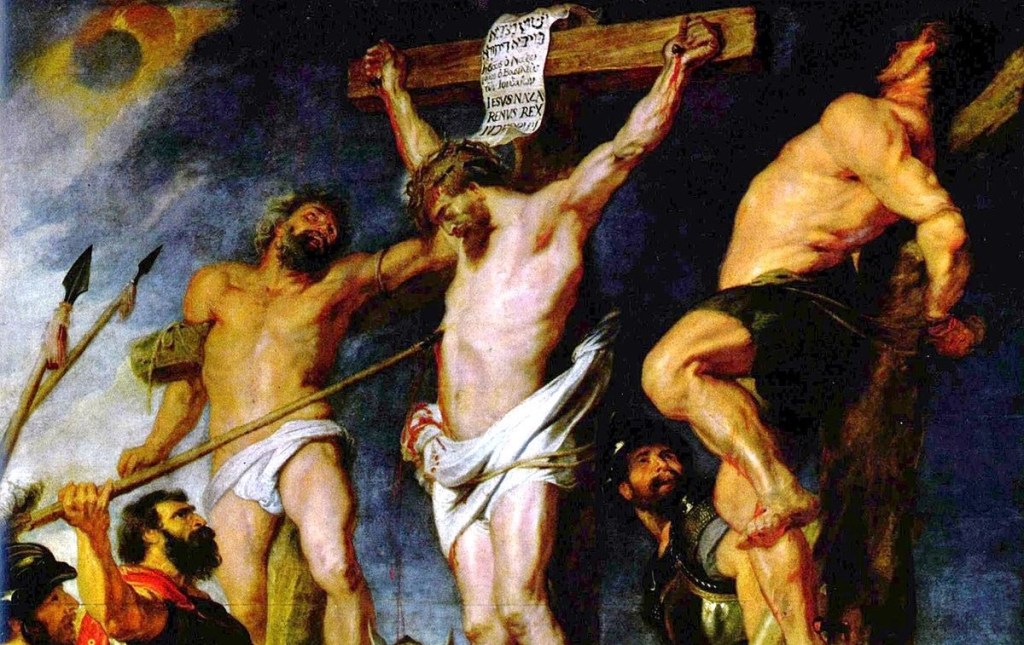
John 19:32-34 “The soldiers therefore came and broke the legs of the first man who had been crucified with Jesus, and then those of the other. But when they came to Jesus and found that he was already dead, they did not break his legs. Instead, one of the soldiers pierced Jesus’ side with a spear bringing a sudden flow of blood and water.”

Over Fourteen hundred years earlier God had given Moses instructions about how Passover lambs were to be chosen and treated. They had to be year old males, males in the prime of their lives, without blemish. As the lambs were sacrificed and prepared, their bodies must be kept intact. No bones were to be broken. These sacrificial lambs were to be perfect in every way. After all, God was accepting these animals in place of the lives of the first-born sons of the people of Israel. For such an exchange he was not satisfied with second-rate, crippled animals. He demanded the best.

On this Passover, Jesus himself was the sacrificial lamb, offered up in the prime of his life in exchange for the lives of all Israel, and all people. After all the abuse his body had taken over the past 24 hours, the point of his legs not being broken could easily be lost on us. But God was making a statement here: this Son of his was the perfect Passover Lamb. Even in death his bones remained intact, and he remained fully qualified to give his life in exchange for ours as the perfect sacrifice for our sins.

Since the soldiers weren’t going to break Jesus’ legs, they looked for another way to be sure of his death. The point of the spear was likely pressed against his body just below his rib cage, and then thrust up into his chest and through his heart. The sudden flow of blood and water which the John saw would be consistent with the spear piercing the pericardium, the sack around the heart, and then the heart itself. Thus the last blood which Jesus shed for us flowed directly from his very heart.

For John and the women who witnessed all this, the piercing of Jesus’ side was the final blow. If there had been any hope up to this point that Jesus had not died, but merely passed out on the cross, now it was gone. The spear removed all doubt that Jesus was dead.

But Jesus had to die if he was going to be the perfect sacrifice for you, and for me, and for our world. He did not come to be merely a great moral example, or a great moral teacher. He came “to give his life as a ransom for many.” Those are his own words. The wages of our sin is death, and the blood and water flowing from Jesus’ side confirm that Jesus has died, just as we needed him to do.

Can a dead man still love you? Maybe we find it unsettling, even frightening, to realize that, in Jesus’ death, God has died. But even in death this God is infinitely powerful. And more important, even in death, his love for you continues unwavering and unimpaired. He is perfect for you, even in his death.