An Acquired Taste?

Romans 6:23 “The Gift of God is eternal life in Christ Jesus our Lord.”

When I was a little boy, certain kinds of Christmas or birthday gifts were generally let downs. I didn’t like to get clothes for gifts. Maybe if I had grown up in a third world country where clothing was rare I would have thought differently. But to open the box and find that it contained new pajamas, or even worse socks and underwear, was a big disappointment.

My problem was: I didn’t want what I needed. I wanted what I wanted. My parents generally provided clothing as I needed it. Through the year it trickled into my chest of drawers at various times as I grew or wore things out. Toys, on the other hand, were special. Toys were fun. Toys were generally reserved for Christmas or birthdays. But no child ever suffered a premature death for a lack of toys. They are a want, not a need.

As I’ve gotten older, my tastes have changed. Clothing is just fine for Christmas or birthdays—maybe even preferred. Gifts I need and gifts I want have sort of merged. To get to this point, the gifts I need were something of an “acquired taste.”

A similar phenomenon can happen in our Christian life of listening to God’s Word. We would like to hear something special, something I haven’t heard before, especially at holidays and special occasions. Give me a message with some fun in it, something I can take out of the box and play with on Monday morning. A lady once told me she stopped attending church because, “I’ve had enough theology.” She meant that she had heard enough about what God is like and what he has done for us. “Give me something new to play with! Tell me what to do!”

Like the gifts we need, the gospel is an acquired taste. But without it my soul, my faith cannot live. God’s rules and principles for living my life are true and important, too, but they don’t keep my faith alive like the gospel. Jesus so loves you and me that he gave up his own life to rescue us from sin. Jesus so conquered sin and death that he rose to life to assure us of life that never ends. Jesus so lives and rules over the universe that all we know or experience is working to support and strengthen our faith and see us safely home to heaven. This is the message that feed our trust in God and keeps it alive.

The gift of God is eternal life with him, not so much improved behavior or experiences in the short term. Open his gift often, and see a taste for it grow in your heart.

Too Rich to Be Afraid

Luke 12:32 “Do not be afraid, little flock, for your Father has been pleased to give you the kingdom.”

You have heard of it, but have you ever read the Guinness Book of World Records? I had my own copy as a kid. One record that made an impression on me was the record for most miserly. An elderly woman worth millions saved scraps of soap in a tin box.   

Maybe you have heard stories of people who didn’t know that they were sitting on top of great wealth. They stuffed valuable stocks and bonds into the chinks in their shack to keep the drafts out. They tore pages from a rare book to use as kindling to keep the house warm. You may know that one of the oldest manuscripts we have of the New Testament was rescued from a monastery where its pages were being used this way.

Sometimes we find ourselves in a similar position spiritually. I may be a Christian minister who handles God’s priceless promises every day. That doesn’t prevent me from harboring my own fears and anxieties. I may let worries about church finances distract me from my work. Friction between member of the congregation or declining membership can leave me feeling defeated and hopeless. Doubts lurk in the back of my mind about the survival of the institution I serve.

The people I serve come to me with their own concerns: strained relationships, insecurities about their employment, divisions that plague our politics and government, bad news from the doctor. God has never withdrawn his promises. They haven’t stopped being true. Still, we struggle to apply them properly to the cold and drafty episodes in the stories of our lives.

Take a moment to note the juxtaposition of these words in Jesus’ promise: “Do not be afraid…your Father has been pleased to give you a kingdom.” Are we spiritual millionaires worried about few scraps of soap? Are we living like beggars, unaware that we are sitting on top of a gold mine? Our Father has given us a whole kingdom! What reason do we have to be afraid?

Jesus isn’t scolding us so much as he is helping us find courage and confidence in his promises. He doesn’t want fear to paralyze us. Fear erodes faith. It changes our view of God. It shrinks him in our eyes, makes him less trustworthy. It leads us to see him as small-minded celestial bookkeeper, to borrow a picture from Brennan Manning. We think that he is more interested in tracking our deposits of love and service to him, as though we were paying on a debt, rather than recognizing him as our great and generous Father who richly provides us all things for free. We then work like we are trying to save the scraps instead of investing the treasures we have been freely given.

Jesus assures us of where we really stand. God’s gift of a kingdom is past tense, not future. It is already ours. As Luther’s battle hymn, A Mighty Fortress reminds us, the future only holds this confidence: “The kingdom ours remaineth.”

Jesus reinforces our certainty that the kingdom is a gift. Our Father doesn’t sell us the Kingdom. He gives it to us by grace. He paid the purchase price with his own blood.

Jesus reveals that this makes God happy. The kingdom is not a begrudging gift. It pleases him to give it away. We need not fear that he is about to take it back. God’s grace has made us wealthy beyond belief.

Don’t be afraid to live and serve as though you have a kingdom of treasures that can never be exhausted, because you do.

Wrestling With God

Genesis 32:24-28 “So Jacob was left alone, and a man wrestled with him till daybreak. When the man saw that he could not overpower him, he touched the socket of Jacob’s hip so that his hip was wrenched as he wrestled with the man. Then the man said, “Let me go, for it is daybreak.” But Jacob replied, “I will not let you go unless you bless me.” The man asked him, “What is your name?” “Jacob,” he answered. Then the man said, “Your name will no longer be Jacob, but Israel, because you have struggled with God and with men and have overcome.”

Are you a “thrill-seeker?”

We frequently find a sensation of pleasure in doing things dangerous. Some people like to jump out of airplanes with only a large sheet to break their fall. Others will jump off bridges or towers with only an oversized rubber-band to prevent them from hitting the ground.

Sometimes the danger is only apparent (or mostly so). Many of the thrill rides at the carnival let us experience the taste of danger and a rush of adrenalin without truly risking our lives.

Sometimes the danger is real. One Florida alligator wrestler wound up with his head stuck in the alligator’s mouth. The man survived, but the animal had to be destroyed to save his life.

Does prayer ever feel like a “thrill-seeking” activity to you? It might if you were the patriarch Jacob. His prayer landed him in a wrestling match with something more powerful and dangerous than an alligator between his hands. Jacob had a grip on God himself!

The Lord appeared to Jacob to wrestle with him here. Such a close encounter alone would fill most mortals with fear. Jacob not only wrestled with God, he also held on to him, and he refused to let him go, until the Lord gave him what he wanted.

How could Jacob pray so boldly? He got away with his daring demand because he asked for that which God himself wished to give him. The Lord had promised him blessings, as he had promised his forefathers.  Jacob was simply “holding” God to the promises he had already made.

We can make such bold requests when we pray for things our Lord has promised us, too. Sometimes our prayers might seem like a wrestling match as we wait for him to answer us. But when we base our prayers on his previous promises, we can be sure he will answer us. He is much more reliable than a parachute or a bungee cord.

In our case, the thrill lies not so much in approaching God with our requests as it does in the mysterious and marvelous ways he often chooses to answer. The Apostle Paul reminds us, “(He) is able to do immeasurably more than all we ask or imagine” (Ephesians 3:20).

But let’s not be frightened by that.  Jesus has made it possible to call on God as our own Father. Since we have his forgiveness, we know that he works all things for our good. “Let us, then, approach the throne of grace with confidence, so that we may receive mercy and find grace to help us in our time of need” (Hebrews 4:16).

The Crown

2 Timothy 4:7-8 “I have fought the good fight, I have finished the race, I have kept the faith. Now there is in store for me the crown of righteousness, which the Lord, the righteous Judge, will award to me on that day—and not only to me, but also to all who have longed for his appearing.”

The Christian life feels like a fight. It’s a battle to stay healthy. We scratch and claw to feed and clothe and house ourselves. Our values come under attack, and the world pounds away at our faith.  

Paul could sense the end of this fight, the finish line in this race, and say, “I have kept the faith.” It’s not as though he thought he did this on his own. He knew that Jesus had carried him along all the way. “The Lord will rescue me from every evil attack and bring me safely to his heavenly kingdom,” he writes a few sentences later.

If Paul seems to take his end in stride, it is because he was convinced of what came next: “Now there is in store for me the crown of righteousness, which the Lord, the righteous Judge, will award to me on that day–and not only to me, but to all who have longed for his appearing.”

There are two different kinds of crowns mentioned in the Bible. One is the kind worn by king. It is a symbol of his power, wealth, and authority. In some passages we are promised that kind of crown when we get to heaven, too. But that is not the kind that Paul is writing about here.

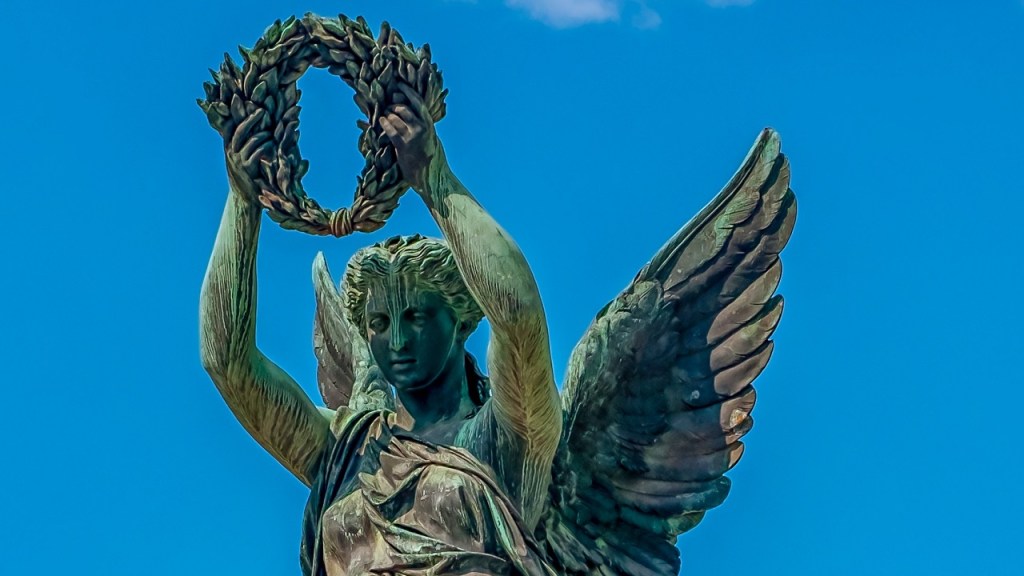
The other kind of crown was a crown made of sticks and leaves, or made of precious metals molded to look like sticks and leaves. It was given to someone as a symbol of victory. Maybe they had just won an athletic contest. Perhaps a general or emperor had won a war. When our athletes win an event at the Olympics, we hang a medal around their necks. The ancients put a crown of laurel or olive on their heads instead.

Obviously, heaven offers us more than the right to wear some sticks on our heads. This is a crown of righteousness. In this world, here and now, we are declared righteous. God treats us as though we have no sin because Jesus forgave all our sins by his death on the cross. But we know that we are still surrounded by sin all the time–both in us and around us. It has infected and spoiled the entire world in which we live.

Our rich reward when Jesus returns is that we will actually be righteous. We will never be troubled by sin again. We will commit no sins of our own. We will be surrounded by people who never sin. We will live in a place which doesn’t know even the slightest taint of sin. Everything and everyone will be only perfect, all the time. We will only love and serve each other.

Our crown, the evidence of our victory, will be the righteousness that permeates everything we are and experience. In the time you have left, fight the good fight, run the race to the end, and keep the faith. Jesus is waiting with your crown at the end.