Beware the Faith Chokers

Luke 8:14 “The seed that fell among the thorns stand for those who hear, but as they go on their way they are choked by life’s worries, riches, and pleasures, and they do not mature.”

Nobody I know makes it their goal in life to live in poverty. But historically God’s people have not handled prosperity very well. It tends to corrupt more than it blesses. That is Jesus’ picture here.

The problem is that “prosperity” too easily transforms into “worldliness.” If we could accept that the material world in which we live is all headed for the ash heap–there is no saving anything here, only applying a few band aids and fixes to keep it going a little longer; if we could be content with what we have been given and stop obsessing about having more; if we could see things mostly as tools to serve people and share the gospel with them; if we could trust God’s promise to take care of every need; if we cared more about a real heaven to come than an artificial one we try to build on earth; then prosperity would present no particular temptation. 

Then we would worry less about who gets elected, how my retirement funds are doing, where the unemployment rate stands today, whether the polar ice cap is melting, whether they are coming to take away my guns, which news is fake and which news is real, and whether I am getting my fair share.

Then we would go and live our faith. We would go to work and do our job faithfully. We would love our neighbor, no matter how he looks or thinks. We would be good stewards of the things God has given us to manage. We would speak up for those who need someone to speak up for them. We would raise our families to know that Jesus is the best thing there is, and we would tell our friends. We would dig deep so that people all over the world could know it, too. We wouldn’t worry. We wouldn’t obsess. We wouldn’t hoard. We would believe, and then we would go and live, because we have Jesus and all that his forgiving grace promises.

But as powerful as God’s word is, faith can be “choked by life’s worries, riches, and pleasures.” If we will not let these things go, we will not mature. All our scurrying around trying to build a little utopia right here on earth makes us of little use to God or man. Don’t let worldly distractions strangle our faith all the way to death.

No Root

Luke 8:13 “Those on the rock are the ones who receive the word with joy when they hear it, but they have no root. They believe for a while, but in the time of testing they fall away.”

You heard Jesus right. These are people who believe for a while (we are people who have believed for a while) but in a time of testing they fall away. Matthew’s gospel defines this testing a little further as trouble or persecution that comes because of God’s word. This is suffering because of what we believe. Others oppose our Christian faith.

This kind of testing is a universal Christian experience. In some places it is severe. Almost 10 years ago 275 Christian girls were kidnapped from their school in northern Nigeria by Boko Haram, a Muslim terrorist group. The terrorists oppose educating girls because it prevents them from adopting Islamic teaching. All the girls were pressured to convert. Many were forced to marry. Scores were martyred, and over 100 converted to Islam.

For you and me, the testing has been more subtle. But the pressure is unrelenting. It is so much a part of the atmosphere in which we live that at times we may not even notice it. While I was canvassing a neighborhood, a woman asked me what we believed. I wanted to talk about our need for repentance and Jesus’ redeeming work on the cross. She wanted to talk about same-sex marriage and paths to heaven outside of Christianity. She had grown up a Christian. But the spirit of the age in which we live had its way with her heart. She gave up not only a few isolated Christian doctrines. She gave up on Christianity altogether. Though she was polite, she made it clear there was something wrong with me for not “moving on” and letting go of what the Bible teaches.   

Jesus never said that following him would be easy. He said, “Take up your cross.” It is easy to be a Christian when you are living in the joy of knowing God loves and forgives you, surrounded by people who share that faith and support it. That is God’s good seed at work in us. And we don’t have to lose that joy or surrender our faith when it comes under fire.

But we need roots in God’s word to go down deep, because Jesus did not come to bring peace but a sword. He warns that in this world we will have much trouble, and that we must go through many hardships to enter the kingdom of God. God’s word is a powerful seed, but we know it will be opposed by others.

Hard Ground

Luke 8:5, 11-12 “A farmer went out to sow his seed. As he was scattering the seed, some fell along the path; it was trampled on, and the birds of the air ate it up… The seed is the word of God. Those along the path are the ones who hear, and then the devil comes and takes away the word from their hearts, so that they may not believe and be saved.”

During archaeological excavations of Herod the Great’s palace on Masada in the mid-1960’s, a cache of Judean date palm seeds was discovered. The Judean date palm tree became extinct 800 years ago. For forty years this cache of seeds was stored at an Israeli university. In 2005 three of the seeds were planted, and one of them has grown into a tree that has been nicknamed “Methuselah.” The hope is that this tree can be crossbred with its nearest contemporary relative to produce fruit. After 2000 years this dry, hard, apparently lifeless piece of plant material has produced new life.

Seeds are little miracles of creation. Something that looks so simple, just a little ball of ordinary material to the naked eye, possesses the power to transform itself into a living thing thousands of times its size, complex in shape, and beauty, and function.

Seeds make a fitting picture for the word of God in Jesus’ parable. Something that looks ordinary and small–just some words, a simple message–has the power transform itself into a new heart, a changed man, a life that never ends.

But sometimes the seed does not get a chance to produce the new life God seeks. The first time the devil appears in the Bible, the first words out of his mouth are, “Did God really say…?” Since that time attacking God’s word has been central to his business. It’s no surprise, then, when Jesus explains the first part of his parable this way: “Those along the path are the ones who hear, and then the devil comes and takes away the word from their hearts, so that they may not believe and be saved.”

Note that Jesus does not say the devil prevented these people from ever hearing the word of God. That is part of his business, too. He has many different strategies to keep God’s word out of human ears: oppressive governments that criminalize Christian mission work; lazy parents who won’t take their children to church; cultural forces that turn Sunday morning more and more into “me” time–you know, time to sleep in, golf, fish, or watch TV; jobs and sports that invade Sunday mornings and every other spare moment of time. The word of God terrifies Satan because of its power. He feels safest when he can keep a person from hearing or reading it altogether.

But when that fails, plan B is to attack God’s word inside the human heart. That’s where Jesus picks things up in his parable. The devil has ways of hardening the heart and snatching the word away before it can do any “damage.” He makes the word sound unreasonable. I mean, miracles and magic are fine for fairy tales. Prince Charming can kiss the princess and bring her back to life. But the dead leaving their graves and rejoining the living? Maybe in a horror flick. Grown-ups don’t put stock in that kind of thing, do they?

Or, he pits the word against our personal experience. “Honor your father and mother.” Yeah right. Maybe in some 1950’s Leave-It-to-Beaver family. Dad was a workaholic, and mom was an alcoholic, and neither cared about anyone but themselves. “He will command his angels concerning you to keep you in all your ways; they will lift you up in their hands, so that you will not strike your foot against a stone.” So where were they when the car accident left me with chronic back pain, or robbed me of 80 percent use of my right hand?

By stirring up false human reasoning, flattering shallow human goodness, appealing to selfish ideas about “fairness,” the devil hardens human hearts and snatches God’s word away. He goes over the heart like a steam roller, making it hard to the idea that I am a sinner who needs God’s grace; or that there is such a thing as God; or that God is loving, forgiving, good, and kind. In this way the greatest gift ever given, Jesus’ selfless sacrifice on the cross, sits like seed on a concrete slab. It might be heard, but it won’t be considered or believed. Satan has effectively snatched the seed away.            

Thank God that his Spirit has ploughed and worked our hearts so that his word could find its way in, and his grace now stirs new life within our souls.

Today!

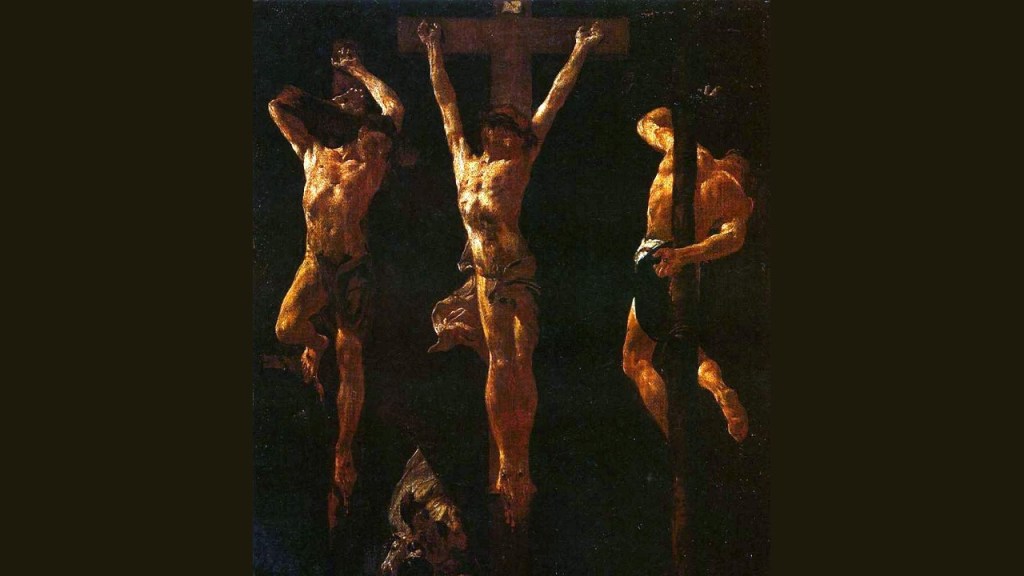
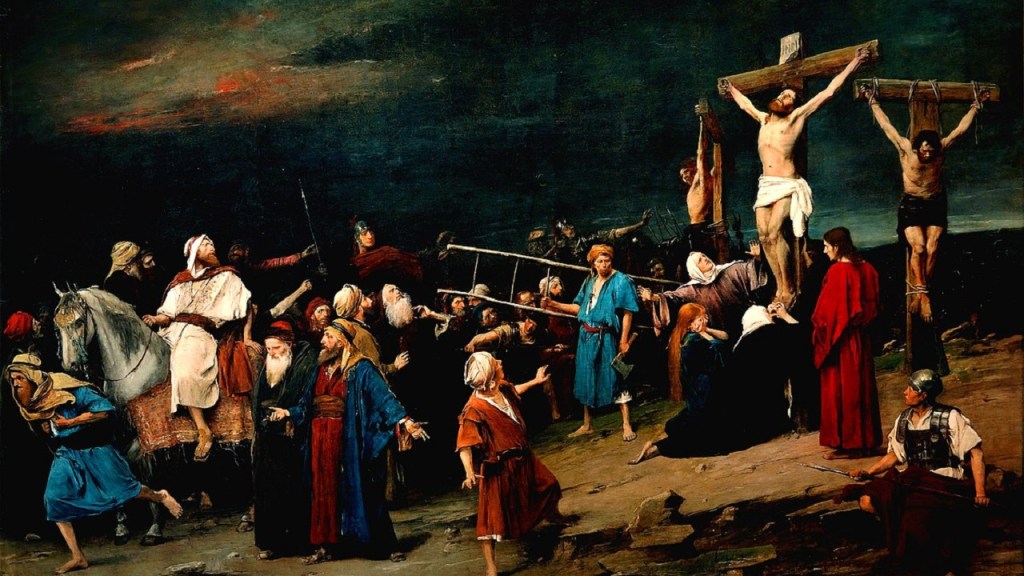
Luke 23:39-43 “ One of the criminals who hung there hurled insults at him: ‘Aren’t you the Christ? Save yourself and us! But the other criminal rebuked him. ‘Don’t you fear God,’ he said, ‘since you are under the same sentence? We are punished justly, for we are getting what our deeds deserve. But this man has done nothing wrong.’ Then he said, ‘Jesus, remember me when you come into your kingdom.’ Jesus answered him, ‘I tell you the truth, today you will be with me in paradise.’”

Do you remember earlier in Jesus ministry, when he came down from the Mount of Transfiguration, and he found his disciples trying to drive out a demon unsuccessfully? The father of the possessed boy pleads with Jesus, “If you can do anything, have pity on us and help us.” And Jesus replies, “If you can? Everything is possible for him who believes.” The boy’s father exclaims, “I do believe. Help me overcome my unbelief.”

The criminal next to Jesus is in a situation no less desperate. Really, it is more so. Before the day is over he is going to meet God face to face. The challenge to his faith is not a foaming, convulsing child. It is a bleeding, dying Jesus. And yet there is no word of doubt in his simple prayer. There is no “if.” “If you are the Savior you claim to be.” “If you are going to take your place on your throne.” He speaks a confident “when.” “When you enter your kingdom.” “Remember me when you enter your kingdom.”

 Jesus only reinforces the certainty. “I tell you the truth.” “Amen” is the word Jesus used in his native tongue. When you and I say, “Amen,” for us it is usually the conclusion to the matter. For Jesus it was usually the introduction. “I tell you the truth” means you can have full confidence that what follows is fact. No doubt Jesus had a sense of humor and could kid around with his disciples at other times. But the cross was no place to be kidding. Every word required heroic effort just to get it out. There was no time or energy for wasted words. Death and eternity were mere hours away. This was no place to be joking. This was the place for “Amen,” certainty, nothing but the truth, and that is exactly what Jesus promised this dying thief from the cross.

The promise itself is spoken in certainty. “Today you will be with me in Paradise.” Sometimes the further we can put our promises in the future, the less we fear we will be held to them if we can’t keep them. Time has a way of making people forget. But Jesus assures this dying man that before this day is over, the two of them will stand together in Paradise, the garden of God, the home of life. Jesus can speak with such certainty: “Today” this will happen.

Jesus can speak with such certainty because on this cross, at this moment, giving his life, opening the doors to heaven for us all. As the life slowly faded from his body, so did the crimes and sins of the criminal pleading for his mercy. So do ours. They shrink and fade until Jesus breathes his last, and they completely disappear. And as our sins shrink and fade from sight, the glow of heaven’s glory grows brighter and closer. Our own final “today” comes soon enough, and with it the certainty of Paradise.

He Can’t Save Himself

Luke 23:35-39 “The people stood watching, and the rulers even sneered at him. They said, ‘He saved others; let him save himself if he is the Christ of God, the Chosen One.’ The soldiers also came up and mocked him. They offered him wine vinegar and said, ‘If you are the king of the Jews, save yourself.’ There was a written notice above him which read: THIS IS THE KING OF THE JEWS. One of the criminals who hung there hurled insults at him: ‘Aren’t you the Christ? Save yourself and us!’”

Do you notice the common theme running through the words of anyone who had a comment about Jesus’ crucifixion on this day? “Let him save himself.” “Save yourself.” “Save yourself and us!” The irony seemed clear to them. This Jesus styled himself as the one who was going to save Israel. Some people had already been referring to him as the Savior. Some Savior he turned out to be. If he couldn’t even keep himself from being killed like a common criminal, why should anyone else trust him to save them?

It’s a logical conclusion, isn’t it? If Jesus can’t keep himself alive in this life, why should we trust him for the life to come? It makes more sense to get back to the business of real religion, the business that occupies most of our spiritual energy. It makes more sense to do what everyone was taunting Jesus to do: Save yourself.

For isn’t that how we think? Isn’t that what we work at almost all of the time? We are good at saving ourselves, or so we imagine. From the time we get up in the morning until the time we go to bed at night, we are all about looking out for number one. How can I work the system today? How can I turn the whole world to serving me? I can save myself a load of time if I can get someone else to take this project. I can save myself from the hassle and irritation of dealing with that manager I don’t like, or that customer I don’t like, or that coworker I don’t like, if I can just find an excuse to miss the meeting or call in sick today.

A few years ago I was struck by the words of a political commentator scratching his head over a block of voters he believed were voting against their own interests. I don’t mean to suggest it’s a virtue to vote against your own interests, but the way he talked about it made it sound so self-evident that everyone should be in it for themselves. It was almost as if you had to be crazy to choose something, or someone, for principled reasons that didn’t somehow work to one’s own advantage. In a thousand little ways every day we go about the work of “saving ourselves.”

And then we apply it to our religion. Practically every religion, every faith practiced by man, consists of a system of behavior designed to save yourself. And because doing the kinds of things God really wants is often hard and unpleasant, these systems usually consist of made up little sacrifices God never asked for: don’t eat this, don’t drink this, don’t wear this, don’t enjoy this. You know that the Pharisees of Jesus’ day had mastered this approach to faith. The monasteries of medieval Christianity were full of it. Much of what passes for conservative Christianity in our own country suffers from the same disease.       

“But Pastor, we are grace alone, faith alone Lutherans. Surely we have avoided that kind of legalism.” Let’s not fool ourselves. About a hundred years ago one of the fathers of our own church wrote a very uncomfortable essay titled, “Legalism Among Us.” We may be too well educated in the Bible to come right out and say, “I think my good works will save me.” But even Lutheran Christians like us start to get the idea that what makes us different, what makes us better, has to do with how we keep our own traditions, or how we stand against the old traditions. Issues of taste, whether for the old or for the new, become a badge of pride.

My friends, let’s be honest. We stink at loving God and loving our neighbor, much less navigating any of the externals of faith-life in way that could possibly be pleasing to him. The irony isn’t the idea of Jesus’ saving himself as he slowly gives up his life on the cross. The irony is a world of mankind, including ourselves, who think that they are any better at it.

The irony is that, by refusing to save himself, Jesus has managed to save us all.