Suffering and the Man of God

1 Kings 17:17-18 “Some time later the son of the woman who owned the house became ill. He grew worse and worse, and finally stopped breathing. She said to Elijah, ‘What do you have against me, man of God? Did you come to remind me of my sin and kill my son?”

Few things tempt us to doubt God more than suffering. It is the main reason the Apostle Peter wrote his first letter. It has inspired books like Why Bad things Happen to Good People or Pain: The Gift Nobody Wants. It became a problem for the widow who offered food and shelter to the prophet Elijah and took him into her home.

Children get sick and die every day in our world. Worldwide, over three million children die before they are five years old, or a little over 4%. In our own country, about 4000 children will die before they turn four, and another 5000 will die before they turn fourteen. That’s a small percentage of the population, but still a lot of people.

In Elijah’s day the mortality rate for such young people was probably more like one out of two or worse. There was a famine going on in the land. Childhood death was common.

But that didn’t make it easy. It can be hard enough to understand why God lets us suffer ourselves. When our children suffer or die, it is even harder. It doesn’t seem fair, somehow. The children may not be perfect, but compared to adults their sins seem relatively mild and few. Why should their lives be cut off?

Adding to a parent’s torment is the natural affection we have for our children. Something more dear than all our possessions is being taken away. We have a helpless, powerless feeling when all we can do is stand by and watch some disease or condition have its way with our child.

On top of this, the widow in our story was losing her only child. Now her family was gone. She was all alone in this world. Someday, when she became old, there would be no one to take care of her.

So this personal tragedy was sad, and hard. It was also a trial for her faith. “What do you have against me, man of God? Did you come to remind me of my sin and kill my son?” she asks the prophet. How do I explain such a painful, scary thing? Today some people choose to believe that incidents like this are evidence for God’s non-existence. Their own existence is all a big accident. We are all alone in a senseless universe with no meaning or purpose. Others get mad at God and accuse him of being cruel and unfair.

Some believe that God is punishing them, as the widow here. A past sin is coming back to bite them. God is angry, and they are now being forced to pay for their past crimes or misdeeds. That adds a spiritual crisis to the personal loss we are already suffering. We won’t long be able to trust a God we are convinced is living in our past, who won’t let our mistakes go, who is set on making us pay for our sins years after we have committed them. Our hearts are wounded, and like the widow in the story we need the power of God’s mercy to come and address our doubts.

Let me point out that this is why your pastor visits you in the hospital or in a time of personal tragedy. Perhaps that’s obvious. He does not come with physical healing powers, nor is he a doctor. He won’t be bringing anyone back from the dead.

But your pastor has the cure for your guilt. He gives you something to nourish a lagging faith: God is love. His dealings with you begin and end with grace. He forgives your past. He will bless and transform your present. He has secured your future. Maybe his mercies aren’t always easy for us to see. But they are there, no less than his grace. They are filled with power to work on our hearts and address our doubts, even when life hurts more than we can bear.

All Is Grace

Deuteronomy 8:17-18 “You may say to yourself, ‘My power and the strength of my hands have produced this wealth for me. But remember the Lord your God, for it is he who gives you the ability to produce wealth, and so confirms his covenant, which he swore to your forefathers, as it is today.”

In today’s charged political climate, the reasons for poverty or wealth are hotly debated: are they the product of special privilege or simple cause and effect; abuse of power or hard work and sweat; a matter of victims and oppressors or lazy freeloaders and honest laborers. This morning Moses would like to say, “Wait a minute. You are all forgetting something.”

“Remember the Lord your God, for it is he who gives you the ability to produce wealth.” The circumstances that have made most of us relatively prosperous are not solely the result of our own efforts. They are not even mostly the result of our own efforts. The talents that made us employable were not our own creation. God himself wired our brains for the skills we have.

The health that allowed us to put our talents to use is not merely the result of healthy diet, exercise, and choices. In the mid-1980’s, Jim Fixx, whose books popularized running and helped lead the fitness revolution, died of a heart attack at the age of 52. There are countless diseases and conditions from which you and I have been spared purely by the grace of God.

We did not choose to be born into one of the world’s strongest economies and best political systems. But even if we did, there is no guarantee that we would personally do well in them, or that the system itself will continue to work.

God’s hand has kept wars from being waged on our own soil, and limited the severity of natural catastrophes, and prevented politicians more corrupt than the ones we already have from rising to power. More than one empire has fallen from power and prosperity to subjection and poverty in just a matter of days.

But here we sit in the comfort of our climate-controlled homes and vehicles, well-fed and clothed, about as safe and secure as any people have ever been.

Why? Because all is grace. The same God who sacrificed his own Son for an ungrateful world, who found us and claimed us as his own when we weren’t looking for him, who forgives us not because we deserve it but because that’s just the way he is, continues to feed and care for us, often in a princely way. All is grace, and let’s not be blind to his ongoing generosity.

Those Who Remember History Are Destined to Exceed It

Deuteronomy 8:14-16 “Your heart will become proud and you will forget the Lord your God, who brought you out of Egypt, out of the land of slavery. He led you through the vast and dreadful desert, that thirsty and waterless land, with its venomous snakes and scorpions. He brought you water out of hard rock. He gave you manna to eat in the desert, something your fathers had never known, to humble and to test you so that in the end it might go well with you.”

“What have you done for me lately?” In sports, if the quarterback who led you to the Superbowl, or the pitcher who won the World Series, has a down year, the team may trade them, or even cut them. There is little or no loyalty for past contributions.

“What have you done for me lately?” In business, if the CEO who drove the company to the top of the industry can’t keep it there, if last year’s salesman of the year can’t make his quota this month, they may find themselves on the street looking for a new job. “What have you done for me lately?” the board of directors, or the management team demands. People don’t value past contributions very much.

In history, particularly history seen from the viewpoint of faith, the God we worship has an impressive resume, one we can’t seem to remember very long. Moses walked the Israelites through some of the Lord’s more impressive work the last forty years: deliverance from Egypt, water from a rock, miraculous free food in the desert. In spite of experiencing these things themselves, the people’s forgetfulness was draw-dropping. Just two weeks after walking through the middle of the Red Sea on dry ground the people were accusing God of trying to starve them to death! It was as though the epic plagues the Lord brought on Egypt and the parting of the waters never happened. “What have you done for me lately?”

The Lord’s deliverances have only gotten bigger and more impressive since then. He left heaven to live on earth himself. He permanently adopted a human body and soul, fused himself to his own creation, and subjected himself to all the heartache and hardships of life in our world.

He made the guilt of our sins his own, carried it in our place, and faced the consequences for it though he was completely innocent himself. He endured the justice that should have been served to us, suffered the kind of abuse and torture that would be outlawed as inhumane in our place and time, and died pinned to a cross of wood, mocked or abandoned by all who knew him, forsaken by God the Father in heaven, to set us free from our sins.

Three days later he left his own grave alive and glorified to prove the price for sin was paid, and document the defeat of death and the devil. No greater sacrifice has ever been made. No greater danger to humanity has ever been overcome. No greater gift has ever been given.

But that was nearly 2000 years ago. Today Moses’ words urge us to remember the history that has brought us such good things. It is his promise of even greater blessings to come.

Do Not Forget

Deuteronomy 8:10-14 “When you have eaten and are satisfied, praise the Lord your God for the good land he has given you. Be careful that you do not forget the Lord your God, failing to observe his commands, his laws, and his decrees that I am giving you this day. Otherwise, when you eat and are satisfied, when you build fine houses and settle down, and when your herds and flocks grow large and your silver and gold increase and all you have is multiplied, then your heart will become proud and you will forget the Lord your God…”

There are three potential problems with our prosperity that Moses either implies or directly identifies. The first is its negative effect on our prayer life. “When you have eaten and are satisfied, praise the Lord your God,” he urges. Praise the Lord your God. That’s a kind of prayer. You might think it would flow naturally from our happy circumstances and prosperous condition.

But you know from experience that is not always, or even usually, the case. Be honest. When is your prayer life usually better, more regular, more fervent–when your life is purring along with no stress or worry, or when your world is caving in around you? Don’t you find yourself on your knees begging him for help in a crisis, but maybe going days without talking to him when all your needs are met? We are like the college kid who only calls home when he needs money. In our prosperity it is easy to forget to talk to God, and not talking is never good for a relationship.

Second, we get careless about keeping his commandments. Forgetting the Lord your God is practically the equivalent of “failing to observe his commands, his laws, and his decrees.” We have all known the spoiled rich kid who sees himself a little above the law. The rules are meant for lesser creatures who can’t buy their way out of trouble. He’s a common character in movies or literature. We see them on the news, too. A lawyer defended one spoiled rich kid by saying he suffered from “affluenza.” The uglier and darker truth is the way our own prosperity begins to erode the seriousness with which we take God’s law.

Third, all of this is symptomatic of the way prosperity can corrupt our hearts: “…then your hearts will become proud and you will forget the Lord your God.” Our proud hearts get the idea that we are naturally superior. Our wealth gives us the illusion we don’t need God. When prosperity makes us proud, our need for God is hard to see, and it is easy to forget the Lord your God.

We may be tempted to think, “At least I’m just a middle-class person. I probably don’t have to worry about this too much.” Take a moment with me for a brief reality check. Anyone who makes $34,000 a year is in the top one percent of income worldwide. Half of the people on the planet bring home less than $1300 a year. The poorest 5% of Americans earn, on average, the same as the richest 5% of people living in India.

This isn’t to say that our prosperity is immoral. But few of us can say that we haven’t tasted the prosperity Moses describes. Our food, our homes, our wealth, our possessions generally dwarf the experience of the richest Israelites 3000 years ago. The temptation to put all our focus on these things and forget God still haunts us today.

Though we may forget God, that doesn’t mean he has forgotten us. Prosperity itself is evidence of his loving attention. He is still providing for us, much more than we need.

Evidence of his love and attention appears even more clearly in the riches of his grace. Moses could speak to Israel’s prosperous future only because the Lord had rescued them from the slavery of their past. We anticipate an even more prosperous future in the abundance of heaven, because the Jesus has rescued us from the poverty of hell and the slavery of our sin. Praise the Lord for his goodness! Do not forget his greater gifts.

Get the Question Right

Luke 10:25-33, 36-37 “On one occasion an expert in the law stood up to test Jesus, ‘Teacher,’ he asked, ‘What must I do to inherit eternal life?’ ‘What is written in the Law?’ he replied. ‘How do you read it?’ He answered, ‘Love the Lord your God with all your heart and with all your soul and with all your strength and with all your mind; and, Love your neighbor as yourself.’ ‘You have answered correctly,’ Jesus replied. ‘Do this and you will live.’ But he wanted to justify himself, so he asked Jesus, ‘And who is my neighbor?’ In reply Jesus said: ‘A man was going down from Jerusalem to Jericho, when he fell into the hands of robbers. They stripped him of his clothes, beat him and went away, leaving him half dead. A priest happened to be going down the same road, and when he saw the man, he passed by on the other side. So too, a Levite, when he came to the place and saw him, passed by on the other side. But a Samaritan, as he traveled, came where the man was; and when he saw him, he took pity on him…Which of these three do you think was a neighbor to the man who fell into the hands of robbers?’ The expert in the law replied, ‘The one who had mercy on him.’ Jesus told him, ‘Go and do likewise.’”

They say there is no such thing as a stupid question. But there is such thing as asking the wrong question. If you get the question wrong, you can’t get the answer right.

Do you see how Jesus corrected the question posed to him by the “expert in the law”? He subtly shifted the question from “Who is my neighbor?” to “What does it look like to act like a good neighbor to others?”

The first question is an attempt to justify myself. And we would like to defend ourselves. The problem is, we have no business trying to defend our failure to love others and show mercy when the opportunity has presented itself. We will never save ourselves by defending our failure to love our neighbor.

The second question helps us identify our sin more quickly. It leads us to see our lack of love, repent of it, and confess it. It keeps us from the horrible, deadly mistake of trying to justify ourselves.

Because we cannot justify ourselves. Because we cannot and do not love our neighbor like God demands. Only Jesus can justify us by living the life of love we don’t. Only Jesus can justify us by taking the blame and assuming the fault for our loveless neglect. Only Jesus can justify us by dying in our place and paying for our guilt. Only Jesus can justify us by forgiving our sins and reconciling us to God.

That is where Jesus wanted to lead the expert in the law with this honest look at how you love your neighbor. Get the question right, and we will stop asking, “What must I do to inherit eternal life?” “Who is my neighbor?” “How can I justify myself?”

Instead we will ask, “Why haven’t I loved my neighbor more?” “How can I escape the penalty I deserve?” “Where can I find a Savior to deliver me from my guilt?”

Then Jesus will be standing in front of us, the Good Neighbor who loves us, the Savior who justifies us in his mercy.

Risky Business?

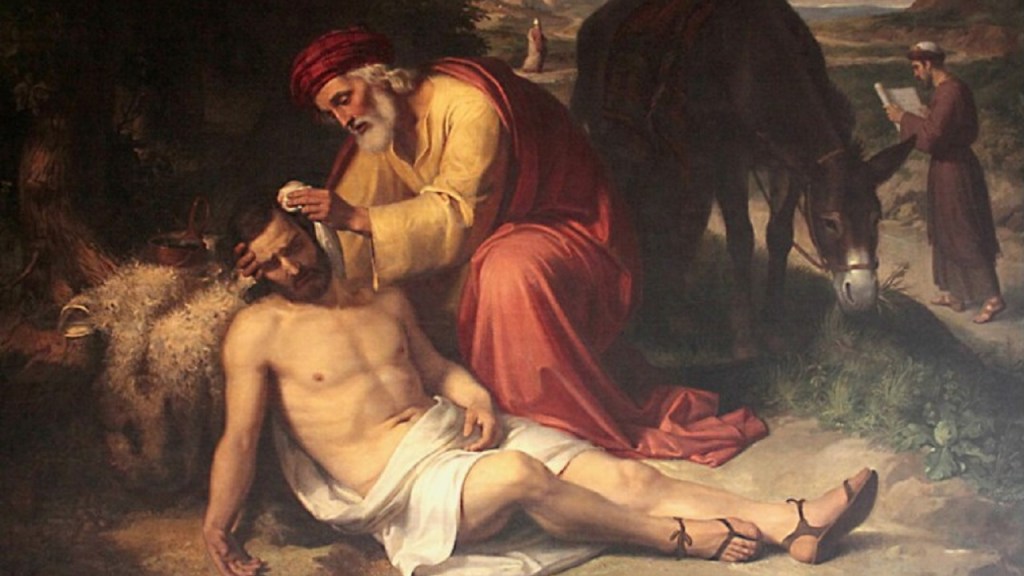
Luke 10:33-35 “But a Samaritan, as he traveled, came where the man was; and when he saw him, he took pity on him. He went to him and took care of his wounds, pouring on oil and wine. Then he put the man on his own donkey, took him to an inn and took care of him. The next day he took out two silver coins and gave them to the innkeeper. ‘Look after him,’ he said, ‘and when I return, I will reimburse you for any extra expense you may have.’”

How many times don’t we pass up the opportunity to help, and to love? Let me tell you a story from my own life. I wasn’t the man beaten and left for dead alongside the road. I was a stranded motorist whose battery had died along a Georgia highway in the middle of a thunderstorm. This was before ordinary people owned a cell phone. After over an hour, hundreds, maybe thousands of cars, had passed, including two highway patrols. No one stopped to help.

When no help came, I finally got out and started walking in the rain to the next exit. Then a man named pulled over and offered to give me a ride. It turns out that he was an agnostic recovering drug user. He was also dying of AIDS. He had no faith or church. He himself was low on gas. But he had compassion on this stranger walking in a rainstorm looking for help.

The Samaritan in Jesus’ story couldn’t be more different than the priest, the Levite, or even the half-dead man alongside the road. Two thousand years ago Jewish hatred for them was extreme. They publicly prayed in their synagogues that the Samaritans would not share in the resurrection from the dead. They were never accepted as converts. Eating their food was just as bad as eating pork. It was better to suffer than to accept their help.

I don’t know who might be our “Samaritans” today. For some perhaps Muslims, North Koreans, or illegal immigrants? Maybe it would be members of the opposite political party, or white supremacists, or members of Antifa.

At any rate, it is a Samaritan, a religious enemy, who helps. His help is full of sacrifice and risks. It is hardly convenient. The highway robbers had already struck once. The longer the Samaritan pauses to help the beaten man, the greater the chances for him to become the next victim. It isn’t safe.

He applies the standard first aid of the time. Then he gives up his seat on his donkey and walks so that the wounded man can ride. He spends a day caring for the man at an inn. When he leaves, he gives the inn keeper enough money to house and feed his injured friend for up to two months. What it would cost you to stay at even a cheap hotel for 60 nights? This gives us some idea of the Samaritan’s generosity.

As a pastor people often ask me questions about helping others. “I see this panhandler begging for food or money. What if I give him money and he wastes it on booze or uses it to buy meth? It is okay for me not to give him something?” “Someone is stranded along the highway. I have heard of cases in which people were faking their car trouble so that they could rob the person who stops to help. Should I put myself or my family at risk for someone I don’t know?”

I can’t say that it is wrong to be concerned about contributing to someone’s addiction. I can’t say that God wants us to put our children at risk, or that we should ignore potential dangers to ourselves.

I can say that self-interest should not be the greatest concern for the believing child of God. Almost all of Jesus’ twelve disciples ended up being put to death just for sharing their faith. No one I know criticizes them for that. Of course, Jesus himself came to our dangerous world knowing full well it would cost him his life. But he did it because our desperate need for salvation outweighed his concern for his own comfort or safety. Love led him to make the ultimate sacrifice to rescue us from our sins and bring us home to safety with him.

Sometimes showing Christian love will involve risks. Most of the time it calls for sacrifice. If we are taking an honest look at how we love our neighbor, we need to consider which one influences our choices more: self-interest or showing mercy. Self-interest will rarely, if ever, lead to mercy. Christ’s love leads us to risk loving our neighbor as well.

More Than a “Profession”

Luke 10:30-32 “A man was going down from Jerusalem to Jericho, when he fell into the hands of robbers. They stripped him of his clothes, beat him and went away, leaving him half dead. A priest happened to be going down the same road, and when he saw the man, he passed by on the other side. So, too, a Levite, when he came to the place and saw him, passed by on the other side.”

I don’t have to spend much time defending the notion that people have high moral expectations of religious professionals. This was true for ancient Jewish society as much as our own. The priest in Jesus’ story was a religious professional. His life was dedicated to the service of God. No one should have understood what God expects of us better. No one should have been more changed by constant exposure to God’s love for us.

The Levite was a religious worker who served in a support role. We might compare him to the elders or deacons in a church today, or to volunteers in the office or church committees.

Both of these men walk by the severely wounded man who had been robbed. Some believe their excuse might have been concern for ceremonial uncleanness. This is doubtful. Even if it were the case, it was no excuse for refusing to stop and help. There is nothing to suggest the beaten man was “unclean,” even according to Jewish ceremonial law. Nothing suggests he was a leper or a corpse. He was only “half dead.” Neither the priest nor the Levite managed to offer the man along the road basic human consideration.

Does faith make a difference in how we live, and love? Are we any different than the general population? The evidence doesn’t look good. A Barna poll finds a majority of practicing Christians, almost 70%, agree with this statement, “The highest goal of life is to enjoy it as much as possible.” That is similar to their secular counterparts. Jesus says, “Whoever wants to find his life will lose it, but whoever loses his life for me and the gospel will find it.” Again he asks, “What good will it be for a man if he gains the whole world, yet forfeits his soul?” Still, even practicing Christians will say, “God just wants me to be happy, right?” Where is that written?

On moral issues, Christians have often made the most noise about the problems with secular society. Yet Christian teens become sexually active before marriage at about the same rate as their non-believing counterparts. Christian marriages end in divorce more often than atheist ones. Apparently about half the time we find it difficult to love our very nearest neighbor, the one with whom we share a bed and a room.

On issues of kindness and charity we aren’t so different as we might like to think, either. Rosaria Butterfield is a Christian pastor’s wife with children. Before that she was an atheistic lesbian professor. But she says about the days before her conversion: “I strove to stand with the disempowered. I valued morality… The (LGBT) community values hospitality and applies it with skill, sacrifice, and integrity.” Helping others did not first become her concern when she became a Christian.

The main point of Christian faith is not to make us kind, or make us better. It is to make us God’s own. It is to make us safe in his forgiveness. God sacrificed his Son just because we need his grace, just like every other human being.

But God also intends his saving love and sacrifice to change us. Those who know what Jesus endured to come to our rescue will look at inconvenience, risk, and even suffering for others differently. His grace teaches us to put our faith into practice and show compassion. Christianity is not a “profession” confined to temples or churches.

A Better Prayer

Matthew 6:10 “Your will be done on earth as it is in heaven.”

“Your will be done” is an easy thing to say. The words are simple–no running to the dictionary to discover what they mean. They are short words–just one syllable each. These are easy words to pronounce. They are all words we could say and use by the time we began grade school. But together, as a sentence, these words form one of our hardest prayers.

This is a hard prayer because it is hard to want what these words say. “Oh,” we might think, “This isn’t so hard. What Christian doesn’t want what God wants to happen? Love your neighbor and love the Lord with all your heart, feed the poor and spread the good news–who doesn’t want that to happen?” But it isn’t as easy or simple as that.

It’s no secret to you that the people who live in this world have been corrupted by sin–every one of them. You and I have it too. God has never stopped loving us after we became sinners. But because he loves us, he wants, he wills, that there would be consequences for our sins. He knows that sin always hurts us. It messes with our minds and gives us a false view of reality. It is poison to the love that should live in our hearts. It suffocates faith and destroys our relationship with him. It makes us sullen and selfish and sad, and frankly we become generally unpleasant people to be around.

That’s why God created pain. He wanted us to realize that sin is bad for us. He has attached pain to practically every sin there is, even the little ones. It is his will. Sometimes the connection is obvious. For example, he wants us to take care of our bodies and practice a little self-control. It is not to satisfy our every desire. Too much alcohol or food, and in the short term we may suffer from a monster headache, or a stomach ache. Keep it up day after day, and the consequences dial the pain way up: liver disease, heart disease, diabetes, cancer, dementia, arthritic joints. God made it to work that way. It is his will.

But I don’t want to give the impression that the difficulty is the main feature of this prayer. This is a beneficial way for God’s people to pray. More than that, I will go so far as to say that “Your will be done” can be considered our best prayer.

The Greeks had an old saying: “Know thyself.” “To your own self be true.” But do we really understand what makes us tick, why we do what we do? David prays in the psalms, “Who can discern his errors?” Paul confesses in Romans 7, “I do not understand what I do. For what I want to do, I do not do, but what I hate I do.” Jeremiah says, “The heart is deceitful above all things and beyond cure. Who can understand it?” If we don’t even fully understand ourselves, how are we going to know if what we want is best?

Jesus our Savior gives us the greatest proof that “your will be done” is our best prayer. If God had left me to my own will, I would be trying to pay off my sins by myself. My relationship with God would not be based upon his forgiveness but my own hard work. If I could work my little merit system honestly, I would live in constant doubt and despair of ever doing enough. More likely, I would “fix the game” in favor of my strengths and overlook my weaknesses. I would live in the delusion that I was really making it, only to lose the game for all eternity in the end.

God’s will called for his Son to become one of us and die in our place. We would never have dreamed of asking him for that. God’s will works, because the blood of Jesus Christ his Son purifies us from all sin. His will is best, because it always ends with our hope and our future in heaven.

Perhaps you have noticed this slogan used by the Salvation Army: “Doing the most good.” It’s an interesting sentiment, but it is hard to prove. If we really want the most good, a better place to look is the prayer Jesus taught us to pray: “Your will be done.” It may be hard to pray, but God promises us only what is good, if not always easy. That is better than getting what I want.

Our Father

Matthew 6:9 This, then, is how you should pray: “Our Father in heaven…”

I know the picture of a “father,” or even “parent,” isn’t always a pretty one for us. Some of us may have had loving parents who sacrificed the world to raise us. They applied a good balance of discipline and boundaries, encouragement and freedom. Yet even then we can recognize some flaws.

Some of us had parents who drank way too much beer. They loved their careers and hobbies more than their children. They weren’t able to see the line between spanking their children and beating them. They used their children to try to feel better about themselves and soaked up all the love and affection in the relationship for themselves without sharing any of it with their kids.

When Jesus says, “This, then, is how you should pray: Our Father in heaven,” he isn’t saying, “Think of God as a really, really big version of your dad or mom, warts and all.” This is your Father in heaven. He is the perfect parent. That is what gives us the confidence to pray.

Your Father in heaven loves you perfectly, even when it comes time to discipline you. We often think of fathers as the disciplinarian in the family. It is a special kind of love, a perfect love, that loves us enough to set aside our comfort when a little pain or discomfort will do us some good. The writer of Hebrews reminds us, “Endure hardship as discipline; God is treating you as sons… No discipline seems pleasant at the time, but painful. Later on, however, it produces a harvest of righteousness and peace for those who have been trained by it” (Heb. 12:7,10-11).

Because your Father in heaven loves you perfectly, he gives you just what you need for your soul. That starts with the forgiveness of sins. David writes in Psalm 103, “As far as the east is from the west, so far has he removed our transgressions from us. As a father has compassion on his children, so the Lord has compassion on those who fear him.”

But when we look at what our Father did to forgive us, does it seem that the idea of “perfect Parent” and “perfect love” begins to break down? Ordinarily any hint of favoritism in a family is death to the relationships there. If a parent had some children who were “natural” children, and some children who were “adopted”, and the one set received preferential treatment, we would expect all kinds of problems. If anyone was going to receive special treatment and privileges, we would expect it to be the natural children, those who belonged to the family by birth, not the adopted children who were accepted into the family later.

Our Father in heaven sacrificed the only “natural” Son he had to spare the children he wanted to adopt. Our Father had the natural Son, the only innocent member of the family, suffer the punishment for the crimes the adopted children committed. We are the adopted children, Jesus the natural Son, and it doesn’t seem fair. But in our perfect Parent’s family, this wasn’t favoritism gone mad or injustice. It was perfect love, from Jesus who calls himself our brother, and his Father who has also become our Father.

These are the things Jesus wants us to remember as we begin our prayers: Our Brother suffers and dies for our forgiveness and adoption. That makes our God our Father in heaven. That makes us confident to pray as his dear children.