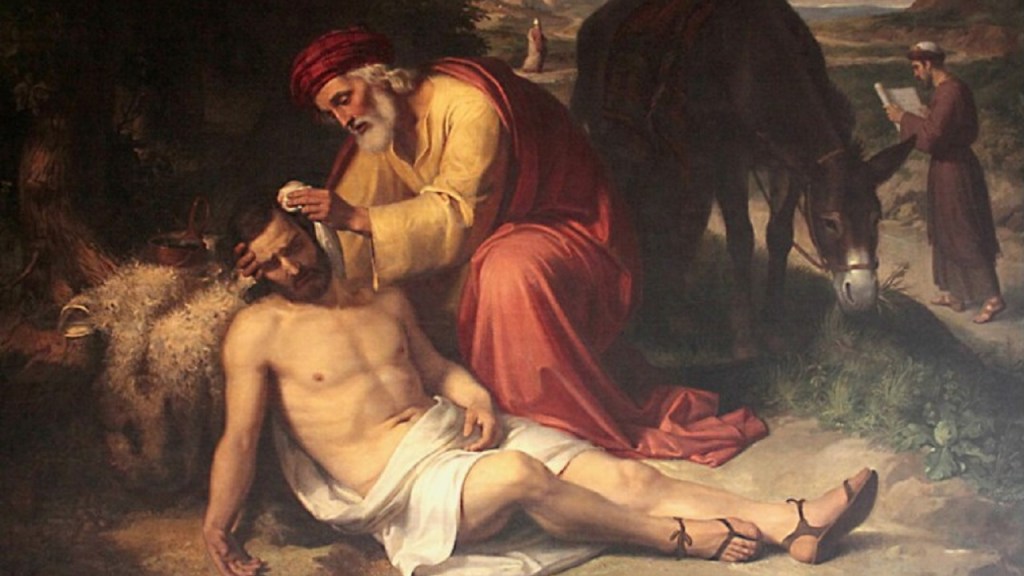
Luke 10:33-35 “But a Samaritan, as he traveled, came where the man was; and when he saw him, he took pity on him. He went to him and took care of his wounds, pouring on oil and wine. Then he put the man on his own donkey, took him to an inn and took care of him. The next day he took out two silver coins and gave them to the innkeeper. ‘Look after him,’ he said, ‘and when I return, I will reimburse you for any extra expense you may have.’”
How many times don’t we pass up the opportunity to help, and to love? Let me tell you a story from my own life. I wasn’t the man beaten and left for dead alongside the road. I was a stranded motorist whose battery had died along a Georgia highway in the middle of a thunderstorm. This was before ordinary people owned a cell phone. After over an hour, hundreds, maybe thousands of cars, had passed, including two highway patrols. No one stopped to help.
When no help came, I finally got out and started walking in the rain to the next exit. Then a man named pulled over and offered to give me a ride. It turns out that he was an agnostic recovering drug user. He was also dying of AIDS. He had no faith or church. He himself was low on gas. But he had compassion on this stranger walking in a rainstorm looking for help.
The Samaritan in Jesus’ story couldn’t be more different than the priest, the Levite, or even the half-dead man alongside the road. Two thousand years ago Jewish hatred for them was extreme. They publicly prayed in their synagogues that the Samaritans would not share in the resurrection from the dead. They were never accepted as converts. Eating their food was just as bad as eating pork. It was better to suffer than to accept their help.
I don’t know who might be our “Samaritans” today. For some perhaps Muslims, North Koreans, or illegal immigrants? Maybe it would be members of the opposite political party, or white supremacists, or members of Antifa.
At any rate, it is a Samaritan, a religious enemy, who helps. His help is full of sacrifice and risks. It is hardly convenient. The highway robbers had already struck once. The longer the Samaritan pauses to help the beaten man, the greater the chances for him to become the next victim. It isn’t safe.
He applies the standard first aid of the time. Then he gives up his seat on his donkey and walks so that the wounded man can ride. He spends a day caring for the man at an inn. When he leaves, he gives the inn keeper enough money to house and feed his injured friend for up to two months. What it would cost you to stay at even a cheap hotel for 60 nights? This gives us some idea of the Samaritan’s generosity.
As a pastor people often ask me questions about helping others. “I see this panhandler begging for food or money. What if I give him money and he wastes it on booze or uses it to buy meth? It is okay for me not to give him something?” “Someone is stranded along the highway. I have heard of cases in which people were faking their car trouble so that they could rob the person who stops to help. Should I put myself or my family at risk for someone I don’t know?”
I can’t say that it is wrong to be concerned about contributing to someone’s addiction. I can’t say that God wants us to put our children at risk, or that we should ignore potential dangers to ourselves.
I can say that self-interest should not be the greatest concern for the believing child of God. Almost all of Jesus’ twelve disciples ended up being put to death just for sharing their faith. No one I know criticizes them for that. Of course, Jesus himself came to our dangerous world knowing full well it would cost him his life. But he did it because our desperate need for salvation outweighed his concern for his own comfort or safety. Love led him to make the ultimate sacrifice to rescue us from our sins and bring us home to safety with him.
Sometimes showing Christian love will involve risks. Most of the time it calls for sacrifice. If we are taking an honest look at how we love our neighbor, we need to consider which one influences our choices more: self-interest or showing mercy. Self-interest will rarely, if ever, lead to mercy. Christ’s love leads us to risk loving our neighbor as well.
 Bits of Bread