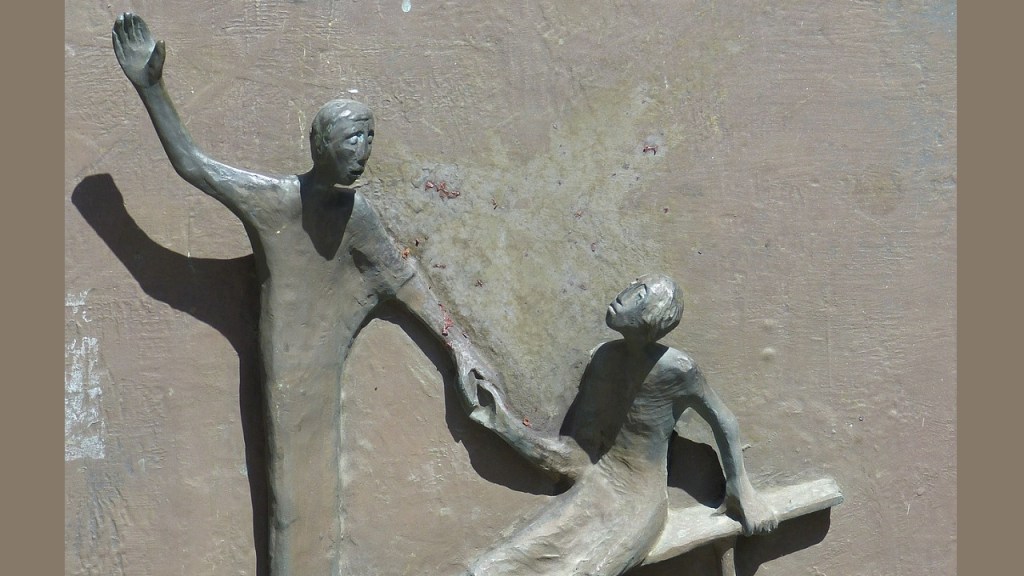
Matthew 9:3-7 “At this some of the teachers of the law said to themselves, ‘This fellow is blaspheming!’ Knowing their thoughts, Jesus said, ‘Why do you entertain evil thoughts in your hearts? Which is easier: to say, Your sins are forgiven, or to say, Get up and walk? But so that you may know that the Son of Man has authority on earth to forgive sins’… Then he said to the paralytic, ‘Get up, take your mat, and go home.’ And the man got up and went home.”
Jesus’ question is an interesting one, isn’t it. Which thing is easier to say? Forgiving sins may seem easier to say, but harder to do. Only God can forgive sins, and those he has chosen to speak for him. But can anyone challenge the statement? Sins don’t wash out like a visible stain. If I say, “Your sins are forgiven,” how is anyone going to prove it one way or another? You can’t see that they are gone.
On the other hand, it may seem harder to say, “You are healed. Get up and walk.” Healing or forgiving both take miraculous power. But the healing you can see. The person is either better or they are not. If you are going to say something like that, you better be sure you can do what you are saying, because everyone is going to know.
Jesus intended to use the second to prove the first. Have you ever wondered why Jesus did so many miracles during his ministry? Certainly, he did them because he loved people and he wanted to show them mercy.
But especially in John’s gospel, Jesus’ miracles are called “signs.” They weren’t just acts of power. They weren’t just acts of mercy. They were messages, indicators, communications from God about the real identity of the man who so easily bent and broke the laws of nature.
Miracles play a special role in our faith, then. Professor Peter Kreeft has made the observation that you can take the claims of miracles out of all the other world religions and you are left with essentially the same faith. But all the essential features of Christianity involve something miraculous: the virgin birth of Jesus, and God becoming a man; the atoning value of Jesus’ death on the cross; Jesus’ bodily resurrection from the dead; his ascension into heaven, to mention some of the highlights. All of these tell us that Jesus was more than a prophet, no ordinary man.
And in the healing of this paralyzed man, a miracle is more than just a fascinating act of power or demonstration of God’s love. It is a message proclaiming: “This is no ordinary man. This is your Savior. He has the power to forgive your sins and heal your soul.” The miracle was important, because it proved the power of Jesus’ words. But it still takes second place, because the needs of the body aren’t as urgent as the needs of the soul, the forgiveness of our sins.
This is still true. God may use his church to feed a hungry family or reconcile a hostile relationship or strengthen a struggling marriage. But we are still a collection of broken souls with one great need: the forgiveness of our sins.
 Bits of Bread