Charge!

1 Samuel 17:48-50 “As the Philistine moved closer to attack him, David ran quickly toward the battle line to meet him. Reaching into his bag and taking out a stone, he slung it and struck the Philistine on the forehead. The stone sank into his forehead, and he fell facedown on the ground. So David triumphed over the Philistine with a sling and a stone; without a sword in his hand he struck down the Philistine and killed him.”

There is a time for the child of God to retreat when under attack. When the kinds of temptations that appeal to the lusts of our own sinful natures are luring us, especially sexual sins, God’s word to us is “Flee!” Nothing in Scripture suggests that we should engage the temptation to see how long we can hang in there before we finally give in. That would be foolish, not faithful.

But David was facing an entirely different situation here. The Giant Goliath had insulted God. He had called into question God’s power and grace. God’s reputation as the Deliverer of his people was at stake. And when God’s reputation suffers, so does the faith of his people.

The real issue was not the physical battle between an impetuous teenager and a godless Giant. It was the spiritual attack on the hearts of God’s children. There was an entire army standing behind David. But their faith had been compromised by Goliath’s size and threats. That’s why they were behind David, not out there meeting the challenge themselves. That meant that more than lives were at stake this day. Their very souls were in danger.

For that kind of battle, you can’t get started fast enough. David ran to meet the giant. There is an appropriate sense of urgency for us to get going, to engage our spiritual battle with the world for the hearts of neighbors who don’t know Jesus or church members who are losing their grip on him. For this the signal is never “Flee!” but “Charge!” when we are acting on faith, not fear.

Doesn’t David’s story make you want to do something? Doesn’t it make you want to act? Let me share with you a little story told by a pastor at a youth conference: “My kids have “Dave and the Giant Pickle,” (The Veggie Tales version of this story) and after they watched it a few times, I watched it with them and I thought, ‘That’s enough.; And so we read this whole narrative and my little son Johnny, he’s four years old, and he says, ‘Dad, he killed him all the way dead, didn’t he?’ I said, ‘Yeah, he did.’ He says, ‘He chopped his head off with a sword, didn’t he?’ I said, ‘Yes, he did.’”

“I have a sword in my office. It’s an unsharpened sword. We came in the next Sunday morning and I was out making copies—Johnny was in my office—and I could hear—it makes a certain sound—a “shing” when it comes out of the sheath, and he pulled it—and he comes out in the office and he’s almost in tears, and John says…it never dawned on me that he didn’t think Goliaths were still around today.  He says, ‘Dad,’—he’s almost in tears and he’s dead serious and he says, ‘If Goliath comes in this office, I will chop his head off.’” “I’m on your team, that’s where I am.”

That’s the power of God’s word in the heart of a young man, the power and faith that makes him ready to act. The battles God gives us to fight for him today may be spiritual, not physical. We fight with words, not swords. But his word gives us the faith to engage the battle, and trust him for victory in the end.
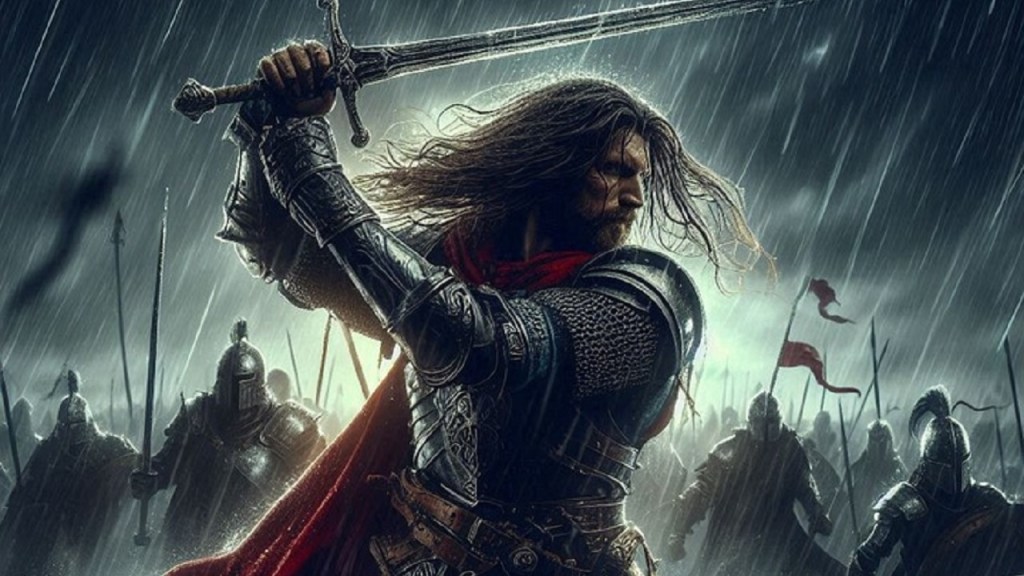
Courage!

1 Samuel 17:45-46 “David said to the Philistine, “You come against me with sword and spear and javelin, but I come against you in the name of the Lord Almighty, the God of the armies of Israel, whom you have defied. This day the Lord will hand you over to me, and I’ll strike you down and cut off your head. Today I will give the carcasses of the Philistine army to the birds of the air and the beasts of the earth, and the whole world will know that there is a God in Israel.”

David was absolutely convinced of the reality and power of our God. The God of the armies of Israel was the one who destroyed the chariots of Egypt and brought down the walls of Jericho. In both cases, Israel did not have to fire a single shot or swing a single sword. This was the God who allowed just 300 Jewish soldiers under Gideon to defeat a Midianite army of over 100,000. This God, who could flick Goliath away like an irritating fly, was as real and as present for David as a person sitting next to you at this moment.

Here we have our Christ window into this Old Testament account. Here we see our Savior, because the God of the armies of Israel is the same God whose love and power have delivered us in way that makes all of this look tiny. Our hero and champion Jesus is this same God of the armies of Israel. He has defeated the devil and all his demons. He canceled every one of our sins and destroyed death itself. We didn’t even have to lift even a finger in that fight.

He did it all for us by giving up his own life at the cross, then taking it back again in his resurrection from the dead. This same Jesus is present with us every time we take the sword of the Spirit, which is the Word of God (Ephesians 6:17), out of its sheath and use it today. Confronting sin and overcoming unbelief is not about our power. It’s not about our cleverness, our persuasive arguments, or skills in debate. It is about the power of Jesus Christ working in his word. He says this word “will not return to me empty, but will accomplish what I desire and achieve the purpose for which I sent it.”

With this gracious, saving God on our side David was completely confident of victory. And we should be just as confident for our battles with God’s enemies, too.

That’s not to say that our success will always look like David’s on the outside. The early Christians were often forced to defy the Roman empire of their day in order to remain loyal to Christ. In thousands of cases that meant beatings, torture, and even death. Did that mean failure and defeat? Even when their bodies were lying lifeless on the sands of the arena, their souls were living and reigning with Christ in heaven. Beyond a personal victory over the powers of this world, their example of faithfulness in the face of death inspired many more to hear the gospel, know Jesus as their Savior, and spread his love to others.

It has often been said, “the blood of the martyrs was the seed of the church.” The more Christians died, the more the gospel got out, and the more the Church was winning. These early Christians were courageous, not cowards. They believed the truth, not the world’s brash claims. God give us the faith to be as courageous and loyal as they were.

Don’t Believe the Trash Talk

1 Samuel 17:42-44 “He (Goliath) looked David over and saw that he was only a boy, ruddy and handsome, and he despised him. He said to David, ‘Am I a dog, that you come at me with sticks?’ And the Philistine cursed David by his gods. ‘Come here,” he said, ‘and I’ll give your flesh to the birds of the air and the beasts of the field!’”

Trash talk is not a phenomenon that began with late 20th Century sports. This kind of psychological warfare goes back at least 3000 years. Goliath used it against David. Right away the giant went to work trying to destroy David’s courage.

First, he attacked David’s person. He despised the young man. Goliath seemed offended that the Israelites would send a teenager to fight him. His words and body language said, “You are an inadequate little wimp.”

Some still use that kind of trash talk against those fighting on God’s side. Many years ago a pastor was attending a conference where an agnostic professor was speaking. After the speech the pastor questioned the speaker about something unbiblical he had said. The professors just dismissed him by saying, “Oh, you’re from one of those churches where they have no scholars.” He was saying, “Intellectually, you are an inadequate little wimp. You can’t win this argument with me.” The same thing is going on when you stand up for the truth and others call you a “fundamentalist,” “Bible-thumper,” or “dinosaur.” “You’re too stupid to figure this out,” they imply.

Second, he mocked David’s weapons. “Am I a dog, that you come at me with sticks?” David had nothing more than his slingshot, a little bag of stones, and a staff in his hand. They didn’t look like much use against a giant whose spearhead alone weighed 15 pounds, not to mention his sword, shield, and armor. “You don’t have the tools, the weapons, to beat me.”

Do our weapons for fighting God’s battles look even weaker? We have nothing more than a message about God’s love, a ritual involving words and water, a little taste of bread and wine mixed with a promise of Jesus’ forgiving presence. They look harmless compared to the money, the fun and excitement, the reasonable sounding arguments, and sometimes the raw power and influence of those who find Christianity old-fashioned, restrictive, unscientific, or too boring to take seriously.

Sometimes we even begin to believe the trash talk. We doubt whether word and sacrament are enough. Then we reach for gimmicks or lose courage. We begin to fold, because we don’t think we have the tools, the weapons, or the resources to win.

So are we just going to let the giant win? Should David have resigned himself to the conclusion that Goliath was going to feed him to the birds that day? Should we accept that we are going to lose the next generation to the world and the false teachers, that we can’t compete with worldly pleasures for the hearts of our neighbors, that we are too small and too poor and too outgunned to make a difference in a culture that seems bent on overturning everything that is good and true and godly?

Or are we going to stand and fight? Our weapons don’t look impressive, but we wield divine power when we use them. The gospel is enough to protect ourselves and drive back the enemies of biblical faith in every era.