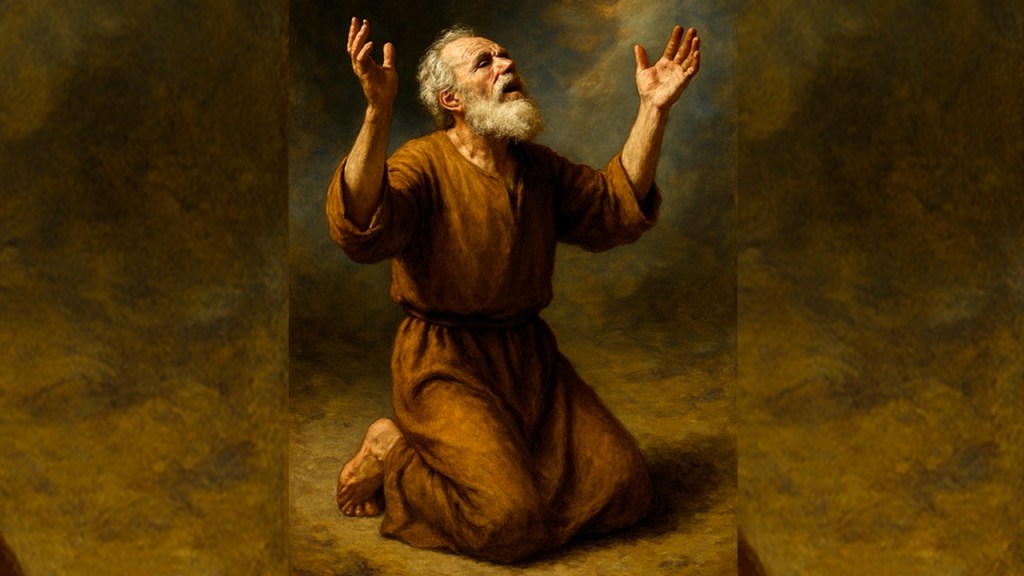
Numbers 12:3-8 “Now Moses was a very humble man, more humble than anyone else on the face of the earth. At once the Lord said to Moses, Aaron, and Miriam, ‘Come out to the Tent of Meeting, all three of you.’ So the three of them came out. Then the Lord came down in a pillar of cloud; he stood at the entrance to the Tent and summoned Aaron and Miriam. When both of them stepped forward, he said, ‘Listen to my words: When a Prophet of the Lord is among you, I reveal myself to him in visions, I speak to him in dreams. But this is not true of my servant Moses; he is faithful in all my house. With him I speak face to face, clearly and not in riddles; he sees the form of the Lord.”
There are three ways that the Lord defended Moses and his character here. First, for us the readers, he records that Moses was “more humble than anyone else on the face of the earth.” Sometimes we might get the idea that a leader has it coming. He has been so arrogant, so drunk with power, that he needed someone to knock him down a few notches.
That was not Moses. He was not perfect, by far. But he had not pursued this position as leader of Israel. The Lord practically had to force it on him. Moses had objected that he wasn’t qualified. “I don’t really know you that well, Lord. I am a nobody that no one will want to listen to. I am not very good at speaking.” Apparently, this humility had not left him even after the many miracles God had done through him and the defeat of one of the world’s super powers.
The Lord wants us to know this about him. Real leaders don’t have to puff themselves up by bragging about their accomplishments or constantly comparing themselves to others, at least not Christian ones. Humility is a trait of biblical leadership, and Moses was a role model of that trait.
Second, for Aaron and Miriam, the Lord defended Moses as “faithful in all my house.” Moses had not used his leadership for his own advantage. He wasn’t a third world dictator living in luxury while his people starved. He didn’t impose his own rules or ideas in place of Gods. He did not see himself as above the law and give himself permission to commit sins anyone else would be punished for. He delivered God’s word to the people straight and unvarnished even when the people talked of replacing him. God said, “Jump!” and Moses said, “How high?”
There is no character trait the Lord desires more in his leaders than faithfulness. In the New Testament Paul wrote the Corinthians, “Now it is required that those who have been given a trust must prove faithful” (1 Cor. 4:2). Nowhere does he say that a leader must prove successful, though more than one pastor has been shown the door for lack of results. He doesn’t say that a leader must prove popular, or even socially skillful. Faithful, doing his best with the gifts God gave him: that was Moses. That is still the kind of leader the Lord will defend if his ministry comes under attack.
Third, the Lord points out how he had clearly demonstrated his satisfaction with Moses and his leadership by the way he dealt with the man. Unlike any other prophet before or since, the Lord spoke to him “face to face.” No other mere mortal ever came closer to seeing the form of God himself than Moses did. No other man in his time was given a more direct word from the Lord than this man.
Moses occupied a unique place in God’s plan. We don’t expect our spiritual leaders to have such direct contact with the Lord today. Nor is it necessary. We have the word of Moses’s great successor Jesus, who brings us God’s word of grace even more directly. “In these last days he (God) has spoken to us by his Son” (Hebrews 1:2). “The law was given through Moses; grace and truth came through Jesus Christ” (John 1:17).
Our great need is for leaders today to whom the Lord has revealed himself in his word, people who are open to God’s revelation and put their trust in it. Then we need them to deliver it to others faithfully, regardless of the cost to themselves.
 Bits of Bread