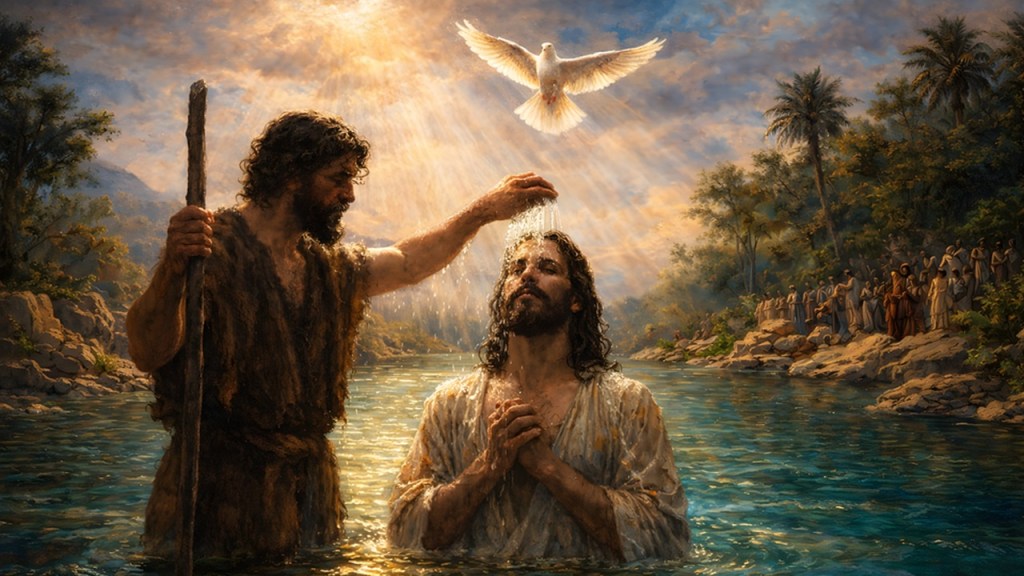
Luke 3:21 “When all the people were being baptized, Jesus was baptized, too.”
Jesus didn’t get this day all to himself. The ceremony didn’t take place in the temple witnessed by priests and rabbis. The family hadn’t come from out of town to see. There were no cards or gifts or celebrations afterward.
He stood in line with a sorry assortment of farmers and fishermen, shady merchants and smelly shepherds, greedy tax collectors and intimidating soldiers, hard-drinking men and loose-living women and whomever else John the Baptist had convinced to repent. He stood there with the rest of them, and when his turn came, Jesus was baptized in a dirty little creek called the Jordan River. “When all the people were being baptized, Jesus was baptized, too,” just like all the sinners around him. He was baptized with us all.
But why? He had no sins for which to repent. He had no old life that needed to die, no new life he needed to embrace. A tangible, visible statement of God’s cleansing grace and forgiveness seems wasted on the only perfect person who ever lived. He had the pure heart and soul, the clean life that those who understand aspire to receive. Do you take the clean dishes out of the dishwasher and wash them again before you put them away? Would you bring new furniture home from the store, and have it cleaned before it has ever been used?
Jesus came to be one of us. He came to stand with us all. Yes, he had no sins, not even one. But his life played out as though he did. He knew deep hunger, nearly starvation during his forty days in the wilderness. He felt the sting of rejection, the bullying and shaming of the Pharisees, the betrayal and abandonment of his closest friends. He suffered grief and loss. His father Joseph died sometime during his teens or twenties. The death of his friend Lazarus brought him to tears. This isn’t a life for the sinless Son of God. These are the burdens human sinners bear. These are the wages of our sins, no particular sin necessarily, but the consequences we brought on ourselves for spoiling God’s perfect creation.
Jesus could have stood above it all. He didn’t. He lived the life the sinners lived–not sharing their sins, but sharing all the misery and unpleasantness that was common for a Jewish peasant living in relative poverty 2000 years ago, and then some.
In another sense, he did share our sins, though, didn’t he. He didn’t commit his own. He carried the responsibility for ours. He did more than become one of us. He became us. Our sins made him dirty. Our lives soiled his own.
How could he not, then, stand with those sinners along the banks of the Jordan river waiting to be baptized? Why would he not desire this sign, this statement, this seal and promise of God’s cleansing grace, considering the burden he carried?
Jesus went to worship every Sabbath, not just to keep an old, musty rule. His heart, too, was refreshed and uplifted by the words of God’s love that were read, sung, and prayed there.
Jesus stood along the banks of the Jordan with a motley assortment of sinners, and in the waters of his baptism God poured out his grace on him. Jesus made himself one of us, and so he was baptized, too.
 Bits of Bread