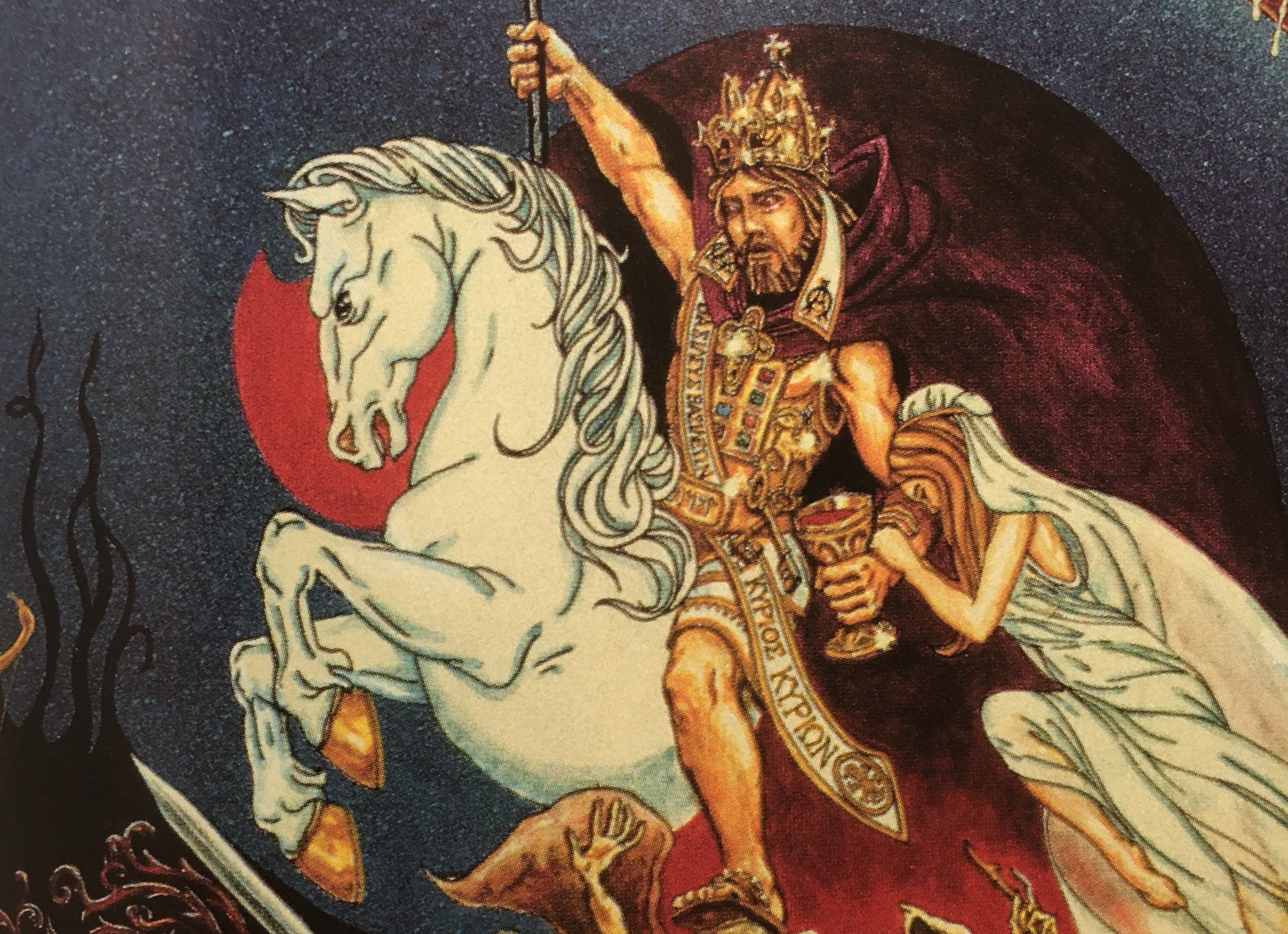
Fear and Death Destroyed

Grim Reaper Cross

Hebrews 2:14-15 “Since the children have flesh and blood, he too shared in their humanity so that by his death he might destroy him who holds the power of death–that is, the devil–and free those who all their lives were held in slavery by their fear of death.”

Death is a problem. Is that a statement of the obvious? We can even say that death is the problem. This is true on a number of different levels.

Death is the problem because it gives the devil power over us. It’s not just that death is painful to experience, destroys our earthly bodies, and ends our earthly relationships. Death is the consequence of our sin. We suffer it because we are members of the rebellious family of mankind, and we have mounted our own personal rebellions against God. Sin qualifies us to share the devil’s fate in hell. It disqualifies us for life in God’s presence. The power of death is its power to make sure we get what our sins deserve.

Since God is the one who determines when each person will die, he has power over death. But God doesn’t want to use death for its original purpose. “I take no pleasure in the death of anyone” he says through the prophet Ezekiel.

The one who infected humanity with death by leading our first parents to sin is the devil. The one who is constantly working to arrange for us to die in unbelief is the devil. Death, used for its original purpose to judge and destroy the enemies of God, is the power of the devil. He introduced it and still manipulates it to keep us from God and heaven.

Death is a problem because it makes us slaves to fear. Until we know what Jesus has done for us, we are “those who all their lives were held in slavery by their fear of death.” Fear is a powerful motivator. It gets you to do things you otherwise would not. It drives us to all kinds of bizarre behaviors. It inspires silly superstitions, like trusting in rabbit’s feet and avoiding the cracks on the sidewalk. It makes us selfish and unwilling to share with others. We horde and we hide because we fear the day when our own stock will run out, and we freeze or starve to death. It keeps us awake all night, afraid of the boogeyman as children, afraid of dread disease as adults.

Jesus became a flesh and blood Savior because he came to deal with our death. He does so by his own death. “Since the children have flesh and blood, he too shared in their humanity so that by his death he might destroy him who holds the power of death…” Death, by definition, involves a separation–whether the separation of the soul from the body, or the separation of the sinner from God. God is a Spirit. Neither of these separations are possible for him as such. So Jesus shared in our humanity so that he could die.

By his death he destroys the one who holds the power of death, that is the devil. He didn’t make the devil cease to exist. He took away his deathly power. He ruined the devil’s work of damning souls. Jesus’ death made himself look weak, but it is actually the most powerful thing in the world.

When you split an atom, that atom “dies,” if you will, and you unleash incredible power. When you split the flesh and blood Son of God from his soul, and from his Father, in his death at the cross, incredible power is unleashed. A chain reaction begins that serves the death sentence for everyone’s sin. Satan is left disrobed and disarmed, a whimpering little spirit whose deadliest weapon has been taken away from him.

Jesus also “shared in their humanity so that by his death he might…free those who all their lives were held in slavery by their fear of death.” The death of our flesh and blood Savior removes our fear because it promises us God is not going to punish us for our sins. It removes our fear that death is going to be the end. Now we know that it is the gateway to life that never ends.

This sets us free to live our lives without the guilt trips, and without the superstitions, and without the desperation and panic that comes with the belief that I have to look out for number one and save myself. Jesus shares our flesh and blood to deal with our death and end our slavish fears.

Stronger Hearts

Heart dumbell

1 Thessalonians 3:13 “May he strengthen your hearts so that you will be blameless and holy in the presence of our God and Father when our Lord Jesus comes with all his holy ones.”

Do you like to exercise? I have reached the age when doing something that uses muscles I don’t use while sitting at my desk leads to feeling it in my back, my shoulders, or in my legs the next day. In order to get into better shape, I need to expand what I do. But in order to stay in shape I also need to repeat what I do. Exercise those muscles just one time, and they won’t become so strong. They will merely be sore.

Doesn’t the strengthening of the faith in our hearts call for a similar plan? We need to expand our exposure to God’s word, and hear facets of the gospel we hadn’t heard before. We need to gain new insights into his great love for us. As Paul wrote the Ephesians, “May (you) have power together will all the saints to grasp how wide and long and high and deep is the love of Christ, and to know this love that surpasses knowledge…” Then our faith grows broader.

But we also need to drive it deeper. We need to repeat those things we already know about God’s love. Using the same muscle over and over makes it strong. Hearing the same gospel over and over makes faith strong. This is how God answers our prayer to strengthen our hearts.

Even a little, wavering, struggling faith is a saving faith. But Paul didn’t want the Thessalonians to stagger to the finish line with a faith that barely got them through life. He wanted them to have a strong faith that lived in full confidence of God’s grace. He wanted there to be no doubt they would stand before God on the day of Jesus’ return, “blameless and holy,” washed from every spot of sin by Jesus’ blood received by faith.

I pray the same for you. I would like you to accomplish great things for God. I would like you to be shining examples of Christian faith to the people around you. But more than anything, I pray that God will strengthen your hearts so that you will make it all the way, and you will be blameless and holy in the presence of our God and Father when Jesus comes with all his holy ones.

Make Our Love Overflow

Hearts overflow

1 Thessalonians 3:12 “May the Lord make your love increase and overflow for each other and for everyone else, just as ours does for you.”

You can’t read Paul’s letters to the churches he founded, like this letter to the Thessalonians, and miss the passion this pastor felt for his people. He genuinely cared. But the love he wanted to see increase and overflow is more than warm feelings.

Our world’s idea of love often has less to do with what is good for someone else, and more to do with possessing the person or thing that I desire for myself. It is a selfish and self-serving thing to which we may become addicted, and it often moves us to take complete leave of our senses.

Paul prayed that the Lord would make a genuine Christian love increase and overflow among these people, but what does that look like? How is it different? A quick walk through the New Testament gives us a rather lovely picture of it. Jesus’ example of washing his disciples’ feet shows us that it does not balk at performing some of the most menial tasks for others. Later that evening he tells us that it lays down its life for a friend. Among other things Paul’s description in 1 Corinthians 13 reveals that it is not self-seeking. It carries each other’s burdens he writes the Galatians. According to John, it will give up material possessions to help a brother in need. It is in every way epitomized by the sacrifice God has made for us in Christ.

Such a love grows only where faith grows. In fact, you can’t separate them. Luther’s rather famous description of faith in his preface to the book of Romans jumps quickly to the way faith reveals itself in love: “Faith is a living, daring confidence in God’s grace, so sure and certain that a man would stake his life on it a thousand times. This confidence in God’s grace and knowledge of it makes men glad and bold and happy in dealing with God and all His creatures; and this is the work of the Holy Ghost in faith. Hence a man is ready and glad, without compulsion, to do good to everyone, to serve everyone, to suffer everything, in love and praise to God, who has shown him this grace.”

And such faith and love grow only where the gospel feeds them. “We love because he first loved us.” “This is love, not that we loved God, but that he loved us and sent his Son as an atoning sacrifice for our sins.” God’s love in sending his Son and offering him for my sins doesn’t shame me into a more loving life. It changes me. Again, Luther on the difference faith makes: “It changes us and makes us to be born anew of God; it kills the Old Adam and makes altogether different men, in heart and spirit and mind and powers.”

A prayer to increase our love is at the same time a prayer for our Lord to flood us with his grace. When Christ comes to us in his word and sacrament, faith increases, and so will our love.

Things Above

Look above

Colossians 3:1-3 “Since, then, you have been raised with Christ, set your hearts on things above, where Christ is seated at the right hand of God. Set your minds on things above, not on earthly things. For you died, and your life is not hidden with Christ in God.”

What’s wrong with earthly things? They are God’s gifts to us, his own creation. But we are all aware of the hold they can have on our hearts. Has the wild dive in the stock market made you feel woozy? Maybe you have been unsettled by the situation. Why is that? Perhaps the coronavirus has dominated our concerns. Why does this create so much anxiety? Is it not because we are fixated on our earthly standard of living and the quality of our present lives?

Let me ask you another question: How does this affect us spiritually? Does focusing on such things make us firmer in our faith, and draw us closer to God? Or isn’t it true that the more we fixate on our financial uncertainties, the less convinced we become of Bible promises like this one: “My God will meet all your needs according to his glorious riches in Christ Jesus”?

There are subtler worldly traps into which we can fall. We Christians work hard to improve the morals or the living conditions of our neighbors. Then we despair when the world doesn’t cooperate and nothing seems to change. Do we show our love in such ways because Jesus’ love for us has moved us to care about others, or because we entertain some utopian dreams about creating a pseudo-paradise on earth?

The sin of worldliness is at work when we become obsessed with our own earthly identities. I want to be thought of as a paragon of virtue, even a hero of the Christian faith. Then my sinful nature gets involved. There is no virtue in flaunting our faults. But hiding shortcomings or denying sins as part of a desperate defense of our self-image spells trouble. It is true that the Lord wants us to fight our sinful urges. The goal, however, is not to appear a little holier than everyone else. There is nothing godly about taking a prideful ego trip like the Pharisees of Jesus’ day.

All of these concerns share this in common: they focus on earthly things. Paul doesn’t say we should never think about money, health, morals, or reputation. He says they are not the sorts of things for Christians to set their hearts and minds upon.

Why? Look at what has happened to your earthly life: “For you died.” Death is the great ender of all relationships. For obvious reasons, when you die your employer doesn’t expect you to show up at work anymore. Your family doesn’t expect you to come home anymore. No one has anything to do with you at all. All relationships come to a grinding halt.

And Paul says that you died. But what does he mean by that? He is referring to the way in which God has dealt with the problem of our sins. Since the wages of sin is death, we all had to die. That’s exactly what happened. But instead of having us die for our sins personally, God sent Jesus to be our substitute. He died for us. In God’s eyes, we died on the cross when Jesus did. God can forgive our sins because, in Christ, we died.

This profoundly changed our earthly lives. As we just said, death is the great ender of all relationships. Perhaps you have seen movies in which someone stages his own death to escape the law, or to escape the organized crime syndicate, or to escape some loathsome responsibility. After that the person took on a new identity. The law stopped chasing him. The mob stopped trying to assassinate him. He no longer had to do what he hated doing.

In our case, God didn’t stage our death. He had Jesus, our substitute, die for us. With this he also gave us a new identity. Now he sees us as righteous and holy saints who have no relationship with sin anymore, no longer desperately attached to this world.

And that’s the way he wants us to see things, too. By faith we died to sin. We died to this world. Those old attachments are broken. They can’t chase us, kill us, or control us anymore. We may still live in this world. We still interact with it. But it makes no sense for us to set our hearts on earthly things. We have better things on which to set our hearts, a better place to fix our attention. Set your mind on thing above!

That They May Proclaim My Praise

Praise Hymn

Isaiah 43:20-21 “I provide water in the desert and streams in the wasteland, to give drink to my people, my chosen, the people I formed for myself that they may proclaim my praise.”

In God’s hands, you are the spiritual equivalent of a work of art. When he says that we are people he formed for himself, he speaks of the kind of forming a potter does with his clay. With his own hands he carefully molds and shapes his work until it is just the right shape and will serve just the function he intends.

In one sense, all of the people on earth are the work of God’s creation. But when he speaks of “my people, my chosen,” he is referring to those in whom he is carefully forming and shaping their faith. We are all still works in progress. None of us has fully taken the shape that God wants us to have. But he continues to work with this material to get it to express just the message he wants.

When an artist creates some piece, he is trying to do more than make something look pretty. He wants it to communicate a message. That is also God’s intent with the people he has formed for himself: “that they may proclaim my praise.” When a Hebrew thought of praising God, he was not thinking primarily of emotional outbursts. Praise transcended how God made him feel. His very word for praise suggests that he was going to tell a story. Something very important had happened, and he was going to tell about it.

You have a story to tell, a story that praises God, too. Right now God is forming and molding your faith so that you can tell it. He is molding and changing your behavior, so that your life tells the story of his impact on it. He is molding and changing your Bible knowledge, so that your mouth can tell others the story of God’s grace. He is molding and changing your heart, so that you have the courage to open that mouth and live that life and let the story come pouring out.

The last verse of the old gospel hymn “I Love to Tell the Story” closes this way, “And when in scenes of glory I sing the new, new song, ‘twill be the old, old story that I have loved so long.” The new song of heaven is about the old story: Christ’s love for us. It goes back thousands of years, but for those who have drunk from its waters and experienced its life-changing powers, it remains ever fresh, and ever new. May we always love to tell that story, too.

In with the New

desert streams

Isaiah 43:19-20 “See, I am doing a new thing! Now it springs up; do you not perceive it? I am making a way in the desert and streams in the wasteland. The wild animals honor me, the jackals and the owls, because I provide water in the desert and streams in the wasteland, to give drink to my people, my chosen…”

God’s new thing forms an interesting contrast with the crossing of the Red Sea. At the Red Sea there was too much water, it seemed. The Lord had to make a dry place through the middle of the sea so that his people could cross it to safety. In the new thing God is doing, there is too much dry, trackless desert his people need to cross. That’s why God creates streams of water–so that they can survive their journey and cross the desert to safety.

One might guess Isaiah is referring to his people’s return from captivity in Babylon. Isaiah had predicted this captivity was coming. He even gave the name of the man who would let them go home when it was done: Cyrus, the future king of Persia. When the time finally came, and the people could come home to Jerusalem, they certainly had to cross a very dry, very lonely desert to get there.

That crossing of the Arabian desert may have begun the fulfillment of this prophecy. But we have no record from either the Bible or history of literal streams appearing in that desert on the Jews’ trip home. It’s also hard to think of the return from Babylon as being a more momentous event than the crossing of the Red Sea, whether for its historical or for its spiritual significance.

But there was another time ahead for God’s people when he was making ways in the wilderness and providing drinks in the desert. Remember Isaiah’s words describing John the Baptist? “A voice of one calling: ‘In the desert prepare the way for the Lord; make straight in the wilderness a highway for our God.’” Remember Jesus’ words to the Samaritan woman at Jacob’s well? “Everyone who drinks of this water will be thirsty again, but whoever drinks the water I give him will never thirst. Indeed, the water I give him will become in him a spring of water welling up to eternal life.” The reason God led his people home from Babylon to Jerusalem was to bring them the Water of Life later in the person of Jesus. Then they could cross the spiritual desert in which they were living to safety with him.

Look at this new thing God has to show you. Do you see how it is blessing you in the present? These wonderful works of God were not done in a vacuum. They were not merely awesome displays of his power far removed from us. We still drink from these streams in the desert. God says that he has given them “to give drink to my people, my chosen.” That includes you and me. Does it occur to you that you have been personally privileged to experience an even greater miracle than the crossing of the Red Sea?

Less than two years after Israel had crossed the Red Sea, the impact of that miracle had worn off for most of them. After the people refused to enter the Promised Land on their first trip to its borders, God complained to Moses, “How long will these people treat me with contempt? How long will they refuse to believe in me, in spite of all the miraculous signs I have performed among them?”

But you believe in him. You haven’t seen all kinds of astounding changes in the forces of nature. You simply heard the name of Jesus. You heard him inviting you, “Come to me, all you who are weary and burdened, and I will give you rest.”

When he promises you that your sins are forgiven, you can’t see that it is so. But when you drink from that promise, your soul is refreshed and your strength is renewed.

Jesus has sent you no postcards of your heavenly home. He has never invited you to come and inspect the foundation or check out the furnishings before you move in. But though you have never seen it, its very mention fills you with longing to go there. Its promise is sometimes all that keeps you going when your life has become uncomfortably hot or dry.

Is that not a miracle? We are a uniquely jaded and skeptical people. By nature the human heart is closed to the spiritual truth about God. But on the force of some promises flowing from the loving life and sacrificial death of Jesus Christ nearly 2000 years ago, God has opened a way through the wilderness into your heart. He has poured the cooling drink of his love into your soul, and you live with the present blessing of believing it is so.

Out with the Old?

Exodus

Isaiah 43:16-18 “This is what the Lord says– he who made a way through the sea, a path through the mighty waters, who drew out the chariots and horses, the army and reinforcements together, and they lay there, never to rise again, extinguished, snuffed out like a wick: ‘Forget the former things; do not dwell on the past.’”

From our perspective in history, it may difficult for us to appreciate how shocking these words of Isaiah were. They allude to the crossing of the Red Sea and the drowning of Pharaoh’s army there. In our day God’s people have more or less followed this command, though not intentionally. We might watch The Ten Commandments on TV at Easter. We might study this part of Bible History in a Sunday School class. But we don’t dwell on it anymore. Our church and our faith revolves around Jesus and the events of his life, death, and resurrection.

But when God inspired Isaiah to write this, the Exodus from Egypt and the crossing of the Red Sea were the most important things God had ever done for his people. This was how Old Testament people came to know the true God and what he is like. His justice, his love, his power, and his deliverance are all wrapped up in these events. How could he say, “forget the former things; do not dwell on the past”?

The Lord wasn’t saying this deliverance no longer held any importance. He was telling his people it would be overshadowed by the new thing he promised to do. That new thing culminated in the life, death and resurrection of Jesus. To an outsider, this may seem mistaken. How could Jesus’ simple life of love, telling people the good news about God, overshadow the power of God forging a path through the waters of the Red Sea? How could the criminal death of one man overshadow the destruction of an entire army on the floor of the Red Sea? How could one empty tomb overshadow the deliverance of an entire nation from the most powerful empire on earth at that time? The people of Israel simply had to trust God when he told them the future would hold greater things. We, too, must simply trust God when he tells us that the events of Jesus’ ministry are more significant than all the other wonders God has performed.

We aren’t always inclined to see it that way. God’s people have often found it difficult to keep their eyes focused on the main event, and the main event is Jesus. In an age that wants to dismiss God’s wonder-working power, some Christians react by making miracles the center of attention. In a society that denies God’s right to establish the standards of right and wrong, other Christians want Biblical morality to take the center ring. In a world where life is a struggle, relationships are prickly, and health is teetering on the edge, some want God’s principals for successful living or promises to provide to stand in the spotlight.

All these have their place. But sometimes we get so caught up in the peripherals we forget that the great issue of the day is not evidence for God’s supernatural power, or society’s lack of respect for life, or the success of my own life. The great issue of the day is still what I am going to do with my own sin. The always new thing that overshadows everything else God has said or done is freedom from sin and victory over death in the death and resurrection of his Son.

Better Than Tears

weep

Luke 23:28-31 “Daughters of Jerusalem, do not weep for me; weep for yourselves and for your children. For the time will come when you will say, ‘Blessed are the barren women, the wombs that never bore and the breasts that never nursed!’ Then ‘they will say to the mountains, ‘Fall on us!’ and to the hills, ‘Cover us!’ For if men do these things when the tree is green, what will they do when it is dry?”

It is too easy for our earthly circumstances mask our true spiritual condition. We equate success and prosperity with God’s approval of our lives. If I am healthy and gainfully employed, happily married and respected in my community, then everything must be okay between me and the Almighty. This is why so few are interested in a Jesus who forgives my sin and takes me to heaven. If I have already found heaven on earth, why do I need a heaven to come? If I have already been so blessed, why should I think I have been doing anything wrong? Even we begin to lose our sense of how desperately we need what Jesus wants to give. The grip of our faith begins to loosen. We begin to replace the security of a Savior’s grace and love with worldly comfort.

But if worldly success equals divine security, why did the beggar Lazarus go to heaven and the rich man go to hell in Jesus’ parable? Why did Jesus tell the rich and religious Pharisees that the prostitutes were getting into heaven ahead of them? Why did Jesus tell these women of Jerusalem that they needed to weep for themselves rather than the condemned man stumbling to his death in front of them?

A terrible death was waiting where Jesus was going, it is true. Crucifixion was a cruel, cruel way to die. The deeper hell he would suffer on the cross was hidden from the onlookers who watched him make his way through the streets.

But a new life awaited Jesus just three days away. A place of power at the right hand of God in heaven would follow less than a month and a half after that.

God’s judgment would not be so kind to those who cried at the sight of Jesus, but never put their faith in him. Jesus doesn’t go into graphic detail about the horrors of that judgment, but his description of its effects upon the heart and mind are just as effective.

For Jewish women of that time– who prized children and viewed childlessness as the greatest possible curse–to wish their children never existed suggests a terror beyond description. My own son’s cancer made it unmistakably clear for me how painful it is for parents to see their children suffer. To see your children suffer where there is no kind Savior, no hope, and no escape hurts to think about.

But if no tears of repentance followed their tears of sentimental sympathy, this was the only fate awaiting these women of Jerusalem and the unbelieving generation they would raise. “For if men do these things when the tree is green, what will happen when it is dry?” Do you get Jesus’ picture? Jesus was the green tree, a tree full of life. He shouldn’t be cut down. He was not fit for the fires of judgment. He was the innocent and holy Son of God, a man of perfect love and unquestionable goodness. If Jesus suffered this kind of treatment now, what could possibly be in store for those so spiritually dry and dead that they were perfect candidates for judgment?

Do you see what Jesus’ words are trying to do? They may sound severe, but they are not the words of a bitter man lashing out in pain and anger. They are not his desire for these people who cry, but do little to help. He is not a man so wrapped up in his own misery that he can’t appreciate the sympathy of others.

These are the words of a Savior who isn’t seeking our tears. He wants to spare us the misery he is about to suffer. The beatings and whippings exhausted him. The cross filled him with dread. But Jesus is always the Good Shepherd seeking straying sheep. It is not vengeful anger, but a breaking heart that moves him to make a final plea: “Repent! Trust in me! Escape the judgment I am going to bear for you on the cross!” If we must shed tears, let them be tears of sorrow for our sins, so that he can replace them with tears of relief in forgiveness and tears of joy in heaven.

One Master

crown hands

Matthew 6:24 “No one can serve two masters. Either he will hate the one and love the other, or he will be devoted to the one and despise the other. You cannot serve both God and money.”

Most Christians would have no trouble getting the answer to this question right: “Which do you think you should serve, God or money?” We understand God’s claim on the title “Master.” We are his creation. Not one of us invented ourselves. We were his idea. He thought of us, planned us, and assembled us. He came up with a complex, powerful, gifted creature capable of managing planet earth and relating to him as children.

Even in our fallen and broken state we are wonders of his creative mind. No fair observer, Christian or not, should fail to see that we are not the happy accident of random natural forces working without direction. I’ve seen what a random mess looks like. I have made a few myself. They don’t become living beings able to spout poetry, compete in the Olympics, or work complicated algebraic formulas. We are God’s workmanship.

But Jesus warns us that there is a rival for our hearts. We should not underestimate its power. He calls it here, “Money.” More literally, he gives it the Greek name “Mammon.” Some commentators claim that this was originally the name of a Syrian god of riches. One of the church fathers believed that it was the name of a particular demon. This much is clear: there is an anti-Christian spiritual power lurking behind this part of the material world we make so much use of every day.

Mammon includes money, but it is more than the cash we carry. It is the lure of the material world that promises so much happiness. It includes the things that excite our senses: food, music, entertainment. It includes the things that bring us comfort: luxuries, sleep, and ease. It involves the activities that get our competitive juices flowing, provide a sense of accomplishment, and bring us praise and honor: our jobs, our sports, our pastimes. You can’t avoid having and using these things in your life. They aren’t evil in themselves. But they become Mammon when you make them master of your life.

Christian writer Mark Buchanan calls Mammon the “pig god.” Serving in its cult always involves a catch. It promises far more than it ever gives. “It has a well-practiced habit of depriving us of taking deep and lasting pleasure in his gifts: he brings with his gifts the sour aftertaste of ingratitude (it’s not enough), or fear (it won’t last), or insatiableness (I want more)….It trains us, not to value things too much, but to value them too little. It teaches us not to cherish and enjoy anything (Christianity Today, September 6, 1999).

Is it saying too much to say that Mammon has become the unofficial god of the United States, the unofficial religion behind the “American Dream”? Is our national cathedral really located on Wall Street in New York City? Could we fault a foreigner for wondering whether the phrase “In God We Trust” on our currency is really a reference to the cash and coins themselves? Don’t underestimate the power of this other option, who doesn’t want so much to serve us as to be our master.

But God has made a greater claim on the title. We are fallen creatures, rebels against his love. Still, that hasn’t stopped him from desiring us as his own. He dug deeply into his pockets to purchase us for himself. What he pulled out to pay wasn’t cash, gold, or other baubles. What he pulled out were great drops of blood belonging to his one and only Son, the life and breath of heaven’s Prince and earth’s Maker sacrificed in place of ours.

God scoured every moment of human history from the dawn of time until the last word on the last page of its story. He gathered every sinful act along the way without exception, and the relentless river of rebellion flowing from human hearts. He loaded the great burden on the shoulders of his Son, who carried it to the cross, and died under its crushing load. In doing so he banished it from our records forever. God claimed us as his children, and declared us his holy people. He has provided a place for us at his side, a share of his glory, a home in his heaven.

How can we believe this is true and not come to confess, “Jesus is my Lord”? Only one Master can rule our hearts. The one with the rightful claim is clear.