1 Corinthians 15:21-22 “For since death came through a man, the resurrection of the dead also comes through a man. For as in Adam all die, so in Christ all will be made alive.”
It’s amazing how much trouble one person can cause sometimes. I can’t help thinking of the character Kevin McCallister from the Home Alone movies. This eight-year-old single handedly ruins his family’s holiday vacations and foils the plans of a team of thieves.
That mischief is nothing compared to the mischief our ancestor Adam created when he fell into the first sin. The effects of that one misstep spread far beyond his immediate family to every family on earth since. He didn’t mess up a few days of happy diversion. He destroyed our lives–all of them. His one sin was far worse than any weapon of mass destruction the world has known. In Adam all of us became sinners. It’s our inheritance, our share of the family “fortune.” We all received it from him. And so, in Adam we all die.
But Christ is the first to rise to restore our future. So often it takes one person to break something, but many to fix it. One might think that would be especially true with death. It is the greatest human catastrophe of all time. In fact, how many world religions don’t believe that every individual has to solve the problem of sin and death all on his own?
Not so with Christ. “The resurrection of the dead comes also through aman.” “In Christ all will be made alive.” All by himself, Jesus has restored our future. He has obliterated our sins. He makes us look as though we have never committed a single one. He has reversed the effects of death. Instead of the end of life, it is the gateway to life the way it was originally supposed to be. He has created for us a new life, an existence on the other side of death, where there is no more sin, where perfect love permeates all our human relationships, where we walk with God by sight, not just by faith as we do now. All problems, pain, and poverty will be gone. These bodies will function properly all the time. Everything will be back the way it was always supposed to be.
Our future has been restored, because Christ, and Christ alone, was the first to rise.
1 Corinthians 15:19-20 “If only for this life we have hope in Christ, we are to be pitied more than all men. But Christ has indeed been raised from the dead, the firstfruits of those who have fallen asleep.”
The fact that Christ is the first one to rise from the grave is a fact that raises our hopes. This life we know now doesn’t amount to much of our total existence. A century or so is just a drop in the bucket compared to the eternity that follows. C.S. Lewis, comparing our lives to the story in a book at the end of The Chronicles of Narnia, said that all our life in this world is just the cover and the title page of the really Great Story to follow in heaven.
Does that sound like the place to invest too much of ourselves: something so short as this tiny fraction of eternity we know in this present life? It’s a little like investing in a car. The moment you drive it off the lot it loses thousands of dollars in value. Every year you own it, it will be worth less and cost more to keep running. Finally, it is just worn out junk. It isn’t worth putting back together again.
Your home may be a better place to put your money. Homes appreciate in value. They last a long time. But the day will eventually come when our earthly homes aren’t worth putting back together again, either. The heavenly home in which Jesus will someday wake us forever is always a sound investment.
We aren’t so inclined to trust the long term investment, though. We like to have the shiny, super-charged, super-fast, sports car-model life; or the smooth, elegant, leather-trimmed, luxury model life right now. I’m not talking about just materialism and greed. We may so invest ourselves in creating the perfect family environment, or promoting every social or political cause to make the world a better place, that we have completely rested our hearts in this world and neglected the one to come. When that happens, this sad place becomes the only heaven such people will ever know.
Wouldn’t it be tragic if that were reality: if, as Paul says, only for this life we have hope in Christ? Against that fear, Jesus’ resurrection raises our hopes. “But Christ has indeed been raised from the dead, the firstfruits of those who have fallen asleep.” When he rose, Jesus’ lifeless body woke up to a new day and a new life. The same body that had been bruised, lashed, pierced, and hung on a cross to die, was now transformed, glorified, and very much alive. Christ was the first to rise to the never ending day of eternal life.
Just the first. Paul says Christ is “the firstfruits.” That means more to follow. That raises our hopes, because someday our bodies, heavy with the sleep of death, will wake up to the same never ending day as well.
When is it that sleep becomes such a precious commodity to us? When I was a child, I used to resist going to bed every way I knew how. I was convinced that there must be a whole world of excitement I was missing after I went to sleep. Now I look forward to the end of the day. My body resists waking up to face the world I seem to get all too much of. But do you find, like I do, that when you have something you really look forward to the next day– some exciting project or trip or outing– that it isn’t so hard to wake up, shake out the cobwebs and get going in the morning? You don’t even need to set an alarm?
The new day of eternal life to which Jesus will awaken us is just such a day of excitement. It is that whole world of excitement I imagined I was missing out on as a child at bed time, only infinitely more. There are no bad days in the new day to which Jesus will wake us from death. You see these bumper stickers that say, “The worst day fishing is better than the best day at work”? The worst day in heaven (if you could call it that) is better than the best day on earth, period.
Christ may be the first to rise to enjoy that day, but he is going to be getting each one of us up from the grave as well, and that raises our hopes.
Revelation 5:4-6 “I wept and wept because no one was found who was worthy to open the scroll or look inside. Then one of the elders said to me, ‘Do not weep! See, the Lion of the tribe of Judah, the Root of David, has triumphed. He is able to open the scroll and its seven seals.’ Then I saw a Lamb, looking as if it had been slain, standing in the center of the throne…”
Are you ever concerned about the future? When life is good, we may not think about the future much. We are too busy enjoying all the goodies in the present to worry about things to come. “Carpe diem,” “Seize the day” becomes our theme. We don’t stop to consider that the good times could come to an end.
But introduce some trouble, or a little uncertainty into our present, and our future becomes a matter of great concern. Make a trip to the emergency room, spend a day in the hospital, or have the doctor order up a series of tests for you, and all of a sudden the future is a big deal. Lose your job, or receive news that your company is “down-sizing,” or take a cut in pay, and the future starts demanding a bigger percentage of our attention. Experience a close brush with violent crime, and we might wish for a crystal ball to see how it’s all going to turn out.
The Apostle John was concerned about the future, too. In the vision John sees in these verses from Revelation 5, he sees God holding the future in his hands in the form of a scroll. The whole future is there— the scroll is full of writing on both sides. But it is sealed shut with seven seals. No one can look into the future, no one can read it because God has hidden it from view.
Who can open this scroll and show us the future written on it? There are those who claim that they can open the scroll today, but they are all frauds. I know of two establishments in my town that advertise “Psychic: Palms read, Card readings.” But the person inside cannot read what God has written on the scroll in his hand. Even more respectable people with titles like “futurist” or “weatherman” can’t tell you with certainty what tomorrow holds. The scroll in God’s hand is sealed with seven seals.
The Apostle John was deeply troubled that no one could open this scroll. He, too, was concerned about death and survival. Death had become an all too common part of his life. Of the twelve men Jesus chose as disciples, only John was left. The others had all been put to death by persecutors. Many other leaders of the church at this time were being gathered by the Roman authorities and executed. John’s concern extended to the survival of the Church he had helped to establish. He deeply wanted to see that everything would be alright.
Then he received this comfort: “Then one of the elders said to me, “Do not weep! See, the Lion of the tribe of Judah, the Root of David, has triumphed. He is able to open the scroll and its seven seals.” Do you recognize this Lion? The old patriarch Jacob spoke of him just before he died in Genesis chapter 49. “You are a lion’s cub, O Judah….The scepter will not depart from Judah, nor the ruler’s staff from between his feet, until he comes to whom it belongs and the obedience of the nations is his.” This great ruler from Judah didn’t look very lion-like when he first appeared in Israel, but looks can be deceiving. If we find it hard to identify him, John’s next description may make it easier: “Then I saw a Lamb, looking as if it had been slain, standing in the center of the throne…” Jesus is the one! Jesus is worthy to show us the future!
You couldn’t create two more seemingly contradictory descriptions than these: “…the Lion of the tribe of Judah, the Root of David, has triumphed” and “Then I saw a Lamb, looking as if it had been slain…” Aren’t these two things opposites? How could they be the same?
You couldn’t create two more seemingly contradictory days than Good Friday and Easter Sunday. On Good Friday Jesus looks absolutely helpless. Whatever his enemies want to do to him, they do to him. He ends up tortured to death on a cross. On Easter Sunday, Jesus looks absolutely victorious. If death can’t hold him, if the grave can’t oppose him, who or what else can?
In his death on the cross Jesus is the Lamb who was slain. By his resurrection from the dead Jesus is the Lion who has triumphed. By them both Jesus is worthy to open the scroll and show us the future. Do you see why?
When Jesus was slain, he didn’t just die like a lamb. There was more than a matter of similarity here, with both going quietly without a fight. Jesus died as a Lamb, the Lamb of sacrifice, giving his life in payment for our sins. When Jesus rose, his triumph over death was more than a personal triumph. It was a triumph for us all. It wasn’t just his death defeated. Death itself was defeated, ours included.
By paying for our sins and defeating death, then, Jesus has written our futures. They may not look the same in all the details. You may die rich, or you may die poor. You may die old, or you may die young. You may die peacefully, or you may die violently. But in every case, your future is the same. You will rise from death to live and rule in heaven eternally, for Jesus is the Lamb who was slain, and the Lion of the tribe of Judah has triumphed.
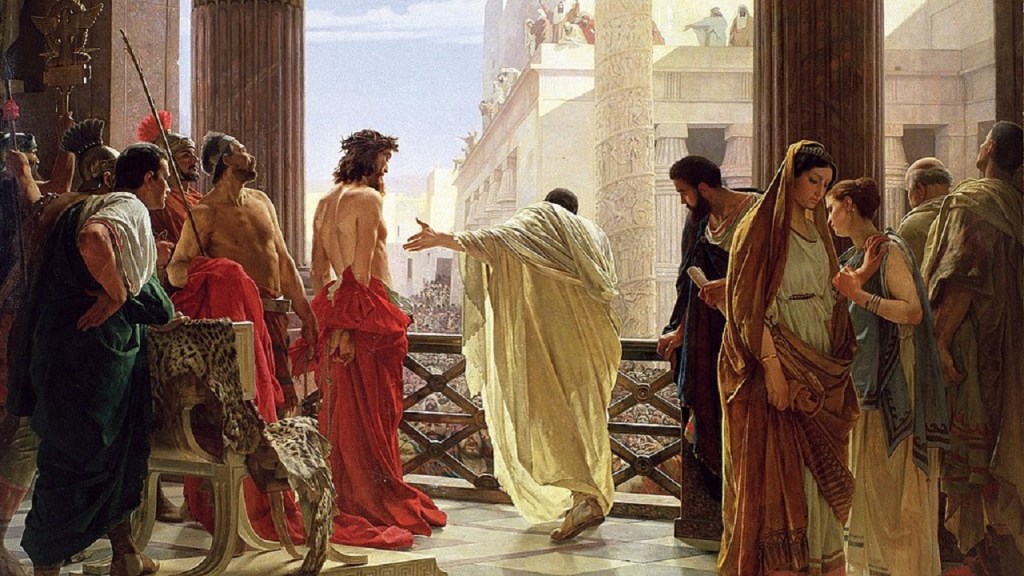
John 19:10-12 “‘Do you refuse to speak to me?’ Pilate said. ‘Don’t you realize that I have the power either to free you or to crucify you?’ ‘You would have no power over me if it were not given to you from above. Therefore the one who handed me over to you is guilty of a greater sin.’ From then on, Pilate tried to set Jesus free, but the Jews kept shouting, ‘If you let this man go, you are no friend of Caesar. Anyone who claims to be a king opposes Caesar.’”
Bullies are insecure. Their bullying isn’t evidence that they have too much confidence. It is an attempt to cover up their lack of it. Pilate’s insecurity leads him to try to bully and threaten Jesus into responding. “I am the mighty Roman governor. I hold your life in my hands. I am free to save you or destroy you. Don’t you dare disrespect me with your silence!”
Jesus brings Pilate back to reality and deflates his delusions of power. “You would have no power over me if it were not given to you from above.” Even in worldly terms, Pilate had to answer to the emperor for his actions. He was not completely free to do as he pleased. And an even greater authority was standing in front of him at this moment, the Son of God from whom Pilate ultimately received his authority in the first place. Pilate has things exactly backwards. He doesn’t hold Jesus’ life in his hands. This Jesus hold’s Pilate’s life in his hands. Jesus claims to be, and is, the Son of God, and that deflates Pilate’s delusions of power.
As if to further drive this point home to him, we see how effective Pilate’s power is when he attempts to use it. Pilate tried to set Jesus free. Why try? If he has so much power, why doesn’t he go ahead and do it? In both word and experience, the Son of God has a way of deflating our delusions of power.
You and I don’t sit in positions of political power like Pilate did. But we live in a free country and we believe that we sit more or less in control of our own lives. Or do we? The Apostle James reminds us, “Now listen, you who say, ‘Today or tomorrow we will go to this or that city, spend a year there, carry on business and make money.’ Why, you do not even know what will happen tomorrow. What is your life? You are a mist that appears for a little while and then vanishes. Instead, you ought to say, ‘If it is the Lord’s will, we will live and do this or that.’” Who of us doesn’t experience this often? We make plans, we have intentions, we pour ourselves into making something happen, but when the day comes circumstances far beyond our control change everything, and nothing goes according to plan. We aren’t in control. Jesus is.
The bare fact that Jesus is the Son of God as he claims calls for our trust just because of who he is. Once you find the true God, does it make sense to follow any other? Look again at the scene before us this evening. Here we have the Son of God, who can create the universe out of words, who can send down fire from heaven, who controls the winds and the seas, who can bring the dead back to life. But what does he look like? He is a man, and a rather humiliated man at that. He stands there soaked in his own blood. He endures the sarcasm and insults of Jewish official and Roman governor alike. His own people are calling for his death because he claims to be who he is: the Son of God.
The governor values his life less than the governor’s own political career. It is more convenient for Pilate, less of an interruption in his day, to let Jesus be killed than to see to his defense. Jesus doesn’t speak in his own defense. He does not plead for justice. He does not power his way out of the predicament. The Son of God endures it all, and then crucifixion and death.
Why? This is how much he loves you. This is how intent he is to see your sins forgiven, your soul redeemed, your heaven secured. You won’t find love like that from any of the gods in any of the holy books in any of the world’s other religions, even if they were something more than myth. Only here. Only Jesus. He claims to be the Son of God, they say, and he is. And the fact that he endures so much to save you invites our faith in his grace.
Philippians 2:5-8 “Your attitude should be the same as that of Christ Jesus: Who, being in very nature God, did not consider equality with God something to be grasped, but made himself nothing, taking the very nature of a servant, being made in human likeness. And being found in appearance as a man, he humbled himself and became obedient to death, even death on a cross.”
Without question, the most important thing Christ crucified and Christ glorified means for me is redemption. This is how God made forgiveness and heaven possible. Miss that, and we might as well spend our time on Good Friday or Easter watching a movie or catching up on our sleep.
But here Paul suggests we can learn something else from Jesus’ sacrifice and victory. His understanding of who he was and why he was here suggests something about the way we look at ourselves. It suggests something about the way we approach our own lives.
Almost all of human life revolves around self-interest. I go grocery shopping and prepare meals so that I won’t starve. I exercise so that I stay healthy. I take medicine and visit doctors and dentists for the same reason. I wear clothes so that I stay warm, and people will think I look good, and maybe so that I can even attract a mate. If I seek a mate, it is because that way I don’t have to do all the work myself, and because I have urges to satisfy. If I have a family, it is because I enjoy the affection of children, and there will be someone to look after me when I get old. I travel to satisfy my curiosity, my thirst for adventure, or to escape the stress and pressures of work. I get a job so that I can finance it all.
You might say that I have painted an incomplete, even cynical picture of human motivations. I plead guilty as charged. Our motives are more complex than that. But can you honestly say any of those statements don’t apply at all? If “self” isn’t the whole thing, isn’t it at least involved to a high degree? Take away my food, my medicine, my spouse, my family, my pleasure, my income, and why am I concerned? Be honest. I feel trampled upon. I am a victim. My rights are being denied.
Now consider Jesus. He was not another human trying to carve out a satisfying life. He was God to the core of his nature. He was just as much God as any of us is a human. He was all powerful, all knowing, present everywhere at once; unchanging, undying, unbounded by time; perfect in holiness, perfect in love. Angels beyond count served him and took care of anything he desired. He lived in the unspoiled atmosphere, unchallenged security, the uninterrupted pleasure of heaven.
He let it all go. Equality was not his concern. He didn’t hold onto it like some entitlement. He made himself nothing, literally, “emptied himself.” He didn’t stop being God. But every advantage that went with the position he set aside for a while.
There were no limits to what he would give up to serve. Jesus kept lowering himself. The Creator became one of his own creatures. Well, at least he could have become an immortal creature, like Adam and Eve were before the fall into sin. But no, he goes lower still, and becomes obedient to death. Well, maybe he could have lived to a ripe old age and peacefully died in his sleep. But no, he goes lower still, and lets himself be unjustly arrested, unjustly charged with crimes, unjustly condemned, and unjustly subjected to death by suffocation nailed to a cross.
He didn’t just suffer it. He embraced it. He went willingly all the way. He made himself nothing. He took the nature of a servant. He humbled himself. He went all the way to the cross to serve, and to save.
“Your attitude should be the same as that of Christ Jesus.” What is your “sacred cow”? You know what I mean by that? What is the thing you think you must keep? You will follow Jesus until he tries to take away “that.” “That” is non-negotiable. You are keeping “that” for yourself, no matter what he says. If he takes it away, you will leave him. Is it some pleasure, whether sinful or wholesome? Is it something about your lifestyle, your standard of living? Maybe it is a person you hold dear. It could be your reputation, your respect, your dignity.
Paul’s words convict me. I don’t want to lose my comforts. I don’t want to let go of the things I love. I’m trying to build my life here, not lose it. But Jesus himself said, “Anyone who wants to find his life will lose it.” It’s not that he has necessarily asked for or taken away the things I love…yet. But my attitude is so far away from his. I hesitate to empty myself of everything, to become nothing, a servant, a corpse. It scares me to think of what I could lose, especially when I see him this week: humiliated, beaten, dead. Jesus presents me, he confronts me, with a different way to think about my life here.
Thank God his humility and death are the forgiveness of my all-too-worldly soul. They release me from the debt I owe for being so attached to the life I want to build for myself here. They open the door to a life like he has in the life to come.
Ephesians 3:17b-19 “And I pray that you, being rooted and established in love, may have power together with all the saints to grasp how wide and long and high and deep is the love of Christ, and to know this love that surpasses knowledge–that you may be filled to the measure of all the fullness of God.”
Have you seen the Disney movie Inside Out? Riley is a little girl dealing with the stress of leaving the only home she has known and moving half way across the country. Inside hers and each person’s head there is a control panel, and the control room is occupied by basic emotions, like joy, sadness, anger, fear, and disgust. Each of them is vying to take a turn at the controls and run the person’s behavior.
What if Christ were always at the controls driving what we do? But how does that happen? How does Christ take over the heart when he moves in and get his hands on the controls? This starts, Paul says, with being rooted and established in love. It is certainly true that my own spirit of love needs to lay at the base and foundation of all Christian behavior. Without love our best works have no value. Without love, Paul reminds us in 1 Corinthians 13, all my words of witness are just a harsh, noisy gong or cymbal. All my knowledge, all my charity, all my sacrifice amount to nothing.
But there is another love, even more foundational. “This is love,” John writes in his first letter, “not that we loved God, but that he loved us and sent his Son as an atoning sacrifice for our sins.” And again, “We love because he first loved us.” This is the anchor and foundation of our whole relationship with God, and any love to follow from us.
That love alone could consume an entire lifetime trying “to grasp how wide and long and high and deep is the love of Christ.” Close your eyes for a moment, and imagine your greatest personal enemy. Someone, somewhere in your life, rises to the top of the list of those who have hurt you. They have broken your heart. They have stolen your time, dignity, love, or friendship. They have persecuted you without provocation. They seem to desire only your misery. No opportunity to inflict pain in your life passes unnoticed and untried.
Now imagine giving up everything to rescue this person and make them part of your life forever–everything! You do not withhold your home, your fortune, your time, any personal comforts, your heart, your health, and finally your life. You literally embrace hell for their sake. Now multiply that person a million times, billions and billions of times, and you begin to get the faintest glimpse of the love of Christ for us. He reconciled us to God when we were still his enemies. He died for us when we were still sinners. How many directions it must run! How far beyond our puny mind’s ability to understand or conceive it must be!
A love like this surpasses knowledge, Paul says. The cross, the atonement, the sacrifice that forgives and redeems us, is just one facet on the face of this vast jewel of God’s love that stretches far beyond the limits of our vision, though it is the foundational one. In countless ways God has loved us, and each involves a height we cannot climb, and a depth we cannot fully fathom.
We can know it, but not like a subject we master at school. The time comes when we are tired of working the simple math problems, or we have read everything there is to read about the Spanish-American War, and we want to move on to something else. But we are getting to know God’s love like we know a dear friend. We know him personally. And every day for as long as we live we will get to know him more and know him better. All the while we will realize there is still far more about him I don’t know, but I am thankful to know him and have him in my life.
Know God’s love like this, and you will “be filled to the measure of all the fullness of God.” Christ will live in you and so much more. And so Paul’s prayer for your power will never be fully answered. My prayer for you to grasp the full extent of his love will not be fully granted, at least not this side of heaven. We can never get to the end of his love and say, “There. Now I know it all.” But we can know Christ, and we can be the people on whom he pours out all this love forever and ever.
Such love remains a great mystery to explore, a great adventure that has no end. We wouldn’t want it any other way.
Ephesians 3:14-17 “For this reason I kneel before the Father, from whom his whole family in heaven and on earth derives its name. I pray that out of his glorious riches he may strengthen you with power through his Spirit in your inner being, so that Christ may dwell in your hearts through faith.”
When I was a kid I was fascinated by things like fire, and knives, and guns. Fortunately, I had good parents who kept these things off limits until I was approaching my teens. Part of the fascination may have been the fact that these were all “forbidden fruit.” We want what we can’t have. Another factor in my young obsession, I believe, has to do with power. To wield fire, to wield a knife, to wield a gun, is to possess power. They empower you to do things far beyond the limits of your mere personal strength. They may be tools for good or for destruction. But they all offer the prize of power.
Historically, humans haven’t handled power very well. We all know the saying, “Power corrupts.” As exhibit A, we have the two-ring circus called Washington D.C. Like my first matches, knife, or gun, political power can be a tool for good or destruction. But we know the temptation to pervert and twist power to serve self at the expense of others is strong.
Power is a central concern of Paul’s prayer in this letter to the Ephesians, a prayer one commentator has called “the greatest of all Paul’s prayers.” Paul wants these people to have it. It is a unique power in that it is above the possibility of misuse. That is why I join Paul and every pastor in praying for your power. Cultural forces made living as a Christian hard for the Christians in Ephesus. There are always challenges to maintaining our faith and living a life consistent with it. One of the challenges for the Ephesians came from the dominant religion of their city. Ephesus was the unofficial capitol for worship of the goddess Diana. You may remember that while the Apostle Paul was doing mission work in the city, the silversmiths, who made idols of the goddess, started a riot to protest this new religion. If you were a Christian in Ephesus, chances are your neighbors were Diana worshipers. They thought you were weird, maybe a little dangerous, for following this foreign God, Jesus.
Like most of the churches Paul started, this congregation was also a mix of former Jews and former Gentiles. Historically, these two groups had been separated by culture, race, and religion. They didn’t like each other very much. Now their shared faith in Jesus formed them into a single family. This wasn’t easy to make work. At the same time their former faiths and former ways of life pulled at them, tempting them to come back.
How do you deal with the forces pulling Christians away from Christ, tempting them to adopt the beliefs and values of the culture around them? That is no insignificant force! “Peer pressure” doesn’t end in high school. If it were just a matter of people having polite conversations about different ways of looking at things, it might not seem so serious. But the non-Christian world is not so kind to the Christian faith and life. We face ridicule for believing in creation. We are considered narrow-minded for believing Jesus is the only Savior. We are evil for limiting sex to a married man and woman. “Give it up,” they say. “Christianity needs to evolve. Let your outdated thinking go, and the insults and disrespect will all go away.”
Paul understood that his people needed strength, they needed power, to keep their little church in Ephesus going. He could have simply written them a list of instructions about how to live. In the coming chapters he was going to do just that. He painted a picture of what Christian faith and life look like.
But these people needed more than a task list to survive. Notice how his language is all about what is going on inside of them: “the Spirit…your inner being…your hearts…through faith.” Paul is saying, “I am praying for God to change you, to make you a different person. I am asking God to transform how you think, what you believe, the way you feel, and what you want, all with a certainty that won’t let it go.”
The secret to escaping the penalty our sins deserve starts outside of us with Jesus’ sacrifice at the cross. The secret to having and holding on to his forgiving work begins with his Spirit working inside of us. Then Christ can live in us by faith, and give us the power to resist the forces pulling us away from him.
Luke 11:17-20 “‘Any kingdom divided against itself will be ruined, and a house divided against itself will fall. If Satan is divided against himself, how can his kingdom stand? I say this because you claim that I drive out demons by Beelzebub. Now if I drive out demons by Beelzebub, by whom do your followers drive them out? So then, they will be your judges. But if I drive out demons by the finger of God, then the kingdom of God has come to you.”
A strategy used in everything from military campaigns to sporting events involves making a fake retreat in order to draw the enemy into a trap. You make it look like you are weak, you are losing ground, until the other side has spent themselves. Then you press the attack with greater strength than you had appeared to have at the beginning.
If Jesus was just an agent of the devil to make it look as though the demons were weak and losing before they turned around and pressed the attack, he sure didn’t understand the strategy well. He just kept beating up on his own team, one after the other. There was no turning point when the demons came out swinging. Instead, they were going down in flames.
You don’t win the war or win the game by actually beating up on your own side. That is Jesus’ point. Turn your guns on your own soldiers, and you will lose the battle every time. Jesus’ unbroken string of victories in his showdowns with the demons was steadily eroding the devil’s power. And it speaks volumes about Jesus.
“But if I drive out demons by the finger of God, then the kingdom of God has come to you.” If Jesus doesn’t work for the devil, then he works for God. And note his awesome power. Not a single demon could resist him. It is worth noting that Jesus calls the power by which he works the “finger of God,” not the “fist of God,” or the “arm of God,” but his finger. With the possible exception of some of the toes, the fingers are thinnest and weakest parts of the body. Literally, of course, God doesn’t use a human body in his spiritual battles. But at his weakest, with a single breath, with just a few words, he draws out the demons and sets people free to live as citizens of his kingdom. That’s the side that Jesus worked for, and still does. The demons’ inability to mount a serious challenge proves the source of Jesus’ power is the power of God himself.
The only greater demonstration of his power would come if he could take something far weaker, like his own death, and use that to break the devil’s hold on people, and set them free from the chains of death and hell. Imagine if Jesus’ death could rob the devil of the sins he needs to accuse us, and the guilt that would condemn us. Imagine if the simple preaching of such a thing would win our hearts to God’s side and fill them with faith and love. If Jesus’ death could do all that, there is nothing that the devil and all his angels could do to resist.
That’s why we live secure in the safety of his grace and love.
Luke 11:14-16 “Jesus was driving out a demon that was mute. When the demon left, the man who had been mute spoke, and the crowd was amazed. But some of them said, ‘By Beelzebub, the prince of demons, he is driving out demons.’ Others tested him by asking for a sign from heaven.”
When Jesus helps people, it produces some strange reactions. Some of those who saw him deliver a man from demon possession decided that Jesus wasn’t cute or entertaining. He wasn’t even good. He was evil. He posed a problem for society. This miracle, all his miracles, were only possible because he was in league with the devil. They had to stop him before he deceived the nation. You know that they didn’t stop until they had nailed him to the cross.
I leave it to the historians to debate whether the U.S.A. is or ever was a Christian nation. Historically, at least, Christianity had a major influence on this country, and Jesus was respected, if not embraced. In my lifetime approaching 60 years, many people have been critical of Christians, and critical of the church. The truth is, we have given them plenty of reason to be critical. Financial scandals and moral scandals have involved clergy of all kinds of Christian flavors. Christians are often known more for what they are against than how much they serve and love. At least Jesus himself has seemed to enjoy the respect of most. Rarely are people critical of him, whether or not they particularly choose to follow him.
Yet that is becoming less and less the case. One blogger says this about him: “Jesus a nice guy? Not in my book. Nor in any other person’s who is capable of compassion and rationality.” The Freedom from Religion Foundation does not consider Jesus one of the good guys of history. The big names in the so-called Sexual Revolution don’t generally like him. I could go on. This isn’t so much your problem and my problem, except to realize that a growing number of people we meet will not even agree that Jesus was good, much less the Savior of the world. They would rather see his movement die than let us make it grow.
The group criticizing Jesus’ exorcism were still skeptics, even after the miracle. “Others tested him by asking for a sign from heaven.” Do you find their request mind-boggling in its audacity? What kind of sign could Jesus give to prove himself? Let’s see. I don’t know, maybe throw a demon out of a man? If that wasn’t enough, what miracle would be?
That’s the problem with people who ask for that kind of “proof.” No proof will ever be enough. No miracle will be so clearly divine that the skeptic won’t try to explain it away. As Jesus said to the rich man who ignored poor Lazarus at his gate and wound up in hell, “If they (your brothers) do not listen to Moses and the Prophets, they will not be convinced even if someone rises from the dead.” The skeptic often fancies himself a man with an open mind. “Free thinkers” they call themselves. The truth is, no one’s mind is closed and sealed more tightly.
Christian apologist Frank Turek tried to answer a man who said he wanted proof. “If I could prove that Jesus rose from the dead…” Dr. Turek kept beginning. And though he always began with “if,” the man wouldn’t even give him that much. He kept cutting Dr. Turek off and saying that people don’t rise from the dead. So much for the open mind. No “proof” is great enough for those who don’t want to believe.
Jesus doesn’t let the opposition stop him. He knows that many, often the majority, don’t want what he is offering. He keeps on with his mission of setting people free from sin and Satan anyway. We who know his freedom may be few, but Jesus didn’t come to be the most popular. He came to save any he could. We are enough for him, no matter how much grief the haters and skeptics give him.





 Bits of Bread