Children of God

1 John 3:2 “Dear friends, now we are the children of God, and what we will be has not yet been made known.”

Now we are the children of God. Jesus’ death and resurrection promise even better things to come. But just this, “children of God,” is not so bad when you consider what we were. You know Paul’s words from Romans 5: “When we were God’s enemies we were reconciled to him through the death of his Son…” Really? Enemies? That seems a bit strong. Enemies? Yes! There is no other way to describe people who have taken their own Maker’s instructions, thrown them aside, and like a defiantly told him, “It’s my life. I’m going to do what I want. I don’t care what you say about sharing. I don’t care what you say about how I use my body. I don’t care if you don’t like my potty-mouth.” Active little rebels–we were God’s enemies!

Another of Paul’s picture from Ephesians isn’t any better: “As for you, you were dead in your transgressions and sins…” Dead! A spiritual corpse! From God’s point of view, in our sin, without real love for anyone but ourselves, we were lifeless, hopeless, useless–done!

And that is what we were. It is hard to say which is worse, enemies or corpses, but we don’t have to make a choice. The Bible calls us both.

Jesus’ resurrection marks the change of all of that. On Good Friday Jesus gave up his life to remove our guilt and forgive all our sins. Look at the end of the quote from Romans 5, “When we were God’s enemies we were reconciled to him through the death of his Son.” We are reconciled, not enemies.

By his resurrection from the dead Jesus conquered our death. As much as that means new life for our bodies, it also brings new life to our souls. “When you were dead in your sins and in the uncircumcision of your sinful nature, God made you alive with Christ,” Paul wrote the Colossians. Now we have faith, we have hope, we have life.

It’s harder to say which is better, Good Friday or Easter, but Jesus gives us both. His salvation doesn’t leave us hard choices. It gives it all together as one beautiful gift.

That is why John can say, “Dear friends, now we are the children of God.” Now we are children! Do you know what that means? Children are not the same thing as employees–cheap labor for God because they are “part of the family.” His main interest is not what we can do for him.

Nor are children the adult sons and daughters who stand independently and alongside God as his equals. We are in no position to advise our Lord about how he runs the universe. One Christian writer compares our relationship with him to the relationship between a parent with an IQ like Einstein, and a little child who is only two. To make a relationship possible, the father will accommodate himself to the toddler he loves. The child will know her daddy, but she won’t completely comprehend him. What the father reveals to the daughter will be true, so far as it goes. But there will always be more.

You see, we are the children of God, and that means that we are dear, we are loved. God treasures us as his own.

As God’s children, we are cared for. “As a Father has compassion on his children, so the Lord has compassion on those who fear him” (Psalm 103:13). Do you have pictures of this kind of thing from your own childhood? I picture my wife keeping vigil at the side of one son when he was hospitalized with RSV as a 6 month old, or at another son’s side when he had cancer. Our heavenly Father keeps his vigil over us, always ready to take care of our every need.

We are protected. Have you ever watched protective parents at a child’s soccer game? If another player is too pushy with their budding star, or the referee isn’t making good calls, woe to the person who dares to threaten their little athlete. The mama bear or papa bear inside comes out. You don’t want to be on the other end of that fight.

If something threatens the souls of our heavenly Father’s children, woe to the demon or tempter who dares to do so. Be assured that he will protect them. You don’t want to be on the wrong end of that fight!

As God’s children, we are simply enjoyed by him. He is pleased to laugh and play with his little ones. A beautiful picture in the last chapter of Isaiah depicts God enjoying his children like a parent bouncing a child on his knees. I can’t help but think of the Christian character in the movie “Chariots of Fire,” Scottish runner Eric Liddell. He tells his sister that when he runs he “feels God’s pleasure.” God’s children are people in whom he takes delight.

“Now we are the children of God.” Our world has many problems. Our lives have many crosses. But “children of God” isn’t a bad position to be in. Jesus’ death and resurrection make it so.
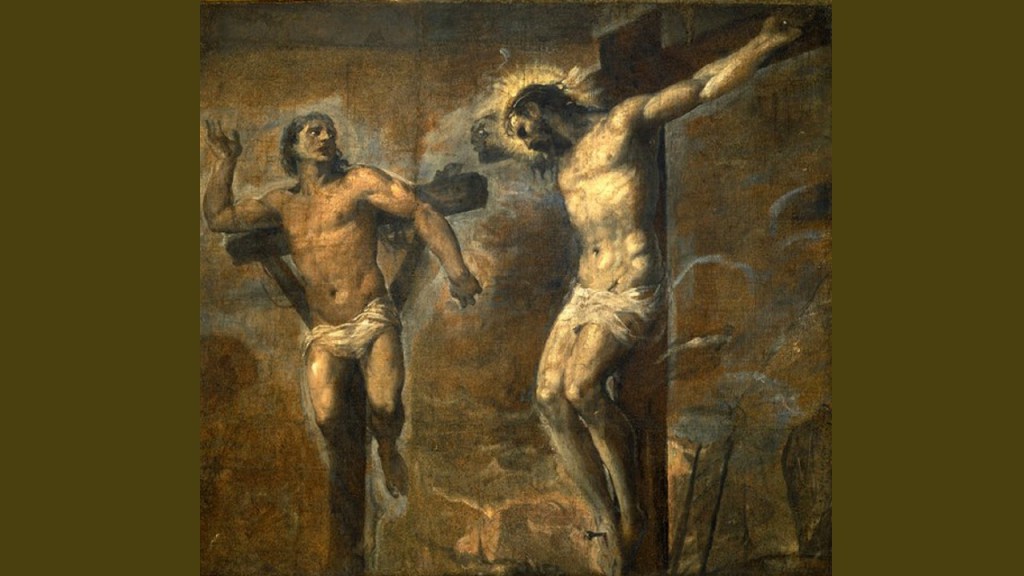
A Different Way to Look at a Cross

Luke 23:39-43 “One of the criminals who hung there hurled insults at him: ‘Aren’t you the Christ? Save yourself and us!’ But the other criminal rebuked him. ‘Don’t you fear God,’ he said, ‘since you are under the same sentence? We are punished justly, for we are getting what our deeds deserve. But his man has done nothing wrong.’ Then he said, ‘Jesus, remember me when you come into your kingdom.’ Jesus answered him, ‘I tell you the truth, today you will be with me in paradise.’”

When Jesus was crucified, there weren’t different ways of looking at a crucifixion. It was only an ugly, brutal, cruel method of executing a criminal. There was no positive spin, no alternative view to offer. Jesus has changed that. His words to the criminal crucified next to him make it a source of promise. Jesus promises something we wouldn’t expect to find there: heavenly comfort.

Already this thief on the cross was with Jesus, hanging just a few feet away. Already he was learning to seek Jesus’ help while bearing his cross, or perhaps we should say, while his cross was bearing him. “Jesus, remember me when you come into your kingdom” is a statement of faith. It says, “I know who you are. I know where you are going. I trust you to help me.” Maybe he doesn’t make our pain go away immediately. He does not remove all the crosses from our lives now. But he is still with us to hear our prayers, forgive our sins, and stand alongside us as we trust in him for our help.

And Jesus rewards that faith with the promise, “Today you will be with me in Paradise.” Our comfort is that Jesus’ presence with us does not end in death. Death is more like the beginning, the beginning of a visible, tangible experience of Jesus’ presence. Death is the beginning of our life in Paradise, the heavenly garden of God.

So many people I have known want to escape the man-made jungles of concrete and steel, the man-made worlds where people are stacked on top of each other and there is hardly room to breathe. We call them cities. Weary citizens want to retire and escape to the country, the forests, the mountains, the lakes, the green and unspoiled goodness of God’s creation.

But sin will follow us wherever we go. So will its effects. No part of this world is unspoiled. No part of ourselves is unspoiled. From the cross, of all places, Jesus can promise us real escape with him in Paradise.

 Are there different ways to look at a cross? Some still remember that it was an instrument of execution. Some wear it or display it as little more than a piece of decoration. Jesus uses it as a picture of lives that will suffer for him in this world. And from a cross, because of his cross, Jesus promises us sins forgiven and the comfort of a Paradise with him that never ends.

Know Yourself. Know Him.

Mark 14:27-31 “‘You will all fall away,’ Jesus told them, ‘for it is written: I will strike the shepherd, and the sheep will be scattered. But after I have risen, I will go ahead of you.’ Peter declared, ‘Even if all fall away, I will not.’ ‘I tell you the truth,’ Jesus answered, ‘today–yes, tonight–before the rooster crows twice you yourself will disown me three times.’ But Peter insisted emphatically, ‘Even if I have to die with you, I will never disown you.’ And all the others said the same.”

The ancient Greeks had a saying, “Know yourself.” It was carved on the entryway to the temple at Delphi. It was a theme the philosopher Socrates picked up from time to time. Before you can dig too deeply into other subjects, you need to understand yourself. And if you are really going to understand yourself, you need to be honest about the good… and the bad. And that’s where “know yourself” becomes really hard.

When they heard Jesus’ announcement, it was good that Peter and the rest didn’t just shrug their shoulders and say, “Oh well. If we fall away, we fall away.” Jesus should mean too much to us to be content with our sin.

But where does Peter put his confidence? What is the point of comparing himself to all the others? On whom is he depending to stay faithful? “I…I…I…” Peter’s confidence is all in himself. What makes it worse, he is contradicting his Savior. As he had done other time’s in Jesus’ ministry, he is trying to correct his Lord. That never turns out well.

It is never our job to be Jesus’ teachers. No matter how much we learn, no matter how “spiritual” we might think we have become, we are always, only, Jesus’ students. He has much to say that contradicts conventional wisdom. He has much to say that contradicts popular opinion. He has much to say that contradicts the best and most respected minds of our time. Yet, we are only his students. Our only job is to learn from him.

But when Jesus says things that point out our sin, when his word confronts our pride and exposes our weakness, then we want to rationalize what we do. We want to deny our weakness and sin. We don’t want to know ourselves. Then we put our own souls in danger. “If you think you are standing firm, be careful that you don’t fall.”

The strength to maintain our faith doesn’t grow from guilt. It grows from Jesus’ promises. Did you hear his promise hidden in his warning? “‘You will all fall away,’ Jesus told them, ‘for it is written: I will strike the shepherd, and the sheep will be scattered. But after I have risen, I will go ahead of you.’”

The shepherd in this quote from the prophet Zechariah is Jesus himself. Who is the “I”? Not the prophet. God the Father is the one who strikes the shepherd. Everything the disciples would see over the next 24 hours–his mistreatment, whipping, crucifixion, death, and burial–was under God’s own control. God used the anger of Jesus’ enemies to work something good. This was the sacrifice of the Messiah prophesied since the Garden of Eden.

You hear the promise, don’t you? The death of God’s Son isn’t meant to shake our faith. It’s the supreme gift of love that inspires our faith. What looks like the worst thing that could ever happen, the death of God on a cross, turns out to give us the best thing we could ever have: rescue from our sin and life that never ends. It is every reason to own Jesus in trust and love no matter what challenges may come along.

The other promise was clear and undisguised. “But after I have risen, I will go ahead of you into Galilee.” Jesus wasn’t going to stay dead. Death was not his end. Listen all the way to the end of what he is saying, and he is predicting not his defeat, but his victory.

We 21st Century disciples don’t honor and remember a dead hero. We serve and follow a living Lord. No matter how dark things look, no matter how much danger we see, no matter who opposes us, the one who rose from death is on our side. He transforms our failures and crosses into blessings. There is never anything to be gained by disowning or denying him.

It’s helpful to know yourself, but that’s hard work. It is even more important to know Jesus and all he has done to save us. More important still, he knows each of us, and claims us as his very own.

Watch and Pray

Matthew 26:40-41 “Then he returned to his disciples and found them sleeping. ‘Could you men not keep watch with me for one hour?’ he asked Peter. ‘Watch and pray so that you will not fall into temptation. The spirit is willing, but the flesh is weak.’ He went away a second time and prayed, ‘My Father, if it is not possible for this cup to be taken away unless I drink it, may your will be done.’”

Was it so much to ask, to sacrifice just a little sleep for the love of the Savior who was about to suffer what no other person has ever suffered, who was about to bring all history to its climax and save a fallen world? Jesus had been teaching them for three years. He had spoken to them for several hours this very night about the things that were about to happen.

Did they still have no sense of the importance of this night or of the sacrifice it would require of him? Did they have no sense of their friend and Master’s burden? Keep watch for Jesus? They needed to watch and pray for themselves and their own weakness. Their loveless neglect only made Jesus’ heavy load heavier, his sorrow deeper, his prayer more difficult.

What is our great sin against Jesus, his suffering, and his sacrifice? Is it not our own failure to appreciate the magnitude of what he did, our own neglect of the centerpiece of his saving love? We don’t fall asleep, at least not usually. It’s worse. Jesus’ suffering and death bores us. We get all excited about a bunch of grown men chasing a ball around a field or across a court. Our heart rate soars, we scream, we cheer. We will watch for hours and hours. Our attention is riveted to the news when people are senselessly or tragically killed in the latest crime, war, or natural catastrophe. The news anchors can give the same five-minutes worth of details hour after hour, and yet it’s hard to pull away from the TV. Perversions of God’s good gifts of sex and beauty are like magnets that would pull our eyes right out of their sockets if they weren’t attached.

But when the eternal God makes himself a mortal man, and he stands in our place, and he lets himself be abused by the very people he came to save, and he submits himself to outrageous indignity and injustice, and for me he lets himself be nailed to a cross, and for me the blood pours from his body, and for me he endures wages of my sin, and for me he breathes his last, we yawn. It’s an old story. It’s a familiar story. “Tell me something new, something upbeat with a little more action.” No, watch and pray. Don’t let the temptation to find this all common and ordinary lead us to miss the greatest gift and deepest love we have ever been given.

The urgency and obedience of Jesus’ own prayer stands in stark contrast. “He went away a second time and prayed, ‘My Father, if it is not possible for this cup to be taken away unless I drink it, may your will be done.’” “May your will be done.” That makes Jesus’ prayer a true prayer, prayed in faith–not an attempt to push God off his throne, not an attempt to change the changeless God, not an attempt to dictate terms to the Almighty, but a prayer. True prayer trusts God’s will, and accepts that God’s will is better than my own even though it may mean pain, discomfort, disappointment and apparent defeat.

There are worse things than suffering. God often does his best work through suffering, maybe even usually does his best work through suffering. “We also rejoice in our sufferings, because we know that suffering produces perseverance; perseverance, character; and character, hope,” Paul wrote the Romans. Jesus’ suffering was the salvation of the world. “May your will be done.”

Jesus was a man of prayer. He prayed to be spared the agony of the cross, but mostly he prayed his Father’s will. And so he came to the cross. Three of his seven statements from that cross were prayers. And now he lives to pray for us, prayers that are heard, because he carried and buried our sin’s heavy load.

One Foundation

1 Corinthians 3:11 “For no one can lay any foundation other than the one already laid, which is Jesus Christ.”

Nothing is more important than the foundation in a building project. You see commercials for foundation repair. Sometimes the damage is so severe, there is no saving the building. Structure and foundation must all be removed and replaced. You’re familiar with the leaning tower of Pisa in Italy? Big foundation problems.

So Paul warns us not to build on false foundations. Some Christians try to build on fervent, passionate feelings towards Jesus. Everything is based how humans respond. Now don’t get me wrong. I hope that Jesus inspires powerful emotions in you. I hope that your heart is broken by the things that break God’s heart. I want you to know joy in God’s grace to you. But can you build the faith of people or a church on something so uncertain and shifting as emotions? Isn’t that going to turn out like a bad marriage in which two people were married because of their infatuation, without ever really getting to know each other?

Others try to build on moral lives. They fill their preaching and teaching, their reading and learning, with practical instruction. The applications extend to the finest points of Christian living. Again, don’t misunderstand me. I want you to practice good morals. As a pastor I may even get on someone’s case if they don’t! But without a healthy dose of Jesus’ love, all this morality teaching will eventually lead away from God to self-righteousness or despair.

Some churches try to build on such a spectacular presentation of music and pictures, lights and drama, that they could rival or even surpass the best theaters. One that I know even advertises itself as the “fun church.” I am not suggesting that there is any virtue in making church boring. But entertainment alone cannot feed the soul. It only distracts the mind and dulls the soul.

If we build with God, there is only one foundation on which we can build, and that is Jesus himself. He is the same yesterday, today, and forever. He is not going to shift on us. He will not change his mind about his love for us. I know that he loves me and forgives me whether I feel it or not.

And he does not base my relationship with him on my performance. He bases it upon his performance in his perfect life of love and his innocent death for our sins on the cross. He established that relationship by calling me to faith at my baptism. He maintains that relationship by sending me love letter after love letter in his word, and by inviting me to sit down with him and share an intimate meal of forgiveness with him in his Supper. That not only supports my faith. It supports a life that loves to serve him, that wants to serve him, in all I do.

Is it hard to find Jesus’ life of love and sacrifice for us interesting, compelling, captivating? Tell me the story again and again! Here is where I want to build my faith and life. Here is the place that I can confidently set the faith and future of my friends and neighbors. When we build with God, Jesus himself is the only foundation on which we build.

Free Indeed!

John 8:34-36 “Jesus replied, ‘I tell you the truth, everyone who sins is a slave to sin. Now a slave has no permanent place in the family, but a son belongs to it forever. So if the Son sets you free, you will be free indeed.”

There are few things worse than living in a state of denial. Not only do you have the harm and damage caused by some problem in your life. You have the additional obstacle of not being able to see it. You can’t start to fix it until you recognize it.

For example, the “bump” you feel keeps getting bigger and more painful. Maybe there’s even more than one now. But cancer isn’t an option, and you won’t see the doctor.

You insist that you only drink to relax a little. It’s not really that much, and you can stop any time you like. But you can’t imagine a day, much less a life, without it, and the empty bottles are overflowing your dumpster on trash pick-up day.

Do you sin? Every hand has to go up. If we think we are free, then why don’t we just stop? Sometimes people may muster all their strength and courage and manage to put a stop to one sin in their life. They will get past their addictions, clean up their language, stop sleeping around, or put a stop to some other vice. Then pride grows in place of their vice–I mean the ugly arrogance that is full of oneself. Love may still be lacking by and large. Sin runs deeper than the bad behaviors we see on the surface.

Some people will even redefine sin in order to avoid Jesus’ diagnosis. A visitor to a Bible insisted that she had stopped sinning years ago. A little exploration of the subject made clear that she was not willing to consider any bad thoughts or attitudes as sins. Anything we might classify sexual sin was “just some people’s interpretation.” It’s hard to lose the game when you get to change the rules as you go along.

If we are honest, we can’t duck Jesus’ diagnosis: we are slaves to sin by nature. Don’t we find ourselves in the same struggle as the Apostle Paul, “The good that I want to do, I don’t do. The evil that I don’t want to do, that is what I keep on doing.” People speak of “free will,” but it would be better to say we are “self-willed.” Our “self” has been twisted and bent by sin. We are all inclined in a certain direction. That’s not real freedom anymore.

Here’s the problem with our slavery: “Now a slave has no permanent place in the family.” What is Jesus’ saying? What does it mean to lose your place in the family of God? It’s the same as losing your place in heaven. It’s Jesus’ gentle way of saying, “Your sin has earned you a place in hell.”

Thankfully, there is more to the story. Jesus promises: “So if the Son sets you free, you will be free indeed.” Earlier, Jesus promised this freedom through the truth he teaches. Sometimes people say “The truth will set you free” as an encouragement not to lie. Everyone knows how one lie has to be covered by another. Soon you can’t remember exactly how your own story goes. Each new lie adds a bar to the cage you have built around yourself. But the truth, however painful, will set you free. This observation may be true, but that’s not what Jesus is means in this case.

The truth Jesus has in mind teaches about where we stand with God. It starts with the truth that we sin, and we are slaves to sin. But it is so much more than that.

Jesus teaches us the truth about God’s grace. Even more, “…if the Son sets you free, you will be free indeed.” Jesus makes grace possible. He made our freedom happen. Mere months after he spoke these words, he was going to return to Jerusalem. The city would welcome as a King, but in less than a week they condemned him as a criminal. They crucified an innocent man whose only crime was that he loved them enough to tell them the truth.

On the cross, he loved us still more. He carried our crimes with him and the sins and crimes of the whole world. He let his heavenly Father forsake him, as though he was the one who needed to be banished from the family for his sin. He let death take him there as though he was the world’s one and only sinner. By his suffering and death, he satisfied all the debt we owed because of our sin.

That means we are no longer spiritual prisoners sitting on the devil’s death row. We are restored sons in God’s everlasting family. Here is Jesus’ truth: the Son has set us free.

Treated Like a Christian

Luke 6:22-23 “Blessed are you when men hate you, when they exclude you and insult you and reject your name as evil, because of the Son of Man. Rejoice in that day and leap for joy, because great is your reward in heaven. For that is how their fathers treated the prophets.”

If you had lived in Jesus’ day, would you have sided with the conservatives or the liberals?

On the conservative side were the Pharisees. They were the ones concerned about upholding the whole Bible. They were concerned about promoting good morals. They worked hard at teaching people how to live a godly lifestyle.

On the liberal side were the Sadducees. They were the ones who were progressive in their thinking. They were in tune with the culture. They had a vision for a better society through creative thinking and an acceptance of people and ideas from other cultures.

Does it surprise us that Jesus didn’t become cozy with either one? To be sure, Jesus once said of the Pharisees, “The teachers of the Law and the Pharisees sit in Moses’ seat. So you must obey them and do everything tell you.” But in the next breath he continues, “But do not do what they do, for they do not practice what they preach. They tie up heavy loads and put them on men’s shoulders, but they themselves are not willing to lift a finger to move them” (Matthew 23:2-4). The Pharisees may have gotten the moral issues right much of the time, but theirs was a burdensome and graceless religion. It lacked the power to help people do the right thing. It was devoid of love—either God’s love for us, or true love for one another.

Jesus insisted on sticking with the truth, even if that meant that he was taking a very lonely position. It made him unpopular with the major movements of his day. Eventually, it led to his crucifixion.

Those who follow Jesus still find that sticking to the truth can put one in a very lonely position. More and more, confessing what the Bible has to say brings the disapproval of those around us.

When Bonnie Witherall was murdered in Lebanon for her missionary work fifteen years ago, even fellow Christians criticized her for evangelizing. One Christian leader compared her to a terrorist, complaining, “She was in the habit of gathering the Muslim children of the quarter and preaching Christianity to them while dispensing food and toys and social assistance” (Christianity Today, Feb. 2003).

Is telling people that Jesus is the Way to heaven a form of terrorism? The churchman quoted wasn’t alone in his evaluation. Similarly, the book titled When Religion Becomes Evil lists five signs that religion has become corrupt. Among the five signs: “absolute truth claims.” Apparently the one who said, “I am the Way, the Truth, and the Life,” and “If you hold to my teaching you are really my disciples. Then you will know the truth…” was starting a corrupt religion.

We should not be surprised if faithfulness to our Savior’s words meets with the same kind of disapproval. Jesus warned that those who disturb the peace by defending the truth of the gospel would be unpopular. But then, he promises that those who do so enjoy some fine company. “That is how their fathers treated the prophets.” That’s how they treated Jesus, too.

Living Light

Ephesians 5:8 “For you were once darkness, but now you are light in the Lord. Live as children of light.”

Every proud parent has high expectations for his offspring. In the Disney movie The Lion King there is that scene in which the hero Simba is confronted by the ghost of his father Mufasa. Mufasa tells him that he is disappointed in him, because “You are more than what you have become.” The point is: Simba is living his life as a goof-off instead of assuming the responsibilities he should be performing as the rightful king.

Perhaps your parents played on a sense of family-pride to get you to live up to their expectations. “A Jones doesn’t give up when things don’t go your way.” Or maybe you’ve seen parents try to blame the other side of the family tree when Junior started showing character flaws.

Our Lord also has high expectations of us when we become his children and members of his family by faith. But he doesn’t rely on New Age psychology, or guilt trips, or family pride to encourage us to reach toward his goals. He takes us back to his grace. He helps us understand who we are, what he has made us.

At one time you were darkness. For the Christians in the city of Ephesus, people who grew up Gentiles worshiping the ancient Greek and Roman gods, this had been their condition for the majority of their lives. They grew up worshiping the wrong god. They grew up learning to excuse or accept behaviors that were sinful and destructive. They grew up in fear, never certain that their gods cared for them now, or where they were going when they died.

For some of us, our time in darkness may have been relatively short. But all of us were once darkness, if only from birth to Baptism. Even now, the darkness lurks within. And so today, things that should be condemned and fill people with disgust or horror are insisted upon as rights. Filthy talk is called a sense of humor. Greed is called healthy ambition or a good work ethic. Self-righteous, self-promoting busybodies are described as pious or devout. God condemns it all as darkness.

And that is what we were. But now, Paul says, you are light in the Lord. Now the light of God’s love, and the light of God’s truth, is shining on us and shining in us. The light of God’s word has shown us that God is not some moody, vicious monster we must constantly pay off to make him like us. He is the God who freely gives. He freely gave his own Son in payment for our sins. He freely gives forgiveness no matter how great the sin, no matter how poor the sinner. He freely makes us his own children. He freely invites us to receive and enjoy all the blessings of our home with him. The light of such love and truth change the way everything looks to us. That light pierces into our own hearts, making them the home of our Savior and his light by faith.

That truth has highest importance for eternity. It means that after we die, we will rise again to live with God forever. We will ever bask in the beautiful, warming, joy-giving light of his love in heaven.

But it also means something for us right now, which is more to Paul’s point in these verses. You are light in the Lord. That light of God’s love and truth, light which showed you how all your sins were taken away and why God considers you holy and precious, that light also lives in you. You have something new that you didn’t have before. You have the power of God’s love in Christ living in you, a new source of life and strength, so that you can live as children of the light, starting today.

The Lord Still Goes Before You

Deuteronomy 1:29-31 “Then I said to you, “Do not be terrified; do not be afraid of them. The Lord your God, who is going before you, will fight for you, as he did for you in Egypt, before your very eyes, and in the desert. There you saw how the Lord your God carried you, as a father carries his son, all the way you went until you reached this place.”

Moses spoke these words to Israel when God led them to the Promised Land the first time. They were afraid to go in and take it because the people who lived there looked like giants to them. So long as we are fixated on the giants in our way we will be afraid to move forward. But following our God is not a reason to be afraid. It is a reason to trust his promises.

God’s first promise in these words is one we may not recognize at first. It looks more like a command. “Do not be terrified; do not be afraid…” Those words are meant to do more than confront us. They are meant to reassure us. They say more than “Stop that!” They say, “You don’t have to be afraid. The Lord is on your side. He is going to take care of you. He has good things in mind for you.” He goes on to explain what those good things are.

“The Lord your God, who is going before you, will fight for you, as he did in Egypt…” Did Israel think that they had gotten out of Egypt because of their own ingenuity? Was it the overwhelming force of Israel’s armies that persuaded the Pharaoh to let them go? Wasn’t Israel rather practically passive while the Lord sent the Ten Plagues, divided the waters of the Red Sea, and then drowned the armies of Egypt?

When in history have God’s People ever succeeded because of their own great strength? God’s power gave Abraham’s little company of servants victory over the combined armies of five kings. Gideon’s band of 300 achieved victory over 100,000 Midianites only because of God’s help. Only the Lord’s intervention made it possible for Hezekiah’s little group of defenders to break Assyria’s siege of Jerusalem.

When the Lord wanted to give us victory over sin, death, and Satan, he didn’t send us into battle by ourselves and tell us, “Go get ‘em.” He didn’t involve us in the battle at all. He made himself as weak as possible. He burdened himself with full responsibility for our guilt. He died in our place. Yet by his death he crushed Satan, completely obliterated all record of our sin, and then shattered death by rising to life once again.

It doesn’t work differently for us today just because a couple thousand years have passed. We can follow him confidently because we can still trust his promises to fight for us today. Jesus promised that the gates of hell will not prevail against his church. Church history is a demonstration of this truth. Our personal histories are as well.  

The future will bear this out, too. His gospel, not our efforts, will be the power of salvation for everyone who believes. His Word, not our cleverness, will accomplish what he desires and achieve the purpose for which he sent it. So long as we continue to take the Sword of the Spirit, which is the Word of God, out of its sheath and let it speak; so long as we will not be ashamed of his Word, but preach and teach the whole counsel of God and let it do its work, our God will not be behind us cheering us on. He will go before us. He will fight for us. He will lead us as we carry his salvation to our world. We have every reason to trust his promises.