Worth the Crosses

Matthew 10:38 “…anyone who does not take his cross and follow me is not worthy of me.”

Following Jesus means carrying a cross. This is unavoidable for the Christian. In order to follow Jesus, we give up certain things, and that always pinches a little, sometimes a lot. We pass up some opportunities for pleasures. Sometimes they are sinful. Sometimes they simply fall down the Christian’s priority list and we don’t get to them. We may give up business advantages at times because we are no longer looking out only for ourselves, but for what serves my neighbor.

Depending on where they live, Christians may not get to be popular. Others may not accept them. Those who are open about their faith on university campuses may find themselves accused of bigotry or ignorance. Those who live their faith at work may jeopardize their careers. A friend of mine was criticized, and eventually let go from his job, because he “wasn’t making an effort to be a part of the team.” His employer’s issue with him? He didn’t join his coworkers in visiting strip clubs each night after work.  

One Christian blogger shared some of the hate mail he received in a blog post. While accusing this blogger of being hateful, the emails expressed a desire for the man to be dead, hurt, or sexually brutalized. Some wished for him to burn in Hell for all eternity. A few threatened to kill him for his ideology.

Jesus is worth it. When he says that those who refuse the cross are “not worthy of me,” he is not saying that we “earn” something by our suffering. God’s grace is still free. But you can’t “have” Jesus, you can’t believe in him and follow him, without there being consequences. If I gave you some free food, you can’t eat the food without also ingesting the calories that come along with it (though we may wish that were possible). The food was free, but the calories come along as a consequence. The only way to avoid the calories is not to eat the food.

If I had a swimming pool, I could let you swim in it for free, but you can’t swim in it without getting wet. The swimming is free, but you get wet as a consequence. The only way to avoid getting wet is not to swim.

If two countries were at war, you may be free to pick a side. But you can’t pick sides without making the other country your enemy. You get the picture.

It is possible to avoid the cross that comes with following Jesus. But you have to give him up in order to do it. It’s a package deal.

Jesus promises he is worth it. Crosses come into our lives as a consequence, but that is not the only consequence. Your 70, 80, or 90 years of earthly trouble will be replaced by an eternity of heavenly bliss. That’s a no-risk guarantee. Even now he promises freedom from carrying your guilt with you everywhere. You have been justified. He promises relief from the uncertainty and frustration of trying to work your way into God’s favor. Forgiveness is free. He promises peace in knowing that all of life is lived under the umbrella of God’s love. Angels are always protecting and watching. Prayer gives immediate access to God at all times. The Holy Spirit permanently resides in Christian hearts to help with resisting temptation and understanding God’s word.

            These things, too, belong to the package deal, so value your Savior. He is worth all your crosses.


Family Values

Matthew 10:37 “Anyone who loves father or mother more than me is not worthy of me; anyone who loves son or daughter more than me is not worthy of me.”

“Family values” are practically universal. Parents will do almost anything to save their children, whether animal or human. On one of my morning runs I saw a mother bird attacking a cat that had gotten hold of her young. I don’t mean merely dive-bombing the cat. This mother bird was hopping around on the ground next to the cat, pecking at its head, as though it were trying to start a fight.

I know of one mom with cancer who declined chemotherapy in order to save the baby in her womb. She needed the chemotherapy to save her own life. She declined to take it because it certainly would have taken the life of her child.

Jesus doesn’t say it’s wrong to love family and friends. He simply insists he is worth more. Because family affections run so strong, all these relationships pose a potential temptation. Would you compromise your faith in Jesus for someone close to you? Some of the sadder chapters in my ministry have come from counseling or calling on spouses who have given in to that temptation. One spouse is a believer. The other is not. For the sake of peace in the house the believer stops going to church. A wife I know not only tolerated, but even participated in, her husband’s pornography addiction to keep him in the relationship.

Parents dote on their children to the point of compromising their faith. Spanking may not be the appropriate response to every misbehavior. But can you deny that the Bible calls for us to discipline the children that God has entrusted to us? “He who loves him is careful to discipline him.” Yet a worldly affection may set in that just can’t bear to see the little princess suffer. Parents end up making excuses for them instead of holding them responsible.

In other cases, parents’ dreams for their children get in the way of their love for Jesus, too. They are so sure junior has what it takes to play professionally that church is set aside. In its place they haul their little one to to every tournament, every game, every practice or workout that invades the Sunday morning schedule.

Children become guilty of the same thing. The fourth commandment says, “Honor your father and your mother,” but even God’s own command can be taken too far. I worked for over two years with one man, trying to lead him to see Jesus as his God and Lord. He was drawn, he was troubled. But the beliefs of his Jewish father, a man he seemed to revere more than Scripture, kept getting in the way.

Jesus’ conclusion when we bump him out of first place is clear: “Not worthy of me.” None of us is ever “worthy” of Jesus in the sense that we have done so much good that he is obligated to love and accept us. Salvation does not come by putting family second, but it could be lost by putting family first. That is against the first commandment, “You shall have no other Gods.” Giving ourselves over to such false values and priorities, is toxic to faith and cuts us off from grace.

Why is Jesus worth so much more? No family member ever has or will sacrifice what he sacrificed to save you. None of them ever traded heaven for earth, but he did. In extreme cases, a family member may give up their life to spare another. But no one else ever carried the full weight of our guilt, and endured the full punishment of hell for our sins, as Jesus did on the cross.

Some dear member of the family may claim they love you so much. Big nut-brown hare may love little nut-brown hare all the way to the moon and back in the popular children’s book. But Jesus loved us all the way to hell and back, and all the way to heaven and back, to save us.

No human family member will ever give us what Jesus gives. Parents give their children a home, the necessities of life, a place to belong, but only Jesus gives a place in the family of God. Members of the family can supply what is needed to keep you alive, but only so long. Someday all their resources will be useless to give you another breath.

But Jesus gives life after death. He gives life that never ends. He takes his people home to heaven. Family is worth a lot, but Jesus is worth even more. Let your love for him reflect his superior value.

Giving Freely

2 Corinthians 8:6-9 “So we urged Titus, since he had earlier made a beginning, to bring also to completion this act of grace on your part. But just as you excel in everything— in faith, in speech, in knowledge, in complete earnestness and in your love for us— see that you also excel in this grace of giving. I am not commanding you, but I want to test the sincerity of your love by comparing it with the earnestness of others. For you know the grace of our Lord Jesus Christ, that though he was rich, yet for your sakes he became poor, so that you through his poverty might become rich.”

Paul encouraged the Christians in Corinth to complete an offering that had been begun. Notice how careful he is to make his encouragement in the spirit of the gospel. “I am not commanding you,” he tells them. There is not a list of rules about how much each one should give and when they must have it turned in. Giving that deserves the name Christian (even more, all living that deserves the name Christian) isn’t a mere matter of rule keeping. God doesn’t want to go on treating us like criminals who need bars, and guns, and razor wire to keep them in line.

No, “It is for freedom that Christ has set you free,” Paul told the Galatians. Martin Luther was fond of saying that Christians become “little Christs.” As children of the heavenly Father, we have inherited what our world would consider our Father’s “idiosyncrasies.” He has always related to us in grace. We have experienced his grace uninterrupted since the day he claimed us by faith. He keeps on giving and loving regardless of what we have done.

So now Paul describes our giving as “this act of grace on your part.” He encourages us to “excel in this grace of giving.” Like Father, like son— sons and daughters, that is. Our gifts aren’t “obeying the rule.” They are family traits. They are expressions of one of the most significant ways in which we have become like our heavenly Father: grace. Giving and generosity have become a part of us. They flow from faith in God’s giving and generosity to you and me.

But someone might object, “Doesn’t Paul say that he wants to test the sincerity of the Corinthians’ love by comparing them to the Macedonians? Doesn’t that suggest some kind of mild threat?” Let’s not think our Lord deals with us like a teacher threatening grade school children with a test. The Greek word for “test” in this verse focuses on the results of the test. This was testing so that something could be proved genuine and true. This was not a threat. It was a means by which the sincere faith and grace-filled hearts of the Christians in Corinth could be made clear for all to see. Paul had every reason to be confident. Why?

“For you know the grace of our Lord Jesus Christ, that though he was rich, yet for your sakes he became poor, so that you through his poverty might become rich.” We know the grace of our Lord Jesus Christ, too. We know his grace not like we know multiplication tables or state capitals. We know grace like we know the laugh of our dearest friend, or the difference between our baby’s dirty diaper cry and hungry cry, or the smell of grandmother’s kitchen. You and I have experienced this grace.

You and I have been awed by the depths to which Jesus descended to save us. We can imagine what it would be like to have lots of money. It is difficult for us to imagine the kind of riches Jesus gave up. Rich people we know still get sick. Their money can’t always keep them alive. They still do unethical things, and their money can’t always keep them out of jail. They still say mean and hurtful things, and their money can’t always save their relationships.

Jesus freely left riches where there was no sin, sickness, or sadness. He did so to suffer pain, be rejected, and finally die as his gift to save us. It was grace, purely a gift on his part. and now we thrill to think about the riches that are waiting for us as the last installment of Jesus’ gracious gift.            

Children of the heavenly Father, little Christs, know the grace of our Lord Jesus Christ. I trust that this has made you generous people, whether or not I reminded you of Paul’s encouragement today.

Evidence of Grace

2 Corinthians 8:1-2 “And now, brothers, we want you to know about the grace that God has given the Macedonian Christians. Out of the most severe trial, their overflowing joy and their extreme poverty welled up in rich generosity.”

Paul uses the word “grace” here in a way that we aren’t used to seeing. Usually, when we think of grace we think of God’s undeserved love for us, that unearned favor with which he regards us. This love led him to make a gift of his dearest treasure. He gave up his only Son for the sins of the world, including you and me. Grace is how we know that God is on our side, that we can trust him, and that we are safe with him in spite of the many ways in which we have offended him.

But sometimes grace is used in another way. Since God so loves us, he also is moved to give us gifts of his power. He works within our hearts and souls in a way that changes us. He lifts us up and ennobles us. Everyone who comes to know and trust how freely God loves us in his grace also receives gifts from him–grace, if you will–to live a life of love. If your heart has been captivated by God’s grace, you can’t help but be filled with it. It is going to produce a different kind of life in you.

That is the example Paul holds before us with the Macedonians. Their example offers not so much a pattern to trace, or a standard by which we should be measured. Rather, it is an example of the wonderful difference grace makes, the beautiful things produced in the lives of people by the love and forgiveness God has impressed upon their hearts. The Macedonians were poor. They received a lot of grief from their non-Christian neighbors. Still, they were incredibly generous. That generosity assures us God’s grace is real. It makes a genuine difference.

God’s grace still impacts the generosity of his people in unexpected ways. Parents in my church once placed before their little girl the opportunity to give to our building fund. They didn’t tell her she had to give. They didn’t even say she ought to give. They simply talked about some possibilities. She might set aside a portion of the money she received in gifts. She might give up some of her other things to support the program. Do you know what she did next? She went into her room and cried. The thought of giving up something of her treasure made her sad.

But when she came out of her room, she had a plan. She wanted to give something to Jesus for his church. There was no coercion. All that had been laid before her was the opportunity. Something else had replaced her tears with the desire to give.

Is it hard to see why such a thing would bring joy to a parent’s heart? A little girl’s gift may not be impressive in size, but it is evidence of God’s grace, isn’t it? The love of Jesus is alive and working in a little heart. Is it hard to see why Paul was excited to share the example of the Macedonians? Here was evidence that the preaching of God’s grace had taken hold in their hearts. Your giving, too, is evidence that God’s love hasn’t fallen on deaf ears. His grace has changed you. That itself is a gift, a grace, for which to give thanks.

Real Riches

Luke 12:16-21 ‘The ground of a certain rich man produced a good crop. He thought to himself, ‘What shall I do? I have no place to store my crops.’ Then he said, ‘This is what I’ll do. I will tear down my barns and build bigger ones, and there I will store all my grain and all my goods. And I’ll say to myself, ‘You have plenty of things laid up for many years. Take life easy; eat, drink and be merry.’ But God said to him, ‘You fool! This very night your life will be demanded from you. Then who will get what you have prepared for yourself?’ This is how it will be with anyone who stores up things for himself but is not rich toward God.”

It isn’t wrong to have wealth. The man in the parable didn’t lie, cheat, or steal to acquire his wealth. He was a farmer, he worked hard, and God blessed his hard work with success at harvest time. His good crop, and the many other things he had, were gifts from God.

It’s not wrong that you and I enjoy the good things we have. Your wealth and mine is a gift from God as well.

The problem comes when selfishness corrupts God’s good gifts. Why had the Lord given the rich man more than he needed, more than he could even store in his barns? Was it really God’s plan to make it possible for this man to stop working altogether? Did the Lord approve of the idea that the man’s purpose in life could now become “eat, drink, and be merry”? Was that a worthy cause to which to devote the rest of his days, a godly use of the gifts he had been given?

Such a small-minded, self-centered use of God’s gifts corrupts them. Our overabundance is a test of our love for others and our trust in God. Love puts a higher priority on sharing the gospel with lost souls, and helping those who have a need, than on personal comforts. Faith trusts that the same God who gave me so much today will give me enough tomorrow. Jesus doesn’t say it is a sin to have a savings account. But when our own enjoyment–having what I want to have, and doing what I like to do–becomes our purpose, our cause, then selfishness has corrupted God’s good gifts.

There is still a higher price to pay for selfishness and greed. Look at God’s words to the man in the parable. “You fool!” he calls him. All of us, even Christians, even believers, are still sinners. At your death do you expect to meet God and hear him condemn you as a fool? Because we are forgiven, we expect to be welcomed as his children. Something is seriously wrong here.

“This very night your soul will be demanded from you.” That is not the language God uses for welcoming his children into heaven: “The angels carried him to Abraham’s side.” “Come, you who are blessed by my Father. Take your inheritance…” God’s words to this rich man sound more like demanding someone pay his debt. It is language that judges and condemns. Jesus is warning about the danger to our souls.

Jesus teaches us to be more concerned about true riches–to be rich toward God. Those are not measured in dollars or kept in bank accounts. Those are not riches for which we have worked, sweated, and sacrificed. They are the gift of God. “You know the grace of our Lord Jesus Christ, that though he was rich, yet for your sakes he became poor, so that you, through his poverty, might become rich.”

Jesus gave up everything–heaven, every worldly comfort, his Father’s loving presence, even his innocent life–to bring us spiritual and eternal riches. “In him,” Paul says, “we have redemption through his blood, the forgiveness of sins, in accordance with the riches of God’s grace.” “The gift of God is eternal life in Christ Jesus our Lord.” In some of the last words of the Bible, John invites us, “Whoever wishes, let him take the free gift of the water of life.”

Take as much of God’s grace as you can hold. There will always be plenty more for everyone else. Let your conscience take it easy. God’s free forgiveness ends our slaving to make ourselves acceptable to him. These make us truly rich and teach us a better use for the earthly wealth we have been given.

On Guard Against Greed

Luke 12:13-15 “Someone in the crowd said to him, ‘Teacher, tell my brother to divide the inheritance with me.’ Jesus replied, ‘Man, who appointed me a judge or an arbiter between you?’ Then he said to them, ‘Be on your guard against all kinds of greed; a man’s life does not consist in the abundance of his possessions.’”

All my life I have been surrounded by a relatively high standard of living. By modern American standards, I don’t believe you would say my family now, or the one I grew up in, is rich. But we have always enjoyed plenty. Some of my neighbors and friends have qualified to be called “rich,” even by modern day standards. Like you, I have grown up in a culture and economy driven by the pursuit of wealth. Some would say that greed is necessary to make it all work. But most of us probably don’t even sense the spiritual danger in which we have been living.

Jesus was not pleased with the request someone in the crowd blurted out as he was teaching them: “Teacher, tell my brother to divide the inheritance with me.” Does this man’s request seem unreasonable to you? Isn’t it right for family members to divide the inheritance? And who would be more qualified to make sure that all of this was done fairly than Jesus?

The first problem with the man’s request was that it misunderstands Jesus’ mission. He came to save the world from sin. He didn’t come to save us from tight-fisted family members. Misunderstanding Jesus’ mission is still a problem for many. He may have had opinions about politics, culture, or legal issues. But by and large he kept them to himself. He did not come to be our judge and arbiter in these areas.

Jesus’ next comment reveals that he understands a greater problem with the man’s request. “Then he said to them, ‘Be on your guard against all kinds of greed; a man’s life does not consist in the abundance of his possessions.’” Jesus isn’t necessarily saying the man’s case was not valid. What he wanted may have been “fair.” But his motivations were wrong. The case the man had framed in his own mind as a matter of fairness was really driven by greed. He was mostly concerned about getting more for himself.

Greed has a subtle way of hiding itself behind all kinds of noble sounding ideas and activities. If the inheritance was divided, but the family ended up divided along with it, what had been gained? There are things more important than money. “A man’s life does not consist in the abundance of his possessions.” It’s true, life doesn’t consist in our family relationships, either. It does consist in our restored relationship with our heavenly Father, restored by the selfless sacrificial death for our sins by our heavenly brother Jesus. Where God has generously and freely given us forgiveness, faith, and new life, what do we need all that other stuff for?

Can we miss the timeliness of Jesus’ warning, “Be on guard against greed”? Is there anyone who doesn’t know some family affected by disputes over an inheritance? Maybe it’s your own. Some are inclined to think of money matters as personal matters. But greed is never just a personal matter. It affects the people around you. It ruins relationships. Nothing our parents, grandparents, or great aunts own is worth ruining a relationship to have, even if we think it rightfully ought to belong to us.

Jesus doesn’t limit his warning to inheritance. “Be on your guard against all kinds of greed…” Do you know the number one reason that marriages fall apart?  It has to do with money. Does money ever turn people against each other where greed is not also involved? We might better apply Paul’s admonition to the Corinthians who were taking their fellow believers to court. “Why not rather be wronged?”

In business, employers and employees ought to be teammates, pulling together for the same cause. Greed often turns them into competitors, fighting for a greater share of the profits. Even in the church tensions arise over money problems. If we are honest about the source of that problem, more often than not you can trace it back to our greed. One reason Jesus urges us to be on guard against greed, then, is the way it ruins relationships.

Jesus has better things to do than feed our greed. We have better things to do than obsess about money, too.

The Divider

Luke 12:51-“Do you think that I came to bring peace on earth? No, I tell you, but division. From now on there will be five in one family divided against each other, three against two and two against three. They will be divided, father against son and son against father, mother against daughter and daughter against mother, mother-in-law against daughter-in-law and daughter-in-law against mother-in-law.”

Jesus dismisses something more intimate than the dream of world peace in these words. Even our most intimate relationships, even family, can be divided by the gospel. He pictures for us a small Jewish family with a father, a mother, a son, and a daughter. The son has married, and in ancient tradition, he and his wife live in his parents’ household. His sister is unmarried and lives at home, too.

To our modern minds, married children living with their parents might sound like a recipe for division in the family. But that is not the way it was in Jesus’ day. This was a generally accepted and usually workable arrangement. In this case, however, the younger generation is divided against the older: father-son, mother-daughter, mother-in-law – daughter-in-law. The reason for the division is Jesus himself.

Does that make sense? Doesn’t our Lord promote family values? Doesn’t he teach children to obey their parents, parents to love their children, and husbands and wives to be committed to each other? Doesn’t that make families stronger?

Yes, but what happens when a new generation stops believing in him? Some of you may have suffered this sad experience. Relationships cool. Priorities, morals, and values change. Urging church attendance or talking religion is perceived as unwelcome meddling or even hostile judging. Not peace, but division.

On the other hand, what happens when a new generation is the first to know Jesus? Christian missionaries can tell you that new converts are often shunned by their parents and grandparents. They have abandoned the old gods and betrayed the family traditions. Not peace, but division.

So why does our Savior trouble us with such unpleasant possibilities? He is teaching us something about the cost of discipleship. Believing in Jesus is free. He does not charge us for forgiveness, heaven, or any other gift that comes with salvation. We are saved by this grace.

But after we follow him in faith, there is a certain price we pay by being his disciples. This is not a price we pay to him. It is not a price we pay to purchase what he has to offer. It is a price we pay in the suffering and sacrifice that come along with being on his side.

When I attend one of my children’s athletic events, there may be no admission charge involved. But there is a certain price I pay in time and exposure to the elements. Maybe I come home soaked by rain or sunburned.

Jesus does not charge admission to follow him, but doing so may expose us to any number of unpleasant experiences. These include the division of our families and friends. It may alienate our children, drive away a potential mate, offend a friend or colleague, or upset a parent. Would that price be too high for us? Does he really have first place in our hearts if it comes to a choice between him or them?

Jesus’ Other Baptism

Luke 12:50 “But I have a baptism to undergo, and how distressed I am until it is completed!”

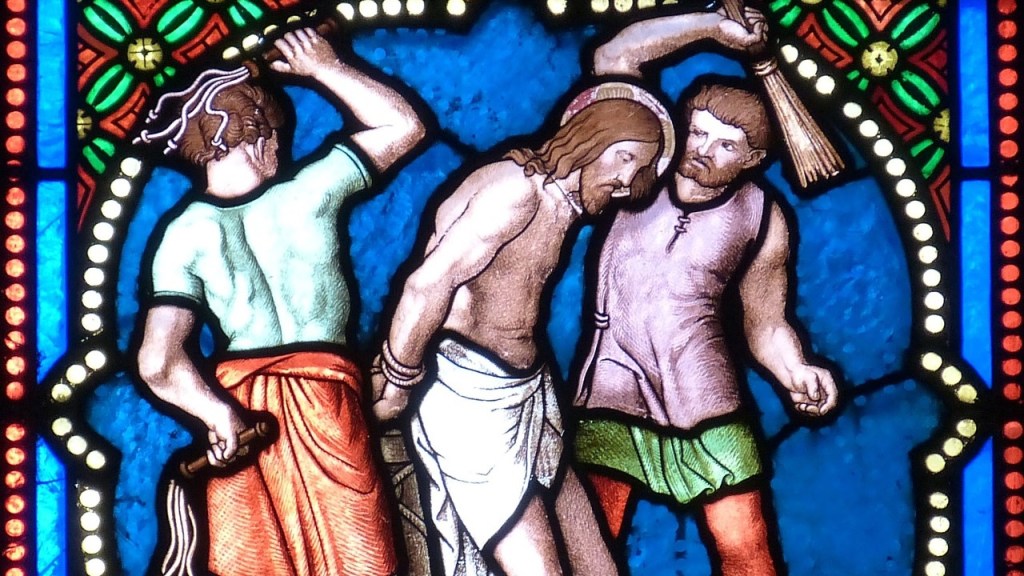
Jesus had been baptized by John the Baptist long ago when he spoke these words. He was not referring to his baptism with water. Rather, Jesus sometimes uses the term baptism as a picture of intense suffering. Whippings, beatings, insults, and spit are going to be poured out on him. Enemies will surround him. His own blood will flow over him. Finally, death will cover him. Jesus’ words contemplate the suffering and death by which he freed us from sin and gave us the ultimate demonstration of God’s love.

Jesus’ own peace was disturbed by that contemplation: “…how distressed I am until it is completed!” Have you ever dreaded a painful experience you had to undergo– maybe a dental or medical procedure? Maybe you have contemplated the pain of hell, fire and torture that never ends, and the thought filled you with a shudder.

Of course, for you the pain of hell is just a hypothetical thing. Hell itself is real enough, but you are never going to experience it so long as you cling to Jesus. For him it was inevitable. If the torture of the cross wasn’t bad enough, he knew that he would suffer the full anguish of hell there for our sins. Every day brought him closer to this “baptism.” The anticipation was painful to think about.

But Jesus did not use his certainty of this future to avoid this baptism. He did not turn and run. He does not even wish it would never happen. He simply wishes that it were already done. Perhaps we could compare his anticipation to an expectant mother who dreads the pain of labor and delivery. Still, she so wants the child she will hold in her arms on the other side. She wishes it were already over.

You and I are the children Jesus longed to hold in his arms on the other side of his crucifixion and death. Having you makes it all worthwhile for him.

Jesus Lights His Fire

Luke 12:49“I have come to bring fire on the earth, and how I wish that it were already kindled.”

What is the fire Jesus came to bring? Jesus sets the world on fire with his gospel message. Here it is viewed from a perspective we don’t often consider. The gospel Jesus preached can’t be believed unless people are willing to be real about themselves. It is meaningless if we aren’t painfully honest about ourselves. Jesus’ gospel is the good news that he has done everything to restore our relationship with God. He has paid for our sins. He has lived the obedient and loving life that we owed. He has done one hundred percent of the work.

When we get past our pride and admit the real extent of our moral failure, that gospel is one hundred percent good news. So long as we are clinging to some illusion of personal goodness, so long as we are convinced of our own spiritual ability, either we won’t understand what Jesus did for us, or we will reject it. In fact, we will probably hate it.

            So what does a fire do? Take a fire out of a fireplace or campfire ring, and set it loose, and what does it do? A fire spreads. A friend of mine had a summer job as a fire fighter in Idaho during his college days. Fires can make some amazing turns and jumps and changes of direction. Just when you think you have them under control, they flare up all over again.

            That’s how it is with the complete forgiveness and total salvation Jesus has set loose on earth. It spreads to hearts in one place where it is preached, and suddenly flares up in hearts no one would have expected to believe it. Who can predict where it will take hold next? Jesus’ own disciples consisted of a government bureaucrat and a radical anti-government militiaman. The New Testament is filled with reports and stories of the gospel catching on in the families and courts of rulers and emperors, as well as with the slaves and prisoners. It caught on with those who made their living as religious professionals and with those who practiced the world’s oldest profession. I have seen it come to life in the hearts of people I would never have guessed might believe it. If I am honest, the most surprising place I’ve seen the flame of the gospel flare up is inside of me.

            But not everyone believes. Of course, fire not only spreads. It burns. Jesus’ message inspires great passions both for it and against it. Those who believe it will insist on spreading it. Those who don’t believe it will insist on putting it out. Only where Jesus’ message has been watered down does it fail to produce friction and heat among men.

            Do you see how Jesus is confronting us here? If you are looking for the politically correct, socially acceptable, consistently civil Rotary-Club god or religion, don’t come knocking on Jesus’ door. His message isn’t tame. It isn’t “safe.” It isn’t respectable from a worldly point of view. If we try to make it that we will only be fighting against him.

Jesus’ message is a fire on the earth. It excites. It inspires. It consumes. On the inside it even gives us peace with God. But on the outside it disturbs the peace as it sets the world on fire.