In God’s Court

Christ-Judgement

Daniel 7:10 “The court was seated, and the books were opened.”

Doesn’t this sound like our own courtroom procedures? What happens when the Judge walks in? The bailiff calls out, “All rise.” Everyone stands up in respect as the judge makes his way to the bench. Once the he has taken his seat, and it is time to begin the proceedings, everyone is seated as well. Then we begin the trial and anticipate the judgment.

God’s court, however, functions differently than our own in some important ways. There are no lawyers arguing the cases. There are no witnesses, no scientific experts, being called to the stand. There is no jury hearing the case. From start to finish, all eyes are on the Ancient of Days, anticipating his judgment.

That is because he is the one who holds the books. All the facts of the case for every human soul have been perfectly recorded. No lawyer’s rhetoric, no DNA testing, no lying witnesses can change the verdict. God knows all our deeds. More than that, God knows our hearts.

Does that fill you with fear or with confidence? Do you anticipate the day with dread or with longing? Do you know what your entry in God’s book looks like? For every believer in our Lord Jesus Christ, it looks like the words we hear from Jesus in his great description of the Judgment: “I was hungry and you gave me something to eat. I was thirsty and you gave me something to drink. I was a stranger and you invited me in. I needed clothes and you clothed me. I was sick and you looked after me. I was in prison, and you came to visit me” (Matthew 25:35-36).

All God knows of us are the good things we have done. By faith, all our crimes and sins have been removed from the books, erased by Jesus’ blood. By faith, all our lives have been made to look clean and new, covered by the loving perfection of Jesus’ holy life. When we join this scene from Daniel chapter 7, and stand in the presence of the Ancient of Days, Jesus makes it possible for us to anticipate his judgment with joy.

That’s because how God sees us is even more important than how we see him. In Jesus, we have never looked better.

Heaven’s Formidable Force

Angel Spear

Daniel 7:9-10 “…the Ancient of Days took his seat…Thousands upon thousands attended him, ten thousand times ten thousand stood before him.”

These hundreds of millions standing before God and attending him are not the people gathered for the judgment. They are the angels. In other contexts they serve God mostly by serving us.

Their name means “messenger,” and often they serve as heaven’s heralds, the postmen of Paradise, delivering important news to God’s people below. Sometimes they are guardians, delivering entire nations from their enemies or wayward individuals from their own mistakes. On the Last Day they will serve as ushers and crowd control, making sure each man and woman is gathered and seated in the proper section of the courtroom for sentencing, whether they are slated for heaven or for hell.

Now Daniel sees them standing before God himself and serving him. Their very number and appearance together is enough to send chills up your spine. Have you ever been gathered in a stadium filled with tens of thousands of people, all making their presence known with their cheering? The mass of people and volume of their voices produces a thrill of emotion, a kind of perception of power and infectious joy.  The very sight of so many people can stir the soul.

Now Daniel sees not ten thousand, but ten thousand times ten thousand–hundreds of millions of God’s holy angels gathered for this occasion. These angels are not the Ancient of Days himself, but their presence surely heightens his glory.

And their number inspires our comfort. There is a passage in Revelation chapter 12 that suggests God’s holy angels outnumber the demons by a margin of two to one. Sometimes we Christians feel like a beleaguered little minority in this world, an ever shrinking resistance movement to the forces of evil. We are weakened by defections and infighting. We struggle to hang on.

But “those who are with us are more than those who are with them,” as Elisha once told his servant frightened by the enemy army encircling them. “We are not alone” is more than a slogan for fans of science fiction or believers in UFO’s. We are surrounded by extraterrestrials. But these are the angel armies of the Ancient of Days, the ranks of heaven God uses to protect us. Their presence and numbers give us courage to fight God’s battles today.

The Ancient of Days

Sun-Clouds

Daniel 7:9 “As I looked, thrones were set in place, and the Ancient of Days took his seat. His clothing was as white as snow; the hair of his head was white like wool. His throne was flaming with fire and its wheels were all ablaze.”

Unlike our names, which we often choose because they sound nice, or they have been in the family for a long time, or they are trendy, God’s names are always meaningful. Daniel wrote approximately 2600 years ago. This name tells us the Lord was already ancient then. Unlike some ladies and a few men who want to hide their age, the Lord is proud of his. This title places him before human memory, before creation, before there even were such things as “days.”

That is a truth that confronts us when we think we are in a position to confront God. It forces us to acknowledge his glory. We commonly take issue with the way that God is running the universe. Some people even doubt his existence because of the presence of disease, hunger, and injustice. But it is not the suffering of others that bothers us most. It’s when he lets it happen to me. Frankly, God seems more than a little incompetent when he lets me live with such pain. Why does everything I try to accomplish seems to be frustrated? I have to put up with the knuckleheads at home, at work, or in the neighborhood. Who does God think he is, anyway?

Have we forgotten? He is the “Ancient of Days!” He is that grand being who comes before us in every way. He has experienced every moment of the past and knows every detail of the future. The better question is the one he once put to Job, “Who is this that darkens my counsel with words without knowledge? Brace yourself like a man; I will question you , and you shall answer me? Where were you when I laid the earth’s foundations? Tell me, if you understand. Who marked off its dimensions? Surely you know! On what were its footings set, or who laid its cornerstone–while the morning stars sang together and all the angels shouted for joy?” A lowly little newcomer like me question the Ancient of Days? That is the height of presumption and arrogance. The only proper demeanor for us when our eyes are on the Ancient of Days is humble submission that acknowledges his glory.

Other features of Daniel’s vision unveil God’s glory. “His clothing was as white as snow; the hair of his head was white like pure wool. His throne was flaming with fire, and its wheels were all ablaze. A river of fire was flowing, coming out from before him.” The whiteness of his clothing and the fire in which he sits emphasize the Lord’s holiness and purity. There is not a speck, not even a trace, of the moral contamination. He is pure, holy, selfless love and absolute justice.

That glorious God is not only pure in himself. He also purifies. The fire of his holiness flows out from this throne in a river. You know how fire purifies things. It’s heat makes our food safe to eat. It can cauterize a wound or refining precious metals. The author of Hebrews quotes Moses in reminding us that “Our God is a consuming fire,” but the impurities he burns away are not bacteria that spoil food or the trace minerals that spoil unrefined gold. The fire of his holiness consumes every taint of sin in anything the Lord contacts.

This is hardly a warm and cuddly picture of the Ancient of Days. I don’t think Daniel would have been tempted to run up to the Ancient of Days on his throne in this vision and wrap his arms around him in a bear hug. There is too much of a sense of awe and holy fear. In order to keep our image of God from becoming distorted, we need to balance Daniel’s vision here with “The Lord is my Shepherd,” with God lying in the manger at Christmas, with the Lamb of God hanging on a cross and dying for our sins. The same God who thunders from Mount Sinai dies for us on Mount Calvary.

That this God–the Ancient of Days, whose existence spans eternity, burning with his zeal for holiness and white in his purity, so much greater than ourselves–that this same God would condescend to make himself small and human, to suffer like we do, to die for the sins we committed, doesn’t detract from his glory. It makes it shine ever so much more brightly. It inspires our humble worship and enthusiastic praise.

Even Better Than “Fair”

Coin

Matthew 20:8-10 “When evening came, the owner of the vineyard said to his foreman, ‘Call the workers and pay them their wages, beginning with the last ones hired and going on to the first.’ The workers who were hired about the eleventh hour came and each received a denarius. So when those came who were hired first, they expected to receive more. But each one of them also received a denarius.”

Equal pay, but definitely not equal work–some had worked for twelve hours in the vineyard, others barely one hour. Yet each received the same.

The same heaven is waiting for each of us at the end our life’s day. We will all enjoy the same eternal bliss in the presence of the same God who shares with us the same eternal love. That reward is not based upon our service but God’s promise. And for that we can be deeply, deeply thankful. During high school and college I spent eight summers working on a dairy farm.  I didn’t get paid much my first summer, but I was a complete novice. If I had been paid what I deserved I would have been deeply in debt at summer’s end.

Honestly, hasn’t our Christian service been like that? Bad church politics and selfish decision making mar our service on the one side, and unwillingness to participate, unwillingness to contribute, stand in the way on the other. Who knows how much of the vineyard we would have uprooted and destroyed if God didn’t transform our humble efforts with his grace! When the day ends, we have every reason to pray, “Lord Jesus, don’t pay me what I deserve. Just give me what you promised. Let grace guide your motives when you reward your workers.”

But pride doesn’t see it that way. “When they received it, they began to grumble against the landowner. ‘These men who were hired last worked only one hour,’ they said, ‘and you have made them equal to us who have borne the burden of the work and the heat of the day’” (Matthew 20:11-12). They speak no lie. Their work was hot and hard. Ours often is, too. Churchill offered the people of England nothing but blood, sweat, and tears as they engaged World War II in 1940. Work in the vineyard is one metaphor for our Christian service. Warfare is another: “Onward Christian Soldiers,” right? It isn’t always tea and crumpets. That doesn’t mean we should punch out and go home. It doesn’t mean that we should desert the ranks. It does mean we can expect some sweat and tears.

And the Master did treat them all the same. Working longer didn’t make him treat them better. Instead, he was consistently gracious and faithful. What they denounced as a miscarriage of justice was actually a miracle of his mercy. “But he answered one of them, ‘Friend, I am not being unfair to you. Didn’t you agree to work for a denarius? Take your pay and go. I want to give the man who was hired last the same as I gave you. Don’t I have the right to do what I want with my own money? Or are you envious because I am generous?” (Matthew 20:13-15).

The Lord keeps his promise in spite of our subpar work and unappreciative attitude. He didn’t pay these workers more. He didn’t dock their pay either. He paid them just the same. Because all our failings find forgiveness at the foot of Jesus’ cross, because God loves us not for our service but for our Savior’s service as the sacrifice for our sin, we can expect him to keep his promise when our last payday comes. Like the rest, we will receive infinitely more than we deserve. After all, what more is there than the denarius we have been promised? Where do you go up from heaven? How do you get more than eternity?

Our Master truly is generous. Why not equally share the wealth that all humanity can never exhaust or consume in the unending world to come?

Grace to Serve

Field Workers

Matthew 20:1-7“For the kingdom of heaven is like a landowner who went out early in the morning to hire men to work in his vineyard. He agreed to pay them a denarius for the day and sent them into his vineyard. About the third hour he went out and saw others standing in the marketplace doing nothing. He told them, ‘You also go and work in my vineyard, and I will pay you whatever is right.’ So they went. He went out again about the sixth and ninth hour and did the same thing. About the eleventh hour he went out and found still others standing around. He asked them, ‘Why have you been standing here all day long doing nothing?’ ‘Because no one has hired us,’ they answered. He said to them, ‘You also go and work in my vineyard.’”

The landowner in the parable is God, and the people he hires are people like you and me who have been called to faith and service. It is true that the landowner in the parable was looking for workers. But if grace is undeserved love, love that comes as a gift, love that is free not forced, then we see grace at work from the very start. The landowner comes looking for someone to serve, for those who are not looking for him, and these first have the privilege of knowing him early. They are blessed to be chosen. They are favored that their relationship with this Master will stretch over a longer period of time. If you were unemployed, wouldn’t you consider it an honor to have an employer seek you out and an advantage to have him hire you soon?

If God has called you or me to faith and service at an early age, isn’t that all evidence of his grace? My parents brought me to baptism in the first weeks of my life. They brought me to Sunday School as soon as I was old enough to attend. Was I doing anything here? Wasn’t God’s grace finding me? I wasn’t always enthusiastic about going to church when I was three. I can still remember being dragged down the aisle loudly pleading not to be spanked because I had been naughty during the service. I was not always excited to tag along with my parents when they were volunteering for some church project.

My spiritual resume has only gotten worse since then. Have I given our Lord any reason to pick me? No. But I can’t remember a time in my life that I didn’t know Jesus is my Savior. There may have been times when I wondered if God loved me. But since I was a toddler I have known that he promises he does. I have known that, in spite of my sins, Jesus died on the cross to save me. I have even had the honor of serving him. My little voice told the Christmas story and sang his praises each Christmas Eve. That was hard work, all that memorization for a preschooler or grade-schooler. My little voice shared my faith with my playmates in my old neighborhood. That was all to my advantage–a blessing, a privilege to serve the Master who sought me and chose me early, early in my life.

Thank God, that grace does not end with me. He has brought in more workers at various hours of the day, at various stages in their lives.

There is a double grace here–grace to those being called to serve, and grace to those who serve already. Not all of us may have come to know Jesus so early. God calls people to faith from youth to middle age to old age. The Master keeps looking and keeps calling as long as there is still breath in our bodies. It has been said that, in the U.S., over eighty percent of those who come to faith do so before the age of 25. Maybe the Lord found some of you when you were older. There is still a place for you, and there is still a task for you, even if you have only days to live. Otherwise, he would not seek you as his servants.

And whether we are young or old, whether the Master called us early in life or late in life, we are all evidence of God’s grace to each other. The more the merrier. It is a blessing to have help. It is a comfort to know that I am not swinging my hoe in the vineyard all alone, but the Lord has surrounded us with people who do what they can with the strength God gives, and the talents he gives, to complete the tasks that he gives. Thank you, thank you, for people like you who stand alongside and work together no matter when you entered the field.

An Unlikely Success

RIP

Judges 16:29-30 “Then Samson reached toward the two central pillars on which the temple stood. Bracing himself against them, his right hand on the one and his left hand on the other, Samson said, ‘Let me die with the Philistines!’ Then he pushed with all his might, and down came the temple on the rulers and all the people in it. Thus he killed many more when he died than while he lived.”

At the end of his life, Samson performed one last act of great strength. He didn’t do this for himself. He didn’t ask for his sight back. He didn’t ask to go free and continue to lead Israel after he’s was done. He realized that what he was about to do would take his own life. But he was willing to make the ultimate sacrifice–as Lincoln described the soldiers at Gettysburg, “to give the last full measure of devotion”– to defend his nation and deliver a crushing blow to the enemies of Israel.

You see, the Christian faith is not a scheme to make our earthly lives easier, a way to manipulate God into giving us whatever we want here and now. Sometimes it actually makes our lives harder. Wherever the gospel renews faith and restores spiritual strength, it frees us from our attachment to this world and its treasures. It releases us from our petty, selfish concerns. It inspires us to serve, to sacrifice, for the one who made the ultimate sacrifice for you and me.

And when weak servants find the faith to lean on God’s strength and live sacrificially, the Lord produces success. “Thus he killed many more when he died than while he lived.”

Does this seem like a sad ending to the story–the death of Samson with his Philistine enemies? Is it a strange measure of success to say that this life ended in success–a blind prisoner who died with 3000 people when a building collapsed? Sounds more like a tragedy, doesn’t it?

In order to see the success, we have to see death from God’s point of view. “Precious in the sight of the Lord is the death of his saints,” states Psalm 116. “For me to live is Christ, to die is gain,” is the faith that Paul expresses in Philippians chapter 1. “Blessed are the dead who die in the Lord from now on,” the voice from heaven says in Revelation 14. When the Lord has brought someone all the way through life to die in faith, as he did with Samson, that’s success. That means heaven and never ending life for those who believe. That’s why our Christian funerals are about victory and celebration of life even more than they are about grief and loss.

But most of all they are about the gracious work of God. A highly decorated life that ends without faith is a tragedy. An unsteady and disappointing life that ends clutching to faith in God rates an ultimate success.

Made Weak to Find New Faith

Boy-Bible-Prayer

Judges 16:26-28 “Samson said to the servant who held his hand, ‘Put me where I can feel the pillars that support the temple, so that I may lean against them.’ Now the temple was crowded with men and women; all the rulers of the Philistines were there, and on the roof were about three thousand men and women watching Samson perform. Then Samson prayed to the Lord, ‘O Sovereign Lord, remember me. O God, please strengthen me just once more, and let me with one blow get revenge on the Philistines for my two eyes.’”

On whom is Samson depending now? If you follow his life until his capture, we see an impetuous man who simply does what he is inclined to do. He acts like a spoiled child without much concern for God or others. Now we see something different.

Commentators disagree on whether his request for revenge for his eyes is legitimate and godly in light of the fact that the Philistines were the idolatrous enemies of God’s people, or whether it is more of Samson’s selfishness and pride looking out for himself. It’s not a question we need to settle. It’s hard to play psychologist 3000 years after the fact. No one is suggesting Samson became sinless in the end. But he is changed. For the first time recorded, he is seeking God’s will before he acts. He is acknowledging the Lord as his strength. Here at the end, the Lord has renewed Samson’s faith.

How was God working here? How come Samson didn’t just become a bitter and defeated prisoner? From his new perspective of humility, Samson not only saw himself more clearly. He could see the Lord more clearly. He saw more than a mighty Spirit who gave him superhuman strength. He saw a gracious and forgiving God who had patiently dealt with Samson’s headstrong and self-motivated ways. He saw a God who had not abandoned him after so many sinful choices and the reckless disregard of God’s commands. He saw a God who even now had spared his life.

What we need in our weakness is not an infusion of otherworldly power. Like Samson, we need a clearer vision of God’s forgiving grace. We need him to answer the prayer of the old hymn Abide with Me, “Hold thou thy cross before my closing eyes. Shine through the gloom and point me to the skies.”

And he does. In the cross, in the preaching of Jesus Christ and him crucified, our Lord continues to smile on us with his forgiveness and grace. There we see our whole lifetime of sins, no matter how often repeated, no matter how selfish or hurtful, paid for and disposed of by Jesus’ sacrificial death. There we see why he has been so patient with us, why he doesn’t treat us as our sins deserve, why he even seems to treat us as though he sees no sin in us at all.

For Jesus’ sake, God doesn’t see our past anymore. He points us to the skies, where our vision isn’t blurred by or pride, or darkened by misery and sin. Our sight is focused by his love, brightened by his grace, and heartened by his promise of unending life to come. That’s how the Lord renews our faith, a faith has stopped depending on ourselves to depend on him.

Made Weak to be Made Strong

Tired Hikers

Judges 16:23 “Now the rulers of the Philistines assembled to offer a great sacrifice to Dagon their god and to celebrate, saying, ‘Our god has delivered Samson, our enemy, into our hands.’”

You know the stories of Samson’s great strength, don’t you? He tore an attacking lion apart with his bare hands. He killed a thousand Philistine soldiers with the jawbone of a donkey. When tied with ropes, he broke them like they were threads. He tore the city gates of the city of Gaza right out of the city wall. As a result of his great feats of strength, Samson came to think that he was invincible. He lost sight of the fact that his real strength came from God.

That’s where the story of Samson and Delilah comes in. He let her nag him into revealing the connection between his hair and his strength. After she shaved off all his hair in his sleep, and he woke up to the threat of his Philistine enemies, he thought, “I’ll go out as before and shake myself free.” You see, he thought his ability was all him. He did not realize that the Lord had left him, and with the Lord went his strength. That’s foolish pride. That’s why Samson was now the weak and blind prisoner of his enemies. But the spiritual weakness he displayed was even worse.

Samson’s arrogance hurt more than just himself. God had given him his strength so that he could lead God’s people Israel and protect them. It wasn’t just to serve Samson. It was a gift, so that the man could serve others. It was a gift Samson had squandered in astounding ways, and that put God’s people in danger. Even the Lord’s own reputation took a hit because of Samson’s conceit. To the Philistines, it appeared as if their false god, Dagon, was even greater. “When the people saw him, they praised their god, saying, ‘Our god has delivered our enemy into our hands, the one who laid waste our land and multiplied our slain’” (Judges 16:24).

Your strength may not be raw physical power. It may be outstanding intellectual gifts, social and interpersonal gifts, monetary gifts, artistic gifts and gifts of craftsmanship, musical gifts, or technological gifts, just to name a few. It is good and right that we recognize these things, thank God for them, enjoy them, and put them to good use.

But how easy it is for us to slip from recognition to pride! These have all been given to serve. It’s not all about me. We do more harm than good if we squander our various gifts on self, if we let them fill us with a false sense of superiority, if we develop an empty belief in our own invincibility. God can take them all back in an instant, just like he did with Samson. Prideful and selfish use of our gifts only divides and impoverishes Christians, obscures their witness, strengthens the case of their critics, and damages God’s own reputation. Such pride is death to our own souls, a danger to our Christian brothers and sisters, and a huge obstacle in our attempts to reach the lost. God have mercy on us when we believe his gifts are our creation!

God did have mercy on Samson. He taught him humility. But the lesson required a rather severe mercy. “While they were in high spirits, they shouted, ‘Bring out Samson to entertain us.’ So they called Samson out of the prison, and he performed for them” (Judges 16:25). In his mercy, the Lord stripped Samson of his delusions of independent and irrevocable strength. His eyes had been put out by his captors. He was imprisoned. The man who once killed 1000 men with the jawbone of a donkey was given a donkey’s task of pushing a millstone to grind the Philistines’ flour–walking in endless circles day after day. Samson was forced to become the butt of their jokes, an unwilling court jester, a reluctant performer who could not escape the shame of his fall from power and grace. The Lord was teaching him humility. It was necessary if this weak servant was going to find new strength to serve him.

We rarely think of shame as a good thing. It almost always comes as a result of some great sin or failure on our part. Those who impose shame on others mostly do it with a mean spirit, like the Philistines did. But the shame itself can be a tool God uses to serve us. Like pain, shame forces us to notice that something is horribly wrong, something that must be corrected. It makes us see our sinful weaknesses. It teaches us humility. It prepares us for God’s greater work, the work of showing us his grace and forgiving our sins. Then we are ready to receive his greater gifts, and in the gospel weak servants like you and me find strength to serve him once again.


See His Deliverance

Red Sea

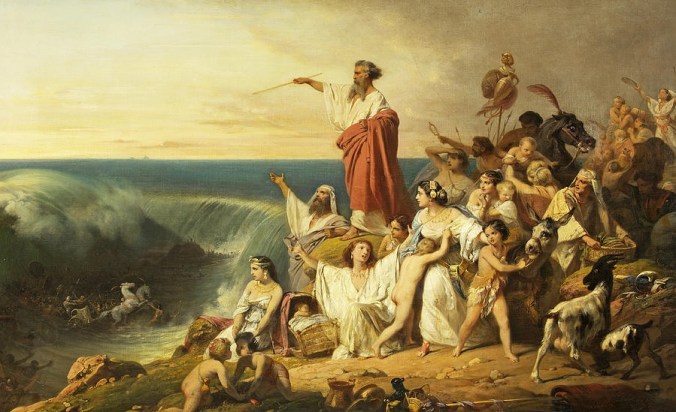
Exodus 14:13 “Moses answered the people, ‘Do not be afraid. Stand firm and you will see the deliverance the Lord will bring you today.’”

“Do not be afraid.” Even before delivering these people from the Egyptians, the Lord wanted to deliver them from their fears. How many times don’t we hear the Lord or his agents express God’s intention to take our fear away? “Fear not!” the angels say to the shepherds at Jesus’ birth, or the ladies at his tomb. “Don’t be afraid,” Jesus told the disciples just before he invited Peter to get out of the boat and walk to him on the water. The author of Hebrews tells us that Jesus came to free us from our fear of death, by which the devil has kept us in slavery to him.

Isn’t that the nature of the God we worship? Fear can be a very effective tool if you want to control someone else. How many evil dictators haven’t used that truth to stay in power? That also explains why Christianity is rarely welcome in their countries. Although Christian faith generally produces obedient citizens, it is hard to control people who have been freed from their fears.

But with fear, control is all you get. You do not trust someone you fear. You certainly cannot love them. Because our Lord wants to live with us in a relationship of trust and love, he comes to take our fears away. He does not stop at alleviating the fear of our enemies. He removes the terror he himself could hold over us. While he still promotes fear in the sense of respect, he wants us to know that he loves us. We can come to him with confidence, as we would go to a father or friend.

For God’s Old Testament people, this very story of God’s deliverance at the Red Sea would become the gold standard for understanding that the Lord was someone they could trust and love. He cared about them and delivered them. They didn’t need to be afraid every moment of their lives. For us, the life and death of Jesus reveals just that much more clearly that the God of all grace delivers us and frees us from our fears.

Deliverance from fear comes just because he delivers us from our enemies. Moses continues, “The Egyptians you see today you will never see again.” I think you all know how this story ends. Israel walks through the middle of the Red Sea on a dry path that miraculously appears in the middle of the waters. But when the Egyptian army tries to follow them, the waters close in and drown them all. The Lord turned an impossible situation and certain death into complete victory and deliverance from their enemies.

For us, the great story of God’s salvation lifts our eyes to a cross where our God is hanging in indescribable anguish, dying for our sins. It looks as though he is suffering total defeat at the hands of his enemies. Then we see that Jesus lives again, body and soul, the conqueror of sin and death. His grave is empty, his fight is finished, his victory is secure. As a result, it’s not the Egyptians, but the sins you see today that you will never see again. Christ has taken them away, drowned them in the waters of your baptism, freed you from their slavery, locked them away in your past where they can never trouble you again. He has turned death into a safe path through the skies, leading all the way to the safety of heaven. None of your enemies can follow you there. The same death that brings you deliverance washes over them bringing only defeat.

And as with Israel, God does everything for us in his grace. “The Lord will fight for you; you need only to be still” (Exodus 14:14). Not a single Israelite drew a sword in the crossing of the Red Sea, or shot an arrow or threw a spear. That’s still how his saving gifts work. He gives us forgiveness. He gives us eternal life. He gives us the very faith that receives it. He gives us patience to endure hardship, wisdom to turn to him, and peace that he will turn all things for our good. “I can do all things through him who gives me strength” (Philippians 4:13).

A little proverb about life and success says, “It’s not what you know. It’s who you know.” That couldn’t be more true if who you know is the Lord. Look to him, and he will deliver you.