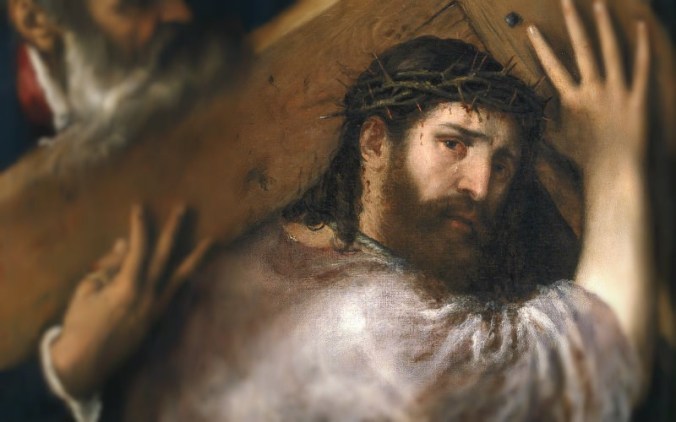
Rescue for the Needy

beggar

Psalm 72:12-14 “For he will deliver the needy who cry out, the afflicted who have no one to help. He will take pity on the weak and the needy and save the needy from death. He will rescue them from oppression and violence, for precious is their blood in his sight.”

Our King, Solomon says, delivers the needy– those who have no one to help. If that doesn’t lead us to give up on our self-made plans of salvation, we need to think about these words some more. Preacher Charles Spurgeon once commented, “The proverb says, ‘God helps those that help themselves,’ but it is yet more true that Jesus helps those who cannot help themselves, nor find help in others. All helpless ones are under the especial care of Zion’s compassionate King.”

Evangelist Watchman Nee illustrates this another way. He tells the story of standing on a dock with a friend who was a strong swimmer. They were watching a man swimming a long way from shore, when this man got into trouble. Pretty soon the man was going under, coming up gasping for air, and crying for help. “Aren’t you going to help him?” Nee asked his friend. “Not yet,” his friend replied. Only after the swimmer became unconscious and stopped struggling did Nee’s friend rescue him. When Nee asked him why he waited so long to rescue the man, his friend replied, “If I would have gone out to him immediately, he would have panicked and pulled me down with him. I had to wait until he stopped kicking. Then I could save him.”

We don’t pose any danger to our King. But only after we have stopped kicking, stopped trying to save ourselves, does Jesus step in and rescue his people. Spiritually, at least, we are only struggling against him when we are trying to do it ourselves. Our King isn’t looking for our help when it comes to delivering  us. He is looking to give us his.

Why does the King take notice of such helpless people and deliver them? “…for precious is their blood in his sight.” There are some things that you or I may consider precious because they are valuable all by themselves. A rare antique or a piece of fine jewelry have value no matter where you take them. The value is in the thing itself.

The dried corsage you saved from your high school prom, or the little clay imprint your child made of his hands in kindergarten, probably isn’t going to get you much at the pawn shop. They may be precious to us because of a value we invest in them. They are precious because of their associations and the memories they give, but their value is given to them by us.

How often doesn’t Scripture remind us that we are nothing but creatively arranged particles of dust. “For dust you are and to dust you shall return.” We have even given our God a daily dose of bad memories by our sins. But the King has given us value by giving us the spark of life. He has given us value by redeeming with his own life. He has loved us because he has chosen to love us, and he considers us precious in his sight.

Our need is just another opportunity to receive his love.

Justice Without Limits

Justice Planet

Psalm 72:4-7 “He will defend the afflicted among the people and save the children of the needy; he will crush the oppressor. He will endure as long as the sun, as long as the moon, through all generations. He will be like rain falling on a mown field, like showers watering the earth. In his days the righteous will flourish; prosperity will abound till the moon is no more. ”

Because it is all too easy for us to feel sorry for ourselves, to blame others for problems of our own making, we need to be careful not to be too quick to declare ourselves the victims .

But honesty, and Scripture, demands that we recognize that sometimes God’s people are the victims. People do wrongfully take advantage of us. We are the targets of unjust slanders and accusations. It isn’t wrong to recognize this and ask God to give us justice. We shouldn’t take matters into our own hands. God tells us not to seek our own vengeance. But the enemies of Christ’s people are the enemies of Christ himself. “He will defend the afflicted among the people and save the children of the needy; he will crush the oppressor.” If the matter isn’t resolved now, we can be sure that we will be vindicated on the Last Day. There are no ifs or maybes here. Our King will see to it.

Our King’s justice would do us no good if we were to find ourselves outside of his jurisdiction, however, or if his reign were to end. Solomon was writing 3000 years ago on the other side of the planet. But that’s not a problem for us. Our King is unlimited by time or space. “He will endure as long as the sun, as long as the moon, through all generations. He will be like rain falling on a mown field, like showers watering the earth. In his days the righteous will flourish; prosperity will abound till the moon is no more.”

Solomon points us to the moon and the sun to help us get our arms around the truth that Jesus is not limited by time. The scene on the ground is changing around us all the time. Just think of the changes the place where you are sitting right now has gone through in the last hundred years. Around the world the forces of nature and the ingenuity of man are constantly changing the landscape.

But the heavenly bodies stay the same. Look up at the sun sometime later today. Step outside your door after it is dark, and look up at the moon and the stars. While the scene around your yard has changed, what you see in the sky looks the same as it did for an American Indian looking up at the sky from that spot 1000 years ago, or for Solomon looking up at the sky at night 2000 years before that. Even the sun and the moon don’t last forever, but they are the closest things to never changing and never ending we can see with our eyes.

Jesus’ reign as King is even more consistent and more enduring. What he considered good or evil in Solomon’s day is no different for us. More important, he loves us no less than he loved Adam, Abraham, Moses, David, Peter, John, the church fathers, or our own grandparents. His control of world events, or the details of our personal lives, has not slipped even a little from creation until now. As the author of Hebrews says so succinctly: “Jesus Christ the same yesterday, today, and forever.”

So too, his justice is unlimited by time or space.

Absolute Justice

Christ Judge

Psalm 72:1-2 “Endow the king with your justice, O God, the royal son with your righteousness. He will judge your people in righteousness, your afflicted ones with justice.”

How does the justice and righteousness of this King make you feel? Does it make you want to go rushing to him for help? Or does it make you want to shy away from him instead? We have reason to fear his justice when we realize that he makes his judgments based on absolute, and not relative, standards. What do I mean by that? By nature, we are lawbreakers at heart. Since we break the law, we don’t want to be judged by whether or not we have kept the law, but by how we compare to everyone else.

When parents confront their children for fighting, how often doesn’t one of them protest, “But he started it.” In other words, don’t judge me for whether or not I am pounding on my brother. Judge me for having the restraint and good sense to let my sibling take the first swing. That’s a relative standard. I heard a talk radio host describing his first appearance before a judge for speeding. He protested that he wasn’t the only one driving over the speed limit. Other cars had even been passing him. Relative to the other drivers, he thought he was doing pretty well. The judge told him, “When you look way over in the right lane, and you see the little Honda putting along at 55 m.p.h., that will be me going the speed limit.” That judge insisted on an absolute, not a relative, standard of right and wrong for handing down justice.

So it is that when I stand before our Lord, the King, for judgment, it is just he and I. He isn’t interested in how we compare to everyone else. He has been endowed with justice. “He will judge your people in righteousness.” He has an absolute standard, a standard that says, “Whoever keeps the whole law, yet stumbles at just one point, is guilty of breaking all of it.” “Cursed is everyone who does not continue to everything written in the book of the law.” Not most of it. Not more than other people. “Everything written in the book of the law.” If Christ our King is just, we have reason to be afraid.

But wait a minute. Is that how Solomon sounds in these verses? Doesn’t he rather seem to be celebrating the King’s justice? We can welcome his justice because it is accompanied by his mercy. Jesus’ mercy doesn’t lead him to lay his justice aside. He doesn’t change his standards. But he did provide another way for those standards to be satisfied. The King traded his crown and royal robes for servants clothes and kept the whole law for us. Then he added ropes and chains and the trappings of a prisoner, and he took our place on death row at the cross. Justice was served on him instead of us. The prison door was opened for us to go free. We were declared just and righteous by the One who is just. No wonder we call him our King!

Don’t Underestimate Its Power

paper cross

1 Corinthians 1:18 “For the message of the cross is foolishness to those who are perishing, but to us who are being saved it is the power of God.”

Let’s say that you are an ambitious and powerful European dictator, and you would like to conquer Russia. Your army is vastly superior in numbers and equipment. Your military strategy surpasses that of the opposing generals. Your siege of Moscow is going to take you well into December and January, but what’s a little cold and snow when you have everything else in your favor?… Underestimating the power of a Russian winter would be a fatal mistake, wouldn’t it. Just ask Napoleon or Hitler what a difference it makes.

Let’s say that you are a multinational fast food chain, and you keep receiving irritating letters from a little girl in grade school about the potential dangers of your Styrofoam packaging to the environment. Someone in customer relations is given the task of sending her a few patronizing letters thanking her for her concern, but you don’t intend to do anything about it. After all, she’s just a little girl… But underestimating the power of a sweet little girl’s face to sway public opinion would be a big mistake. And today, if you order a Big Mac at McDonald’s, the box it comes in will be made out of cardboard, not Styrofoam.

Let’s say you are a member of the human race, and you want to find the meaning of life. You want to know God. You want to find some escape from death. Lined up in front of you is an impressive array of wise sages and sometimes powerful leaders offering their lists of principles and secrets for finding spiritual happiness and eternal bliss.

Then there is this quaint little story about a man who was falsely accused, tortured, and executed thousands of years ago on a cross. The story is filled with blood and suffering. It doesn’t seem very spiritual. But underestimating the power of the cross would be a big mistake.

Let’s say that you and I owed someone a debt far beyond anything we could ever pay. We’re not talking possible bankruptcy. We’re talking about a debt that makes the 22 trillion-dollar national debt look manageable. Then he not only forgives it. He so loves us that he gives his own life to pay it off. Isn’t that the message of the cross? And doesn’t that do something to us inside?

This is why the Apostle Paul doesn’t describe the gospel as a mere offer, a reasonable possibility, an option worth considering. It is “the power of God for the salvation of everyone who believes” (Romans 1:16). The gospel he preached to the Thessalonian Christians came to them “not simply with words but also with power” (1 Thessalonians 1:5). And here in his letter to the Corinthians Paul affirms that the preaching of Christ crucified is “Christ the power of God and the wisdom of God” (1:24).

The message of the cross answers the challenge because it saves those who believe. Don’t underestimate its power.

This Is Going to Hurt

doctor pain

Jeremiah 26:8-9 “But as soon as Jeremiah finished telling all the people everything the Lord had commanded him to say, the priests, the prophets, and all the people seized him and said, ‘You must die! Why do you prophesy in the Lord’s name that this house will be like Shiloh and this city will be desolate and deserted?’ And all the people crowded around Jeremiah in the house of the Lord.”

The people to whom Jeremiah preached God’s law objected that the prophet was wrong to preach it to them. They were living in denial about their sins. What they needed was an honest diagnosis. That is what Jeremiah had just given them. He scatters a list of their sins across his book: oppressing the poor, having the innocent put to death and seizing their possessions, fraud and dishonesty, illicit and perverted sex, mixing the worship of the true God with false religions. All of these were symptoms of the core problem the Lord sent Jeremiah to confront on this day: “You do not listen to me and follow my law… and you do not listen to the words of my servants the prophets…” (26:4-5).

The symptoms haven’t changed all that much, have they? You hear that even Christians fail to practice proper sexual values often enough. Whether TV and the internet are major contributors to the problem or merely reflect it, the problem still lies with us. Materialism makes us willing to walk all over other people for the sake of a buck, and it has been doing so for at least a century in our country. I once read an article by one of the fathers of our church, August Pieper, in which he complains that people in our country seem to assume that the purpose of life is to make as much money as you can. The article was from the 1910’s. According to one survey, the average person lies about twice each day. Over half of those seeking jobs lie on their resumes. Yet people of every political bent raise red flags about “fake news,” as though it is something we shouldn’t expect. The day is coming when no one will be able to trust anyone anymore.

These are all still symptoms of ears that don’t want to listen to God and hearts that don’t trust him. The people to whom Jeremiah preached would not have denied many of the things Jeremiah accused them of. Yes, they thought differently about sex than their prudish ancestors. Yes, they were more open minded and tolerant about religion and didn’t see anything wrong with participating in the ceremonies at other places of worship. They didn’t have anything against poor people, but business was business, and you didn’t expect them to take a loss for such a bunch of no-names, did you? They wouldn’t deny that they did these things. They just didn’t see what was wrong with them.

That’s why they objected to Jeremiah’s prognosis. “Why do you prophesy in the Lord’s name that this house will be like Shiloh and this city will be desolate and ruined?” Shiloh was the place where God had lived with his people about 400 years earlier. There he took up a special, gracious presence with them. About 400 years before Jeremiah, God abandoned that place.

You don’t want God to cut off his gracious presence and blessing like that. It is a foretaste of hell. When we embrace our sins, defend them, and will not repent, eventually God says, “If you don’t want me and my ways, then go your own. But don’t expect me to come along. I will leave you alone, just as you asked.”

When we live in denial about the reality of our sins and the seriousness of their consequences, we are choosing to live in a fantasy world with an illusion of personal goodness and eternal security. When God’s law shatters those illusions of goodness, it hurts. But then we are ready to receive the real thing.

Not everything about Jeremiah’s message that day was negative. “Then Jeremiah said to all the officials and all the people: ‘The Lord sent me to prophesy against this house and this city all the things you have heard. Now reform your ways and your actions and obey the Lord your God. Then the Lord will relent and not bring the disaster he has pronounced against you’” (vs. 12-13).

The Lord did not want to abandon these people, destroy their city, or lose them eternally. He does not want to drive us further away. He wants to wake his people up. Tough love isn’t a modern invention of Christian psychotherapy or the recovery movement. God was practicing it with his Old Testament people in 600 B.C.

That is because the Lord wanted to relent and see his people prosper. He still does. He takes no morbid pleasure in seeing people suffer. He won’t promise us cross-free life. Sometimes we need our burdens, and he doesn’t want us to mistake earth for heaven. But he does want us to know the peace and security of his forgiving grace. As forgiven people he wants us to find his abundant supply. As people of faith he wants us to trust his angelic protection. He doesn’t want us to miss the benefits that come to those whose hurts have been healed by his love.

Sometimes the doctor warns, “This is going to hurt,” before he proceeds to address my problem. But I usually feel better after I go to him. A few moments of pain lead to long term relief. We feel better when God has cut us deeply with his law so that his healing grace can penetrate deeply into our souls and fortify our faith. God give us ears that hear and hearts that believe, even when his message hurts.

Thank God for the Thorns

thorn and flower

2 Corinthians 12:7-9 “To keep me from becoming conceited because of these surpassingly great revelations, there was given me a thorn in the flesh, a messenger of Satan, to torment me.”

Pride, conceit, arrogance–no matter what you call this sin, it is always with us, ready to take a thousand different situations in life and turn them into an excuse for believing that we are better than others. The Apostle Paul had spent long years savoring an inflated self-image as a Pharisee.

That temptation to see himself as superior because of his heritage or life did not come to a complete and sudden end when Paul became a Christian. That sense of pride he had so cultivated years ago could easily take the new, spiritual, Christian Paul and blow him up into some sort of little god at whose feet everyone should fall down in worship and respect. Paul needed something to keep him humble.

If we dig into our own lives, we find that pride is just as capable of taking any quality we have and using it to convince us that we are so much better than everyone else. You can become conceited because you look pretty, because you’re smart, because you’re a good athlete, because you make a lot of money, because you drive a cool car, because you make friends easily, or because you take great care of your body. Or you can become conceited because you go to church every Sunday, because you work hard, because you sacrifice yourself to take care of others, because you read your Bible and pray for hours, or because you accept people who are different than you. You can become prideful in the fact that you are conservative or progressive, open-minded or unbending, contemporary or traditional. The possibilities for our pride are endless. No sin is more spiritually deadly than pride.

So God confronted Paul’s potential for pride with a unique preaching of his law. God gave Paul a “thorn in the flesh.” We don’t know exactly what this was. Some people have suggested that he might have had an eye-problem, or suffered from recurring malaria, or struggled with a speech impediment.

What we do know is that everything about this thorn in the flesh seemed wrong, even evil to Paul. He calls it a “messenger of Satan.” That’s not just a colorful way to talk. The Lord might well have allowed Satan to make life miserable for Paul with this thorn. Of course, Satan meant it only as a temptation. No doubt Satan was whispering in his ear, “You see, God doesn’t really love you.” But the Lord was using this for Paul’s good to battle his pride. So we see that even Satan himself must serve God for our good.

Every once in a while, when talking about someone whose life is a mess, I or someone else will comment, “He really needs Jesus.” Of course, that’s true of everyone one of us. I really need Jesus. We really need Jesus. Paul really needed Jesus.

And that was God’s answer for Paul. “But he said to me, ‘My grace is sufficient for you, for my power is made perfect in weakness’” (2 Cor. 12:9). He didn’t make the problem go away. He gave him a Savior. The Lord set his heart upon Paul, laid down his life for him, forgave all his sins, preached the gospel to him, brought him to faith, made him a dear member of his own family, gave him a new life, reserved a place in heaven for him, and guaranteed him an eternity of endless joy. In short, he made Paul the object of his grace–his unending, unequaled, unconditional love. And that was enough.

Note what the Lord is saying. He didn’t say, “My grace is sufficient to solve your problems and take away your pain.” He said, “My grace is sufficient for you.” God’s grace is the big thing, the one great need we have. We become so obsessed with our lives in this world that we tend to overlook God’s grace. We take it for granted. We don’t value it as highly as we value our cheap junk.

Often, it is not until God sweeps all our cheap junk away and pokes us with thorns that we appreciate his grace. Then we realize it is the one, substantial, priceless gift we need. Everything else about our lives is trash by comparison. “God’s grace is sufficient for you” is something of an understatement. In reality, it far exceeds every need. Its value far surpasses all else. This is a hard lesson to learn. Asaph, the author of Psalm 73, dealt with his own thorny problems before he came to the conclusion: “Yet I am always with you; you hold me by my right hand. You guide me with your counsel, and afterward you take me into glory. Whom have I in heaven but you? And earth has nothing I desire besides you. My flesh and my heart may fail, but God is the strength of my heart and my portion forever.”

If the problems we suffer help us to see God’s grace for what it is–the single, sufficient gift of God for our lives–then thank God for the thorns!

A New Life of Privilege

diverse team

Ephesians 2:19 “Consequently, you are no longer foreigners and aliens, but fellow citizens with God’s people and members of God’s household…”

When we travel overseas, we immediately recognize some disadvantages of being in a foreign country. It is hard to understand what is going on around us because we don’t speak the language.  Some of the laws and customs are different than what we are used to. As foreigners we don’t have the same rights the citizens do. The natives may treat us well, but we always know that we aren’t at home.

That is what the Gentiles in Ephesus experienced before Christ was preached to them. That is what it is like for anyone who doesn’t know Jesus as their Savior yet. There is this language of God’s Kingdom which is hard to understand–words like repentance, justification, sanctification. There is a way of life that doesn’t make sense to people who are used to living only for themselves. There is a fear of God instead of the right to come before him confidently. Unbelievers don’t feel at home when they have to think about God or they are confronted with his word.

But the peace which makes us people of God changes all that. We have the privilege of being close to God. We are no longer foreigners and aliens. We have the privilege of being fellow citizens.  The language, and the way of life, start to make sense. The rights that we have to full forgiveness for all sins,  eternal life in heaven, the strength to live a Christian life, and answers to our prayers are privileges of citizenship we especially appreciate.

In fact, this closeness goes beyond citizenship. We are a part of God’s own family, members of his household. We enjoy a personal, intimate relationship with him in which he listens to all our concerns, and takes care of all our needs right down to the smallest detail. He knows everything about us and uses what he knows only to love us and care for us. The peace we have with God assures us that in his Kingdom we have finally found our home.

Because It Tells You He Loves You

bible heart

Deuteronomy 5:15 “Remember that you were slaves in Egypt and that the Lord your God brought you out of there with a mighty hand and an outstretched arm. Therefore the Lord your God has commanded you to observe the Sabbath day.”

If you wanted to assure someone God loves us deeply and unconditionally, what historical event would you point to? If you longed for that assurance yourself, where could you best find it? At Jesus’ death on the cross, right? Jesus’ sacrifice for our sins is the greatest evidence of God’s love. “For God so loved the world that he gave his one and only Son…”

But if you lived when God first gave us the commandment about the Sabbath day, that event was still a hazy promise for the distant future. The historical event that best proved God’s love for the people of that time was the Exodus from Egypt. In it God rescued the nation of Israel from death and set them free from their slavery. Time after time Old Testament psalmists and prophets refer to that event to remind the people of God’s love for them. This was food for their faith. This was God’s “I love you.” It fostered a stronger relationship with his people.

This was something for God’s people to remember on the day they gave God for worship. “Remember that you were slaves in Egypt and that the Lord your God brought you out of there with a mighty hand and an outstretched arm.”

Why should we give God a day? Because God has given us no less evidence of his love for us to remember. It runs through our Sunday worship. Early in the service the pastor assures you, “God our heavenly Father has been merciful to us, and has given his only Son to be the atoning sacrifice for our sins.” There God is whispering, “I love you” in your ear. A little later we confess the creed together: how Jesus suffered under Pontius Pilate, was crucified, died and was buried. Again God is demonstrating how dear you are to him. Peppered throughout the sermon are reminders that you mean more than the world to him. He considers you so precious that he was willing to sacrifice the life of his Son for you.

And do you note that he asks you to remember more than words or statements, but events from real life? Just a couple of years after I arrived at my first congregation, I celebrated my golden birthday. When I came to the office that day I found that the faculty had arranged for themselves and all the children to wear gold in recognition of the day. A couple of years later, when we had to rush our son Nathan to the hospital in the middle of the night, members of the congregation got up at 2 a.m. to watch our other children so that we could take him for help. When cancer struck our family, we were overwhelmed with the outpouring of cards and gifts and food and visits and prayers and offers of help fellow Christians showed to us. When I received my call to serve the church, one of the last statements on the document read, “We will receive, honor, and love you as our pastor.” I believed it at the time. But it was the expressions of love from the members, genuine gifts and acts of service, that left no doubt in my mind that it was true.

Likewise, on the day we give God for worship each week, we are remembering more than words written in a book. We are remembering the story, the real life story, of how he loved us so much that he came to save us. We are remembering events and gifts and acts of service he has shown each of us personally. This is quality time, quality time with Jesus, and it leaves no doubt in our minds that, when he says “I love you and forgive you,” it is really so.

Because Everybody Needs the Rest

tired cafe

Deuteronomy 5:14 “On it you shall not do any work, neither you, nor your son or daughter, nor your manservant or maidservant, nor your ox, your donkey, or any of your animals, nor the alien within your gates, so that your manservant and maidservant may rest, as you do.”

From time to time I run into people who seem to believe the Lord must have had the biblically ignorant in mind when he gave the command to rest on the Sabbath. To them, church going is for small children who need to learn morals, or those few people who find worship and Bible study interesting for some unknown reason. The Lord himself disagrees. He impresses upon us that giving God a day is for all.

Giving God a day is for you, whoever you are. You are at the very top of God’s list of the kind of person who needs to take time off to pay attention to God. So am I. No matter how old we get, no matter how much we know, no matter how much we believe that we have it all together, this will never change: we will always be the kind of people God has in mind when he tells us to get some rest and go to worship.

So is everyone else we know. This is command is for your son or daughter. Now, convincing them of the “no work” part may not be much of a problem, at least when it comes to work around home. But whether they are little toddlers who scream like you were torturing them when you try to get them into Sunday clothes, and flop around like a fish out of water when you try to get them to sit still in the pew; or whether they are teenagers who cross their arms, roll their eyes, and “humph” at you when you insist that they come to church with you, God wants them in church on Sunday, too. Don’t relent parents. Don’t resist, kids. I know of no biblical exemptions for being too little, too cool, or too ornery.

God even expresses a concern for our neighbor. Servants and foreigners were to observe this day just like everyone else. It’s possible some cold-hearted soul might have reasoned that he could keep the commandment personally by not working, but avoid losing a day’s revenue by forcing his servants to do his work for him instead. Maybe he could get some foreigner to keep things going while he was taking his day off and going to the synagogue.

But don’t servants need rest and time to worship God as much as anyone else? Don’t those who are foreigners to the true faith need all the encouragements possible to find God at church? What was good for the master was good for the servant. What is good for the employer is good for the employee.

Many of you are aware that the founder of Chik-Fil-A® restaurants had this principle in mind when he decided none of his establishments would be open on Sunday. Few of us may believe that we are in a position to have a similar influence on a world that never wants to take a day off. Maybe we don’t have the power of a CEO of a major corporation. But what is preventing us from talking to our employers about the importance of having time off for God? What keeps us from using our influence with other Christian parents to confront the practice of scheduling our children’s athletics on Sunday mornings (in competition with worship, a practice that has spread like a cancer in our culture today)?

Giving God the attention due him is not for a select few “super saints.” Giving God a day is for all.