A Safe Place to Rest

Baby sleep

Psalm 91:1 “He who dwells in the shelter of the Most High will rest in the shadow of the Almighty.”

Is the appeal of the Christian faith to be found in its rules? Is the emphasis of the Christian faith the moral responsibilities it lays upon its members? Are we the religion of more and more work to do? Maybe we have given outsiders that impression, and maybe that is part of the reason they aren’t more interested in getting to know our Jesus. That kind of religion is hard to distinguish from all the competing religions of the world. That kind of religion doesn’t seem likely to offer much help.

Sometimes, maybe that’s how this faith feels to us. Jesus’ claim on me just adds more items to my task list each day. I am socked with obligations and responsibilities from which other people seem to be free. Maybe that’s the way we even think it should be. My Christian faith is here to give me more instructions, more tools, more help in living my life the way I am supposed to.

Now I don’t want to deny that following Jesus involves giving oneself to his service, a life that aspires to keep his commandments. But is that the main reason we are here? Is that the desire of our hearts that he has filled? Let me put it this way. Suppose you are a soldier fighting a war. The battle has stretched on for days. You are tired. At such a time better strategy, clear orders, and more weapons in your arsenal may all sound appealing. Then you could fight better. But don’t you suppose that what you really want is rest? A cease-fire so that you could get some uninterrupted and secure sleep? A few days leave away from the battle so that you could get some much needed R and R? Maybe that even sounds good for life’s little battles you fight now.

Those who make their home with the Most High find rest. “Come to me, all you who are weary and burdened, and I will give you rest,” Jesus invites us. Jesus took all the heaviness out of the commandments by keeping God’s commandments for us. He emptied them of their crushing weight when he gave his life to pay the penalty for our sins they imposed. He has lifted the burden of performance-based religion: constantly trying to bribe God into sparing us with our weak attempts at good behavior. Those chains have been removed and we are free. In him our souls find sweet rest and safety. That’s not to say that all Christian activity comes to a halt. We may still serve him, but now we do so like free men and women, doing the things we love to do, doing them for the one we love, doing them because he loved us first.

Must we limit that rest, that peace of mind, to the spiritual realm? In the context, I believe the psalmist wants to take us farther. Our Lord has taken the heaviness out of life in this world, with all its uncertainties and dangers– crime, illness, poverty, war, conflict, and hardship. In fact, he mentions these very things in the verses that follow. But he does not do so by taking them away. We rest in his shadow even as these things are going on around us, even happening to us. We do not need to be afraid when he is near because we know he loves us. We can join Jesus in the back of the boat, sleeping through the storms of life. We are safe with him, because he has everything under control. Under his shelter we find rest.


Safe at Home

Cozy

Psalm 91:1 “He who dwells in the shelter of the Most High will rest in the shadow of the Almighty.”

Where do you live spiritually? What do you call home? When we read “live” or “dwell” in our Old Testament, there are a couple of different ideas the writer might have in mind. Sometimes a word is used which refers to “tenting.” The Patriarchs Abraham, Isaac, and Jacob spent most of their lives in tents. It meant that they moved around quite a bit. My family likes to go camping and live in a tent. But we wouldn’t want to live that way all the time. Tenting is and should be a temporary thing.

“He who dwells in the shelter of the Most High” is the person who is there to stay–permanently. This is more than temporary lodging. This is home. A tent or even a nice hotel room might provide adequate shelter. But none of us is inclined to mistake them for home. We realize that even a house isn’t the same thing as home. When we dwell in the shelter of the Most High, then we have found our permanent home.

But just what does that mean, to live in God’s shelter like that? We know that God is present everywhere, but we are not able to see or find him in the vast expanse of nature, other than the fingerprints he has left on creation, the evidence of his power that remains in what he has left behind for us to use. That is not the same thing as meeting God or living with him, and so it is not there that we find our home with him.

Nor is the psalmist referring to our heavenly home in this context. Even now we are at home with our Lord when we are in his word. When we are gathered to worship, then we are dwelling in the shelter of the Most High. When we gather for Bible study, then we have come home. We are living in our home when God’s word and prayer sanctify our breakfast table, our supper table, or the last moments of our day before we close our eyes for sleep. This same shelter accompanies us through the day when our thoughts go back to his word to guide our choices and rule our behavior. When this is where we have found our home, then we are safe with God.

It ought to be clear to us, then, that many people are spiritually homeless. They are completely vulnerable to the demonic and worldly elements around them because they do not live in his word. They may be wandering aimlessly from one idea or belief to another. They may have taken up more or less permanent residence in the seedy motel of immorality or reside in the rickety old shack of self-righteousness. In any case their souls are exposed, these buildings are collapsing around them, and they will perish forever if they don’t get out in time.

We shouldn’t think that this same danger is far from us. Many of us know where our true home is, but we spend less time there than we should. We may visit the shelter of the Most High from time to time, maybe even weekly. But can it be said that we dwell there? Can it be said that God’s word is the place I call my home?

And what do we get for our journeys away? Worry, anxiety, stress, fear, guilt, ulcers, sin, failure, hurt, and trouble. And those are the small problems. Wander far enough away, and hell itself can be added to the list.

At home with the Lord, all we know is safety from these things. His shelter is composed of certain promises that guard our hearts, guard our souls, and even guard our bodies. His gracious forgiveness of all our sins for Jesus’ sake is the key element in the security we find at home with him. But from that grace flows every other promise he gives to grow our faith, to be our life’s companion, to feed us and clothe us, and to protect us from anything that could result in our ultimate harm. When I have found my home in these promises of his word, then I know that I am safe with God.

The Power of His Resurrection

Cross and Tomb

Philippians 3:10-11 “I want to know Christ, and the power of his resurrection and the fellowship of sharing in his sufferings, becoming like him in his death, and so, somehow, to attain to the resurrection from the dead.”

Several years ago Christian writer Rachel Evans wrote an editorial piece for CNN online explaining why young people are leaving the church, and what it is that they are looking for. Some of the things she says they are looking for should make us listen, because they are good and biblical. Some of the things she mentions indicate we have some teaching to do, because they aren’t changes the church could make without losing its soul. But one thing in particular caught my attention, because it is the heart of the matter: “Like every generation before ours, and every generation after, deep down, we long for Jesus.”

Deep down, we long for Jesus. Can you argue with her? But why do we want this? Paul frames an answer to that question in his letter to the Philippians. He connects it to Jesus’ resurrection, and our longing for life after death as well.

Jesus’ resurrection involves power. Of course, there must be immeasurable power, indescribable power, unearthly power to bring a man back to life after he has been dead for three days. But the power of Jesus’ resurrection does not work only on Jesus. It works on us, too. It’s why Paul wanted to know Christ.

The power of Jesus’ resurrection is the power that makes us spiritually alive. A dead Christ inspires no faith. It can inspire fear. That’s the effect it had on Jesus’ disciples. They locked themselves behind closed doors because they were afraid they would be the next to go, the next to be arrested and executed. It can inspire grief, depression, hopelessness. Poor Mary Magdalene weeps alone at Jesus’ tomb. She is beside herself because not only is her Friend and Master dead. Now they have desecrated his tomb and taken his body away and she has no proper place to mourn her loss.

At most, maybe a dead Christ can inspire curiosity. I once visited the Vatican, and there you can see the mummified remains of four popes on display, each one kept under a glass case inviting the stares and the photographs of millions of visitors every year. I was curious to see the centuries-old bodies, too. But my interest was like the interest a person takes in the sideshow at the circus. It is true that during their lives these were some of the wealthiest, most influential, most powerful people on earth. But their dried and shriveled remains inspired no desire to know them, to trust them, or to follow them anymore.

Without a living Christ, this is what we are left with in this world: Fear of our own death and the sin for which we have to answer ourselves; grief, depression, and hopelessness over a life filled with losses beyond our understanding or control; and the occasional curious sideshow to distract us from the misery we live today, and the misery we fear will follow.

A Christ who takes my place under God’s judgment, dies on a cross for my crimes, and then walks out of his grave alive three days later with all the power and promise of heaven–that invades my soul and takes over my heart! Here is someone who invites more than my admiration or imitation. This is a man who deserves my complete trust and utter dedication. More than deserves it, he creates it: inserts it right through my ears and eyes and plants it deep inside my mind and heart. I want to know Christ because today, right now, his resurrection has the power to make me spiritually alive. It fills me with faith, and from that faith flows a new life full of love, and hope, and joy.

And don’t think the resurrection is merely an inspiring story to make us feel or act better. We are confident Jesus’ resurrection is the way we “attain to the resurrection from the dead.” This is and needs to be the main focus of our faith. The life you and I live now is important, and it can be useful for serving and saving others. But even if we make a complete mess of this present life, yet we manage to cling to Christ in faith until we take our final breath, and the Last Day finds him raising us to eternal life, we will have all eternity to know Christ better and better.

Which is the one thing we wanted all along.

Forsaken

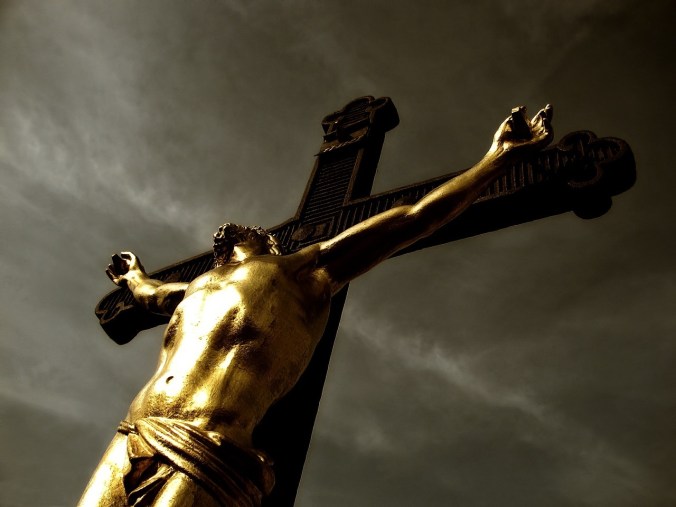
Cross Dark

Matthew 27:46 “About the ninth hour Jesus cried out in a loud voice, “Eloi, Eloi, lama sabachthani?”–which means, “My God, my God, why have you forsaken me?”

Every word Jesus had spoken from the cross up to this point had been shockingly positive: a word of forgiveness, a promise of paradise, expressions of love for mother and friend. These words are shockingly frightening: “My God, my God, why have you forsaken me?” And in them we get a glimpse of the true nature of both sin and salvation.

What does sin look like, really? Ordinarily we see sin dressed in all its glittering promises, its true face hidden behind inches of make-up that disguise its grotesque and hideous appearance. Its promises of pleasure and power enchant us and draw us like a moth to a light. No amount of warning can completely convince us that the gorgeous young lady we think we see is really an ugly and deadly old hag.

Here Jesus unmasks sin. Here he shows us where it really leads. Here he suffers its true consequences in our place, not the fake promises it makes. Forsaken, utterly forsaken by God. How this is even possible for the divine Son of God defies all human explanation or understanding. There is nothing so dreadful, so terrifying, so unbearably painful in all of human experience as the total abandonment, the God-forsakeness, that Jesus endures for our sins here. His question is not, “Why have you crucified me?” or “Why have you turned me over to my enemies?” or “Why have you let me suffer such torture and pain?” It is “Why have you forsaken me?” The extremely depressed think that God has left them. That is only their faulty perception. Jesus alone, of anyone still alive on earth, knows the real abandonment of God. He alone knows the difference between little hope, imperceptible hope, and absolutely none whatsoever. He alone knows what it is that not a single sensation anywhere in the body or in the soul can perceive anything good or even tolerable, with no prospect of relief. This is sin carried out to its natural and logical consequence. This is hell, and the remote prospect of suffering what Jesus expresses here ought to be, to borrow a phrase from C.S. Lewis, enough to send any soul flying to its prayers in nightmare terror, pleading to be spared.

Yet here we see the true nature of salvation. This is how much God loved you. God so loved the world that he gave his one and only Son…to this. God’s love is measured by something infinitely greater than a willingness to bear crucifixion for you. Thousands of people have been crucified throughout history. Only one endured the God-forsakeness of the damned in hell for you.

Jesus’ words here may seem heavy, not light. They may seem more serious and somber than joyful and uplifting. But they are still good news. For you who believe, they are a promise that there is not even a remote prospect of suffering what Jesus expresses here, for God has forsaken him to embrace you and me.

It Kills to Give You Life

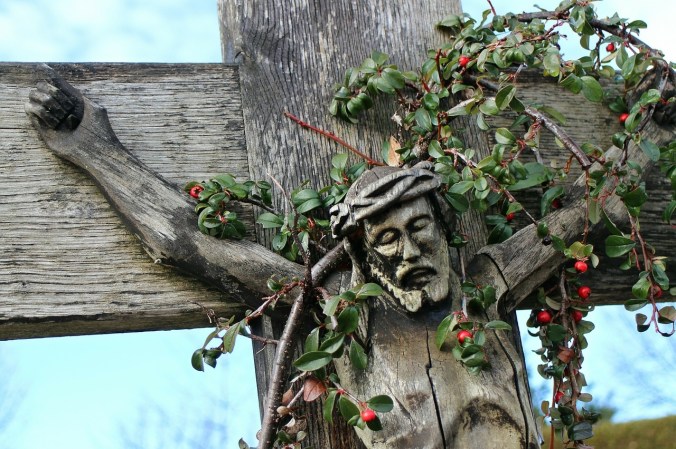
Crucifix Vine

Colossians 2:13-14 “When you were dead in your sins and in the uncircumcision of your sinful nature, God made you alive with Christ. He forgave us all our sins, having canceled the written code, with its regulations, that was against us and that stood opposed to us; he took it away, nailing it to the cross.”

Guns were created for one purpose: to kill. I am not trying to wade into our nation’s debate about the Second Amendment and public safety here. I am simply stating a fact. Guns are the instrument of choice for so many who have a need or desire to kill. It would be rare or strange to think of them giving life.

Crosses were made for one purpose: to kill. Thousands of people were executed on crosses during the reigns of the Roman emperors. It was a form of execution designed to be a deterrent to the worst kinds of anti-empire rebels among the conquered peoples. The sheer agony of dying this way was meant to scare people into submission. Crosses were made to kill. It would have been strange to think of them giving life.

But that is the way God works. He does what is unheard of. He uses things in ways no one would have ever imagined. In God’s hands, the cross doesn’t kill us. The cross makes us alive.

Jesus’ cross makes us alive by its power to cancel the accusations of God’s law against us. Spiritually, the cross couldn’t kill us because we were already dead. The funny thing is, by nature people think that they are already alive. They think they love God, but the God they think they love is not the One who really exists. They think they love the God who makes pretty flowers; and paints the sky a gorgeous combination of yellow, orange, red, and deep blue at sunset; and lets them fall in love. They are convinced this God has easy standards and overlooks their rather obvious moral failings.

That God is only a myth. It’s true that God paints the flowers and the sky. But the real God punishes every sin and damns men in hell. By nature, people don’t love that God. They fired that him long ago. They hate him, like Thomas Jefferson, who said that a God who damns men in hell is a monster, not a God.

Or they hate him because he lets them fail, and suffer, and even die. They hate him because he lets them go blind and they can no longer see the beauty he has made. They hate him because they never find a special someone to love them, or those who once did turn on them. They hate him because everyone else has so much more, so much easier, so much better. That’s spiritual death, and it is the natural condition of everyone born into this world. It chokes our spiritual life, and fill us with hate for the God who punishes every sin.

But “God made you alive with Christ. He forgave us all our sins, having canceled the written code, with its regulations, that was against us and that stood opposed to us; he took it away, nailing it to the cross.” God punishes every sin, but in the gospel he reveals that he has punished every sin in his Son on the cross. The very cross that brought Christ death makes us alive! The written code of God’s law was like an eager executioner, happy to deal death to each derelict who crossed its path. The law isn’t just a definition of right and wrong. It is also the enforcer of the just consequences of breaking it. And the wages of sin is death.

But God has canceled the written code by nailing it to the cross. We are familiar with the power of a cross to cancel life. We have read the next-to-last chapters of the gospels often enough; we have sung enough hymns about the cross to be thoroughly familiar with its power to sap Jesus’ life from him. The cross was created to kill people, and it fulfills its mission without fail.

Thank God it does! There was more than the body of Jesus Christ hanging on that cross the day he died. You remember another passage Paul wrote to the Corinthians? “God made him who knew no sin to be sin for us, so that in him we might become the righteousness of God.” Jesus was our sin hanging on that cross. Or Peter’s words? “He himself bore our sins in his body on the tree.” The law had its day in court at the cross of Jesus Christ. There our executioner was satisfied. There our executioner was silenced. The demands of the written code for our death were cancelled, because its demands were completely met at the cross.

There the demands of the written code also die. You probably know that honey bees only sting a victim once, and then they die. The barb on the stinger tears it from the bee’s body, tearing open its abdomen, and it cannot survive the injury. The law injects its deadly sting only once. There is no double jeopardy. After it has killed once, the written code loses its power. It dies with Christ at the cross, cancelled by its power, nailed there forever. And so the same cross that kills Christ and cancels the threat of the law makes us alive.

That’s how an instrument of death became our source of life that cannot end.

Watch and Pray

Pray over Bible

Matthew 26:40-41 “Then he returned to his disciples and found them sleeping. ‘Could you men not keep watch with me for one hour?’ he asked Peter. ‘Watch and pray so that you will not fall into temptation. The spirit is willing, but the flesh is weak.’ He went away a second time and prayed, ‘My Father, if it is not possible for this cup to be taken away unless I drink it, may your will be done.’”

Was it so much to ask, to sacrifice just a little sleep for the love of the Savior who was about to suffer what no other person has ever suffered, who was about to bring all history to its climax and save a fallen world? Jesus had been teaching them for three years. He had spoken to them for several hours this very night about the things that were about to happen. Did they still have no sense of the importance of this night or of the sacrifice it would require of him? Did they have no sense of their friend and Master’s burden? Keep watch for Jesus? They needed to watch and pray for themselves and their own weakness. Their loveless neglect only made Jesus’ heavy load heavier, his sorrow deeper, his prayer more difficult.

What is our great sin against Jesus, his suffering, and his sacrifice? Is it not our own failure to appreciate the magnitude of what he did, our own neglect of the centerpiece of his saving love? We don’t fall asleep, at least not usually. It’s worse. Jesus’ suffering and death bores us. We get all excited about a bunch of grown men chasing a ball around a field or across a court. Our heart rate soars, we scream, we cheer. We will watch for hours and hours. Our attention is riveted to the news when people are senselessly or tragically killed in the latest crime, war, or natural catastrophe. The news anchors can give the same five-minutes worth of details hour after hour, and yet it’s hard to pull away from the TV. Perversions of God’s good gifts of sex and beauty are like magnets that would pull our eyes right out of their sockets if they weren’t attached.

But when the eternal God makes himself a mortal man, and he stands in our place, and he lets himself be abused by the very people he came to save, and he submits himself to outrageous indignity and injustice, and for me he lets himself be nailed to a cross, and for me the blood pours from his body, and for me he endures wages of my sin, and for me he breathes his last, we yawn. It’s an old story. It’s a familiar story. “Tell me something new, something upbeat with a little more action.” No, watch and pray. Don’t let the temptation to find this all common and ordinary lead us to miss the greatest gift and deepest love we have ever been given.

The urgency and obedience of Jesus’ own prayer stands in stark contrast. “He went away a second time and prayed, ‘My Father, if it is not possible for this cup to be taken away unless I drink it, may your will be done.’” “May your will be done.” That makes Jesus’ prayer a true prayer, prayed in faith–not an attempt to push God off his throne, not an attempt to change the changeless God, not an attempt to dictate terms to the Almighty, but a prayer. True prayer trusts God’s will, and accepts that God’s will is better than my own even though it may mean pain, discomfort, disappointment and apparent defeat. There are worse things than suffering. God often does his best work through suffering, maybe even usually does his best work through suffering. “We also rejoice in our sufferings, because we know that suffering produces perseverance; perseverance, character; and character, hope,” Paul wrote the Romans. Jesus’ suffering was the salvation of the world. “May your will be done.”

Jesus was a man of prayer. He prayed to be spared the agony of the cross, but mostly he prayed his Father’s will. And so he came to the cross. Three of his seven statements from that cross were prayers. And now he lives to pray for us, prayers that are heard, because he carried and buried our sin’s heavy load.

Do You Think Jesus Loves You?

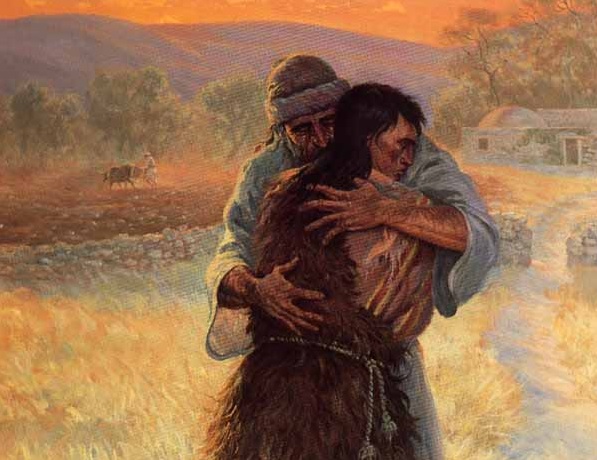
Prodigal.

Revelation 3:9 “I will make them come and fall down at your feet and acknowledge that I have loved you.”

“Do you think Jesus loves you?” The answer to that question makes all the difference in the way we perceive our lives.

“Do you think Jesus loves you?” Isn’t our inability to say “yes” the reason we find sin so appealing? The question was implied in the very first temptation when Satan told Eve, “For God knows that when you eat of it your eyes will be opened, and you will be like God, knowing good and evil.” “God is holding out on you! He is keeping you down! He is spoiling your fun! He doesn’t love you!” As long as we aren’t sure that Jesus loves us, we will not be sure his commandments are meant for our good. We won’t be able to see the sense in sacrificing our immediate gratification for a code of conduct we find difficult to understand. People turn to alcohol and drugs because they aren’t sure Jesus loves them. People “hook up” sexually with those to whom they are not married because they aren’t sure Jesus loves them. People bail out of their marriages, rebel against their parents, and lie their way out of trouble because they aren’t sure Jesus loves them. If they were sure Jesus loves them, they would trust him when he tells them what they’re doing is hurtful and wrong.

“Do you think Jesus loves you?” Isn’t our uncertainty the reason we find our present circumstances so hard to bear? We instinctively believe that good times are a sign of God’s favor, and that hard times are evidence he doesn’t care anymore. But the Bible teaches us the opposite is often true. Experience should teach us this as well. Almost everything good God ever did for his people came out of hardship, difficulty, and suffering. Abraham, Joseph, Moses, David, Jonah, Daniel, Paul, and many others all learned this lesson by personal experience. They persevered because they knew Jesus loved them. When that is our conviction, then we know that our present sufferings are not worth comparing with the glory that will be revealed in us (Romans 8:18). Then we can declare that if God is for us, who can be against us? He who did not spare his own Son, but gave him up for us all—how will he not also, along with him, graciously give us all things? (Romans 8:31-32). Then we can be assured that after we have suffered a little while, the God of all grace will himself restore us and make us strong, firm, and steadfast (1 Peter 5:10).

“Do you think Jesus loves you?” Isn’t our doubt the reason we fear what the future holds? Our fear and uncertainty paralyze us. We convince ourselves we are doomed. We are afraid to move ahead. But if Jesus loves us, will he really stand idly by while our world crumbles and we are lost? Paul once confessed, “The Lord will rescue me from every evil attack and bring me safely to his heavenly kingdom” (2 Timothy 4:18). Not even the future can separate us from the love of God that is in Christ Jesus our Lord.

“Do you think Jesus loves you?” The purpose for asking is not to cast doubt on the fact. It is to remind us of a truth most of us have known for a long, long time. Yes, Jesus loves me. The Bible tells me so. Greater love has no one than this, that he lay down his life for his friends. In his death for our forgiveness we begin “to grasp how wide and long and high and deep is the love of Christ” (Ephesians 3:18). That gives us courage to live his way now, and certainty we will live in his home forever. Then, he promises, even our enemies will have to “acknowledge that I have loved you.”

Listen and Live

Listen

Deuteronomy 4:1 “Hear now, O Israel, the decrees and laws I am about to teach you. Follow them so that you may live and may go in and take possession of the land that the LORD, the God of your fathers, is giving you.”

Some people are worth listening to. Your doctor is generally someone worth listening to. Take ALL the medicine in the bottle until its gone, even though you feel better, and you won’t end up with a relapse twice as bad as the original illness. Take it easy for a few weeks after surgery, even though you feel no more pain, and you won’t land yourself back in the hospital with complications. Your parents–your parents are people worth listening to. How many of us had parents who told us not to jump on the bed? But how many of us banged our heads on the headboard, or on the floor, or on another brother or sister because we were jumping on the bed?

The Lord God is one person who is always worth listening to. Others may occasionally steer us wrong, even the doctor, even our parents. But when we listen to the Lord, we always come out smelling like a rose.

One reason to take God’s word seriously is that he takes it so seriously himself. It’s not so obvious in our English translation, but the word for “decrees” literally refers to something carved or etched into something solid. That makes us think of the ten commandments which were carved into stone. What was God telling us about how he felt about his commandments when he chiseled them into two sheets of rock? They could have been written on scrolls like the rest of the five books of Moses. But even after Moses broke the first set of stone tablets in the golden calf incident, the Lord insisted the commandments be carved into stone again. In stone they would not fade, they could not be erased, and they could not be changed. We still use the phrase “set in stone” today to refer to something which cannot be changed. God is serious about his word!

If there was any doubt about that among his people, look at the conditions he placed upon following his commands. First, he says follow them so that you might live. By “live” he is not talking about having an enjoyable lifestyle, a desirable standard of living. By “live” he means the difference between life and death. In essence he was giving his people a choice. “Follow my commands, and I will permit you to stay alive. Break them, and I will wipe you out and destroy you.” God means serious business!

Then the Lord conditioned their earthly happiness upon keeping his commands. He told Israel to follow them “so that you may go in and take possession of the land that the Lord, the God of your fathers, is giving you.” The last time Israel had a chance to take possession of the promised land had been forty years earlier. When they disobeyed him and refused to trust him, they ended up wandering in the desert for forty years instead. Again, when God says, “Listen,” he wants to be taken seriously.

The Lord is no less serious about his commandments today. They are not suggestions or “voluntary initiatives” as one humanist has called his set of ten replacements. Choosing to break what God has commanded still invites the Lord’s anger. Those who insist on living in some sin are only adding to their own misery and making life more miserable for those around them. The Lord designed each of his commandments to take care of us in some way. Breaking them may result in short term pleasure, but it leads to long term pain.

Though we take God’s word seriously, none of us keep his commandments perfectly. All must confess their failure. For Jesus’ sake the Lord does not condemn us. For Jesus’ sake he forgives those who repent. As Paul preached to the synagogue in Pisidian Antioch: “Through him everyone who believes is justified from everything you could not be justified from by the law of Moses” (Acts 13:39). God’s word also teaches that he is loving and forgiving. That makes us desire to take his word all the more seriously and keep his commands. People to whom God has revealed himself as their Savior and Redeemer find in him the power to do so.

Listen, and Live!

True Glory

Sunbeams

2 Corinthians 4:4 “The god of this age has blinded the minds of unbelievers, so that they cannot see the light of the gospel of the glory of Christ, who is the image of God. For we do not preach ourselves, but Jesus Christ as Lord, and ourselves as your servants for Jesus’ sake. For God who said, ‘Let light shine out of darkness,’ made his light shine in our hearts to give the light of the knowledge of the glory of God in the face of Christ.”

“The light of the gospel of the glory of Christ”–that is a long, descriptive phrase. Paul is helping us to see Christ’s most important thing, his true glory. When many people think of glory, they think especially of God’s brilliant, blinding light that shines whenever he appears. We have Jesus shining like lightning at his Transfiguration. We have Moses face shining with the reflected glory of God, the glory his face absorbed from standing in God’s presence on Mount Sinai. When many think of God’s glory, they think of God’s holiness, his power, the things that put him at a distance from us and lift him far above us.

But one’s glory is closely tied to one’s reputation, the best thing about someone. That isn’t always what we expect. Maybe you saw a children’s movie a number of years ago based on the comic book character Ritchie Rich. The plot is based around Ritchie Rich trying to make friends, and thieves trying to break into the family vault to steal the Rich-family fortune. When the thieves finally get into the vault, they find nothing but cheap family memorabilia: old baby books, and photo albums, and school awards, and baby clothes. Ritchie’s parents, who have been bound and taken hostage, explain to the thieves that these things were their true treasures. They didn’t keep money and jewels in the vault. That wasn’t nearly so valuable.

In a similar way, the most important thing about Christ, his true glory, is not found in the power by which he controls the weather, heals diseases, and feeds the thousands. It is the gospel, the story of Jesus’ self-sacrificing love to save us. Paul wrote the Corinthians in his first letter to them, “Now, brothers, I want to remind you of the gospel I preached to you, which you received, and on which you have taken your stand. By this gospel you are saved….For what I received I passed on to you as of first importance: that Christ died for our sins according to the Scriptures, that he was buried, that he was raised on the third day according to the Scriptures…” (1 Corinthians 15:1-4). That is the glory of Christ.

“Your attitude should be the same as that of Christ Jesus: Who, being in very nature God, did not consider equality with God something to be grasped, but made himself nothing; taking the very nature of a servant, being made in human likeness. And being found in appearance as a man, he humbled himself and became obedient to death, even death on a cross! Therefore God exalted him to the highest place…” (Philippians 2:5-9). That is the glory of Christ.

In the halls of heaven the holy ones sing to Christ the Lamb, “You are worthy to take the scroll and to open its seals, because you were slain, and with your blood you purchased men for God from every tribe and language and people and nation” (Revelation 5:9). That is the glory of Christ.

“No one has greater love than this, that he lay down his life for his friends” (John 15:13). That is the glory of Christ, the substance of the gospel, the light that needs to shine from every pulpit and Christian classroom.

That is why “…we do not preach ourselves, but Jesus Christ as Lord, and ourselves as your servants for Jesus’ sake.” Jesus Christ, the Lord of love, the Lord of life, the Lord of salvation, is the substance of our message. If you do not find that gospel ringing in the preaching to which you listen, find someplace else to worship. If your children do not find that gospel shining on them in their Sunday School, find someplace else to take them on Sunday morning.

The glory of this gospel is not measured by crowd size or church growth. It can’t be proved by numbers on the church’s balance sheet. Changed hearts aren’t always as evident as we might like in visibly changed lives. But something shines, something burns in a heart that wasn’t there before. A child of God knows Jesus, and that light allows him to remain Jesus’ own forever and ever.

Let the Gospel Light Shine.