Good Timing

Time Middle East

Galatians 4:4 “When the time had fully come, God sent his Son, born of a woman, born under law, to redeem those under law, that we might receive adoption to sonship.”

Some might be tempted to question Paul’s intelligence when he asserts, “When the time had fully come, God sent his Son…” This was good timing? God chooses the ninth month of Mary’s pregnancy to coincide with a government mandated journey of over 100 miles, quite possibly made by this young couple on foot? I remember our family going camping just 25 miles from home when my mother was 8 months pregnant, and that was with all the modern amenities of travel by car. It may have been the low point of our camping experience. Jesus is born when the inns of Bethlehem are filled to overflowing because of the census, and Joseph, who as a carpenter could otherwise provide for his family reasonably well, is forced to take his wife to a stinking shelter for animals for labor and delivery? There is no doctor or mid-wife to assist? What does a carpenter know about these things? Perhaps we could forgive Mary and Joseph if God’s timing seemed a little less than “full” to them.

Then we remember that when God sent us his own Son, he sent him on a mission, with a purpose. Over the centuries the Lord had made dozens of prophecies in anticipation of this birth. As the years rolled along, he quietly drove the course of history so that one by one these prophecies could be fulfilled. In fact, this little excursion to Bethlehem neatly fulfilled one of the promises God had made about location of his Son’s birth. “But you Bethlehem Ephrathah, though you are small among the clans of Judah, out of you will come for me one who will be ruler over Israel, whose origins are from of old, from ancient times” (Micah 5:2).

When we look beyond this little family, what about the timing for the nation of Israel, or for the greater world around it? Politically and spiritually, Israel was at another low ebb in its history. The nation had lost its independence to the Empire of Rome, and for all practical purposes the throne of David had disappeared. There was still a little remnant of true believers in God’s promises of a Savior from sin, but in the hearts of most there was a full scale rebellion going on. It showed itself in a religious formalism: going through the motions of their faith in an outward way for traditional reasons. They looked pious on the outside, but there was no love and no sense of need for God within. In others it showed itself in a general disinterest in the faith and slide into immorality. Does this seem like a strange place for God to send his Son? Does one send a baby to quell a rebellion?

But then we remember that God sent us his own Son on a mission, not to save the state of Israel from the shame of political insignificance and foreign control, but to save the people of Israel, and the people of all the world, from the shame of sin and unbelief. Roman roads and the law and order that the empire maintained were superior ways for taking Jesus’ message of faith to the world. And the work of a Savior is not to congratulate the spiritually strong, but to heal the spiritually wounded, strengthen the spiritually weak, and to raise the spiritually dead. What better time for the doctor to arrive than when the waiting room is full? When God sent us his own Son, the time had fully come.

Does God’s sense of timing at Christmas offer us any comfort today? This past year has seen more than its share of troubles: terrorist attacks and mass shootings, celebrity scandals, political unrest, the threat of war, and the countless daily irritations with which we have had to contend. Is anyone running this show? Why this? Why now?

Then we remember that the one who sent us his own Son has a plan and a purpose for each of us. Ultimately that plan has less to do with making us comfortable here than it has to do with getting us out of here. From where we stand, we do not share God’s perspective, his long range view, and his timing is difficult to understand. When we get the pieces of the puzzle that makes up our lives one at a time, we cannot see the completed picture on the box our Lord is looking at. But then among the many other promises of Christmas we find this one: God doesn’t sit in heaven waiting for things to fall into place, hoping he will find just the right situation to carry out his plans. He drove the course of history for thousands of years, he directed the rise and fall of entire empires, to make sure that the setting into which he sent his Son to save us was just right. He who so loves us, who worked so hard and labored so long to save us from our sins, continues to direct the times and events that work toward our salvation today.


Glory and Love

Glory

“The Word became flesh and made his dwelling among us. We have seen his glory, the glory of the One and Only, who came from the Father, full of grace and truth.” (John 1:14).

Dr. Paul Brand’s mother did not live a typical life. Though she was born in a magnificent, mahogany trimmed house in London, she settled for a portable hut, eight feet square, for her home. Though once people told her she looked like an actress, her face was weathered by the sun, toughened into a leathery texture. For the last twenty years of her life she refused to keep a mirror in her home. She suffered frequently from malaria and walked with a limp because of injuries she had sustained in a fall. Yet, when her son, a doctor, asked her to come live with him, she replied, “If I leave, who will help the village people? Who will treat their wounds and pull their teeth and teach them about Jesus? Why preserve this old body if it’s not going to be used where God needs me?” She is practically unknown in the world. One would hardly consider her life glorious.

We seldom associate glory with characteristics like humility, poverty, kindness, or sacrifice. Glory belongs to the powerful, not to those who serve others. Glory belongs to the aggressive who take what they want and promote their own cause, not to those who quietly spend their time making life better for others. Glory belongs to those who possess obscene wealth, not to those who barely enjoy the minimum necessities of life.

But God views things differently, and so do his people. Why have the events of Christmas received so much attention? Why have so many artists been inspired to portray the events of this night on canvass? Why have so many musicians been moved to compose their songs of praise and joy for this occasion? Where is the glory that makes Jesus’ birth so special?

The answer to these questions is this: The glory of Jesus’ birth is not merely the greatness of someone like the woman whom I described before, someone who is willing to put aside her own comfort to help others. The glory of Jesus birth is that all the glory of heaven–the glory of God himself– has come to live with us in the form of this helpless child born to this homeless family. Here we see God’s love for us in all its glory, God’s love with us in all its glory, in the events described by Luke, explained by John, and proclaimed in the songs we sing this season. Here God’s greatness and his closeness meet.  Here the glorious God stoops to save us. As this glory inspires our awe and reverence this Christmas, may it also assure us of his incomparable love.

Go Ahead…Rejoice!

Celebration

Psalm 14:7b “When the Lord restores the fortunes of his people, let Jacob rejoice and Israel be glad!”

David does not say “IF God restores the fortunes of his people…” He emphatically says “WHEN.” There was no question in his mind that someday the Lord would come and save his people. It was only a matter of time.

And David had good reason for such firm confidence. The whole history of his people is an object lesson in God’s faithfulness. Time and time again the Lord came to the rescue. He restored their fortunes by leading them out of Egypt, leading them out of the wilderness, defeating their enemies in the promised land. David himself had been God’s tool to defeat Goliath, defeat the Philistines, and give his people a settled peace. David’s faith in God’s great and future salvation was firm.

What is our faith this Christmas season? Is it that big fat red guy? Is it in some vague spirit of the holidays?

Or is it in the promises of Scripture and the Savior who has come? We look back on salvation accomplished, not in future hope like King David. Note how God is inviting us to trust him as he appears to us in Bethlehem. This is not the thunder and lightning and booming voices and smoke and clouds with which he appeared at Mount Sinai. This is God so loving us that he joins us in all our human poverty and weakness. This is God as a little human baby. And what could be more appealing, more approachable, and more lovable than a little baby? When we understand what really happened at Christmas, its message leads us to trust in God all the more.

People who believe that Jesus is God come to live in our world, to rescue us from sin, to deliver us from our troubles, and to take us to heaven can’t be “ho-hum” about Christmas, can they? Think of the joy it gave the shepherds, who ran through Bethlehem telling others; or Mary, Zechariah, or Simeon, who were moved to compose spontaneous songs of praise about God’s goodness in keeping his promise; or the magi, who traveled hundreds of miles to worship him.

The rejoicing and gladness of which David speaks describe a joy that infects a person’s whole heart, mind, and soul, a joy which wants to express itself vigorously throughout our whole bodies and lives. You can smile, and even laugh, this Christmas season. It’s okay. You can sing the Advent and Christmas hymns at the top of your lungs. No one will mind, even if you do sing a little off key. You can go all out in your decorating, and you can feast and celebrate without feeling guilty, because God has sent us a Savior, and that gives us joy.

Renewing our Longing

Homeless

Psalm 14:7 “Oh, that salvation for Israel would come out of Zion!”

My parents used to wait until just a day or two before Christmas to put the presents under the tree so that they wouldn’t have to put up with us kids begging them to let us open this or that gift early. Already as children we have greedy reasons for wanting Christmas to come.

A large number of people long for Christmas to come just to get the season over with. December crams more traffic, longer lines, and more activities into lives which are already too full. For some people, the Christmas season may seem to bring as much stress as it does fun.

King David was filled with longing for other reasons. He doesn’t mention Christmas by name, but it was the events of Christmas he longed for just the same when he says, “Oh that SALVATION for Israel would come out of Zion!” David longed for salvation. He longed for God to send him a Savior. David was not unaware of the fact that God already forgave him for the sake of his coming Savior. But he longed for the day when God’s promises would be fulfilled. He wanted the historical events upon which our forgiveness and eternal life would be based to become accomplished facts. His hunger for such things grew out of his deeply felt need to be saved from his sin and saved from this world, and his heart-felt appreciation for how good God was to promise him this.

We would like to long for Christmas, and long for Christ, like David did, too, wouldn’t we? We would like this to be a special event that moves our hearts like his was obviously moved. When we hear other people give gut-wrenching, heart-tugging testimonies of God’s grace to them, and they speak in such a way that it is clear that Jesus means more than anything, we want to get some of what they have. We want to find Jesus so moving. But how can we long for our celebration of Christ’s birth like David longed for its first coming?

They say that hunger is the best cook. We share that hunger which makes Christmas a savory feast when we understand our need for the gift that God is giving to us. Christmas is about salvation. Salvation is about being in the greatest of danger, the most desperate of situations. We find ourselves absolutely helpless, faced with certain death, when all of a sudden God himself swoops into our world, and he plucks us up, and he carries us in his arms to safety. Jesus’ birth is God swooping into our world, and his outstretched arms on the cross are the arms that pick us up and carry us to safety. But I will never appreciate the great danger I was in, nor the heroic rescue which God has made, unless I understand that what got me into this predicament in the first place was my own sin.

Advent is what we call a penitential season. As much as it anticipates our Savior’s coming, it leads us back to why he had to come. I am a sinner. I’m not just a diamond in the rough, a real jewel with a few rough edges that need to be smoothed. By myself, I am helplessly lost, a hopeless case. King David knew that, and he longed for God’s salvation. It meant something to him. Christmas will be meaningful for us, and we will long for its message of God’s grace to come to us again, when we see and feel that God’s salvation is something which we really need. Renewing that longing is part of the Christian way to wait for Christmas.

Our Spirit-filled Savior

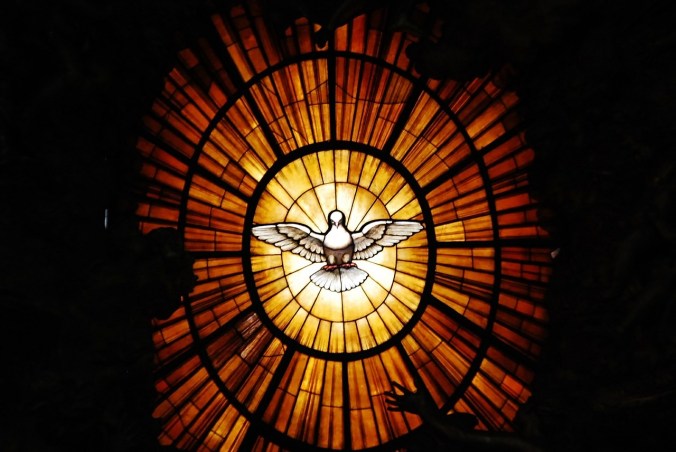
Dove Glass

Isaiah 11:2 “The Spirit of the Lord will rest on him– the Spirit of wisdom and of understanding, the Spirit of counsel and of power, the Spirit of knowledge and of the fear of the Lord.”

The Holy Spirit specially equipped and accompanied Jesus for his work of saving us. Three of the extraordinary powers Jesus possessed have to do with his thinking processes. He had a Spirit of wisdom, of understanding, and of knowledge. Some of what we know, how we understand things, and the wisdom to apply it we can get from books. Some we get from the school of experience. But there is also a wisdom that only the Spirit of God can teach us.

This is the wisdom that doesn’t sugar coat the human condition. It isn’t afraid to call a spade a spade, to acknowledge the way things really are, to diagnose the human dilemma in all its utter hopelessness. This is the wisdom that says “every inclination of man’s heart is evil.” “There is no one who does good, not even one.” “No one will be declared righteous in God’s sight by observing the law.”

And isn’t that just the wisdom that earned Jesus so many passionate enemies? The religious leadership of his day didn’t hate him because he taught a different 10 commandments, but because he refused to let them live in their delusion that they were keeping the ones that he and they agreed on. Jesus blew them away by suggesting that they weren’t good enough to save themselves.

Are we in any position to think that we are wiser than Jesus thousands of years later? Has the human race really become so much kinder and better and purer and more generous? Haven’t our sins and imperfections in many ways become magnified over the past couple of thousand years?

Jesus’ wisdom shows us how desperately we need a Savior, and how gracious God has been to send the Savior we need. He doesn’t hold out the perpetual uncertainty of self-improvement. “Have I ever done enough?” He holds out the certainty of a perfect substitute. Christ has done it all! His own words promise, “whoever believes in him will not perish but have everlasting life.”

And don’t judge this book by its cover. He may have a humble background, but the Lord poured out on him a “Spirit of counsel and of power.” No matter how long you look at the manger at Christmas, your eyes will see only a helpless baby lying there. Yet that little baby had the power to turn shepherds into preachers. No matter how long you stare at the grown man, no longer an infant resting in a manger, but suspended from a cross of wood, you will see only the battered body of a dying man. Yet that death has the power to turn sinners into saints and lifeless corpses into immortal creatures of heaven.

Our world has never known another power like this one. Sometimes we fear power, because power is so often abused. But we can trust this new king in David’s royal line because he wields it in “the Spirit of knowledge and the fear of the Lord.” Jesus was not afraid of his heavenly Father. He is simply the only one who has ever treated him with the full respect and honor he deserves. Only he has lined up every moment, every feature, every purpose of his life with the will of our Father in heaven. And Jesus reveals that the will of the Father is simply this:  “that everyone  who  looks to the Son and believes in  him  shall have eternal life, and I  will  raise  him  up at the last day.”

The fear of the Lord brings us full circle to the first of the gifts the Spirit poured out on Jesus. “The fear of the Lord is the beginning of wisdom” (Proverbs 9:10). May faith in this Spirit-filled Savior fill us with the same Spirit-born gifts!

Humble by Choice

Stump

Isaiah 11:1 “A shoot will come up from the stump of Jesse; from his roots a Branch will bear fruit.”

Jesse, as you probably know, was the father of King David. David began a royal dynasty in Israel that provided kings for 350 years. But over the years the proud family tree David established fell into decline. Many of the kings abused their power. Many ruled selfishly instead, not in the interest of God’s people. Some became idolaters and even used their position to lead God’s people into idolatry.

That is what led to God’s judgment upon the nation and the royal family. First he tore the nation in two by civil war. Later he let foreign nations invade. Eventually the capital city was burned to the ground and the best and brightest people taken into exile. Only a handful returned 70 years later.

All that was left of the proud tree David started was a stump. When Jesus was born, there had been no kings in the family for more than half a millennium. There was nothing to suggest this family would ever produce a person of influence again.

The surprising thing about Jesus’ background is not his family’s slide into obscurity or his now humble roots. History is full of stories of peasants and paupers who rose to become great leaders. Think of the stories we learned about Abraham Lincoln in grade school. He grew up in a log cabin. He was schooled by his mother at home. His early life didn’t include the kind of grooming some have had to prepare them for national leadership. Yet he rose to become one of the most influential presidents our nation has ever had. That career path is not unique. We could multiply stories of inventors and explorers and businessmen and statesmen and churchmen who rose from obscurity to change the world.

What stumps us about Jesus’ background, at least from a worldly point of view, is that he had a choice. While others worked their way up, Jesus was, in a very real sense, working his way down. From heaven he oversaw the events that led to his family’s fall from power. He guided the history that went into his being born in a stable instead of a palace, that went into growing up learning carpentry instead of statecraft.  Other great men of history may have appreciated the lessons they learned from having humble beginnings. I doubt that they would have chosen such circumstances for themselves. Jesus chose to leave his heavenly throne, and to remove his family’s earthly throne, before he became the new shoot on Jesse’s humble family tree.

Would you? Isn’t our life so often about bettering our position? Don’t we pour ourselves into making our lives easier? Doesn’t so much of what we do revolve around making things as comfortable for ourselves as we can? And doesn’t this so often lead us to a rather selfish approach to life in which we attempt to make ourselves the center of our universe and the god of our own little world?

But though Jesus truly is God, he came to serve. He came to save us from the sinful life and selfish little universe we try to construct for ourselves. And in order to do that he had to become one of us and die in our place. His humble background helped assure that nothing would obstruct his mission. Earthly power and riches never got in the way of people killing him. It also helps assure us there is no one so low or so obscure they are beneath Jesus’ saving work. Jesus was common and ordinary and human, just like you, and just like me. And so we are qualified to be the common and ordinary human beings he came to rescue and make his own.

Isn’t that what rivets our eyes on Christ as we prepare to celebrate his birth? Jesus’ humble background is not just a great human interest story for the 10 o’clock news. It is the story of unfathomable love willing to give up every earthly advantage, and eventually life itself, to set a world of sinners free. He chose this humility, because he chose to make us his family. We are the fruit produced by this lowly branch.

Wrestling with God’s Word

Peniel

Luke 11:28 “Blessed rather are those who hear the word of God and keep it!”

Do you ever find the Bible frustrating?

Perhaps you have tried to read it cover to cover before. Things started well. Genesis was easy reading, because it covered the lives of real people, and there was plenty of action, intrigue and adventure. Exodus started out much the same way. But by the end of Exodus, page upon page of laws and instructions for ancient worship became tiresome. Leviticus was just too much. Its list of rules and regulations for the Israelites was sometimes hard to make any sense of. “This was once what faith in God was all about!!?” You put it down, and never started it again.

Or maybe you have visited Bible class before, but they had been studying this topic for three weeks already, and it was obvious that if you didn’t attend those first class periods, what followed wasn’t going to make much sense. “What was that exinanition of Jesus thing again?” At other times the class was starting a topic that didn’t have any immediate connection to your life. “Almost everyone I know and work with is a Christian. I live in a free country. Why do I need a class on dealing with persecution?”

Or maybe you have tried to start those home devotions that you always feel guilty about not having. But you didn’t feel sure of what you were doing, the kids were antsy and didn’t pay attention, and the whole experience seemed more irritating than uplifting. “This is supposed to strengthen my faith!!?”

Do we just give up?

Jesus pronounces blessing on those who hear God’s word and “keep” it: hold it dear, trust it, and strive to put it into practice. God’s promise through Isaiah still stands, “My word…will not return to me empty, but it will accomplish what I desire and achieve the purpose for which I sent it” (Isaiah 55:11).

Time with God’s word is never wasted time. Ever. That is God’s promise.

But this does not mean that time with God’s word will always be a warm and wonderful experience. It doesn’t mean that reading or studying God’s word will always be an easy thing. In fact, sometimes it may simply be hard work. But isn’t that true of many lesser activities that are good for us?

At times we need to approach our study of God’s word and trust its promise to bless us in much the same way that Jacob approached the Lord himself when he wrestled with the Lord at Peniel (Genesis 32:22-32).

When Jacob was returning home and about to face his estranged brother Esau, the Lord appeared to him at night as a man and the two wrestled with each other all night until dawn. “When the man saw that he could not overpower him, he touched the socket of Jacob’s hip so that his hip was wrenched as he wrestled with the man. Then the man said, ‘Let me go, for it is daybreak.’ But Jacob replied, ‘I will not let you go unless you bless me’” (Genesis 32:25-26).

Jacob’s experience was a painful one, but he held on. He held on and would not let go of the Lord until he received his blessing. As much as this was a physical struggle, it was a struggle of faith. And Jacob’s faith was blessed: “Your name will no longer be Jacob, but Israel, because you have struggled with God and with men and have overcome.”

In the same way, when we are wrestling with God’s word–struggling to study it–and it doesn’t come easy, let us take a hold of that word and hold on to it in faith and not let go until it blesses us. God promises us it will. Maybe the blessing won’t be immediately obvious and maybe it won’t be the blessing we had in mind, but bless us it will. “Learn of me,” Jesus promises, “and you will find rest for your souls.”

The Voice – Special Christmas Edition

John the Baptist

Luke 1:13 “But the angel said to him, ‘Do not be afraid, Zechariah; your prayer has been heard. Your wife Elizabeth will bear you a son, and you are to give him the name John.’”

Some have the impression miracles and angels appeared all over the place in Bible days. But no one was more shocked to be visited by an angel than Zechariah. He lived at the end of what has been called the 400 silent years. It had been 400 years since the Lord had even sent his people a prophet. No doubt Zechariah believed in angels, but this sort of thing just didn’t happen anymore. Yet here he was, standing face to face with an angel!

That unexpected messenger had an unexpected announcement. This elderly couple were going to become parents for the first time. And their son would be no ordinary child. “He will be a joy and delight to you and many will rejoice because of his birth, for he will be great in the sight of the Lord. He is never to take wine or other fermented drink, and he will be filled with the Holy Spirit even from birth” (Luke 1:14-15). We hear that God is gracious to us and loves us. But to call a man great sets this man apart. The command that Zechariah’s son not drink alcoholic beverages indicates he was to live his life under the Old Testament Nazirite vow. His life was dedicated to God’s service in a special way. That this child was under the influence of God and empowered for great things by his Spirit would be obvious from the time he was born. Proud parents hope for their children to do great things. Christian parents hope for their children to grow up faithful workers in God’s kingdom. But Zechariah had hit the jackpot!

This other-worldly birth announcement is for our benefit, too. During this Advent season the Sunday gospel lessons direct our attention to John the Baptist’s ministry. So do many of the hymns we sing. Listen carefully! John the Baptist preached in a style that doesn’t play well on main street today. It’s sharp. It bites. It’s urgent. It demands a response. But no prophet ever spoke with a clearer commission from God himself. If John’s own message doesn’t make us sit up and pay attention to the Baptist’s words, then let the angel Gabriel’s announcement convince us this is a man we dare not ignore.

But why is it so important for us to hear this message? No prophet ever spoke with such promise. “Many of the people of Israel will he bring back to the Lord their God. And he will go on before the Lord, in the spirit and power of Elijah, to turn the hearts of the fathers to their children and the disobedient to the wisdom of the righteous–to make ready a people prepared for the Lord” (Luke 116-17). A godly man like Zechariah could not have missed the angel allusion to the very last words of the Old Testament spoken 400 years earlier (Malachi 4:5-6). They announced that Zechariah’s son would be a new Elijah sent to prepare God’s people for the imminent appearance of their Savior.

God’s people desperately needed that preparation. To a godly man like Zechariah this might have been obvious. To much of his nation, such an idea might have seemed strange. The religious establishment felt that they were on top of the situation. This was a rare period in Israel’s history in which the people were not worshiping all sorts of strange foreign gods. Immorality was held in check. Public sinners were not accepted, applauded, and imitated. They were identified and avoided. On the surface it looked as though God’s people were doing the right things.

But their religion had become an empty shell. People were doing the right things for the wrong reasons. Zechariah’s son John was coming to make the people aware of the problem with their empty hearts. He was coming to turn those hearts to a Savior who would fill them with his forgiveness and grace, and to the life of love that that forgiveness and grace produce.

Have you looked at your December calendar and heaved a big sigh at the heavy load of activity this month? Even when it’s full of church events, that very busyness can make it hard for us to keep our eyes and hearts turned toward Christ. We, too, need a voice calling with the spirit and power of Elijah to turn our hearts from all the worldliness and externals of this season, and to rest those hearts in the grace and forgiveness of the Savior whose coming we celebrate.

The True Star of Christmas

Star ornament

Numbers  24:17 “I see him, but not now; I behold him, but not near. A star will come out of Jacob.”

Balaam son of Beor was not a likely preacher of the Gospel. He was a religious mercenary, a prophet for hire, who would speak a message from any god if people paid him to do so. Balak, king of the Moabites, had hired him to put a curse on Israel as they marched toward the Promised Land. He didn’t want the threat of this new nation in his neighborhood. He was determined to drive them away, so he sought Balaam’s services for some extra insurance before he went to war.

Balaam hoped he could manipulate the Lord into letting him speak the curse and collect the fee. He had no true faith in God. He thought that he might control the Lord for his own selfish purposes. But God turned the tables on him. Balaam ended up being the one under control, serving God’s purposes.

This is how Balaam came to receive a glimpse of our Savior’s glory. What he saw was not the present moment, not even the near future. It was over a thousand years away, in a stable in Bethlehem, on a seashore in Galilee, and on a cross outside Jerusalem.

But did the mercenary prophet really see? When he failed to curse Israel for King Balak, he later devised another plan to make God angry with his nation. He suggested using the women of Moab to tempt them into worship of Baal and sexual immorality. After all God had gone through with Balaam, after all that he had seen, he still couldn’t put his vision of Christ together with faith. He never saw him with his heart.

Isn’t that a common problem as Christmas approaches–people see the newborn Savior with their eyes, but not their hearts? Millions will file past manger scenes in shopping malls. They will drive past them in front of churches or homes. But their reaction will be nothing more than “How cute,” or “How sad,” or “How poor.” A thousand entertainers will sing “Silent Night,” or “Away in a Manger,” but how many will see their Savior from sin hidden beneath the sentimental music?

We need to be reminded, too. The baby in the manger is not a Christmas decoration. He is Christmas itself. Our Savior is now. He is near. In the weeks leading to Christmas, let us see him in our worship, our carols, our entire celebration of his birth.

Let’s see him as the Lord showed him to Balaam, “A star will come out of Jacob.”

The illustration seems almost irreverent when we think about the kind of people who carry the title “star” today. But in many ways, the point of the illustration was not so different when Balaam applied it to Jesus. If you are going to look at a star in the sky, you obviously need to look up. It sticks out because it occupies a place above our heads, where it doesn’t get lost in the crowd. Those we call “stars” today have been put on a pedestal. Right or wrong, they occupy a space where people look up to them. Their heads stick out above the crowd.

In his birth, his life, and his death, Jesus seemed like anything but a star. He wasn’t rich, powerful, or privileged. Crowds of fans didn’t pay millions of dollars to see him. They came to get something, a touch of his grace, relief from some burden. When he appeared before kings and rulers, it was not as an honored guest but a criminal on trial.

Faith sees behind the humble exterior. It sees him shine. His glory is not mere popularity or talent. It is the glory of God himself. It came hidden in human flesh only so that he could live among us. His glory is not a life of ease and prestige. It is the glory of love so uncompromising, so devoted, so profound that it sacrificed everything–respect, life, even paradise–just so that we could be his own and share his glory. The poverty of the stable, the humility of his life, and the shame and agony of the cross shine with the glory of love.

And don’t stars stick out because they are a point of light against a dark background? As human as Jesus looked and acted, he was nothing like the world he came to save. His perfect life stands out against the darkness of human sin. The truth of his teaching is a point of light against the darkness of human rebellion against what is good and right, and ignorance about the way back to God. He lights the way to heaven through our dark world, the way for our return to God.

Jesus is still the true star of Christmas. Don’t just see him. Believe him, and follow where he leads.