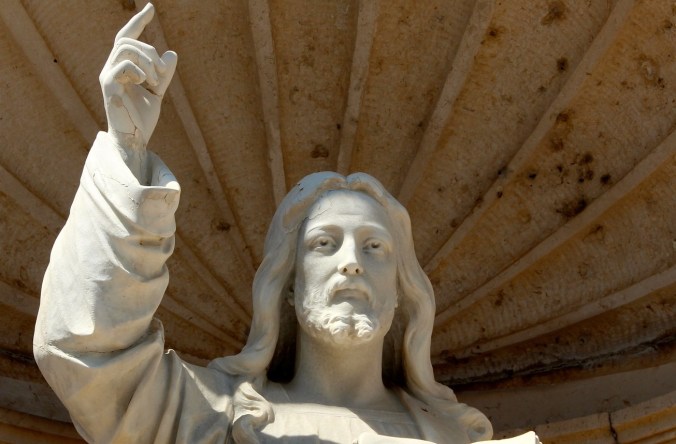

See Yourself. Then See Jesus.


Blind

Cariplo

John 9:13-15 “They brought to the Pharisees the man who had been blind.  Now the day on which Jesus had made the mud and opened the man’s eyes was a Sabbath.  Therefore the Pharisees also asked him how he had received his sight.  ‘He put mud on my eyes,’ the man replied, ‘and I washed, and now I see.’ Some of the Pharisees said, ‘This man is not from God, for he does not keep the Sabbath.’ But others asked, ‘How can a sinner do such miraculous signs?’ So they were divided.”

The title “Pharisee” was once worn as a badge of honor. For us it’s an insult.  Yet each of us knows their sin by experience.  Self-righteousness and legalism plague us every day, and there are so many subtleties to these sins.  There is the explicit self-righteousness of those who keep their own list of man-made rules with the idea that it gives them a higher level of spirituality.  We see it when some Christian considers himself superior because he doesn’t drink alcohol, or play cards, or get married, or eat certain foods.  Even in our own churches we are tempted to make rules that regulate every minute detail of congregational life. That is easier than doing the hard work of teaching people to live by Christian principals and confronting them when they fail to do so.

But those are the easy examples to spot. There is also such thing as a “reverse Phariseeism.”  I once read of a pastor who was talking about legalism in his Bible class.  As an example he mentioned the fact that he attended a Bible college where they strictly enforced rules against beards or mustaches, and no hair could be worn below the ears.  Yet everyday the students walked past a hundred year old painting of the college’s founder, with a beard, and mustache, and hair below his ears.  While most people in the class laughed, one member pointed out that now they were the ones who were self-righteous–considering themselves better and more spiritual than those “legalistic Pharisees” as they talked behind their backs and laughed at them.  It’s one thing to recognize self-righteousness. We become guilty of it when we use someone else’s failing to elevate ourselves.

The problem lies in our hearts.  We are sorely tempted to make ourselves–not the Word, not our Savior–the standard by which everyone else should be judged.  We fall into a mindset that says, “This church would be a lot better off if everyone else were more like me.”  The truth is, the church would be in big trouble if everyone were more like me. The church would be better off if everyone were more like Jesus. That’s something only Jesus can make you see.

The Pharisees’ self-righteousness and legalism made them blind. They couldn’t see the truth. They couldn’t see themselves. They couldn’t see their Savior even when he made a blind man see.  Jesus later called them blind guides and blind fools.  That is the danger self-righteousness poses. It blinds us when confronted by the Savior.

Every day of our lives we get beat by our sinful nature. But Jesus helps us see when he draws us to look at him, and watch and follow him. Our vision fails when we look away to ourselves, our works, our ways, and our world.  But when we keep our eyes fixed on Jesus–his perfect life, his suffering on the cross, his payment for sin, his forgiveness–our blindness is gone, our spiritual vision 20/20, and our path through life to heaven clearly lit.  That view is bright with God’s love for us. In it we see that his solution for our sin doesn’t include anything we have to do.  Jesus has done it all, and that is also something that only he can make you see.

Grateful for his Jealousy

Jealous emoticon

Exodus 20:5 “I, the Lord, your God, am a jealous God…”

Ordinarily when we think about jealousy, we think of it as a negative, and even sinful, emotion. It reveals a possessiveness, a self-serving concern, that leads people to say and do some very unloving things. Adultery, murder, and theft have all been committed in the name of jealousy.

It is entirely different if God is possessive of you and me. We belong to him in ways that no human being belongs to another. In fact, God’s claim on each of us is two-fold.

First, he is the one who created us and all things. We are the work of his hands. He provided the stuff from which we are made, and he has carefully and lovingly put us together in special and unique ways. He gave us minds which can think of incredible things, and bodies which can move and work in exciting and useful ways. Watching my children grow and develop reminded me of the miraculous way in which God put our bodies together. I watched them learn to crawl for the first time, saw them begin to grasp all the exciting possibilities which open up in the ability to move from place to place. As simple as it is, all of this comes from God, who made us. It is part of the reason that we are his.

But his second claim on us is much more costly, and much more dear. God has redeemed us. Even though we already belonged to him, he has paid a price so costly that no value could ever be put upon it. When we had turned away from him in sin and rebellion, he gave up the life and the blood of his only Son, in payment for our sin: just so that you might be his very own, and just so that I might be his very own, again. There is no greater sacrifice he could have given, no higher value that he could have placed upon us, so that we might be his people, and he might be our God.

Of course, since our first parents fell into sin, there has always been competition for our love and attention. For God’s people Israel it was especially the rival gods of their pagan neighbors. For us the rival gods have taken more subtle forms. They are turbocharged, or five-bedroom, or ultra high definition, or fixed rate of interest, or suitable for mature audiences only. They would like to have you, too. And do you know what they are willing to sacrifice for you? Nothing.

And so, doesn’t God have a right to be jealous for our love and attention, in light of all he has done for us? Doesn’t he show that he is serious about being your God, with all that it entails? Wouldn’t we be the greatest fools not to take him seriously, especially when we consider all his kindness to us?

For Us He Drinks His Cup

Cup

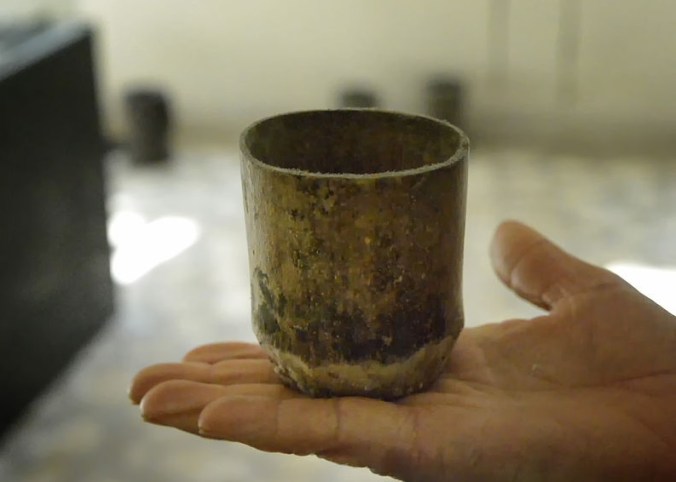
John 18:11 “Jesus commanded Peter, ‘Put your sword away! Shall I not drink the cup the Father has given me?’”

The popular Lenten hymn My Song Is Love Unknown, after remembering the calls to crucify Jesus, objects, “Why? What has my Lord done? What makes this rage and spite?” Samuel Crossman, the hymn writer, agonizes over the hatred and violence directed at this dear friend we love so much. When Lent rolls around, and we hear the passion history read and preached again, isn’t there a part of us that almost hopes that this year the story will be different, that Jesus will unveil his glory, and show them he is God, and fight back and defeat his enemies? “I object! I object to seeing my Savior suffer that way! Stop it! Stop it! Somebody do something to stop his suffering!”

But the Jesus  we love that way isn’t the real thing. The Jesus we love that way would be an idol we created ourselves. A Jesus who does not suffer for us could be many things. He could be our guide to show us the way. He could be our friend who really cares that things are going so badly for us. He could be our cheerleader, pumping us up for our challenges. He could be our miracle worker, making our pain go away. He just couldn’t be our Savior. And if he can’t be our Savior, then he can’t be our God.

When Jesus answers our objection by asking, “Shall I not drink the cup the Father has given me?” he does more than answer it. He exposes it as sin. Sin doesn’t stop at messing up our behavior. We can’t even feel right. We emote sinfully. We can’t respond properly to the most important act of love he has ever done for us. Like Peter, we find ourselves fighting what God has done to save us.

How different is Jesus’ response to his suffering. He, too, agonized over the price he would pay in pain to save us. In the Garden of Gethsemane he begged, “My Father, if it is possible, may this cup be taken from me” (Matthew 26:30). The sweat poured from him like drops of blood. He would not watch this all take place, like Peter. He would feel every moment.

But at no point does Jesus object. At no point is Jesus unwilling. His perfect obedience to the Father’s will extended to the very wishes and desires that occupied his anxious heart. He redeems our cowardly and contrary hearts by offering the Father his perfectly willing and consenting heart in their place. “Shall I not drink the cup my Father has given me?” is Jesus statement of resolve.

And to what is Jesus consenting? Peter perceives only the faintest shadows of it at this point. We will never really know the agony Jesus knew in his soul. In the end, this was not the cup the Jews were giving Jesus in the mocking and beating. This was not the cup the Romans were giving Jesus in the scourging and the crucifixion. This was the cup the Father was giving Jesus as he drank the anger of God, and the hell that our sins had created, to spare us from drinking that cup ourselves. How can we object to the suffering that gives us such forgiveness, and freedom, and life? Jesus’ question answers the objection.

Sometimes a question mark is like an exclamation point. So it is with Jesus’ question to Peter. The greatest accomplishment in the history of the world does not come in a moment of thrilling ecstasy. It comes when our Savior drinks his cup of suffering, served by his own Father’s hand.

Attribute


Don’t You See?

Cross Stained Glass

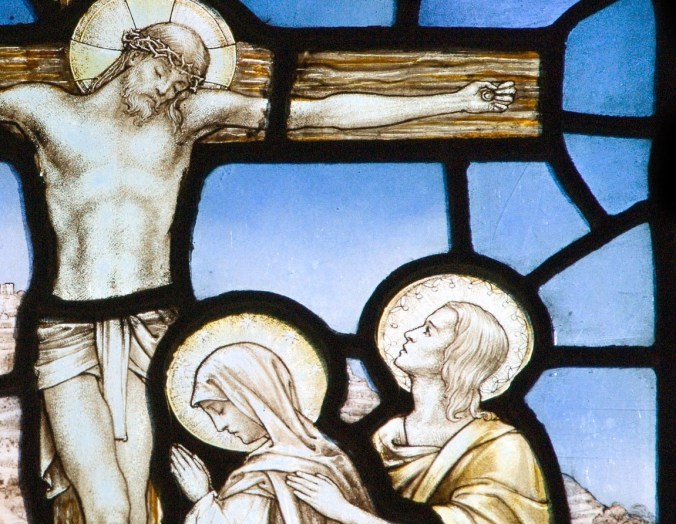
Galatians 3:1 “You Foolish Galatians! Who has bewitched you? Before your very eyes Jesus Christ was clearly portrayed as crucified.”

You and I should not underestimate the strange and powerful allure of a home-made righteousness. None of us wants to believe that we are as bad as that cross says we are. Self-righteousness is like one of those germs or diseases that a person is carrying all the time. If you aren’t sick with a full-blown case at the moment, the disease is lurking and waiting for your immunities to weaken so that it can wreak its havoc on your spiritual health again. All it takes is a few minutes exposure to someone else who is losing the battle with some sin or another–it doesn’t matter much which one. It could be some sexual indulgence, a potty mouth, a bad temper, impatience, their own judgmentalism, materialistic spending habits, unwillingness to share or be generous to others, worry, or some other selfishness. Maybe they aren’t putting up much of a fight at all. How easily we begin to congratulate ourselves for our own self-discipline and good behavior. How quickly we begin to think that others should be more godly–you know, like I am. We sigh and think, “If only everyone were more like me.”

More like me? Have we ceased to take our own very real, daily sins seriously? Can we no longer see the damning nature of the thousand and one opportunities to love we pass up every day? Have we become blind to, have we become comfortable with, our own spiritual deformities? Then our own practice of religion may become all about “doing,” all about opportunities to congratulate ourselves for the fine progress we have been making. Then grace, gospel, forgiveness, salvation, redemption, may become little more than a theological starting place for us–truths to which we still give lip service, to be sure. But not ones we actually think have anything to do with me today.

What is the antidote to this disease? How can we confront our self-righteousness? Paul tells us, “Look at the cross!” “Before your very eyes Jesus Christ was clearly portrayed as crucified.” Just look at the cross and see why Paul called the Galatians foolish for their self-righteous ideas! Have we lost our minds to think that we might have something to add? After cold iron tears through his flesh, severing bands of muscle; ripping at cartilage, tendons, and ligaments; pinning his hands and feet to the instrument of his death, what will we offer for our sins? After he hangs suspended from this simple structure of torture from 9 in the morning, through the slow ticking minutes of the day, through the heat of the noon day sun–all the while his muscles cramping with no way to relieve the painful knots; the blood pooling beneath him as it drains from his many wounds; the panic of not being able to draw a satisfying breath seizing him as it becomes more and more difficult to support his wounded body; what contribution will we make to our redemption? After the dark and hopeless void where even God’s love can’t be found because the heavenly Father has turned his back on his one and only Son and the sins he carries for the world, what will we give up to save our souls? Can we really imagine there is something left, some unfinished work here, for us to do?

To look at the cross, and still think that there must be some heroic work for us to do, we would have to be under some kind of black magic that tinkered with our minds. “Who has bewitched you?” Paul asks the Galatians. When Christ Jesus has been portrayed as crucified before your very eyes, you don’t so easily forget what you have seen. You can’t easily miss what it means. You don’t want some other kind of salvation. Jesus Christ portrayed as crucified is all we need.

Public executions have always been popular. People are fascinated with death. They find some kind of satisfaction in seeing justice executed on a criminal for his bad behavior. In places like North Korea and Iran they are still televised. Jesus’ crucifixion was a public execution, but we do not watch because we are fascinated with death, certainly not because Jesus was receiving justice for crimes he committed. Before our very eyes Jesus Christ is clearly portrayed as crucified so that we will lay our self-righteous inclinations aside, and find a real righteousness in him by faith.

As God Wills

Gethsemane

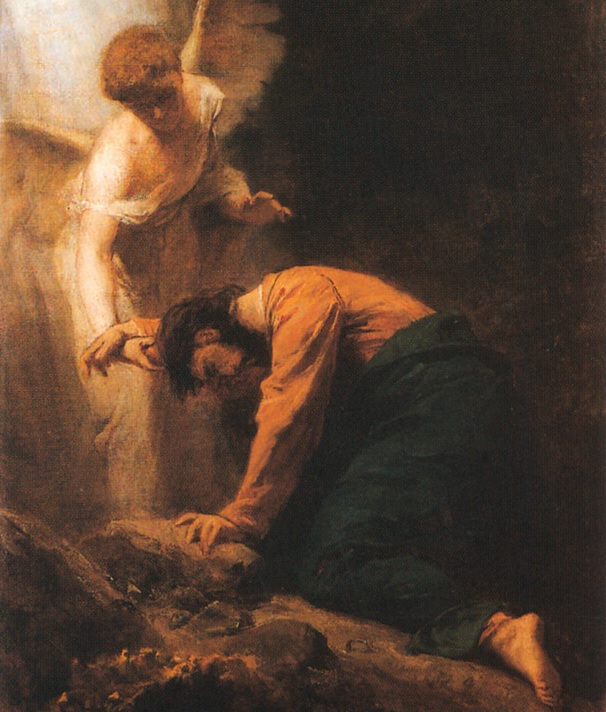
Matthew 26:39 “My Father, if it is possible, may this cup be taken from me. Yet not as I will, but as you will.”

This is no perfunctory prayer, prayed politely before supper or bedtime. Jesus’ whole body is involved, not just his mouth. There he lies stretched out on the ground, his sweaty, tear-streaked face pressed against the Judean sand and gravel. The words pour out from the depths of his soul. Who is this praying, pleading, so? Who is this begging for some way, any way, to be delivered from the suffering he is about to face? This is Jesus, the Son of God, heaven’s Prince, the King of Kings! For all his divine power and heavenly glory, how utterly human he had become. How inconceivably awful the agony he had to suffer must have been.

In the whole history of Jesus’ sufferings and death, without a doubt the most frightening words we hear are Jesus’ cry from the cross, “My God, my God, why have you forsaken me?” There he suffers the fate of the damned and forsaken, an eternity of torment for the sum of all souls packed into few hours on a cross one sad Friday. But next to that, is there anything more frightening than this scene: the very Son of God, so overwhelmed with sorrow at his coming death, so troubled, that at this late moment he is seeking any possible way to avoid it all?

Jesus asked for the cup to be taken from him. He sorrowed over his death just hours away. But that did not mean he was unwilling. He continues to pray, and he is ready to accept his impending death: “Yet not as I will, but as you will.”

This prayer is a true prayer, prayed in faith–not an attempt to push God off his throne. He does not attempt to change the changeless God. He does not dictate terms to the Almighty. He prays. True prayer trusts God’s will. It accepts that God’s will is better than my own, even though it may mean pain, discomfort, disappointment and apparent defeat. There are worse things than suffering. God often does his best work through suffering. “We also rejoice in our sufferings, because we know that suffering produces perseverance; perseverance, character; and character, hope,” Paul wrote the Romans. Jesus’ suffering was the salvation of the world. “May your will be done.”

So Jesus accepted his impending death. He embraced the heavy load. He did not set it down. He carried it forward for our salvation. He does not whimper or whine. He does not turn away. He does not even hesitate. He meets his killers. Courage, resolve, faith–these characterize his path ahead. He carries the heavy load of our guilt all the way to his cross and death. He carries it until we are redeemed, and we are free.

It’s Not Your Tears Jesus Wants

Tear

Luke 23:26-28 “As they led him away, they seized Simon from Cyrene, who was on his way in from the country, and put the cross on him and made him carry it behind Jesus. A large number of people followed him, including women who mourned and wailed for him. Jesus turned and said to them, ‘Daughters of Jerusalem, do not weep for me…”

Do you like a good tearjerker? If someone recommends a movie and tells you a to bring a box of Kleenex along, does that intrigue you? If someone says that he or she cried all the way through the book, does that tempt you to go out and get a copy? I believe everyone likes a happy ending, but a well-told story that moves us to tears before we reach the end holds it’s own special appeal. Even the Bible says that a sad face is good for the heart (Ecc. 7:3).

Is that what Jesus wants from us when we hear the events of  his trial and crucifixion–a few tears that show how sorry we are that he had to suffer so miserably?  It’s not your tears Jesus wants. He wants you to know why he goes to pain and death.

The women of Jerusalem recognized that this scene with Jesus struggling to the place of his execution was a supremely sad one. But they didn’t understand why he traveled this path. The long, slow process of crucifixion was not a sight the Romans wanted to have to look at all day long inside the city. The death of a convicted blasphemer and the uncleanness it brought was not something Jewish law would tolerate inside the city. So Jesus had to make the long, slow hike through Jerusalem to the place of his death.

But this forced journey involved something more. As he made his way through the streets of Jerusalem, he was literally carrying the sins of the people, of all people, to the place outside the city where he would give his life to dispose of them once and for all. It wasn’t the tears of these people that Jesus wanted. It’s not our sympathy. It’s our sins he wants. That is why he goes along this way to Calvary, outside the walls of Jerusalem– to take away our sins.

In fact, he wants this so much for us that he gave every last ounce of his strength in the effort. Already before he gets to the place where they nailed him to the cross, he collapses under the burden he is carrying. They take the lumber from his shoulders, the lumber to which they will soon pin him with spikes, and pile it on Simon of Cyrene instead. But the load could hardly have seemed any lighter. They could not take the weight of uncountable sins and give it to someone else. He would not give that burden up. It is why he goes this way: he goes to take away our sins.

Abraham Lincoln once said of the soldiers who gave their lives for our nation at Gettysburg, “…they gave the last full measure of devotion.” Even more so, that is what our Savior is giving us here: the last full measure of his devotion. He held nothing back. Before the cross, his strength had all but passed from his body. In the words of the Apostle John, “Having loved his own who were in the world, he now loved them to the end.” When we say that Jesus so loves us that there is nothing that he withheld from us for our good, that is not a theory or a pleasant wish. That is the fact we see before us in his sacrifice. All that he was, all that he had, right down to the molecules of oxygen and sugar his blood carried through his veins to give strength to his body, he gave up to free us from our sins.

He doesn’t want our tears. He wants us to know that this is why he goes this way: He goes to take away our sins.

The Rebel

Rebels

Luke 23:14-15 “You brought this man as one who was inciting the people to rebellion. I have examined him in your presence and have found no basis for your charges against him. Neither has Herod, for he sent him back to us; as you can see, he has done nothing to deserve death.”

There was a rebellion going on here, but it was not being led by the man on trial. Jesus was the rightful ruler of this people’s souls. He deserved their allegiance as the one who would fight their battles against sin and Satan. His rule could lead them to God and to heaven. His rule would only make these people better subjects to Caesar, better citizens of the nation in which they lived.

If Jesus was “rebelling” against anything, it was against the tyranny of people believing, “I’m basically a good person who can save myself. With a little better education, a little better set of principles to live by, I can do the job.”  That guiding principle inspired Jesus’ enemies. They were rebelling against the one who had inspired Isaiah to write, “All our righteous acts are like filthy rags.” They rebelled against the one whose words Moses recorded: “…every inclination of man’s heart is evil from childhood.” Jesus’ accusers were leading a rebellion against the one who leads us to see we are all sinners who desperately need to be saved.

The rebellion continues today. Everyone from TV preachers, to pop psychologists, to New Age Spiritualists, to motivational speakers is preaching, “We are all basically good people. With just a few adjustments you can save yourself. Maybe you can even learn those insights from Jesus.” Sometimes I begin to believe them. Call me what you will, I am not basically a good person. You can call me talented. You can call me friendly. You can call me good looking. I am still a rebel who doesn’t want to believe my sins are so bad they deserve hell. I don’t want to believe I am such a hopeless case that I can do no spiritual good on my own. You’re such a rebel, too. But Jesus? There was no basis for the charge of rebellion against him.

Pontius Pilate could tell that much. He had examined the case against Jesus closely and could see that he had committed no crime. It was easy to conclude, “…he has done nothing to deserve death.”

That is the good news in this story of Jesus’ trial. Tucked away in this terrible injustice committed against our Savior is this comforting truth: there was no basis for the calls for his death. He was perfect within and without. This means that the requirements for our salvation were met on two counts.

First, God’s law demands an active life of love. If you are submitting your resume to apply for a job, the employer is looking for more than a person who refrained from pilfering the company supplies, defying company policies, or sleeping on the job in the past. He is interested in someone who has made a positive contribution. When we are applying for heaven, God is looking for more than a clean record. He wants a record filled with acts of love for our neighbor and for his kingdom.

Since Jesus is our substitute, his perfect life of love fills out our resume this way. His life free from sin, with nothing worthy of death, makes our own record of love perfect and complete. In Romans 5 Paul says, “…through the obedience of the one man (Jesus), the many will be made righteous.” Pilate’s words drive this truth home for us.

Then we are assured that Jesus died the kind of death that we need. Though he did nothing to deserve death, hours later Jesus was breathing his last on the cross. He died not because he deserved death, but because we did. And since Jesus did not need to die for his own sins, his innocent death has the power to wipe the sinful stains from our records and present us to God as his own, holy children.

Criminal charges can leave lingering doubts about the character of the accused. The complete lack of merit in the charges against Jesus was clear even to heathen rulers. Such utter innocence gives us confidence to plead his life and death when we stand in God’s court.

Loyal Love

cross-sunset

Luke 13:31-32 “At that time some Pharisees came to Jesus and said to him, ‘Leave this place and go somewhere else. Herod wants to kill you.’ He replied, ‘Go tell that fox, I will drive out demons and heal people today and tomorrow, and on the third day I will reach my goal.’”

There were people in this part of Palestine reduced to raving lunatics by the demons who possessed them. No one else could help them, and Jesus had compassion on them. There were sick people who had spent all their money and visited all the doctors, but still they could find no relief from their pain. They had exhausted every possibility for a cure. Jesus was all that they had left. There were sinners who all their lives had been held in slavery by their fear of death. The super-pious teachings of the Pharisees offered them no hope. Only Jesus could bring them the word of forgiveness that could restore their faith. These were the people Jesus came to serve, and nothing could stop him from loving them, no matter what the personal cost to himself.

Is his love any different for you and me? Who are we but a collection of all the world’s various heartaches and problems? We are the bereaved and the addicted, the injured and the fearful, the misunderstood and the failed. We are no strangers to doctors and hospitals, failed relationships and troubled homes, lost dreams and lost respect. Every one of us shares the same sickness of sin, and we are sick with it to the point of death. The only solution, the ONLY SOLUTION, for you and for me is the same as it was for the sick and demon-possessed Jesus mentions: this same Jesus who will let nothing stop him from loving you, too.

Not even death. Jesus’ death was not just a tragic mistake, a horrible and unfortunate accident, one of those untimely and unexplained twists of fate that come at the worst of times. He came into our world fully aware that to love us would mean to die for us. That is why the Apostle John begins the portion of his book dealing with Jesus’ sufferings and death, “Having loved his own who were in the world, he now showed them the full extent of his love.” Jesus himself said, “No greater love has anyone than this–that he lay down his life for his friends.” Even when the personal cost meant dying in payment for our sins, nothing could stop Jesus from loving you.

Do you remember what loyalty used to be? Undying, unwavering loyalty is a trait we see too rarely. Companies terminate their seasoned veterans because they can hire two whiz-bang college graduates for the price of one man with 25 years of experience. Then again, employees get tired of waiting for the next promotion and jump ship when a better offer comes along.

Nothing can stop Jesus from loving you, but that does not mean his loyalty was or is an easy thing. It cost him his life. He knew it would. You are worth it to him.

The Time Has Come

jesus-preach

Mark 1:14-15 “After John was put in prison, Jesus went into Galilee, proclaiming the good news of God. ‘The time has come,’ he said. ‘The kingdom of God is near. Repent and believe the good news!’”

A key concept at the heart of Jesus’ preaching was the well-worn preacher’s call, “Repent!” It wasn’t a very new message, was it. When God came to Adam and Eve in the garden of Eden after they ate the forbidden fruit, what was his message to them intended to do? He was calling them to repent. When you read the prophets that God sent to his Old Testament people, a common theme running through all 17 of them is the call to repentance. When John the Baptist came preaching and baptizing, how did the people know he was a prophet? Like those before him he preached repentance.

It doesn’t stop there. When Peter preached to the crowds on Pentecost day, what did he tell them to? “Repent and be baptized, everyone of you.” When Paul summarized his ministry to the Gentiles in his trial before King Agrippa, he told him, “I preached that they should repent and turn to God.” Every day, Jesus’ call to repentance is still directed to you and me.

So often people think of repentance in terms of changing behavior. The Bible itself calls for such “fruits” of repentance. But behavior has never been God’s first concern. In the New Testament’s Greek, the word “repent” is formed by combining the words “change” and “mind.” It is God’s call to change, not first of all your doing, but your thinking. Ultimately, it will change your very being. With the command to repent, God is saying, “Stop thinking about sin. Stop wanting what I have forbidden. Stop considering sin enjoyable. Stop thinking you must live for yourself. Stop harboring lustful, hateful, hurtful, resentful attitudes. Change your thinking!”

Have we? Have we changed our minds about sin? At times we have our behavior more or less under control. In our minds some of our past sinful behavior still sounds appealing. When someone has been awful to you, what is your immediate gut reaction? Smother them with love? Or are anger and resentment closer to the mark? Changing our minds about sin is a work in progress.

Sin isn’t the only thing Jesus calls us to see differently. “Believe the good news.” Every pious Jew in Jesus day was waiting for the time when God would keep his promise to send the Messiah to deliver God’s people. Now Jesus had good news. God had been faithful. Jesus is that Messiah with more good news to share.

“The kingdom of God is near.” God’s kingdom is not a place on earth. Jesus was not going to establish a political kingdom in Israel. God’s kingdom is spiritual. It is Jesus’ ruling activity in the hearts and lives of all who believe in him. Wherever Jesus is present with his word, there his kingdom is. This kingdom was was not coming soon. It was near because it was standing right in front of them. Jesus brought forgiveness and life to sinners, and all who believed his promise had the kingdom’s gates flung open wide. They entered as they believed.

Jesus still preaches “repent and believe the good news” as we begin the season of Lent. Do you see why it makes sense to follow Jesus closely through this season? Early Christians established Lent as a “penitential season.” Nothing changes our minds about sin like following Jesus through his suffering. Nothing stirs our hearts to faith like seeing his love at the cross, dying for our sins. The time has come. Listen to what our Savior says, see what he does, and you will find God’s Kingdom at the end of this pilgrimage. Its gates are open wide for you to enter.