More than a Memory

communion

Matthew 26:27-28 “Then he took the cup, gave thanks and offered it to them, saying, ‘Drink from it all of you. This is my blood of the covenant which is poured out for many for the forgiveness of sins.’”

Do you own a collection of old family videos on VHS? Do you have videos of family events stored on DVD, or thumb drives, or some other digital format? We had a camcorder for a number of years, but I didn’t remember to bring it along as often as I should. And I found that I didn’t like watching life’s major events through a viewfinder. I would rather see things happen live. We rarely watched the tapes we have made of our family anyway. I never even watched my wedding video.

The idea of reliving some of those times, however, hasn’t lost its appeal. When I was growing up my dad used to drag out the slides of family vacations once a year or so, and he never had to twist our arms to get us to watch them.

Slides and videos don’t actually recreate our happy past, though. What’s done is done. But sometimes they do extend the enjoyment we get from life’s milestones, or favorite vacations, or best performances. And they make it possible to share them with friends or grandparents who weren’t there to see it when it happened.

There were no video tapes running or cameras flashing on Golgotha on Good Friday. Christ died for sins once for all. What’s done is done. We can’t relive, or rather Jesus won’t relive, the central event of the Christian faith, and for that we can be thankful.

But in the body and blood of his Supper our Savior does extend our enjoyment of the blessings that flow from his crucifixion and death. This is more than just a video replay of happy feelings. Jesus calls it his “blood of the covenant which is poured out for many for the forgiveness of sins.” This is a covenant, a testament, a promise from him. Jesus does more than take our minds back to Golgotha in memory. Under the bread and wine he has contained the real forgiveness of our sins that his genuine body and blood bring forward from the cross to us. For those precious moments before his altar we can smell and taste and feel the unconditional love of God, no less present than it was when he spilled his blood two thousand years ago.

Sin occupies entirely too much of our time and attention. When we think we are having a good day, we need to look no farther than our thought life to realize how constant this companion has been.

Here and there God’s spoken Word breaks into this enduring affliction with its promise of grace. But in the Lord’s Supper God’s forgiving love blessedly lingers and loiters on our lips and mouth, and we have time to savor the grace that makes us his own.

For me, one of the highlights of attending a pastors’ conference is singing a communion hymn. At home I’m usually caught up in the distribution on Sundays, making sure I don’t drop a wafer, helping communicants get their cups out of the tray without spilling. Rarely do I get to sing the truths that make this Supper so special. Martin Luther once said, “This sacrament is the gospel.” May we find it to be so, too.


He Cares for You

dr-seuss

1 Peter 5:6 “Humble yourselves, therefore, under God’s mighty hand, that me may lift you up in due time. Cast all your anxiety on him because he cares for you.

I’m not aware if you ever knew,

There’s an author I like, his name Dr. Seuss.

And of all of his tales I have come to adore,

There has never been one that I ever liked more,

Than, I Had Trouble in Getting to Solla Sollew,

The story about a young carefree chap who,

One day was attacked by his very first trouble,

Events that would burst that poor carefree man’s bubble.

A quail bit his tail, a rock stubbed his toe,

A Skritz stung him high, a Skrink bit him low.

And in all of this trouble he joined someone who

Was off on a journey to Solla Sollew

On the banks of the beautiful river Wah-hoo,

Where they never have troubles, at least very few…

Spoiler Alert! The mythical city of Solla Sollew didn’t provide our young hero relief from his troubles, either. But Peter reminds us we know someone who can, and does.

Do we recognize the kind of temptation involved with our inevitable suffering? None of us likes it. Perhaps no experience more tempts us to doubt God’s goodness. If the pain becomes severe enough, we might even be tempted to call God evil. Certainly he must know better than this! Or it can make us arrogant. Obviously we are wiser than the Lord, because we would never allow something like this to go on!

God’s strategy for coping with trouble must include humble trust. And the Lord provides us with the loving promises that create that trust. “Cast all your anxiety on him because he cares for you.” Is that hard to believe? Does a God who loves us let our classmates ridicule us? Does a God who cares about us let pain linger on, and on, and on? Does a kind and compassionate God let our hearts be broken when we lose someone we care about, or when someone we love rejects us? Does a loving God leave us hanging in endless, agonizing suspense about our future?

The answer to those questions is that, even in all such experiences, God still cares for you. And underlining that promise, driving it home and making it real, is one reason that the preaching of the cross is always practical for life everyday. Remember, we are not the only ones who know about suffering. Jesus suffered, too. Would Jesus suffer for our sins on the cross if God didn’t care for you? Would the Lord graciously forgive all our sins if he didn’t care for you? Would our Lord have bothered to call us to faith and give us his word if he didn’t care for you? Even the worry and the anxiety and the cares are things he invites us to take off our shoulders, and give to him so that he can bear them for us. Humble trust in him will never be disappointed. His mighty hand has all the strength needed to lift us up at just the time he knows is right.

The Life I Live

clipboard-x

Galatians 2:19-20 “For through the law I died to the law so that I might live for God. I have been crucified with Christ and I no longer live, but Christ lives in me. The life I live in the body, I live by faith in the Son of God, who loved me and gave himself for me.”

The law, even God’s law, can’t give us the power to live for God. It can’t give us the power to stop sinning. It doesn’t give or build faith. Instead of leading us to trust God, it makes us fear his punishment. It makes us realize that we are powerless to do what God wants on our own. The better we know the law, the more we know we can’t keep it.

That’s why using God’s law to stop committing sin is an exercise in frustration if we don’t have something else. Sometimes people feel you can use it like I use my daily planner. Every day I make a list of the things I hope to accomplish. I check them off as I do them. When they are all checked off, I know I have accomplished my goal.

You can’t do the same thing with the law of God. God requires more than the external acts. You can’t check off the items in the ten commandments and feel that you have really kept them. When you know them well, you know they are just as concerned about your attitudes and motivations as they are about the acts themselves. The more I know the commandments, the more ways I can see that I am not keeping them. My check list never gets shorter. It only grows. The law keeps accusing me of failure. It shows me what to do, but it can’t give me the power to do it.

That is why Paul can say “through the law I died to the law.” God is accomplishing something with the law, but it isn’t giving me faith. It isn’t giving me life. It isn’t giving me power to stop sinning. He is showing me I can’t do it myself. He is showing me how much I need him–not only for grace and forgiveness, but also for strength to stop sinning. Only when I have died to the law can I live for God.

So justification by faith–God taking our sins, forgiving them, and declaring us perfect—has as much to offer for day to day living as it does for dealing with our past. Paul continues, “I have been crucified with Christ and I no longer live, but Christ lives in me.” I have been crucified with Christ. Jesus death on the cross is my death. My sins are gone. But he doesn’t leave me hanging there. I no longer live, but Christ lives in me. When Jesus takes away my sins, he also gives me something wonderful. He puts to death my old, sinful self. He comes and lives in my heart and lives his life through mine. We don’t have the power to do what the law says, but Jesus does. When we say that Jesus makes our own hearts his home, that means more than thinking of him alot or having warm feelings for him. It means Jesus himself actually lives in us, and with his life he gives us power to live a life of love.

Where does this life and power of Christ in us come from? “The life I live in the body, I live by FAITH IN THE SON OF GOD, WHO LOVED ME AND GAVE HIMSELF FOR ME.” We call the life we live as Christians “sanctification.” But this always has its source in our justification. It is a life we have by faith in God’s own Son Jesus Christ, faith that Jesus loves me, faith that Jesus gave himself for me. As I continue to sin and confess it to Jesus, he keeps on loving me and forgiving me. He draws me closer to himself in faith. Faith in God’s grace is the thing that makes his life in us grow, and it fills us more and more with love for God and for each other.

A Word that Bears Life

baby-foot

1 Peter 1:23 “For you have been born again, not of perishable seed, but of imperishable, through the living and enduring word of God.”

God has some important things for you to understand when he illustrates our coming to faith as being born again. It illustrates our helplessness. You know people whose pregnancies were filled with uncertainty. Think of how weak, how frail, and how dependent that little baby is before it is born. It didn’t produce it’s own life. It simply received life from its parents. No baby decides for itself when it will be born. When the time is right, the mother’s body gives it birth.

There are many parallels with our spiritual life. Because of sin, we are helpless, totally dependent on God. We have no spiritual life until we receive it from our heavenly Father. Without Christ we are not just spiritually confused or weak. We have no spiritual life at all. That was true of each of us. It still applies to our sinful natures. Since we must be born again, we are utterly dependent on God. He alone can give us spiritual life.

Peter tells us that God has given us this new life through the living and enduring word of God. This word of God is a living word. It has a life of its own. Even though you cannot detect a heartbeat, even though you are not able hear it breathing, it is alive and active and accomplishes great things. The living heartbeat of God’s word is the overwhelming love he gave in the life Jesus lived for us and sacrificed to save us. It’s breath is the breath of the Holy Spirit. Like a good germ this message of love empowered by the Holy Spirit invades our souls and transforms our minds. It drives out doubt and despair. It creates a new life which says, “I trust God and I know he will take care of me.” It overpowers sin and creates a heart that wants to do what is good. It is more alive, more full of life, than anything else we will ever know in this life.

This word of God is also an enduring word. Peter illustrates this in the words of Isaiah, “All men are like grass, and all their glory is like the flowers of the field; the grass withers and the flowers fall, but the word of the Lord stands forever.” We are all like grass and flowers. We are flimsy and frail. Our health doesn’t hold up like it once did. We don’t last very long. Seventy, eighty, even one hundred years aren’t that long compared to the great span of history. Like grass and flowers, our glory is fading and shallow. Our accomplishments will barely be remembered a generation from now. How we looked and what we did just last year is already little more than a memory. The Apostle James sums it up this way: “What is your life? You are a mist that appears for a little while and then vanishes.”

But the word of the Lord stands forever. Long before any of us was around, the word of God was there, the same word we know today. Long after we are all gone, the word will still stand. It will still be the same. It will be comforting, supporting, empowering, and giving life to a new generation, just as it has done for you and me.

Where Understanding Begins

bible-study

Proverbs 9:10 “The fear of the Lord is the beginning of wisdom, and knowledge of the Holy One is understanding.”

How we look at God, Solomon is telling us, is going to affect how we look at all of life. It will change everything about how we view the world. This is where real wisdom must begin. When we get to know God as he really is, when we have a balanced and accurate picture of him, then we know not only him, but we can understand all of life. To the degree that we misunderstand God we will be confused about faith and life as well.

If we think of God as only the horrible Judge and Dictator, then our life will be joyless, peace-less, driven. We will spend all our time scurrying about trying to keep up with his orders. When something painful happens, we will assume that he must be paying us back for something we did to offend him.

If we think of God as some nameless, faceless, distant IT in the sky, nothing but an impersonal life force, then we might conclude that we are an insignificant part of the universe, and our lives are more or less meaningless.

If we think of God as a pansy, a milk-toast, a God who could never find it in him to get angry about anything; if he is only a sugary, grandfatherly Mr. Nice Guy; then we might think sin is no big deal. When trouble comes, we might assume that God is simply too weak to do anything about it.

But when we have a balanced view of the God, we see him as both just and merciful, the God of Law and Gospel. He is, as he so nicely summed it up for Moses, “The Lord, the Lord, the gracious and compassionate God, slow to anger, abounding in love and faithfulness, maintaining love to thousands, and forgiving wickedness, rebellion, and sin. Yet he does not leave the guilty unpunished; he punishes the children and their children for the sin of the fathers to the third and fourth generation.”

This is the God who will not let a single sin go unpunished, but a God who loves us so much that he punished every single sin in his Son Jesus Christ. Know him this way, know his hatred of sin, know his desire to save all people, and we will understand our purpose. We will begin to understand life whether we are experiencing prosperity or hardship, joy or grief.

Do you sometimes find life hard to understand? Sometimes we think that if we study our problems long enough we will be able to understand and solve them. That seems to make sense.  It may be helpful to a degree. But Solomon would suggest we turn our attention in another direction. Knowledge of the Holy One is understanding. Get to know God, learn of him, and you will find the wisdom and understanding to deal with everything else as well.

Fighting With Prayer

soldier-prayer

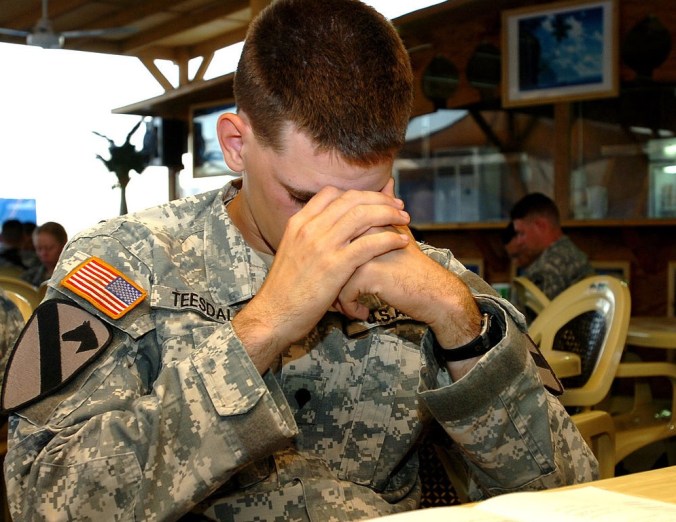
Ephesians 6:18 “And pray in the Spirit on all occasions with all kinds of prayers and requests. With this in mind, be alert and keep on praying for all the saints. Pray also for me, that whenever I open my mouth, words may be given me so that I will fearlessly make known the mystery of the gospel, for which I am an ambassador in chains. Pray that I may declare it fearlessly, as I should.”

In one way, there is nothing greater we can do for our spiritual battles than to pray. Prayer is our strength.

But seen from another point of view, prayer is the opposite of strength–at least our own strength. Prayer is an admission we are weak. We are requesting reinforcements, calling in an air strike from heaven. You see, prayer doesn’t work because there is something magical or mighty about the words we say. It works because we are no longer trusting ourselves. Prayer means that we are trusting our Lord and turning the battle over to him. We have learned to depend on his strength.

Nothing is too big or too small to make the concern of our prayers. Pray “on all occasions with all kinds of prayers.” Remember how the devil is always looking for an angle, always scheming? Take nothing for granted. I once heard a Christian scoff at the idea that meal prayers were very important prayers. But Jesus said them. Just don’t limit your prayers to your meals. Why not make God a part of everything?

Children’s bedtime prayers are cute. They are simple and innocent and sometimes touched with humor. As adults we may fall out of the habit. But who knows how many things God has done in response to a child’s request “to bless mommy, and daddy, and Sparky, and Mittens, and my teacher Miss Johnson, and my best friend Tommy…” As grownups our prayers can be richer and better worded, perhaps. But they aren’t better received, especially if we don’t remember to make them. “Pray in the Spirit on all occasions with all kinds of prayers and requests.”

Then don’t forget that you are not the only one with a battle on your hands. “Always keep on praying for all the saints.” And don’t forget about your pastors. “Pray also for me.” We face all the same attacks on faith that you do. We need the courage to preach God’s word faithfully and fearlessly in a world which will not always like what we have to say.

Pray for the success of the gospel, the words that promise God forgives our sins makes us part of his family. Pray that those words find a permanent place in our own hearts. Then pray that they penetrate the hearts of others. That’s the way the spiritual battle is won, and our souls survive it safe and sound.

God at Work


roman-soldierEphesians 6:13-14, 16-17 “Therefore put on the full armor of God, so that when the day of evil comes, you may be able to stand your ground, and after you have done everything, to stand. Stand firm then, …with the breastplate of righteousness in place…In addition to all this, take up the shield of faith, with which you can extinguish all the flaming arrows of the evil one. Take the helmet of salvation and the sword of the Spirit, which is the word of God.”

All these pieces of armor God gives for our spiritual battles relate to his own saving work. Some of them may be hard to distinguish from each other. Paul lists them in the order a Roman soldier would put them on, and much of the armor is defensive. Fewer pieces apply to the Christian soldier on the attack.

So we have God’s righteousness over our heart. What is it that steals the heart out of your faith and Christian life most easily? Isn’t it feelings of guilt? Isn’t it the burden of some sin? Look at Adam and Eve. Their guilt cut right to the heart out of their relationship with God. They no longer run to him as the Father who loves them. They are afraid, and they hide. Adam makes God out to be the enemy and blames God for giving him a wife and making him sin. The beating heart of faith has been cut out of him.

Righteousness covers the heart–not a righteousness that is full of holes, produced by sinners. It is the righteousness of Romans chapter 3. “This righteousness from God comes through faith in Jesus Christ to all who believe…for all have sinned and fall short of the glory of God, and are justified freely by his grace through the redemption that came by Christ Jesus.” God sets the righteousness of Jesus Christ–his perfect life and his innocent death–over our hearts. Then the devil can’t turn us against God or make us feel afraid anymore.

Faith, too, acts as a shield. This faith is not so much my act or my virtue in trusting God. It is the wonderful truths of God’s love and mercy my faith takes hold of. These put out the little fires of temptation, doubt, or fear the devil tries to light in my soul, and do so before there is real damage.

For my head there is a helmet. Maybe I will never be so wise and intelligent that I can win a battle of wits with the devil. But if I can just keep salvation in front of me–I know my Good Shepherd who lays down his life for the sheep; I know that my Redeemer lives–then I have a helmet to protect my mind from Satan’s deceptions.

At last, we have one weapon to go on the attack, “The sword of the Spirit, which is the word of God.” The devil must laugh his pants off when some Christians come after him with rubber and wooden swords, like “the sword of man-made wisdom and scholarship” or “the sword of feel-good messages” or “the sword of empty-emotionalism” or “the sword of political correctness.” Those swords do nothing but give him a nice massage, or a good back scratch. But take the sword of the spirit, which is the Word of God, out of its sheath and start swinging, and the devil will start running, just like he did when Jesus chased him away at his temptation in the wilderness.

Every once in a while someone invents a product so powerful, so clever, so revolutionary the maker can claim, “It does all the work.” God’s armor for our spiritual battles works that way. Just use it. It will do all the work.

Armed To Be Active

belt-and-boots

Ephesians 6:13-15 “Therefore put on the full armor of God, so that when the day of evil comes, you may be able to stand your ground, and after you have done everything, to stand. Stand firm then, with the belt of truth buckled around your waste… and with your feet fitted with the readiness that comes from the gospel of peace.”

Some parts of the soldier’s armor make it possible for him to maneuver properly when he comes under attack. Paul’s description of our spiritual armor includes the belt of truth, and the gospel of peace worn on the feet. Paul’s belt of truth isn’t truth as an abstract concept–everything that may be true as opposed to everything that may be false. He certainly doesn’t mean to use “truth” the way that so many people use the word today: “It is true if it works for me.” Several years ago I met a man who had struggled with an addiction. He had almost lost his business and his family. Today he keeps his addiction under control by following the spiritual disciplines and meditation of some Eastern swami. When some Christians tried to share the gospel with him, he didn’t want to suggest that there was anything wrong with our version of truth. I mean, if Jesus worked for us, who was he to say that there was anything wrong with that. But he already had a truth that was working for him, and he wasn’t willing to trade it for the truth we were offering.

There is only one truth Paul has in mind when he urges us to put on the belt of truth–Jesus, who is the Way, the Truth and the Life. This is the truth Jesus meant when he said, “If you hold to my teaching, you are really my disciples. Then you will know the truth, and the truth will set you free.” It is the truth of Jesus’ teaching, the truth that sets us free to belong to Jesus, not just any old truth. It is the truth Jesus had in mind when he told Pilate, “I came into the world to testify to the truth. Everyone on the side of truth listens to me.”

This truth that Jesus is our only Savior keeps everything in place around our souls and our Christian life, so that Satan can never trap us or corner us with his lies. We see young men today wearing their shorts half-way to their knees, and how they have to hold them up with their hands and kind of waddle along. How clumsy and inconvenient that would be for the soldier who needs to move. But that’s how it is for us if we try to navigate our spiritual life without the truth that Jesus is our Savior. We would constantly have our hands full trying to keep everything together, and we would be constantly tripping over our own efforts. God has spared the Christian of this by giving him the belt of truth to wear.

For our feet we have been given the gospel of free forgiveness, and that allows us to stand our ground, or make our escape–whatever the situation calls for. In Roman times military footwear was sandals. In our time it is the boot. Whether for war or athletics, everything is riding on the feet. The soldier needs a solid base from which to fight. His feet need some protection. Even a toe injury can be debilitating, as we see in injured athletes. If soldier or athlete cannot move, they cannot win. The soldier is not likely to escape with his life.

So, the Gospel makes the Christian ready. It makes us ready to answer when our faith is questioned. It makes us ready to go and take the message to others. Standing on the gospel, we have a solid base for the fight against falsehood, sin, and unbelief. An old Christian commentator noted, “Our peace with God makes us avid for the battle with Satan! It is true indeed. Without the Gospel and its peace our feet would not for one moment stand or go forward against Satan. Who, save we men of peace, dare to fight him?”

Suit up, Christian soldier. The battle is on! Bible truth and Gospel peace make it possible to navigate the fight.

Know Your Enemy


devilEphesians 6:10-12 “Finally, be strong in the Lord and in his mighty power. Put on the fall armor of God so that you can take your stand against the devil’s schemes. For our struggle is not against flesh and blood, but against the rulers, against the authorities, against the powers of this dark world and against the spiritual forces of evil in the heavenly realms.”

Before you go to battle, it’s important to know whom you’re fighting. Just who is your enemy? People have a lot of ideas about that. Cancer patients fight a battle with their disease. Politicians fight battles over public policy. Divorcing parents fight custody battles. Entire communities are involved in the battle with crime. We find ourselves battling the effects of aging when we are old, or the hurt and pain of bullying when we are young. We struggle with our own bad habits.

Sometimes our battles become very personal, very individual. The enemy is one particular nemesis who makes my life miserable at work, at school, on the other side of my privacy fence, on the ball field, in the PTA, at city hall, at church, or even in the family.

Paul identifies our most dangerous enemy as the devil and his angels. He is not imaginary, as some believe. Several years ago one of our Supreme Court justices was asked in an interview if he believed in the devil, and he answered that he did. The reporter seemed surprised. One commentator later concluded, “We have a lunatic on the court.” That kind of denial of Satan’s existence is just the way the devil wants it.

It is part of his schemes. If he can’t convince you that he is stronger, kinder, more reasonable, and more fun than God, then he doesn’t want you to think he exists at all. He knows that denial of the his existence tends to go along with denial of belief that there is a God. Together that leads to denial that sin has eternal consequences, and a willingness to rethink what is right and what is wrong.

The devil has always been clever at playing both sides of an issue. He finds a way to make seemingly contradictory beliefs or behaviors serve his purposes. If he can’t get you to indulge your sinful desires, he will fill you with pride about how superior you are. If he can’t fill you with pride and blind you to your sin, then he will drive you to despair that God could ever be gracious to you. If he can’t drive you to despair of God’s grace, he will lead you to see God’s grace as a kind of license to sin all you want. He makes you think sin isn’t so bad if God can forgive it so easily. If he can’t get you to take grace as a license, then he will convince you that grace has all kinds of conditions and stipulations attached to it, so that it ends up being no real grace at all. It’s like a game of chess, and the devil has a way to counter your every move. He is always thinking at least three or four moves ahead.

Except that this is no game at all. It is a fight for your eternal soul. Look again at what Paul calls your spiritual enemies: rulers, authorities, powers of this dark world, spiritual forces of evil. These aren’t ghosts that jump out and say, “Boo!” There is real power and influence here. They create genuine misery–suffering, shame, fear, doubt, and unbelief. In Daniel 10 one of them was able to delay one of God’s good angels from delivering a message for three weeks until the Lord finally sent the archangel Michael to intervene. If that scares you a little bit, good! Far too many people fail to take the devil and his angels seriously.

Of course, in Christ we have the victory, but only in Christ. “I saw Satan fall like lightning from heaven,” Jesus once told the Twelve (Luke 10). Jesus shared our humanity “so that by his death he might destroy him who holds the power of death—that is the devil…” (Hebrews 2). In the end Jesus will return “and the devil, who deceived them, (will be) thrown into the lake of burning sulfur” (Revelation 20).

If you and I are going to be strong for our battle, we need to know our true enemy. Trust Jesus, who has already defeated him. But don’t underestimate the power of the enemy, who still desires your soul.