The Lord Who Heals You

first-aid

Exodus 15:26 “If you listen carefully to the voice of the Lord your God and do what is right in his eyes, if you pay attention to his commands and keep all his decrees, I will not bring on you any of the diseases I brought on the Egyptians, for I am the Lord, who heals you.”

What kind of a God do you and I worship? People are naturally inclined to take extremist positions in their view of him. Before his gospel breakthrough, Martin Luther was raised to see God only as a merciless judge making impossible demands upon his people. He was a God who inspired only terror, fear, and trembling. There are still those today who believe that a scowl, a frown, and a general spirit of gloominess are the normal uniform a Christian ought to wear. Following the Lord Jesus is the joyless, humorless burden we must bear if we don’t want to go to hell.

I believe the other extreme is more popular today. God is such an easy-going, mild-mannered, friendly sort of guy that you don’t have to take him seriously at all. One TV preacher with his permanently painted-on smile says that you can’t tell people that they are bad. God wants them to hear good news. A women once sat across the table in my office and argued that Jesus wouldn’t try to make a person feel guilty. He didn’t deal with people that way. I have run into any number of arm-chair theologians who are convinced that they don’t need to change. God loves them just the way they are.

It is tempting to say that the truth lies somewhere in the middle, but that’s not quite right, either. The God who spoke to Israel in Exodus 15, the Lord we follow today, does take some seemingly extreme positions. But he is more than a flat, one-dimensional character.

Do you think that he takes his demands seriously? What does he say? “If you listen carefully to the voice of the Lord your God and do what is right in his eyes, if you pay attention to his commands and keep all his decrees, I will not bring on you any of the diseases I brought on the Egyptians…” When God is bringing his word to you, you had better sit up and pay attention. We ignore his voice at our peril. He expects that we not only hear what he has to say, but that we earnestly put it into practice. “…if you keep all his decrees…” he warns. This is no toothless set of general guidelines or suggestions. Our very lives are at stake. How many thousands of Egyptians died in the 10 plagues for failing to follow his commands? How many sinners does death fail to overcome today?

If it seems his demands are simply too much for us, it should. When he preaches his law or tests our loyalty, he is leading us to know ourselves. He is leading us to see that we are weak, helpless, and needy.

Then we are ready to see that knowing the Lord is knowing him as “… the Lord, who heals you.” When we hear that name, we may be inclined to think of more demands from our ruler. But this is “LORD” in all capital letters. This is God’s Old Testament salvation name. This is the name which reminds us that he has freely chosen to make us the objects of his love. This is the name that assures he is faithful. Even when we wander away, he comes looking for us. He will not stop until he finds us and reclaims us. Even when we have angered him he wants nothing more than to forgive us and reaffirm his love.

It is this Lord who heals us. That’s not just physical healing. That’s not just spiritual healing. It is completely comprehensive. His invisible hand is involved in every problem that has ever been resolved in our lives: physical, spiritual, emotional, relational or any other. Our God is the faithful Lord who heals us, and he exposes our weakness so that we might know this better.

Knowing Forgiveness

chains


Acts 13:38 “Therefore, my brothers, I want you to know that through Jesus the forgiveness of sins is proclaimed to you.”

These words are just the tail end the very first of Paul’s sermons recorded in the book of Acts. The bulk of his sermon covers what we might call “salvation history.” He takes us all the way back to the Patriarchs–Abraham, Isaac, and Jacob. He traces Israel’s history in Egypt, the wilderness, and the Promised Land, up to the time of its first kings.  Then he takes us through the life of Jesus. He retells the story of Jesus’ trial, crucifixion and resurrection. Now he draws the application.

There are many lessons we could learn from this broad sweep of history. But what Paul earnestly desired for these people was that they know Jesus forgives. Everything else in the Christian message hinged on this one central truth.

“But pastor,” you may think to yourselves, “we hear it all the time. We already know that Jesus forgives.” Do we? The Greek word for “know” here means more than learning information. It is more than the head knowledge we gain from hearing or studying. This is knowing that involves our head and heart and whole person. This is a more intimate knowing, a knowing that changes us.

How might lives be different for people who know–this kind of deeper knowing–that Jesus forgives? When someone does something really thoughtless and inconsiderate, something that creates a huge inconvenience, how would you react? It could be someone cutting you off in traffic and making you miss your exit. It could be someone not showing up when they promised. It could be someone leaving you with all the work. How would you react?

I commit countless sins every day. My sins didn’t merely inconvenience Christ. They cost him his life. They hung him on a cross. Still, Jesus forgives. He doesn’t get so irritated that he rips us up one side and down the other. He doesn’t develop an attitude or go off and sulk. He doesn’t subject us to the silent treatment. He forgives. If we know the break that we have been given over and over again, day after day–if we take it to heart–might we be less annoyed at the people around us? German pastor Friedrich Zundel once noted, “It is no help to an unrepentant one to be annoyed with him. What he needs is seeking love.” How about us? Do we consistently know Jesus’ forgiveness this way?

What about when trouble strikes? How easily we despair when misfortune comes. We are out of work and staring at the bills. We have been suffering through chronic pain, and now we are waiting for the test results. We are being mercilessly persecuted by someone at work or at school. What starts going through our heads? Is God paying me back for something I did? Has he stopped loving me? Is he going to let me go to my doom? Isn’t he unfairly singling me out for bad treatment? All kinds of fears flit through our minds.

We would know that none of those things is possible if we knew, with all our heart and soul, that Jesus forgives us. After giving up heaven to suffer hunger, and cold, and heat, and rejection; after enduring hell and his heavenly Father’s abandonment; after giving up his life to take away our sins, now he is going to turn against us? Maybe we think we know Jesus forgives us. But if we harbor anger, if we struggle with fear and worry about our future, we still don’t know it well enough.

If we are starting to know it better, then we know there is no sweeter message in all the world. It’s like a favorite song that strikes a chord inside of us every time its is played. The first time we hear it, at one and the same time it creates a sense of satisfaction and fills us with a hunger for more. It’s not enough to hear it just once. We could play it over and over again. True, we may get tired of the song. But Jesus’ forgiveness? That we always long for. It’s like the love of a good marriage. It matures from the initial infatuation to the steady, dependable, and comfortable support and care of committed partners.

Like Paul, “I want you to know that through Jesus the forgiveness of sins is proclaimed to you.” He has removed all your guilt. You stand, at every moment, under a loving God’s grace and mercy.

Peace Is Having a Redeemer and Ruler

crown-of-thorns

Acts 10:36 “You know the message God sent to the people of Israel, telling the good news of peace through Jesus Christ, who is Lord of all.”

If God is at peace with us, that gives me peace. The shame, the nerves, the stress that go along with guilt evaporate under the promise of forgiveness. In his book Counseling at the Cross, Curtis Lyon tells of counseling a lady whose guilt drove her to paranoia and anxiety. It made it impossible for her to sleep. Doctors gave her medication, but that did little more than make her feel tired and restless. After some time she came to her pastor, and together they discovered her anxiety and paranoia were the result of the guilt she was carrying. He helped her realize that Jesus did more than help her carry her guilt. He took it all from her and carried it the cross. She found peace with God through Jesus. That same day her anxiety and paranoia disappeared. More dramatically, she practically fell asleep in the pastor’s office when suddenly she was rid of the heavy burden.

The gospel isn’t always the cure for insomnia. Such peace with God does not exempt us from rainy days and stormy seas that plague everyone’s life. But it does convince me God is on my side no matter what is going on. Having my sins forgiven does more than promise better things to come in heaven– though it certainly does that, and takes the terror out of facing death. It also gives me the confidence that I can survive everything I face now. I can be certain that my life, just the way it is, is right, in spite of all its crosses. I have peace with God and he is on my side.

There is more good news here. We have peace through Jesus Christ, “who is Lord over all.” Jesus is the Lord and Ruler over all things: my life, my world, my universe. Maybe we are tempted to question whether this is such good news. After all, we cherish our freedoms. We don’t think we want someone telling us what to do.

But people do get excited about a great leader, even in a so-called “free” country like ours. Look at the way we get stirred up about elections. They dominate the news. Millions and billions of dollars pour into them. In countries with kings or dictators, great masses of people will turn out for some parade or speech to cheer their leader on.

Why? Is it just because we like to be told what to do? No, it’s because we expect those who lead us to do great things for us. With their power they can influence our prosperity. They provide for our safety and security, and they help to bring order to our world. We hope their laws will protect us from harm and raise the standard of living in our community.

Jesus Christ, who gave his life to save me, is “Lord of all.” He rules not only “Christian” America, but also “Muslim” Iran, and “Communist” China, and “Hindu” India, and “uninhabitable” Mars! My Lord rules to defend my soul and protect me from every enemy to my faith. As I place my hand in his and follow him in faith, he leads me in ways that fill my life with blessing. Like David confesses in Psalm 23, “He prepares a table before me in the presence of my enemies. He anoints my head with oil. My cup overflows.”

The good news about Jesus is all about peace–lived in his forgiveness and under his lordship.

No Favorites

black-and-white

Acts 10:34   Then Peter began to speak: ‘I now realize how true it is that God does not show favoritism, but accepts men from every nation who fear him and do what is right.’

Like most Jews of his time, the Apostle Peter grew up not fully comprehending God’s take on favoritism. God revealed his plan of salvation to the Jews. He gave his word to the Jews. The Savior of the world was born a Jew. Certainly, it seemed, the Jews must enjoy most favored nation status with heaven. Then God sent Peter to the home of a believing Roman soldier named Cornelius

There are prominent Gentile believers in the Old Testament. Some of them are even included in Jesus’ family tree. The prophets predicted large numbers of non-Jews drawn by God to the Savior’s glory. Over and over the Lord told the Jews that there was nothing better about them. But he had to use some people or another to accomplish his purposes, and they were the ones he chose. Their qualifications, however, were exactly the same as everyone else: thoroughly corrupted sinners in desperate need of a Savior.

Do we get it? Martin Luther King Jr. is credited with being the first to make the observation, “…the most segregated hour of Christian America is eleven o’clock on Sunday morning.” That has changed little since he made this observation. Prejudiced ideas about race and nationality are not always to blame. Cultural preferences and personal comfort are often bigger factors in church choice than false ideas about the kind of people God wants for himself. But we need to police ourselves for racist prejudices.

Still, we are not immune to false ideas about the kinds of people God wants. God wants to save Republicans, Democrats, Libertarians, and Independents equally as much as each other. None of them is easier or harder to save, despite what you might hear from certain partisans. All of them need Jesus. Medieval Catholicism made it seem as though God preferred single, celibate people to married people. Today the churches may have turned that around and give the opposite impression with all their talk of family this and family that. God favors neither and desires all, because he doesn’t play favorites. We are opposing his saving plans if we do.

This does not mean that God is a universalist. It does mean the qualifications are the same for everyone–sinners who need a Savior. God wants all to be saved. He calls all to the same salvation. But Peter says more than, “he accepts men from every nation.” He “accepts men from every nation who fear him and do what is right.” To fear God is not to be terrified of him. It is to recognize God’s greatness, his “bigness.” It is the respect that comes from recognizing that God is superior to everyone and everything in every way.

Such fear or respect is a natural and necessary feature of our faith. In his book Love Must Be Tough, James Dobson points out that respect is necessary for a successful married relationship. You won’t love someone, and you can’t trust someone, that you don’t respect. Ponder that for a few moments, and I’m sure that you’ll come to the same conclusion. This applies to our relationship with God as well. We won’t love or trust in him if we don’t respect him. It is interesting that Luther put these same three concepts together when he wrote his explanation of the first commandment: we should fear, love, and trust in God above all things. Though not exactly the same as each other, these three things go together. Where you find one, you will find the others, too.

So even though Peter does not use the word “faith” or “believe,” he is in complete agreement with the conclusion of John 3:16, “…whoever believes in him will not perish but have everlasting life.” Instead of mentioning faith itself, Peter presents the first fruits of faith–the attitudes and actions that show a living faith is in place. Believers– the kind of people who fear the true God, who offered his one and only Son as the sacrifice for sins; the kind of people who do what is right by repenting of their sins, trusting Jesus for their forgiveness, and responding with a life of love–are the kind of people God has accepted. He plays no favorites. He seeks all and receives those who come to him in faith.

Greatness

baby-and-father

Mark 9:33-37 “When he was in the house, he asked them, ‘What were you arguing about on the road?’ But they kept quiet because on the way they had argued about who was the greatest. Sitting down, Jesus called the Twelve and said, ‘If anyone wants to be first, he must be the very last, and the servant of all.’ He took a little child and had him stand among them. Taking him in his arms he said to them, ‘Whoever welcomes one of these little children in my name welcomes me; and whoever welcomes me does not welcome me, but the one who sent me.'”

You may know the name Robert Fulghum from his popular book Everything You Ever Needed to Know You Learned In Kindergarten.  It is filled with simple yet wise instruction.  Remember to say please and thank you.  Pick up after yourself if you make a mess.  Wait your turn in line.  Take a nap when you are tired. We need the book because as adults we don’t always practice these principles every kindergartener knows.

Jesus knew children had something to teach his disciples.  The men who followed him wanted to be the most powerful next to Jesus. They thought he was going to establish Israel as a powerful nation that would rule the world.  If Jesus had come to be that kind of a king, each one felt, “I want in on some of the action.”  They didn’t understand what he had come to earth for.

We are not so different.  Christians today can lose sight of what is really important in the church.  We get into arguments about official church policy or how the business part of the church should run.  We become skilled at playing church politics.  Egos are injured and feelings are hurt over what color paint to use or what kind of cookies to serve. We want to get our way.

The Master Teacher had a masterful way to demonstrate real greatness. He had a child stand in the middle of them. Then he invited the little one to come to him and crawl up into his lap.  For the proud men standing in front of Jesus, this was impossible.  But they had in front of them a tender illustration of what true greatness in the Kingdom of God is.  Here was this child, bringing no achievements or merits of its own, simply nestled in the safety of its Savior’s arms. This was grace. There is nothing greater than to be the recipient of the loving gifts Jesus came to give. There is no promotion, no “up,” from forgiven, redeemed, deeply loved children of God.

Wouldn’t that be real greatness for us, too– not to have power or authority, but to have our Savior’s embrace?  Don’t overvalue power. Loving and serving the little children is worth far more. Being Jesus’ children is the greatest of all.

Don’t Miss the Wonder

space fantasy. star

Matthew 2:1-2 “After Jesus was born in Bethlehem in Judea, during the time of King Herod, Magi from the east came to Jerusalem and asked, ‘Where is the one who has been born king of the Jews? We saw his star in the east and have come to worship him.’”

Almost every Christmas card with the manger scene on the front includes a particularly bright star hovering directly over the stable. Whether or not it was actually hovering over the stable that first Christmas night is more than this text says. We do know it appeared in the sky in such a way as to lead the Magi to Judea, and as far as the city of Jerusalem, in search of a new king.

Many people have tried to explain what this wonderful star was. Some suggest a comet. Others point to a conjunction of the planets Jupiter, Saturn, and Mars. Still others have pointed to a super nova recorded by Chinese astronomers around 5 or 6 B.C. None of these naturalistic explanations seem to fit Matthew’s later description, in which the star leads the Magi from Jerusalem to Bethlehem, and then comes to a stop directly over the house in which Jesus’ family was living. For the moment it is best to set aside our cold, analytic investigation of the miracle. Let’s simply get lost in the wonder of what God was doing.

For that is what the star communicates to us today. As much as it served as a navigational tool to these men from the east, it preaches to us a sermon about the wonder of this child born in Bethlehem. I know of no other person in history whose birth was marked by such a unique, miraculous sign. It more than suggests; it screams that here we have no ordinary person. Here is someone whose greatness far excels that of any other human being. Here we find hints of his divinity. This child is so wonderful that there are things about him, and always will be, that surpass our ability to figure out. When we have given up trying to figure out everything about him, perhaps then we will be moved to bow down and worship him.

Doesn’t the presence of the Magi preach a similar message? Again, there is a sense of mystery that surrounds these visitors from the east. Who were they? Royal advisors and astronomers from Persia or Babylon? Members of the royal family of Yemen in Arabia, which is said to have practiced the Jewish faith at this time? And how did they know to look for a King of the Jews when this star appeared? Did they deduce this from Balaam’s prophecy about the star out of Jacob in Numbers 24? Had this been handed down to them from Daniel and the time of the Babylonian captivity? Did they receive some direct revelation from God? We have more questions than answers about the Magi and what prompted their visit.

But through these men, God helps us see that this is a child of wonder. No purely logical explanation accounts for this seemingly ordinary child’s ability to move non-Jews from far way to make a journey to come and find him, a journey which may have lasted years. Something wonderful about the child draws them.

That wonder, that miracle, repeats itself today. The gospel of God’s grace and forgiveness moves people around the globe to turn from the vices and the idols they so love to embrace this Jesus. His story, from manger to cross to empty tomb, keeps working the wonder of faith. While we have never seen the wonderful star or met the mysterious Magi, we do know the wonderful power of this child to draw hearts to himself.  By faith he has captured our own.

The Choice

question-mark

Philippians 1:21-23 “For to me, to live is Christ and to die is gain. If I am going to go on living in the body, this will mean fruitful labor for me. Yet what shall I choose? I do not know! I am torn between the two. I desire to depart and be with Christ, which is better by far.”

To die is gain. More and more people seem to agree with that statement. Terrorists routinely kill themselves along with their victims. Every few months some angry father or mother in a custody battle murders the children and then takes their own life. Death doesn’t seem to hold people in the fear it once did.

So long as they aren’t suffering intensely, life is going well, or there is the potential for it to get better, most people still prefer life. But for those coping with pain that can’t be relieved, or facing a future they fear, death seems to offer escape or relief.

A Christian has been given a unique take on life and death. Escape and relief are not what Paul means by “to die is gain.” Death doesn’t lead to nothing. It leads to something. It doesn’t just end something terrible. It begins something wonderful.

That may seem strange in light of the fact that God originally imposed death as part of the ultimate punishment for our sin. Its original purpose was not to give us something. It was to put us out of God’s presence forever.

Jesus changed all of that by dying instead of us. As our Savior, he was dying for us, in our place, when he gave up his life on the cross. His death served out the death penalty for our sins. It satisfied God’s justice and wiped our record completely clean–not only the felonies, but the misdemeanors and petty sins as well. As a result, God has nothing for which to be angry at us anymore, not even mildly irritated, and we have been reconciled.

Since death has been emptied of its original purpose, Jesus has invested it with a new one–it is the doorway to eternal life. His own resurrection from the dead assures us that death is not the end of life. It is the beginning of a new life. To die is gain. Death is not a bad choice when Jesus chooses it for me.

Author and motivational speaker Stephen Covey says that one of the secrets to success is to think “win-win.” It appears Paul thought of this long before. “To live is Christ, to die is gain.”

Be Brave

cowardly-lion

Joshua 1:9 “Be strong and courageous. Do not be terrified; do not be discouraged, for the Lord your God will be with you wherever you go.”

Like most little boys, I wanted to be more like my dad when I got big. That meant I wanted to be tall. I wanted to be strong. I wanted to be skilled at making things and fixing things. Tall, strong, “handy”–those are all fine features, fine abilities and characteristics to have. But I don’t think that we would call them “virtues.” No one may be shooting for short, weak, and clumsy, but we don’t accuse people of indecency or godlessness if they turn out that way.

What about “brave”? What about “courage”? Does that make your list of virtues? If God commands it, can it be anything else? God’s words for Joshua as he entered the Promised Land were, “Be strong and courageous.” Was Joshua afraid? The Bible never says it in so many words, but three times in four verses the Lord gives this command. The third time he adds, “Do not be terrified; do not be discouraged…” It seems something was going on inside the man.

Looking ahead, Joshua faced a mine field of big challenges and serious dangers. He was leading his nation into a foreign land as unwelcome guests. For the next 20 or 30 years he and his people were going to be at war. On Joshua’s side, the people lived in tents. They had limited weapons and military training. They were fewer in number. On the other side the people lived in walled cities and had regular armies. Joshua needed God’s encouragement for all the dangers and uncertainties that lay ahead of him.

We are standing at the border of a new year. What frightens you as you march forward? You don’t have to be a soldier anymore to be concerned about bombs and bullets. Terrorist attacks became so common this past year: Orlando, Dallas, Brussels, Nice, Berlin. Is it safe to go outside? Is it even safe to stay inside? “Be strong and courageous,” the Lord says. “Do not be terrified; do not be discouraged…”

Our financial security seems so fragile at the year’s end. The stock market may be soaring, but other headlines portend possible problems ahead: “Higher Rents Push Up US Consumer Inflation,” “US Jobless Claims Rise to Six Month High,” “US Consumer Spending Slows in November on Weak Incomes.” Some predict 2017 will bring renewed prosperity. Others believe we are primed for an economic depression. Which will it be? “Be strong and courageous,” the Lord says. “Do not be terrified; do not be discouraged…”

Why? “For the Lord your God will be with you wherever you go.”

You see, this “Be strong and courageous” issue is a moral issue and a faith issue, not just a psychological or emotional one. What are we saying about God and his promises when we trade “strong and courageous” for “weak and fearful”? Are we not, in effect, saying, “I don’t think you are really all that powerful. I don’t think you are really all that faithful about keeping your promises.”

Still God is here to bolster our strength and courage with his presence. At no time are we ever alone. Until I was three years old I dragged a little blanket with me wherever I went. One day I went to my parents and said, “Here, I’m big now. I don’t need this anymore.” Of course, the blanket never actually provided me any protections. It was just a comfortable feeling. You have more than an otherworldly security blanket or pacifier in God’s promise. Whether awake or asleep, healthy or sick, in danger or secure, we live every moment in the immediate presence of the Lord God who made our universe, gave us life, and is even now writing all the details of the story we are living. His presence provides more than a nice feeling of security. It is a real reason to be strong and courageous for whatever is waiting in the year ahead.

He is, after all, the Lord “your God.” Those are his words, not ours. He has promised himself to us in love and faithfulness. He is not going to rain his terrible judgements down on you like he did Israel’s enemies because he is the Lord your God. He gave up the life of his one and only Son to atone for the sins of the world. He has removed our every sin and cancelled all our debts to him. By giving us his word and revealing his love to you and me, he has called us to faith and adopted us as his own children. Now he is simply waiting for the day when he will bring each of his children home. “Be strong and courageous,” for the God who goes with you is on your side in every way.

Full of Grace

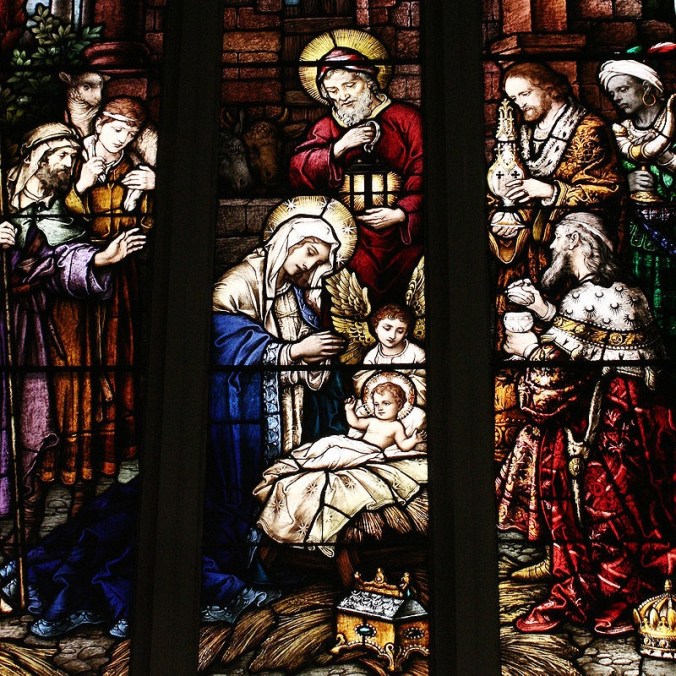
nativity-stained-glass

John 1:14 “We have seen his glory, the glory of the One and Only who came from the Father, full of grace and truth.”

Grace is a very special kind of love God has for us. It is not an “easy” love. Why wouldn’t I love my wife and my family? That is a relatively “easy” kind of love. They make my home a warm and pleasant place to live. They fill the house with laughter and comfort. Loving them is like riding a bicycle downhill. It happens all on its own. It would take effort to prevent it.

Why wouldn’t I love my car, that makes my life so easy, and gets me from point A to point B with almost no work at all? Why wouldn’t I love my house, which keeps me warm in the winter, and cool in the summer, and sheltered all year round? Why wouldn’t I love my clothes which can even create the illusion that I look better than I actually do?

But you know how quickly all of this can turn. Family members get under each other’s skin, and push each other’s buttons, and before you know it they are looking for ways to get out of the relationship. Our “stuff” wears out, and soon we are ready to junk it or trade it in for something newer and better. “Easy” love often doesn’t last very long.

Jesus loves the sinners, the people who have always brought him misery. “A friend of sinners,” they called him. He didn’t deny it. “I have not come to call the righteous, but sinners to repentance.” He actually seeks them out, like the collector who is looking for some rare piece to purchase and to own.

He does more than desire them. He serves them. He saves them. It is his gift. It is why he became flesh and made his dwelling among us. He came to die for us. That was his mission, his purpose, his goal. It was not like it is with the soldiers, or the firefighters, who put themselves in danger to save others, and may even die in the process. Death is a hazard of their professions, but it isn’t their goal. Jesus loved us so much that he came with the intention to die in our place and free us from sins. That kind of love, the love that loves sinners, the love that dies to serve and save them, is the love we know as “grace.”

Jesus is full of that kind of grace. For him it’s not a passing fancy, and tomorrow he will come to his senses and realize that there is nothing it for him. He isn’t going to run out of patience pretty soon, and then look out for what he might do! Grace, this undeserved love, fills him. It is his standard operating procedure and always has been. It flows from his every word, his every action, in an unending supply. To know him is to know this love we know as “grace.”

In the Christmas gospel we get our first glimpse of this grace that will take him from lowly manger and smelly stable to a bloody cross and a borrowed grave. From here you can see his glory in the grace that will save your soul.