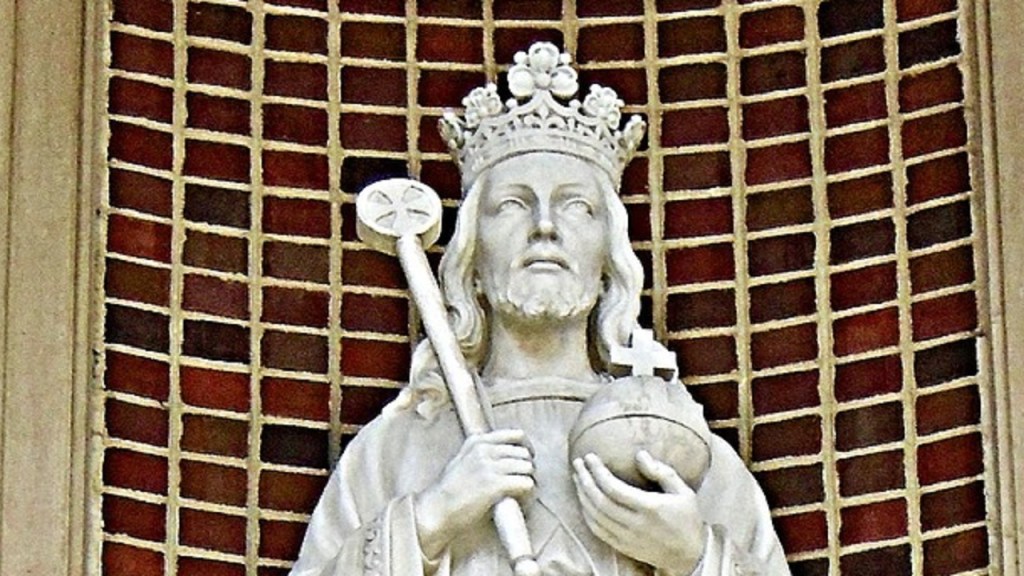
My Savior

Acts 5:31 “God exalted him to his own right hand as Prince and Savior.”

After a team wins the Superbowl, where does the Most Valuable Player from the winning team go? Cue the music for When You Wish Upon a Star.  “I’m going to Disney World,” right? When a college or professional sports team wins a championship, there is usually a trip to the White House involved, too. If you have worked your way to the top of your field, if you have proven yourself the best person to lead in your area of expertise, what do you get? A corner office? A chair in the boardroom? Those are the right places for those who have distinguished themselves in their careers.

If you have redeemed the entire world from their sin, if you have drained all the fear and all the power out of death, if you sacrificed your life to do so but then took it back again, where is the right place for you? Of course, only one person has ever been able to pull off a feat like that. And there is only one appropriate place for him to be– at God’s right hand in heaven.

That’s where we find the one we call our “Savior.” That title–Savior–isn’t just a badge of honor. It is a term of endearment. It says such wonderful things about him. Before I need to know anything else about him, I need to know that his unfathomable love for me led him to rescue me from hell and save me for all eternity.

The Apostle Peter, the man who said this about Jesus, often referred to him as “Rabbi, teacher,” while he was on earth. And Jesus was that. He still is. He has much to teach us about life and love, and God and our future. But we do not follow him primarily as the wise sage or guru who shows us some superior philosophical system of living. He is our Savior.

The crowds of Jesus’ day sought him out as a Compassionate Healer, a miracle-working troubleshooter who could make sickness go away, settle the weather, and feed their empty stomachs. And Jesus still has the power to make our earthly existence a little less painful. We still pray for his merciful intrusion into our physical needs. We pray for health. We pray for rain. We pray for enough money to cover the bills and put food on the table, and rightly so.

But for us, Jesus is not mainly the distribution manager of heaven’s warehouses. He is our Savior. When you come to understand how utterly helpless you are to make amends for all your sins; when you come to realize how spiritually poor and penniless you are to pay for their guilt; when you come to see how relentlessly death is pursuing you, is there anything else you want him to be but your Savior– the one who rescues you from the eternal doom from which you cannot rescue yourself?

There is no higher pedestal on which our Savior could be placed than God’s right hand in heaven. There is no one who deserves it more. There is no one we could possibly prefer to rule our world.

He Fights For You

Acts 5:31 “God exalted him to his own right hand as Prince and Savior.”

No Christian doubts that Jesus is royalty, royalty of a sort that far surpasses all the nobility in all the world.

But Peter’s understanding of the term “Prince” does not include some of the notions that word suggests to us nearly 2000 years later. The stress is not on making and enforcing of laws. That Jesus does this is, of course, true. But that is not his main concern with us.

When we Christians see Jesus mainly as heavenly law enforcement, we wind up with all kinds of distortions in our relationship to him. We feel less cared for and more watched. We experience less peace and more fear. We serve less freely, less joyfully, and more driven. A big, threatening, otherworldly cop tapping his billy club in his hand is not the picture of Jesus Peter wants us to see as we look to God’s right hand.

Nor does Peter choose the term “Prince” to suggest that Jesus is something less than the King. He is not junior royalty, royalty in training, rather than the Ruler of heaven and earth. Many times we would happily demote Jesus to such a figurehead position. Then we feel free to take issue with him on some pet desire of ours. I have heard otherwise sober Christians challenge a direct quote from Christ when they didn’t want to give up a selfish practice or let go of a cherished misbelief. We presume to be Jesus’ teachers, instead of his students; to explain to him how things really work or what is really right.

No, in calling Jesus Prince, Peter brings to mind another function of royalty. It is often forgotten in our time. In medieval times people believed that God had created three estates on earth: the clergy to pray, the nobility to fight and defend, and the peasants to produce food. The idea that the nobility had the responsibility to fight for the people they ruled was not unique to that time. It stretches at least as far back as the Kings and Judges of Israel. Every year King David went to war to protect his people against attackers.

This is the sense in which Jesus is our “Prince:” a hero or champion who will fight to defend his people. He didn’t leave us in the struggle with sin alone. He didn’t even give us a part in overcoming the debt created by our guilt. He took the whole battle on himself when he let our sin kill him in our place.

Nor did he sit back and watch the futility with which we attack death. The whole human race puts its collective heads together. We gather all our technology and medical know-how, and what do we accomplish? We drive death back a few months here, a couple of years there. The life expectancy for an average American grows or shrinks by a year or two. When he rose from the dead, Jesus didn’t merely extend our life expectancy. He destroyed death altogether. Now the life expectancy of the average Christian is infinity, because our Prince defeated our enemy and gives us life that never ends.

Can you think of a better place to see Jesus as our Princely Protector than at the right hand of God? There he has all the weapons he needs to defend our faith. This Prince at God’s right hand is fighting on our side.

The Importance of Our Life-Saving Station

Acts 6:2-4 “So the Twelve gathered all the disciples together and said, “It would not be right for us to neglect the ministry of the word of God in order to wait on tables. Brothers, choose seven men from among you who are known to be full of the Spirit and wisdom. We will turn this responsibility over to them and will give our attention to prayer and the ministry of the word.”

The Twelve Apostles believed a ministry of love was important. They made this ministry of love a major thrust of the early church’s program. They created seven new positions to oversee the work. These were the original deacons–not members of a committee to run the property or make decisions, nor some kind of junior priests. They were men who made sure that poor women didn’t go hungry. In Greek, a deacon is a table-waiter. That is more or less what these men did. Their work gave hands and feet to the church’s love. It also enhanced the church’s main mission, which we will examine momentarily.

Before we do, it is worth noting that our congregations don’t usually have thousands of members. In our context, not so many live in extreme poverty. That doesn’t make our expressions of love less important. They still fill genuine needs. They give evidence that our faith is genuine. Ministries and programs that address the things our neighbors hunger for, like a support group, food drives, or financial classes, are still a legitimate part of a Christian church’s priorities.

But the ministry of the word is paramount. Isn’t that what the Apostles were saying? “It would not be right for us to neglect the ministry of the word of God to wait on tables…. We will turn this responsibility over to them and will give our attention to prayer and the ministry of the word.”

The Apostles wanted the widows fed. They just didn’t want to do it themselves. That was not hypocritical on their part. They clearly understood that they had more important work to do. They understood how the urgency of getting the food to the people who needed it could cannibalize all their time. The church lives on the Bread of Life. Jesus said man does not live on bread alone, but on every word that comes from the mouth of the Father. Without literal food, these widows might die and go to heaven. Without spiritual food, they might die and go to hell.

So, the Apostles understood that for the church, and for their own calling, the ministry of the word was paramount, primary, supreme. That’s not hard to see, is it? From the U.S. Postal Service, I receive a bag once a year to support a food drive for a local food bank. It is a fine thing for them to do. But it isn’t their main mission. If the mailman spent all of his time gathering donations for the food bank and didn’t deliver the mail in a timely way, we wouldn’t be happy. It’s not just a matter of preference. Our society, our economy, depend on the mail going through to function.

Whether they know it or not, the whole world is depending on the church to deliver the life-giving word of God. Not everyone likes to hear the gospel. But almost everyone likes it when someone does something kind. It is easy for the church to get distracted from its mission. American Family Association founder Don Wildmon once explained this in a little parable that went something like this:

Once upon a time there was a community on the coast of the northeast where many shipwrecks took place. There were hidden rocks, and storms often came up quickly. So a concerned individual decided to build a life-saving station. Some friends and neighbors joined him. They bought boats and life vests and even built a lighthouse. Soon they were saving lives, preventing serious injuries, and preserving families with their work.

They did such good work that more and more people joined them. They bonded together and held fellowship suppers and social events at the lifesaving station. After a number of years some of them decided that the old building needed repairs. They built a new one, bigger and more beautiful, and they hosted all kinds of activities in the building.

Eventually, many of the members weren’t willing to go out on the boats to rescue sailors, so they hired professional lifesavers to do the work for them. Then that got expensive, and they needed the money to support all the activities at the life-saving station, so they stopped paying the professionals. Years later someone asked what the purpose was for the life-saving station, and the answer was, “Why of course, to have a place for our community to get together and to host all our activities.”

You get the point, I think. The church is God’s life-saving station. Kindness and love are important. But only the word of God introduces people to their Savior. It is a message that shows people how their sins have been taken away and their relationship with God repaired and restored at the cross. It is a message that replaces the fear of death with the promise of life in Jesus’ empty tomb. It is a message that plants this faith home in human hearts. That message needs to go out from the church to rescue a world drowning in a sea of sin and death. No one else is going to do it for us. If a church isn’t delivering this word of God as the main reason for its existence, then it has mixed up its priorities and lost its true purpose.

A Reason to Review Our Generosity

Acts 6:1 “In those days when the number of disciples was increasing, the Grecian Jews among them complained against the Hebraic Jews because their widows were being overlooked in the daily distribution of food.”

There were no food stamps in the First Century A.D. The government social safety net as we know it didn’t exist.

That didn’t mean there was no help for the poor. The church conducted a ministry of love from its very beginnings. The Christian church in Jerusalem grew rapidly. You remember that in one day, the day of Pentecost, the membership jumped by 3000 people. A short time later the church had doubled in size again. You can imagine some of the challenges this posed for the early Christians. How do you keep track of all these people? There were no computers, no church management software, no Excel spreadsheets. It takes a long time to write down five or ten thousand names and addresses by hand, a lot of paper on which to write them, and a lot of people to keep them all straight. It is not too surprising that once in a while someone might fall through the cracks and be forgotten.

Some of these first Christians were wealthy enough to have property they could sell and give to support the early church. Some of them were quite poor. Widows were particularly vulnerable. Sources of income were very limited for women. If you were still raising children there was no daycare to speak of. Remarriage was often a woman’s best option to stay alive, but most men preferred a woman who had never been married, and men died significantly younger on average. Across all nations and cultures, hungry widows were an acute problem.

The early Christians distinguished themselves by the way they took care of each other. Several times in the early chapters of Acts Luke talks about the impressive generosity with which they provided for each other’s needs. A little more than a hundred years later the Roman writer Lucian thought he was criticizing Christianity when he observed that they did not spare trouble or expense in caring for the interests of their own community, and that they believed, as Jesus taught, that they were all brothers. Love and kindness, not just a pleasant sentiment but a proactive way to treat others, marked the first Christians. It flowed from their faith in Jesus’ great love and kindness for them in the sacrifice of his life on the cross. As John concludes in his first letter, “Since God has so loved us, we also ought to love one another” (1 John 4:11). This reputation was one of the reasons so many people were attracted to the Christian faith.

So we come to the issue in Acts 6. A rapidly growing church was having trouble keeping up with all its members and their needs. They had the desire to love and care for each other, but their organization lagged behind their growth. Jesus’ Twelve Apostles knew that they had to come up with a solution. Before we delve into that, let’s pause to consider what they did not do.

They did not excuse themselves or the church from living out the kind of love that looks out for a brother or sister in need. They did not say, “You know it takes a lot of money to pay the rent, and support the pastor and his family, and send missionaries. We can’t afford to be a charity, too.” I have heard church leaders object that it is not the church’s mission to feed the hungry, clothe the naked, or shelter the homeless. Technically they are correct. Jesus did not establish the institution for that per se.

But love more or less summarizes the individual Christian’s entire life. Can we somehow lay it aside when we start to work together as a group? We may not have the resources to feed and clothe the entire world. The early Christians weren’t trying to take care of the entire city of Jerusalem, either. But they took care of their own, body as well as soul.

The average Christian today gives just two to three percent of income to support his church, and only a tiny fraction of that for any other charity. We don’t have less than the early Christians had. We possess the same grace, the same forgiveness, the same freedom from sin, the same certainty of heaven. Materially, our lives are easier, not harder, in almost every case. The example of these early Christians is an opportunity to examine our own generosity and repent where needed.

The Word Works Wonders

Acts 4:33 “With great power the apostles continued to testify to the resurrection of the Lord Jesus, and much grace was upon them all.”

There is a scene in the movie Dead Poets Society in which Prof. John Keating, played by Robin Williams, is asking his class at this boys’ school why language was invented. They struggle to give him an answer, one student finally weakly proposing, “To communicate?” To which Professor Keating replies, “No. To woo women.” Which, of course, is only partially true. But it illustrates inherent power of words.

For four long years of a long distance relationship I faithfully wrote letters to my wife every other day, and look at where we are today. Words change people. They mold us. They change our minds and change our wills. They inspire us to love and sacrifice, or to fight and destroy. They start wars. They win elections. And yes, they woo women and get them to say, “I do.”

It is no wonder that the Apostle Paul later wrote, “Faith comes from hearing the message, and the message is heard through the word of Christ.” Words are the tool God gives us for creating faith in people, building it, and passing it along to others. But now we are talking about something more than the natural power language and communication has to change people. Now we are talking about the supernatural power of the Word of God.

A message about a man executed as a criminal and then raised to life again isn’t a likely candidate to demonstrate the natural power of words to change people. Torture, execution, and death are not appealing or popular topics, except for a few morbid people with an unnatural interest in that sort of thing. Resurrection from the dead isn’t a rationally convincing claim given the experience of most people with death. I do funerals. Every dead person I ever buried is still dead.

But this was the powerful witness of the apostles. “With great power the apostles continued to testify to the resurrection of the Lord Jesus.” Their power wasn’t the delivery method, loud voices or bold assertions, though it may have involved them at times. Their power wasn’t funny stories or emotional appeals. Some of them may not have been very good public speakers by most standards. The Apostle Paul says that he was not.

The power lay in the supernatural power of the gospel to convince hordes of people to believe words people might otherwise consider foolish. On the first official day the apostles had on the job, the day of Pentecost, the words convinced 3000 people to be baptized. A short time later this new religion counted 5000 men, besides women and children. Then we hear of a large number of priests, previously the sworn enemies of this faith, joining their cause. The apostles had the faith to keep on talking about Jesus’ resurrection in the face of threats, jail, beatings, even death, and this powerful witness was the quintessential face of their faith.

The message hasn’t changed. Neither has its power. Maybe we fear that people won’t believe us if we tell them what we really believe. The Bible appears so unscientific. It is ancient, counter-cultural, unfamiliar to more and more people. But it worked on you. Something still happens when God’s word of grace is unleashed on human ears, regardless of race, culture, or previous beliefs. Hearts change. People believe. Souls are saved. Let’s not be afraid to put God’s word into play where we live, and let its powerful witness work its wonders.

One in Heart

Acts 4:32 “All the believers were one in heart and mind. No one claimed that any of his possessions was his own, but they shared everything they had.”

Few things turn people off from religion so much as divisions. I have talked to many Christians who left the church because of the internal battles they saw, the congregational splits they experienced. Most large denominations go to annual or biennial conventions and argue about church teachings. This has been going on at least since the Jerusalem Council debated the importance of circumcision in Acts 15, about 48 or 49 A.D.

Local congregations develop competing cliques, and meetings where people are discussing God’s work sometimes get mean and nasty. I used to wince when some newly minted graduates of my membership class attended their first voters meeting and watched a couple of “mature” Christian men duke it out verbally in front of the rest of the congregation.

This takes some Christians by surprise. It shouldn’t. When we came to faith, our sinful streak didn’t disappear. Pastor Mark Gungor tells those surprised that he, a married man, notices other pretty women, “Just because I’m sanctified doesn’t mean I’m petrified.” To the people who asked him how he became an alcoholic after he got saved, evangelist Brennan Manning answered, “Coming to faith didn’t turn me into the spiritual equivalent of a patient etherized on an operating table.” The fact of the sinful nature still living in the Christian person means the church will experience rivalries, internal battles, and divisions.

We can all work and pray for more periods of church life like the church in Jerusalem was experiencing here: “All the believers were one in heart and mind.” This does not mean they merely tolerated each other. They didn’t agree to disagree. They functioned as though they all shared the same heart and the same brain. They believed the same things, they lived the same love, because Jesus lived in every one of them by his Holy Spirit.

When God led them to believe that, at the cross, Jesus removed the guilt for every sin, this gave them peace. They didn’t have to live in terror that God was going to punish them. Jesus had set them free from their sins. They were now convinced that God loved them all the time. Death was no longer the scary prospect of facing God’s angry judgment at the end of life. It was their final escape. It was the way home.

This was more than a new way of thinking. God himself was remaking them in his own image, restoring the purity, love, and innocence mankind lost when we fell into sin. When we come to faith, Jesus moves into each believer’s heart and makes it his own home.

This may all take place in the heart and mind on the inside. But this faith has a face. “No one claimed that any of his possessions was his own, but they shared everything they had.” Martin Luther once said that the last thing to be converted is the pocketbook. We will change all kinds of behavior after we come to faith. But ask me to let go of my stuff, suggest that I might sacrifice the security of a full bank account or lower my standard of living to take care of someone else’s need–that takes more than admitting that Jesus has some worthy ideas. We actually have to trust him!

That’s what these early believers did. Their shared heart transformed them into people who shared everything else, money and goods included. Such shared hearts still serve as a powerful testimony to the world that watches us today.

Jesus Knows Me, This I Love

John 10:14-15 “I am the good shepherd; I know my sheep and my sheep know me–just as the Father knows me and I know the Father–and I lay down my life for the sheep.”

Jesus knows his sheep, but not because he read some textbook like The Habits and Handling of Sheep. I assume that my doctor studied anatomy in school. From the moment I first stepped into his examining room, I suppose you could say he knew me like he knew every other patient. He understood the structures and systems that make my body work. But only after he saw me a few times could he say that he knew me, an individual person with individual health conditions. Actually, based on my last visit, he still doesn’t know me very well, if the things from my file he couldn’t remember are any indication.

Jesus knows us like we know our family, only better: “just as the Father knows me and I know the Father.” Though separate persons in their own right, Jesus and his Father are one in a way that defies all human understanding or explanation. If you have seen or known Jesus, then you see and know his Father as well. Jesus is God, and the Father is God, and yet together there is still only one God. That’s more than we can fit inside our little brains. But we can conclude, then, that Jesus knows his Father and his Father knows him unlike any two human beings know each other–whether spouses or siblings or identical twins.

This is also how Jesus knows you and me. He knows the content of our entire lives from one end to the other–even the things still to come. He knows our thoughts and feelings as though they were his very own. He knows our hearts, and he understand the reasons for our inner conflicts and inconsistencies better than we understand them ourselves. He knows every sin, how weak our repentance, how shallow our faith, how easily we fall.

He knows. And still, “I lay down my life for the sheep.” He never regarded saving me, suffering torture and cross for my sins, a waste of his time. It is how he takes care of me. It is how he takes care of all of us. He dies to save us.

This is the Good Shepherd we know. I have been a religious “professional” for over thirty years. I have spent more time intensely studying Jesus than I have spent studying anything else, including my wife or family. There is a vast body of information about him of which I am completely ignorant. I have no clue. Much of what I do know, I don’t understand.

But like the little children I can sing, “Jesus loves me, this I know, for the Bible tells me so.” I know he isn’t the cosmic police, radar gun in hand, hiding in a sin-trap, waiting to catch me going over the limit so he can pull me over and write me a ticket. He isn’t heaven’s bill collector, calling me up to harass me because I am late on paying my debt. He isn’t a spiritual trainer, shouting in my ear to push a little harder and work a little longer if I want to see results. He is my Good Shepherd. He is the Good Shepherd. He knows me, yet laid his life down to save me anyway. And that is what makes him so dear.

What Makes Jesus the Good Shepherd

John 10:11-12 “I am the good shepherd. The good shepherd lays down his life for the sheep. The hired hand is not the shepherd who owns the sheep. So when he sees the wolf coming, he abandons the sheep and runs away.”

A good shortstop knows where to position himself on the baseball field. He has quick reflexes and can get to a line-drive or a short hopper between second and third base quickly. A good soul, a good person, lives a kind and caring life. They practice self-control. They watch what they say and help people in need.

Do you see the difference? The shortstop is good because he does what he is supposed to do. He practices the skills that get the job done right. The person is good because he is moral. His heart is not dominated by sin and selfishness. In the first case, “good” refers to skill and function. In the second place it is measure of godliness.

Jesus was certainly good in the second sense. But when he calls himself the “Good Shepherd,” he actually has something more like the shortstop in mind. When he is feeding and protecting his people, he does the job the way it is supposed to be done. This makes him different from so many other people involved in taking care of human souls.

In his own time, there were two flavors of religious leaders among the Jews, the Pharisees and the Sadducees. The Pharisees were more conservative and moral, the Sadducees more liberal and free. The Pharisees had more respect with the people, but the Sadducees had more positions of power and influence.

What they shared was little respect or care for the common people. A little earlier they had criticized the everyday Jewish believer this way: “This mob that knows nothing of the law–there is a curse on them.” Later they revealed that they feared Jesus because too many people were believing in him, “and then the Romans will come and take away both our place and our nation.” The people, the sheep, were useful so long as it meant respect, prestige, and income for them. But they weren’t going to sacrifice anything for the good of their souls.

Among the shepherds of Christian persuasion today, even our own, there are hired hands who have no sense of responsibility. “So when he sees the wolf coming, he abandons the sheep and runs away.” The “wolf” can take different forms. It might be the peer pressure of a society that has abandoned godly morals and persecutes Christians for clinging to Bible teaching. It might be the rising Christian star whose books and lectures or music are peppered with Biblical terms, but lead people away from the gospel. It might be the so-called scholars who take potshots at Bible teaching and try to make Christians look foolish for believing it. These all have the effect of scattering the flock. They separate the sheep from their faith and from each other.

The hired hand has learned to keep his mouth shut. He doesn’t want to stick his neck out. Confronting the wolf isn’t comfortable. It may cost him respect in his community, popularity among his own people. So he bites his lip and lets the wolf do his thing.

Sometimes the sheep want it this way. They don’t want a shepherd telling them, “This is right, and this is wrong.” They don’t want someone warning them, “Embracing that teaching, or that lifestyle, could cost you your soul.” To them, a “good shepherd” is one who doesn’t demand very much and lets them do their own thing, even if it might kill them.

That’s not Jesus’ style. He is the “Good Shepherd” precisely because he lays his life down for the sheep. But for all his reputation as Love incarnate, just about every time he turns around in the gospels, he is involved in a religious argument. And he was an equal-opportunity offender. He confronted the Pharisees and Sadducees for the aberrations in their teachings.  He called out the worldliness and materialism of the crowds. “Feed our faces, Jesus. Give us free healthcare. Just don’t ask us for any kind of commitment to you.” No. “Get your priorities straight,” he says. On many occasions he confronted his own disciples because they lusted for power, or they didn’t want to forgive.                                           

All this confrontation built ill-will against Jesus until they killed him for it. But that is not what he means by laying down his life for the sheep, or at least not that alone. Jesus isn’t merely saying he would risk death to help his people, like a soldier or a firefighter. He is saying his death is a fact, a necessity. This is what the Good Shepherd does. He dies for the sheep. He dies in their place. He dies so that they won’t have to. He dies to forgive the very sins he confronts. That is what makes him different, and “good.”

Jesus Makes It Safe to Admit Our Sin

1 John 1:10-2:2 “If we claim we have not sinned, we make him out to be a liar and his word has no place in our lives. My dear children, I write this to you so that you will not sin. But if anybody does sin, we have one who speaks to the Father in our defense–Jesus Christ, the Righteous One. He is the atoning sacrifice for our sins, and not only for ours but also for the sins of the whole world.”

If we deny that we still sin today, we aren’t being honest with ourselves. We are only deceiving ourselves. Living in such self-deception is dangerous to our faith and gets in the way of our spiritual growth.

Regarding our past sins, the apostle John points out what we are saying about God: we are calling him a liar, because he says we have sinned. If we insist on taking this stand–I don’t sin and I haven’t sinned in the past–then we have clear evidence God’s word is not working in our lives.

It’s not that John somehow wants us to keep sinning. “My dear children, I write this to you so that you will not sin.” He is just trying to get us to be honest. Until we come to grips with the disease, we won’t receive the right medicine.

Here is the medicine, one last time, and in further detail. “But if anybody does sin, we have one who speaks to the Father in our defense–Jesus Christ, the Righteous One. He is the atoning sacrifice for our sins, and not only for ours but also for the sins of the whole world.” Have you ever dealt with the child who won’t own up to his naughty behavior because he is afraid? All he sees coming if he confesses is the consequences–a spanking, or a tongue lashing, or a grounding, or a time out. A criminal runs from the law for the same reason–fines, prison, or hours of community service are outcomes he hopes to avoid.

But what if we had the confidence that someone had already taken our whipping and did our time? Isn’t that what John says about Jesus here? At the cross, Jesus paid the whole debt. And we don’t need to worry that maybe, somehow, my sin-debt wasn’t included, because there are no exceptions. Everyone and every sin was included. He is the atoning sacrifice “for the sins of the whole world.” Why deny our sins, past or present, when Jesus has removed them?