Don’t Forget Doing Good

Related image

Hebrews 13:16 “And do not forget to do good and to share with others, for with such sacrifices God is pleased.”

What does it mean to you to “do good”? Many Christians today think of living the Christian life especially in terms of avoiding evil. Being a Christian means keeping your life pure, staying out of trouble, not doing something that will hurt someone else. As long as they don’t do anything wrong, many Christians believe that they are living the Christian life.

But is “not doing anything wrong” the same thing as “doing good”? Doesn’t the salvation Jesus’ won for us inspire us to shoot for something a little higher than staying out of jail? Christian love is an active thing. It does something, not nothing. Doing good means helping others. It works hard at providing for our families and raising them in a godly way. It puts in an honest day’s work at the office or in the shop and wants to see my employer thrive. It looks for places to volunteer–at school, for charities, in the community. It wants to share with others. Doing good is love in action, not love trying to get away with as little as possible. Then it is truly the kind of service born of salvation, our sacrifice of praise and thanks to God.

And how does he feel about all of this? It is his pleasure. “And do not forget to do good and to share with others, for with such sacrifices God is pleased.”

Sometimes we are so careful not to give anyone the impression that you can earn your salvation or pay off your own sins that we fail to mention the truth taught here. God is pleased with the service his free salvation inspires in us. That does not mean that our service is a condition we must meet for his love. This does not deny that even our best work is still tainted by sin, and far from perfect, and in need of his forgiveness.

But God is pleased that faith and salvation are producing changed lives in his children nonetheless. We often refer to ourselves as his children, and perhaps this provides a good picture of the pleasure he takes in our praises and good deeds. When you started doing household chores for your parents back when you were a child, your work probably left a little something to be desired. If you mowed the lawn, there may have been thin strips of unmowed grass across the yard that had to be mowed again. If you washed the dishes, there may have been some that needed to be washed a second time. If you did the laundry, maybe you let a pair of blue jeans get in with the whites and turned everything light blue one time. Your work needed a certain amount of your parents’ forgiveness. They may have had to fix your mistakes for you. It wasn’t perfect. But they were pleased that you were trying and you were growing. They wouldn’t be satisfied if it didn’t get better by adulthood. But for the time, they were pleased with your efforts.

God is never happy with our sin and imperfection. He can’t be and still be holy. But he does forgive it. And he is genuinely pleased with the things that come as a product of the faith he has planted in our hearts, the Spirit who has made our bodies his home, the salvation through which he has called us to faith. We don’t have to be afraid to serve. We can be confident that our service born of salvation is his pleasure.

Christmas is still about God’s salvation, the work that he has done in service to us. But we can’t believe that God has left heaven and come to earth in such a humble way to save us without being changed. We want to respond. We want to serve. May the miracle of Jesus’ birth give birth to the miracle of faith and service in us.

Therefore

Carolers

Hebrews 13:15 “Through Jesus, therefore, let us continually offer to God a sacrifice of praise.”

“Therefore” tells us that this is a conclusion, a response, the logical result of what comes before.

What was that? In the preceding verses, the inspired writer draws a comparison between Jesus’ sacrifice for us and the sacrifices offered on the Great Day of Atonement. The blood of the animals sacrificed was used in the ceremonies of the tabernacle, but the bodies were taken outside the camp to be burned. Things that God commanded be taken outside the camp were unclean. There was a distance between such things and God’s people, an end to contact between them. God’s people wanted nothing to do with such things anymore.

When Jesus, our sacrifice for sin, was crucified, he also suffered “outside the camp,” outside the city. His body was treated like the bodies of those sacrifices on the Great Day of Atonement. He was regarded as unclean. The people wanted nothing to do with him anymore. Among all the other indignities he suffered in paying for our sins, there was also this disgrace. It may not have been the greatest insult he suffered, the most intense pain that he endured. But it is surely another example of the great extent of his love for us. That our God should let himself be treated so–as someone so unclean, so lowly, a reject to be gotten rid of–this is one more way in which he demonstrates the depth of his grace. He would not let such humiliation and rejection prevent him from cleansing us from our sins. How dearly he must love us!

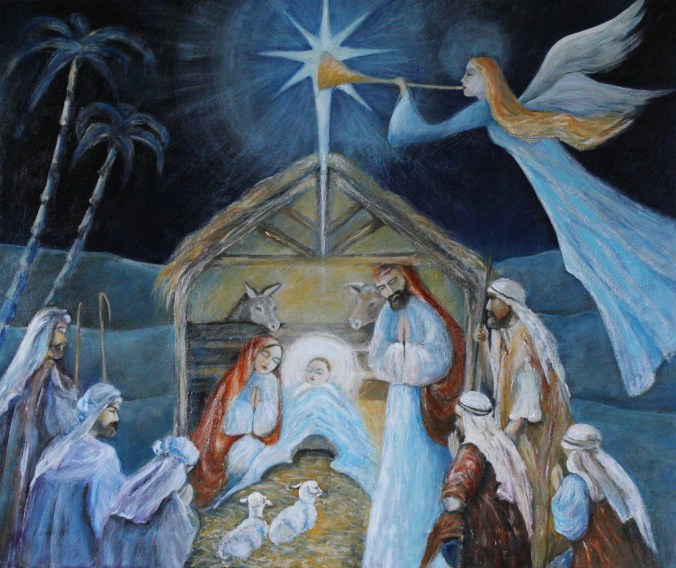
Nor are such examples of his great patience with us missing from any other era of his life. We may wax sentimental about the manger scenes with which we decorate our homes. The scene looks warm and inviting–to us! There was nothing warm and inviting about it for our Savior. It has more to do with humiliation and rejection for him. No one would make room for him and his parents. He was relegated to a place among the animals. Still, he was not so great, so high, so proud that he refused to humble himself this way. If this was what it took to save us, so be it. He would suffer worse things on the way to his mission’s end.

What does this have to do the words of Hebrews 13? “Therefore.” “Through Jesus, therefore, let us continually offer to God a sacrifice of praise…” What we offer God is not something we initiate on our own. It is not a way by which we hope to convince him to love us. It is not a bribe that will move him accept us and give us heaven. No, it is our response. We are merely responding to God and what he has done. He initiated any service we offer. His love convinced us to love him, not the other way around. He has already accepted us and given us heaven, and thus our service is born of salvation.

Let us not miss the sacrifice and love that ever lead to our “therefore.”

What We Want for Christmas

Christmas Shopping

John 12:20-21 “Now there were some Greeks among those who went up to worship at the Feast. They came to Philip, who was from Bethsaida in Galilee, with a request. “Sir,” they said, “we would like to see Jesus.”

This is a season of the year for wanting things. When I was little my Christmas lists were incredible: two or three pages of spiral bound notebook paper filled with requests thanks to ideas I got from the J. C. Penney Christmas Catalog. My wish lists have gotten more modest since I have gotten older, but I would be lying if I told you I didn’t really want to get some of the things on my list.

It’s not just the gifts that make this a season for wanting. This season promotes nearly hedonistic indulgence. Between now and December 25th there are things we want to taste– cookies and sweets and snacks and feasts. There are things we want to hear– Christmas carols and concerts and the happy sounds of gatherings and parties. There are things that we want to see– Christmas lights and seasonal cartoons, sentimental old holiday movies and maybe even an inch or two of snow.

The Greek men who came to Philip wanted to see Jesus himself. How they had heard of him, or why they wanted to see him, we are not specifically told. They simply make the request, “We would like to see Jesus.” Were they curiosity seekers? Jesus’ entry into Jerusalem on Palm Sunday had created quite a stir. Maybe they even witnessed the royal welcome the crowds gave him. Maybe they had heard reports of Jesus’ miracle working and hoped that they might get to see something miraculous done by him.

Were they seekers of a more spiritual sort? Maybe they wanted an audience with Jesus to ask him their questions about God and religion. Maybe they were still trying to find certainty for their faith. Maybe they were seeking salvation.

A common Christmas slogan asserts, “Wise men still seek him.” Why? Why is this still our wish, a couple of thousand years later?

Maybe it’s because the Christ child adds that sentimental touch to our Christmas celebration. The Fourth of July isn’t complete until you’ve gone to see the fireworks. Thanksgiving isn’t complete until you’ve had your turkey and pumpkin pie. A trip to Disney World isn’t complete until you’ve had your picture taken with the Mouse. And Christmas isn’t complete until we have spent some time hearing about that poor little baby who got such a terrible start in the world. It’s a story that tugs at the heart strings, just like hearing about Tiny Tim Cratchett in Dickens A Christmas Carol, or George Bailey in It’s A Wonderful Life.

Then we have reduced Jesus to a seasonal prop. He comes out with the other decorations after Thanksgiving and can just as easily be put back in the closet shortly after New Year. He gives us a warm, cozy feeling, but there is no lasting impact on my heart or life. I experience no soul searching as I ponder my depravity. I find no encounter with God in the face of Jesus, no sweet taste of his grace. Then Jesus is less the object of our worship and more a pleasant diversion. Jesus as Christmas decoration is a subtle example of what God had in mind when he commanded, “You shall not take the name of the Lord your God in vain.” It is a vain, useless, and evil thing to reduce the Savior of the World to an ornament or a good feeling.

But what if our desire to see Jesus this Christmas is because we know what he will be doing on Good Friday and Easter? What if we want to see him because a deeper, more desperate need haunts our souls and troubles our consciences?

Maybe we have been able to hide our mean, twisted and perverted selves from the mutual admiration society we have gathered around us. We haven’t been able to hide it from ourselves. And we haven’t been able to hide it from God. When we consider that God knows– he knows every curse whispered under our breaths, every hateful urge we have choked back, every lustful glance, every perverted daydream– we know our situation is critical. Our sin-sickness is terminal. We want more than a cute baby, then. We want to see a gracious Savior, a heroic and self-sacrificing Champion, who can bring forgiveness where there is sin, life where there is death, and heaven where there is hell.

There is no deeper reason for our desire to see Jesus this season.

Lasting Comfort

withered flower

Isaiah 40:6-8 “A voice says, ‘Cry out.’ And I said, ‘What shall I cry?’ ‘All men are like grass, and all their glory is like the flowers of the field. The grass withers and the flowers fall, because the breath of the Lord blows on them. Surely the people are grass. The grass withers and the flowers fall, but the word of our God stands forever.’”

We don’t naturally go looking for the kind of comfort that will last forever. Our world is full of counterfeit comforts, short-lived comforts, and you and I have probably tried most of them.

There is Southern Comfort, and other similar mind-altering comforts that come in a bottle, or in a pill, or in a syringe. They may make us forget our hardships for a little while, but they can’t make them go away. They usually end up creating more of them than we had before.

There is the comfort that comes from being comfortable, from having all the money we need, all the things that we want, all the prestige and success we have worked so hard to build. The problem is that when we look for our comforts here, we never seem to have enough to be truly comfortable.

We may try to surround ourselves with comforters of various sorts, people who can give us a feeling of safety and security. We strive to build the perfect family. We work hard to elect the right leaders. We look up to heroes and role models who show us the way.

The problem is that “all men are like grass.” Even the good ones may serve well in their time, but death overtakes us all. “And all their glory,” all the best things that their lives have produced, “is like the flowers of the field.” Human accomplishments rarely outlive the lives of the people who performed them.

My great-grandfather and grandfather spent their lifetimes building up a family farm. They worked on it until the day they died. Then one day the bank came and finagled it away.

The history of the world is littered with heroes whose life’s work benefits absolutely no one today, other than to make a great story. You can be sure the day will come when fathers of our own country, whose ideas and sacrifice we still benefit from hundreds of years later, will be added to the list of those whose glory has faded, whose flowers have fallen, and no one will benefit from their work other than a few interested historians.

But the word of the Lord, and the promise of comfort that it brings, will never end up on that list. “The grass withers and the flowers fall, but the word of our God stands forever.” The life’s work of Jesus Christ is no less relevant today than it was 2000 years ago. The power of his gospel to touch our hearts and bring us faith is no less effective today than when he first issued the Great Commission. The forgiveness of sins his gospel promises is no less valid and no less certain than when those comforting words first fell on the ears of his disciples in the towns and villages of Galilee. It is an absolutely sure message.

God’s comfort may not be immediately obvious to us in the stable at Christmas. It is even harder to see hanging on the cross. That is why so many artists have doctored the picture with halos and glowing skin. But we don’t need such special effects to see salvation in the manger. All we need to see is the comforting and certain message of forgiveness connected to that Savior, and know his word stands forever.

Real Comfort

Comfort hand

Isaiah 40:1-2 “Comfort, comfort my people, says your God. Speak tenderly to Jerusalem, and proclaim to her that her hard service has been completed, that her sin has been paid for, that she has received from the Lord’s hand double for all her sins.”

God feels passionately about the comforting message he is preaching through his prophet. He is not a hard-nosed, CEO kind of God, concerned only about the bottom line, seeing people only as cogs in the great machinery of his heavenly corporation. These words are not an impersonal company memo outlining a new policy. They are more a note of individual concern, a letter in which he professes the great love he has for us.

This is a God who cares personally and passionately for the people he calls his own. You can hear it in the way he speaks. You hear his urgency and concern in the repetition of the words, “Comfort, comfort…” If you spoke the Hebrew language, you would hear the depth of his emotions in the choice of the word “comfort,” a word which calls to mind the heaving of a great sigh.

You hear it in the next verse when he tells the prophet to “speak tenderly to Jerusalem.” “Speak to the heart, not just the head. Speak in a way that we will show them I care and they can trust me.” You can hear it in the way he addresses us. He claims us: not just “the people,” but “my people;” not just “God,” but “your God.” The Lord wants us to know how desperately he cares.

But this is not merely an emotional outburst. It is not a content-free expression of his feelings. There is a solid reason that these words can give his people comfort. “Proclaim to her that her hard service has been completed.” Though he wrote a hundred years before Babylon took Judah into exile, Isaiah penned these words for those future exiles. Life would be tough for them. They lost a war. As a result of the war many buried their own children. They suffered through famine. They were finally dragged away from their homeland and forced to live in a foreign country. Worse yet, they knew that they had every bit of it coming. They were suffering for their stubborn refusal to live God’s way.

The Lord doesn’t have to send an invading army and drag us out of our homes for us to know something about the hard service mentioned here. Our own misery so often comes as a result of our stubborn refusal to live God’s way. When you keep the commandments, the commandments keep you. But as someone once pointed out, we never so much break the commandments as we are broken on them. Sin doesn’t make life fun. It makes life hard.

Should it surprise us that we live with miserable relationships when we are so obsessed with making a buck that we invest no time in them? Should it surprise us that Christian marriages come apart when, from the start, we build the relationship on gratifying lustful desires instead of the self-control, self-denial, and self-sacrifice that are necessary to make it last a lifetime? Should it surprise us that we live in a constant state of tension when we won’t be honest with the people around us? Should it surprise us if the crime rate soars when we are tight-fisted? A harder service than these awaits those who won’t repent, but even now our sin makes us comfortless.

Then we hear God’s comforting promise, “proclaim to her that her hard service has been completed.” But why? What has changed? “Her sin has been paid for…she has received from the Lord’s hand double for all her sins.” The Lord isn’t saying his people have paid for their sins themselves. There would be little comfort in such a thought, only temporary relief as we anxiously waited for the next sin we committed and the next payment that the Lord extracted for it.

No, the comfort that the Lord so earnestly wants to impress upon our hearts is the comfort that he has paid for our sins. Whatever price was needed, he paid it himself, even double. There is no tiny fraction of the price left over for us to cover. He has paid it all, and the staggering price was the life of his only Son.

That generous, extravagant love of God that so comforts us is the true glory of our God. His glory is not to be found so much in grand visions of heaven, or awesome demonstrations of miraculous power. It is rather found in the grace and love that led our Lord to pay for all our sins.  It was first revealed in the coming of Jesus, in the announcement of the angels, “Today, in the city of David, a Savior has been born to you. He is Christ the Lord.” The revelation is a comforting message without equal.

His Ways and Our Walk

Boy Jesus

Isaiah 2:3 “Come, let us go up to the mountain of the Lord, to the house of the God of Jacob. He will teach us his ways, so that we may walk in his paths.” The Law will go out from Zion, the word of the Lord from Jerusalem.

When we hear that God will teach us his ways, the prophet does not mean the ways the Lord wants us to act. His ways are the ways that he acts. His ways are the things he has done for us. Here we have the heart and core of the loving change our Savior came to work in us.

We live in a world divided by sin. We can have peace with each other and live a life of love only when we have peace with God. And we can have peace with God only because Jesus has made that possible. Jesus came first to remove the sin that made God angry with us. He stepped between us and an angry God. He bore the punishment that brings us peace (Isaiah 53:5). God’s way was to sacrifice his own Son for our sins. God’s way was to raise that Son from the dead as proof that sin has lost its power. God’s way was to love us enough to take care of our problem for us. He gave us life and salvation as a free gift. When he gathers many peoples from many nations together, this is the way of peace that he teaches us.

And only then can we “walk in his paths.” Only when my Savior has gathered me to himself and taken my sin, only when he has come to live in me himself, will I walk in his paths.  Only then will I treat my brother or sister in the faith the way he would treat them.  Only then will I reach out to others who don’t know God’s peace and extend that peace to them as well.

Perhaps it should be obvious, but we know this because from his house our Lord has taught us his word: “The law will go out from Zion, the word of the Lord from Jerusalem.” Sometimes people get the idea that the church is nothing more than a dead institution. In individual congregations or church bodies, that may be true. But far from a dead institution, the Holy Christian Church, God’s Zion, his gathering of believers, is something the Lord himself has raised up and preserves to share his word. As the Lord gathers the nations there, as he gathers us there, we hear his word and learn his ways.

That word, in turn, changes hearts. It is the power of God for the salvation of everyone who believes according to the Apostle Paul. God’s word takes the heart captive. It makes him our ruler: a good and gentle king who rules there with his grace and love. It makes us his agents: ambassadors of God’s peace and love to a world that desperately needs them.

God’s High Mountain

Mountain

Isaiah 2:2-3a “In the last days the mountain of the Lord’s temple will be established as chief among the mountains; it will be raised above the hills, and all nations will stream to it. Many peoples will come and say, ‘Come, let us go up to the mountain of the Lord, to the house of the God of Jacob.”

The last days is used throughout the Old Testament to refer to the period from Jesus’ birth to the end of the world. It is the time in which we now live. During these last days, God promises a new glory for Zion and his temple. It would not merely be restored to its former glory. It would become chief of all the mountains. It would be raised up on high for all to see.

If you go to Jerusalem today, Mount Zion is still there. It isn’t any higher than it ever was.  The temple is gone. It isn’t even a pile of rubble. Nothing but the foundation walls are left. In order to understand this prophecy, we need to recognize where God has located his temple in the New Testament, and what he means by “Zion.”

The Apostle Paul says that each one of us is a temple of the Holy Spirit. Peter says that we are like living stones being built into a spiritual house, built on the cornerstone of Jesus Christ. Together with all believers, we are part of God’s Zion, God’s temple, which is the Holy Christian Church. Wherever you have believers, you have God’s temple, God’s Zion in plain sight for everyone to see.

This is how our Savior establishes peace on earth. He does not work through political policies or treaties or human diplomacy. He does it by raising up his Church, his Zion, his Temple. He does it by making the people who belong to him a force to be reckoned with. They are a safe haven all the world can see. As he gathers his people together and the Church grows, it is lifted higher and higher and the nations come streaming in.

Those people, Isaiah promises, come from all the nations of the world. “Many peoples will come and say, ‘Come, let us go up to the mountain of the Lord, to the house of the God of Jacob.'”  When Isaiah wrote these words, God’s people weren’t from many nations. They were from one nation–the Jews. Relatively few Christians have Jewish ancestry. But we have the privilege of living after the Savior has come, and the Gospel has spread to all nations, so that we can be included as God’s children, too. Every Christian believer is part of those many nations Isaiah sees streaming to God’s temple and asking to go up to God’s house.

Don’t these words give us a sense of optimism as we work to bring our Savior’s peace to more and more people?  It can become easy for us to get a discouraged by what we see going on in our own churches. We may go for years without numerical. Internal controversies and battles afflict our congregations. Christianity seems to teeter on the edge of defeat.

But here God promises that the nations come streaming into it. People will come flooding in like a river. They are eager to come to the house of the Lord. And that is what is going on all around the world. Remember that God’s Church is more than just the little gathering with whom we meet each Sunday. It includes every believer around the world and throughout time. More Christians today live south of the equator than live north of it, and in many places the Christian faith is growing exponentially. Even if our own congregations have less worshipers today, those faithful members who have gone home to heaven haven’t been lost to us. They are secure in heaven. And each child we baptize, every adult we bring into the fold, only adds to the stream of people flowing into God’s house.

Our Lord is still gathering a Church for himself. We are part of the many peoples streaming to him. We are also part of the way he lifts his temple high. Our love, our life, our witness help the world find God’s house.

The Safe Way Home to Joy

Highway Home

Isaiah 35:8-10 “And a highway will be there; it will be called the Way of Holiness. The unclean will not journey on it; it will be for those who walk in that way; wicked fools will not go about on it. No lion will be there, nor will any ferocious beast get up on it; they will not be found there. But only the redeemed will walk there, and the ransomed of the Lord will return. They will enter Zion with singing; everlasting joy will crown their heads.  Gladness and joy will overtake them, and sorrow and sighing will flee away.”

We can travel this highway safely. We can tell just by looking around at our fellow travelers. Isaiah says none of them are unclean. None of them are wicked fools. Only those who have had their sins washed away in Jesus blood travel this road. Only those who place their faith in him, who walk in that Way, will make this journey. This highway of faith leads in only one direction, and everyone on it is going the right way. We travel in good company.

Nor do we have to worry about any obstacles along the way. Isaiah assures us that no lion or other wild beast can attack us on this road. When we are walking the walk of faith, we are walking in the only safe way to heaven. Some people try to get there by a way of their own making. They won’t go even a step before sin has stopped them in their tracks.

But when we cling to our Savior in faith, then the entire way to heaven has been cleared for us. We could even say that the entire way to heaven has been traveled for us. No sin can stop us while we are in the faith. Satan can’t accuse us. When we follow our Savior, when Jesus himself is carrying us along, the way ahead is always clear.

We don’t travel this highway of faith just for the sake of travel. Our destination is what gives us joy. Our Savior is leading his redeemed to their home, a home Isaiah calls Zion. “But only the redeemed will walk there, and the ransomed of the Lord will return. They will enter Zion with singing; everlasting joy will crown their heads. Gladness and joy will overtake them, and sorrow and sighing will flee away.”

When the Old Testament Jews heard of Zion, they thought of Jerusalem and the temple. When the prophets mention the future Zion, they often had in mind something more. In part, they were writing about the New Testament Church in which we live today. And in part, Isaiah’s description here fits the Church as we experience it. When God called us to faith, he started us on this walk, and he led us into his Church. It is a spiritual home for us in this world. In it we enjoy forgiveness and spiritual growth. In it we already possess eternal life.

But ultimately, coming to this Zion means joining with all believers across the great span of time in heaven. That is where “everlasting joy” will crown our heads. That is where sorrow and sighing will flee away. When we have reached that Zion, we can truly say our Savior has led us home.

As we approach Christmas this Advent season, remember: Christmas isn’t a deadline. It’s our Savior’s birthday. It is the beginning of his saving story. Keep your eyes fixed on him in faith, and let him lead you home to joy.

Jesus Our Strength

Superman

Isaiah 35:3-6 “Strengthen the feeble hands, and steady the knees that give way; say to those with fearful hearts, ‘Be strong, do not fear; your God will come with vengeance; with divine retribution he comes to save you. Then will the eyes of the blind be opened and the ears of the deaf unstopped. Then will the lame leap like a deer, and the tongue of the dumb shout for joy.”

It’s not only Americans getting ready for Christmas who become depressed and discouraged.  Isaiah’s people felt that way, too. The remnant of believers in Israel no longer enjoyed the respect of the rest of the people. They were a minority. And when the time came for the nation to be taken away into exile, the believers had to leave their homes and property behind just like everyone else.

We all face obstacles that make our hands feeble and our knees give way. The story is different for each of us. Is it the responsibility you don’t feel entirely qualified for? Is it the person at work or in the neighborhood who seems like a constant thorn in the side? Is it a physical problem that has changed your life? We all know that living the Christian life also means bearing a cross. Whatever your own story is, the Lord keeps many things like these in our lives as constant reminders and consequences of our sinfulness. It goes back to the garden of Eden and the curses laid upon Adam and Eve for their sin. We are no better, just as much under God’s judgement as they were.

But the Lord does not want us to live in a constant state of fear and discouragement because we are sinful people living in a sinful world. Our Savior comes with a message of strength.  His encouragement takes away our fears. He gives reason to make those feeble hands strong and those wobbly knees steady: “Be strong, do not fear; your God will come with vengeance; with divine retribution he comes to save you.”

We may not feel comfortable desiring vengeance. We generally don’t consider it a Christian attitude. It’s true that God warns us against seeking vengeance ourselves. He is not looking for bloodthirsty mob of followers. But he does promise vengeance as one of the ways he supports his people. Our Savior comes as judge of the world. He will destroy all the enemies of his church and his people.  When God says “vengeance is mine, I will repay,” that is no idle threat.  We are the ones who benefit from this work. Our Savior comes to defeat all the enemies of our faith and take them out of the way. That is a legitimate reason for his people to renew their inner strength.

More important still are the positive things Jesus came to do for his people. Isaiah looks to his ministry of miracles: “Then will the eyes of the blind be opened and the ears of the deaf unstopped. Then will the lame leap like a deer, and the tongue of the dumb shout for joy.”

An old Sunday School teacher once mused about why we don’t simply enjoy the miracle accounts from Jesus’ life more. We don’t have to tear them apart to find their meaning. Each one is a simple confirmation that Jesus really is the Son of God. He is the promised Savior of the world. He genuinely has the power to pay for my sins, raise me from the dead, and take me to heaven. When John the Baptist sent his disciples to find out if Jesus was the Christ, Jesus told them, “Go back and report to John what you hear and see: The blind receive sight, the lame walk, those who have leprosy are cured, the deaf hear, the dead are raised, and the good news is preached to the poor.”

Did our Savior have Isaiah 35 in mind? Both he and the prophet understood that every miracle he performed is good news. These strengthen our spirits, because they assure us Jesus really is the Savior.