Waiting Patiently

Rain Plant

James 5:7-8 “Be patient, then, brothers, until the Lord’s coming. See how the farmer waits for the land to yield its valuable crop and how patient he is for the fall and spring rains. You too, be patient and stand firm, because the Lord’s coming is near.”

James does more than tell us how to act. When we hurt, when we aren’t being treated right, or when something isn’t working right, we want a change! If things weren’t ever going to change, we would despair. We need something to hold on to. We need something to give us hope. We need something that makes patience possible.

James finds that something in our Lord’s second coming. He compares our patience in light of Jesus’ coming to a farmer’s patience waiting for the harvest. Farming is a risky business no matter where a person lives. There are so many things beyond a farmer’s control. Nowhere was this more true than in the Holy Land. When God led Israel into their new home, he told them that farming there would not be like farming in Egypt. Egypt relied on the annual flooding of the Nile River and the human ingenuity of irrigation systems to make the crops grow. Farming in Israel was somewhat unique because this dry part of the world relied upon two rainy seasons for its water. The farmer could plow and plant, but every year his harvest still relied on the Lord to send the former and the latter rains–the fall rains and the spring rains described by James. The harvest would come, but in the meantime the farmer was left with only two things to do–trust in the Lord and wait patiently.

Jesus’ second coming is like our harvest for two reasons. It marks a beginning and an end. It marks the beginning of all the rich rewards God has promised us in heaven–the glory, the perfection, the beauty, the plenty, the power, the reunion, the life, and especially the love. It marks the end of all the things that require us to live with patience now–the tears, the pain, the failures, the worry, the shortages, the sin, and especially the death. It promises us things are going to change. It enables us to trust in the Lord and be patient.

Our Savior’s second coming often occupies the attention of God’s people. Here James is teaching us that it is not just about our future. It is about our life every day. It is something for us to ponder and keep before our eyes all the time.

Why? None of us has life easy. We may look at someone else’s life with envious eyes and long for what they have. We do this just because we don’t always know what lies behind their smile on Sunday morning. But this promise of Jesus’ coming is part of how God’s people cope with life the way it really is. If we understand it, and believe it, it is a source of patience for our less than perfect lives with our less than perfect churches in our less than perfect world. The changes we all long for are coming. The better life and better things to come are on their way. In the meantime God says, “be patient and stand firm, because the Lord’s coming is near.”

Your Father Knows

Sparrows

Matthew 10:29-31 “Are not two sparrows sold for a penny? Yet not one of them will fall to the ground apart from the will of your Father. And even the very hairs of your head are all numbered. So don’t be afraid; you are worth more than many sparrows.”

Sometimes we suspect God doesn’t care about us anymore. Is he really there? Does he really watch? If so, why am I stuck in this job with a mean manager and creepy coworkers? Why hasn’t he done something about my family’s unending drama? Why do I feel so alone so much of the time?

The Lord doesn’t answer all our “whys”. But Jesus makes it clear he is always aware of what is going on, and he always cares. Whether we can see or feel them, Jesus presents promises for us to grab and hold: He knows every bird on earth and what happens to it. My parents once had a cardinal in their yard that flew into the window time and time again. The bird would see its reflection in the window and think the reflection was a rival bird. God was aware this was happening. Each spring there are huge flocks of some sort of black bird that gather in the trees around our neighborhood. The Lord knows every member of those flocks. It’s not just because he is curious, or a bird watcher, or a member of the Audubon society. He has a care and concern for every part of his creation.

There is no part of creation he cares about more than you. Even the hairs of your head are numbered. You and I might pay more attention to our hair than we need to, with all the different shampoos, conditioners, dyes, combs, brushes, and curlers we use. But the Lord knows us so intimately that he knows every single hair. He knows which ones aren’t quite as colorful as they used to be. He knows which ones aren’t attached quite so firmly as they once were.

Of course, his big concern is not birds, or hair. Jesus tells us this to assure us that in every way he cares for you, all of you. He never gave his life for birds. But he loved you so much that he suffered in your place for your sins and died to give you forgiveness and set you free. Not because you and I are so good, but because he loves us so much, we are worth more than many sparrows. So don’t be afraid. You’ve got God’s attention. More than that, you have his heart.

Not Above Our Master

accuse

Matthew 10:24-25 “A student is not above his teacher, nor a servant above his master. It is enough for the student to be like his teacher, and the servant like his master. If the head of the house has been called Beelzebub, how much more the members of his household!”

Not everything about Jesus’ ministry was all chuckles and grins. The people of his home town tried to throw him off a cliff. The Bible experts of the day and the church leaders challenged his teaching, questioned his credentials, and tried to ruin his reputation. Jesus wanted his disciples to realize that they could expect opposition, too. “A student is not above his teacher, nor a servant above his master.”

Consider the relation between these twelve men and Jesus. Jesus calls them his students, more literally, “disciples.” A disciple is a learner, a follower. He is devoted to more than a set of teachings. He is committed to the teacher himself. These men were attached to Jesus. That would never change for the rest of their lives. They would always be his disciples, and he would always be their teacher.

Jesus also calls them his servants. The kind of servant he means is not a mere employee, free to quit and work for someone else whenever he wants. This kind of servant is a slave. And he will always be one. That reflects our relationship to Jesus, too. Once he makes us his servants, we remain his servants, and he our master, forever afterward.

So what’s the point? Neither a disciple nor a slave is above the teacher or master. They don’t take the teacher’s or master’s place. They certainly don’t expect to be treated as if they were vastly superior. They aren’t destined for a life of greater honor, privilege or ease. At most, they might look forward to a life something like that of the teacher or master. “It is enough for the student to be like his teacher, and the servant like his master.”

Jesus wasn’t in heaven yet. Neither were the Twelve. Neither are we. While we follow Jesus on earth, we can expect the same kind of treatment Jesus received here. If we are like Jesus in the things that we say, and the things that we do, then we can expect to be like him in the way others will treat us, too.

Sometimes they aren’t very nice. “If the head of the house has been called Beelzebub, how much more the members of his household!” “Beelzebub” was not a compliment. The name means “Lord of the flies.” It suggests that the person is Lord of the place where flies are most often seen: “Lord of the manure.” From ancient times the Jews used the term as a title for the devil. Thus Jesus’ enemies were not suggesting he was stupid, or strange, or worthless. They were saying that he was evil. We might compare using this title to calling someone “Hitler” today.

It’s not hard to see that Jesus’ warning holds true, is it. Should it surprise that many consider the Christian message not just strange, or stupid, but evil? “How come you Christians are so mean to people with different ideas about sex and marriage, and tell them that what they are doing is a sin? Why are you so hateful and prejudiced against them?” “Hate” is never a Christian attitude. But is it hateful to warn someone about their sin and its consequences? Or, if there are negative consequences, is it really a loving thing to do? “How come you Christians are so arrogant and narrow-minded and think that you are the only ones going to heaven? Everyone worships the same God. People just call him by different names.” But are we just “narrow-minded” when we try to convert people from religions in which people must live in constant doubt of heaven and must pay for all their own guilt? Is it just arrogance that leads Christians to introduce people to Jesus, the only God who loves them to death? They called Jesus “Beelzebub,” the prince of demons. If you let your Christianity be known, don’t be surprised if they call you mean, intolerant, hateful, evil, or worse. Your Master was called things like this. You and I will, too.

But don’t forget the kind of Teacher and Master you follow. “You call me ‘Teacher’ and ‘Lord’ and rightly so, for that is what I am. Now that I, your Lord and Teacher have washed your feet…” (John 13:13-14). “I am among you as one who serves” (Luke 22:27). “For even the Son of Man did not come to be served, but to serve, and to give his life as a ransom for many” (Mark 10:45). Our Master served us to the point of dying to save us. We lose nothing by following him to the end.

Jesus Is Everything

A to Z

Revelation 22:13 “I am the Alpha and Omega, the First and the Last, the Beginning and the End.”

The first two words with which Jesus describes himself in this verse are the first and last letters of the Greek alphabet. We would say the “A and the Z.” With these terms Jesus is speaking of his eternity, but he is saying so much more than that. He is also telling us that he is our everything. If we have Jesus, we have it all. There is nothing more we could want. Jesus himself is the focus, purpose, a sum, and substance of all human history. Jesus himself is the fulfillment of all of God’s saving work. If you have him, then there is really nothing beyond him worth having.

Martin Luther once commented, “When Christ was entrusting the ministry to Peter, He asked him three times whether he loved him. For He knew and saw that no one can be a true preacher or a Christian unless he loves Christ with heart and soul. But how can a person have such love for Christ unless he first believes that he has everything in Him, unless he is convinced beyond a doubt that Christ is his Treasure and Savior, his Life and Comfort?” Jesus’ words convince us that he is our treasure and Savior, that we DO have everything in him. They move the church to love him as his bride, to pray that he would come and be our groom.

When Christ’s love for us creates a heart of faith that loves him in return, that changes our lives in many ways. In fact, life is never the same. His love living in us changes the way we look at what we own, changes what we think is important, changes how we spend our time. It changes things so simple as leading us to think of him and ask his blessing each time we eat. Sometimes it changes things so serious as what career path I will follow for the rest of my life.

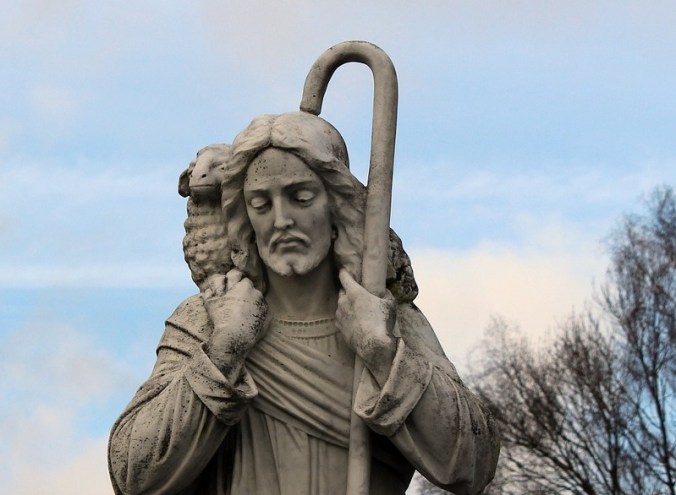
But as much as anything, it simply makes us want to be with him. You know that he still comes to us to be close to us in his word: in preaching, studying, reading, and singing. That’s why we turn to our Bibles for comfort when life has dealt us a blow, isn’t it? You know that he comes to meet you in those promises that he is your Good Shepherd, that nothing can separate you from his love, that you can cast all your anxiety on him because he cares for you.

Still, this can feel like a long-distance relationship. We long to be closer still. Just before Jesus described himself as the Alpha and Omega he promised, “Behold, I am coming soon!” That gives us a thrill. And it moves us to pray with the Apostle John the last prayer in the Bible, “Amen. Come, Lord Jesus.”

Born Just Like Us

Born

Galatians 4:4-5 “But when the time had fully come, God sent his Son, born of a woman, born under law, to redeem those under law…”

I was present at the birth of all four of my children. I wouldn’t want you to have the impression I think their births were anything less than a miracle. Who can fully appreciate the privilege God gives parents of being part of his creative power— that we should have a part in bringing a new life into existence that nine or ten months ago didn’t exist at all?

But childbirth is also something of a messy affair, isn’t it. At the birth of one of my children I remember fussing about tearing one of the paper coverings they give fathers to wear in the delivery room. The doctor and the nurses all told me not to worry: there is nothing particularly clean or sterile about the natural delivery of a child. It’s actually a rather “germy” event.

Like my children, like each one of us, when God sent us his own Son, he was “born of a woman.” Is the great humility and condescension of our Savior in his birth lost on us today? If all Jesus wanted to do was become a human being, there are more majestic and glorious ways in which he might have done so. He could have fashioned a body for himself something like the way God first made Adam at creation. Perhaps he could have even chosen something more precious like gold or gems from which to make that body, rather than the dust of the earth.

But God sent his Son to be one of us, not some other super race of human beings. He so loved us that he accepted the lowly process of child birth, and the lowly life of ordinary people, and a lowly death with common criminals. The depths to which Jesus was willing to sink to save us defies human description. Some have tried to illustrate this with stories like that of a man who had magical powers and became an ant to warn other ants to stay out of houses or they would be killed. But the difference between the holy Son of God and this sinful human race is far greater than the difference between people and ants, or worms, or other lowly forms of created life. And Jesus did so much more than warn us. He was so fully human that he lived our life and he died our death. His love led him to become just like us.

Another example of his full humanity is that he was “born under the law.” As the Son of God, Jesus was above the law. We have no right to take the life of another person, but God oversees the death of every one. We must obey the law not to steal, but everything already belongs to the Lord. Before his birth, Jesus had always been above the law.

But when Jesus was born, he placed himself under the law. He obligated himself to keep it. He subjected himself to all its warnings and threats. He gave up his freedom and put himself under the rules and requirements of God’s 10 commandments.

He did so “to redeem those under law.” When you and I hear that Jesus has redeemed us, we usually think of the price that he paid on the cross when he gave his own life for our sins. And that is certainly part of our redemption.

But Jesus started paying the price of our freedom from sin and hell long before he was crucified. Look at his life under the law already in Luke chapter 2, where the Christmas story and Jesus’ childhood is recorded. You and I may gripe about our government at times. We strain against God’s command to be subject to the governing authorities. Jesus, while still in the womb, is under the authority of the government as his parents make the trip to Bethlehem dictated by Caesar Augustus. On the eighth day he feels the knife of circumcision in obedience to the law God gave to Abraham. After 40 days he is presented in the temple with the appropriate sacrifices for a first born under the law of Moses. Countless are the times you or I rebelled against our parents when we were young. But when Jesus’ parents foolishly leave him behind in Jerusalem at the age of 12, he does what any obedient child should do: he finds the safest place in town at the temple and he stays in that one location until his parents find him. Afterward we are told that he continued to be obedient to them.

Do you see what he is doing? He is paying God the life of love and obedience that you and I owed him. He is setting us free from our debt, taking care of the obligation to keep God’s laws that makes us acceptable to him. This is an important part of the mission for which God has sent us his own Son. This is why we are thankful that Jesus was born just like us.

Good Timing

Time Middle East

Galatians 4:4 “When the time had fully come, God sent his Son, born of a woman, born under law, to redeem those under law, that we might receive adoption to sonship.”

Some might be tempted to question Paul’s intelligence when he asserts, “When the time had fully come, God sent his Son…” This was good timing? God chooses the ninth month of Mary’s pregnancy to coincide with a government mandated journey of over 100 miles, quite possibly made by this young couple on foot? I remember our family going camping just 25 miles from home when my mother was 8 months pregnant, and that was with all the modern amenities of travel by car. It may have been the low point of our camping experience. Jesus is born when the inns of Bethlehem are filled to overflowing because of the census, and Joseph, who as a carpenter could otherwise provide for his family reasonably well, is forced to take his wife to a stinking shelter for animals for labor and delivery? There is no doctor or mid-wife to assist? What does a carpenter know about these things? Perhaps we could forgive Mary and Joseph if God’s timing seemed a little less than “full” to them.

Then we remember that when God sent us his own Son, he sent him on a mission, with a purpose. Over the centuries the Lord had made dozens of prophecies in anticipation of this birth. As the years rolled along, he quietly drove the course of history so that one by one these prophecies could be fulfilled. In fact, this little excursion to Bethlehem neatly fulfilled one of the promises God had made about location of his Son’s birth. “But you Bethlehem Ephrathah, though you are small among the clans of Judah, out of you will come for me one who will be ruler over Israel, whose origins are from of old, from ancient times” (Micah 5:2).

When we look beyond this little family, what about the timing for the nation of Israel, or for the greater world around it? Politically and spiritually, Israel was at another low ebb in its history. The nation had lost its independence to the Empire of Rome, and for all practical purposes the throne of David had disappeared. There was still a little remnant of true believers in God’s promises of a Savior from sin, but in the hearts of most there was a full scale rebellion going on. It showed itself in a religious formalism: going through the motions of their faith in an outward way for traditional reasons. They looked pious on the outside, but there was no love and no sense of need for God within. In others it showed itself in a general disinterest in the faith and slide into immorality. Does this seem like a strange place for God to send his Son? Does one send a baby to quell a rebellion?

But then we remember that God sent us his own Son on a mission, not to save the state of Israel from the shame of political insignificance and foreign control, but to save the people of Israel, and the people of all the world, from the shame of sin and unbelief. Roman roads and the law and order that the empire maintained were superior ways for taking Jesus’ message of faith to the world. And the work of a Savior is not to congratulate the spiritually strong, but to heal the spiritually wounded, strengthen the spiritually weak, and to raise the spiritually dead. What better time for the doctor to arrive than when the waiting room is full? When God sent us his own Son, the time had fully come.

Does God’s sense of timing at Christmas offer us any comfort today? This past year has seen more than its share of troubles: terrorist attacks and mass shootings, celebrity scandals, political unrest, the threat of war, and the countless daily irritations with which we have had to contend. Is anyone running this show? Why this? Why now?

Then we remember that the one who sent us his own Son has a plan and a purpose for each of us. Ultimately that plan has less to do with making us comfortable here than it has to do with getting us out of here. From where we stand, we do not share God’s perspective, his long range view, and his timing is difficult to understand. When we get the pieces of the puzzle that makes up our lives one at a time, we cannot see the completed picture on the box our Lord is looking at. But then among the many other promises of Christmas we find this one: God doesn’t sit in heaven waiting for things to fall into place, hoping he will find just the right situation to carry out his plans. He drove the course of history for thousands of years, he directed the rise and fall of entire empires, to make sure that the setting into which he sent his Son to save us was just right. He who so loves us, who worked so hard and labored so long to save us from our sins, continues to direct the times and events that work toward our salvation today.

Glory and Love

Glory

“The Word became flesh and made his dwelling among us. We have seen his glory, the glory of the One and Only, who came from the Father, full of grace and truth.” (John 1:14).

Dr. Paul Brand’s mother did not live a typical life. Though she was born in a magnificent, mahogany trimmed house in London, she settled for a portable hut, eight feet square, for her home. Though once people told her she looked like an actress, her face was weathered by the sun, toughened into a leathery texture. For the last twenty years of her life she refused to keep a mirror in her home. She suffered frequently from malaria and walked with a limp because of injuries she had sustained in a fall. Yet, when her son, a doctor, asked her to come live with him, she replied, “If I leave, who will help the village people? Who will treat their wounds and pull their teeth and teach them about Jesus? Why preserve this old body if it’s not going to be used where God needs me?” She is practically unknown in the world. One would hardly consider her life glorious.

We seldom associate glory with characteristics like humility, poverty, kindness, or sacrifice. Glory belongs to the powerful, not to those who serve others. Glory belongs to the aggressive who take what they want and promote their own cause, not to those who quietly spend their time making life better for others. Glory belongs to those who possess obscene wealth, not to those who barely enjoy the minimum necessities of life.

But God views things differently, and so do his people. Why have the events of Christmas received so much attention? Why have so many artists been inspired to portray the events of this night on canvass? Why have so many musicians been moved to compose their songs of praise and joy for this occasion? Where is the glory that makes Jesus’ birth so special?

The answer to these questions is this: The glory of Jesus’ birth is not merely the greatness of someone like the woman whom I described before, someone who is willing to put aside her own comfort to help others. The glory of Jesus birth is that all the glory of heaven–the glory of God himself– has come to live with us in the form of this helpless child born to this homeless family. Here we see God’s love for us in all its glory, God’s love with us in all its glory, in the events described by Luke, explained by John, and proclaimed in the songs we sing this season. Here God’s greatness and his closeness meet.  Here the glorious God stoops to save us. As this glory inspires our awe and reverence this Christmas, may it also assure us of his incomparable love.

Go Ahead…Rejoice!

Celebration

Psalm 14:7b “When the Lord restores the fortunes of his people, let Jacob rejoice and Israel be glad!”

David does not say “IF God restores the fortunes of his people…” He emphatically says “WHEN.” There was no question in his mind that someday the Lord would come and save his people. It was only a matter of time.

And David had good reason for such firm confidence. The whole history of his people is an object lesson in God’s faithfulness. Time and time again the Lord came to the rescue. He restored their fortunes by leading them out of Egypt, leading them out of the wilderness, defeating their enemies in the promised land. David himself had been God’s tool to defeat Goliath, defeat the Philistines, and give his people a settled peace. David’s faith in God’s great and future salvation was firm.

What is our faith this Christmas season? Is it that big fat red guy? Is it in some vague spirit of the holidays?

Or is it in the promises of Scripture and the Savior who has come? We look back on salvation accomplished, not in future hope like King David. Note how God is inviting us to trust him as he appears to us in Bethlehem. This is not the thunder and lightning and booming voices and smoke and clouds with which he appeared at Mount Sinai. This is God so loving us that he joins us in all our human poverty and weakness. This is God as a little human baby. And what could be more appealing, more approachable, and more lovable than a little baby? When we understand what really happened at Christmas, its message leads us to trust in God all the more.

People who believe that Jesus is God come to live in our world, to rescue us from sin, to deliver us from our troubles, and to take us to heaven can’t be “ho-hum” about Christmas, can they? Think of the joy it gave the shepherds, who ran through Bethlehem telling others; or Mary, Zechariah, or Simeon, who were moved to compose spontaneous songs of praise about God’s goodness in keeping his promise; or the magi, who traveled hundreds of miles to worship him.

The rejoicing and gladness of which David speaks describe a joy that infects a person’s whole heart, mind, and soul, a joy which wants to express itself vigorously throughout our whole bodies and lives. You can smile, and even laugh, this Christmas season. It’s okay. You can sing the Advent and Christmas hymns at the top of your lungs. No one will mind, even if you do sing a little off key. You can go all out in your decorating, and you can feast and celebrate without feeling guilty, because God has sent us a Savior, and that gives us joy.

Renewing our Longing

Homeless

Psalm 14:7 “Oh, that salvation for Israel would come out of Zion!”

My parents used to wait until just a day or two before Christmas to put the presents under the tree so that they wouldn’t have to put up with us kids begging them to let us open this or that gift early. Already as children we have greedy reasons for wanting Christmas to come.

A large number of people long for Christmas to come just to get the season over with. December crams more traffic, longer lines, and more activities into lives which are already too full. For some people, the Christmas season may seem to bring as much stress as it does fun.

King David was filled with longing for other reasons. He doesn’t mention Christmas by name, but it was the events of Christmas he longed for just the same when he says, “Oh that SALVATION for Israel would come out of Zion!” David longed for salvation. He longed for God to send him a Savior. David was not unaware of the fact that God already forgave him for the sake of his coming Savior. But he longed for the day when God’s promises would be fulfilled. He wanted the historical events upon which our forgiveness and eternal life would be based to become accomplished facts. His hunger for such things grew out of his deeply felt need to be saved from his sin and saved from this world, and his heart-felt appreciation for how good God was to promise him this.

We would like to long for Christmas, and long for Christ, like David did, too, wouldn’t we? We would like this to be a special event that moves our hearts like his was obviously moved. When we hear other people give gut-wrenching, heart-tugging testimonies of God’s grace to them, and they speak in such a way that it is clear that Jesus means more than anything, we want to get some of what they have. We want to find Jesus so moving. But how can we long for our celebration of Christ’s birth like David longed for its first coming?

They say that hunger is the best cook. We share that hunger which makes Christmas a savory feast when we understand our need for the gift that God is giving to us. Christmas is about salvation. Salvation is about being in the greatest of danger, the most desperate of situations. We find ourselves absolutely helpless, faced with certain death, when all of a sudden God himself swoops into our world, and he plucks us up, and he carries us in his arms to safety. Jesus’ birth is God swooping into our world, and his outstretched arms on the cross are the arms that pick us up and carry us to safety. But I will never appreciate the great danger I was in, nor the heroic rescue which God has made, unless I understand that what got me into this predicament in the first place was my own sin.

Advent is what we call a penitential season. As much as it anticipates our Savior’s coming, it leads us back to why he had to come. I am a sinner. I’m not just a diamond in the rough, a real jewel with a few rough edges that need to be smoothed. By myself, I am helplessly lost, a hopeless case. King David knew that, and he longed for God’s salvation. It meant something to him. Christmas will be meaningful for us, and we will long for its message of God’s grace to come to us again, when we see and feel that God’s salvation is something which we really need. Renewing that longing is part of the Christian way to wait for Christmas.