Not Slow

waiting

2 Peter 3:9 “The Lord is not slow in keeping his promises as some understand slowness. He is patient with you, not wanting anyone to perish, but everyone to come to repentance.”

My wife used to sing a little ditty to my children when they became impatient about something. “Have patience. Have patience. Don’t be in such a hurry. When you get impatient you only start to worry.” They didn’t usually appreciate it. We aren’t naturally patient. We don’t like to be told to be patient. We want what we want now.

That little ditty continued, “Remember, remember, that God is patient, too.” That is exactly what Peter tells us. “God is patient with you.” What does that mean for you and me?

It’s not the same thing as slow. “The Lord is not slow in keeping his promise, as some understand slowness.” In our minds we impose human reasons for slowness on God. Sometimes people are slow because they lack the power or ability to keep their promise. Ever order something that was out of stock? You wait and wait for it to come, but they can’t get it to you any sooner because they just don’t have it on hand. Is God slow in keeping promises because he doesn’t have the resources?

Some people are slow in keeping their promises because they don’t care. They made the promise because they want to get something out of us. Once they get it, their promise doesn’t matter to them anymore. We may wonder whether God’s promises are like that– just a scam to manipulate us into behaving a certain way. Once he gets us to stop sinning, or to volunteer our time or money, he has what he wants. He is slow to keep his promises because he doesn’t really love us.

Some people are slow in keeping their promises because they don’t want to do what they promised. A friend promises to help you with some project on your home, but it is hard work, and not very pleasant. Every time you try to schedule a day to do the work, he has a reason why he can’t show up. Do we wonder whether the Lord delays for the same reason–he doesn’t want to? Does he find the task unpleasant, or worse, does he find us unpleasant, and so he puts it off?

We insult God when we think like that about his promises–he isn’t able, he doesn’t care, he doesn’t want to. To us he may seem slow, but his track record for delivering on promises is perfect. Instead, God is patient. And he is patient because he is not willing to see a single soul be lost.

This is the guiding principle that drives everything he does. It is his mission statement, his goal and purpose for all his dealings with us: Save the world, save sinners, save everyone. This is why he promised and sent his Son the first time. He would take the most radical measures anyone could ever imagine to free us from sin. And so he was willing to do what no one ever imagined. He let his Son perish in our place.

Now, he delays his return only because he wants to save as many as possible. He doesn’t need the extra time for himself. People are slow to repent. You may know some of them yourself. You have been working on them for a long time, trying to get them to come to church, trying to convince them to give up some habitual sin, trying to show them they need Jesus. For yourself, Jesus can come as soon as possible. But you have been praying, “Not yet, Lord. Give me just a little more time to work on my friend. Give him just a little more time to repent and believe.” That is what he has done. God has been patient, not wanting anyone to perish, but everyone to come to repentance.

If the Lord were not so patient, where would we be? Might he have come when we were not ready? But he took his time, and now we are his.  If he is just a little more patient, and he gives us tomorrow, that is all the more evidence of his grace–another day to reach those who still haven’t believed the gospel. That’s not slow. That’s patience. Make the most of the time he has given.


Life in the Light

sun-and-field

John 12:46 “I have come into the world as a light, so that no one who believes in me should stay in darkness.”

Apart from Jesus there is only darkness. Put yourself in a pitch dark room for a moment. Better yet, put yourself in a suspense thriller I once saw. A man was trying to squeeze his way out of a narrow labyrinth whose walls were lined with sharp razors, when all of a sudden he turned a corner and found himself face to face with two large, hungry, snarling dogs. Then the lights went out. What can he do? He knows he is surrounded by danger, but he can’t see where the danger is. He knows he needs to escape, but he can’t see to find his way out.

That’s life apart from Christ. Surrounded by danger to our souls, in need of escape from the maze that leads to death and hell, but no way to see the way out. The only difference is that the lights have been out from the very beginning, and the danger is discovered only after it’s too late.

No one who believes in Jesus has to stay in darkness. He brings the light that leads us back to God, and it shows us such wonderful things about him. Watch Jesus stay up all night long healing the sick people of Capernaum. See him moved to mercy by the momentary hunger of the masses before he multiplies a few loaves of bread and couple of small fish into a meal for thousands. Then know that, yes, God not only knows how much it hurts or how hard it is to bear, but love moves him to compassion for you and he genuinely cares. He will give you the help you truly need.

Listen to Jesus tell the public sinners that when the shepherd finds the lost sheep he puts it on his shoulders and joyfully carries it home. Do you hear what he is saying? No matter what you have done, not only will God forgive you and take you back, he himself has done all the work to carry you home to his grace, and it only gives him joy to do so.

See Jesus bow his head. See his body go limp in death as it hangs from his cross, and know that your sins are great, but God’s love for you is far greater. God himself would rather go to hell on that cross than live in heaven without you.

The Greek philosopher Plato once said, “We can easily forgive a child who is afraid of the dark. The real tragedy of life is when men are afraid of the light.” That’s all the more true when people fear the light of Christ. It won’t blind us. It won’t hurt our eyes. It only opens them. It is why Jesus has come, to give us light. See the gifts it exposes.

Light in Your Lamp

lamp

Revelation 1:12-18 “I turned around to see the voice that was speaking to me. And when I turned I saw seven golden lampstands and among the lampstands was someone ‘like a son of man,” dressed in a robe reaching down to his feet and with a golden sash around his chest. His head and hair were white like wool, as white as snow, and his eyes were like blazing fire. His feet were like bronze glowing in a furnace, and his voice was like the sound of rushing waters. In his right hand he held seven stars, and out of his mouth came a sharp double-edged sword. His face was like the sun shining in all its brilliance. When I saw him, I fell at his feet as though dead. Then he placed his right hand on me and said: ‘Do not be afraid. I am the First and the Last. I am the Living One; I was dead, and behold I am alive for ever and ever! And I hold the keys of death and Hades.”

Have you ever walked around the mall in Washington D.C.– the Washington Memorial, the Lincoln Memorial, the Jefferson Memorial, the various war memorials? All these dead heroes performed great services for our country, and it is a privilege to remember them. But they aren’t much use now for repairing the divisions that afflict our country, or fixing our economy, or dealing with war and violence in the Middle East. They won’t be making any more speeches in Congress or formulating any policies or shouldering a rifle and hunting down the Taliban. They are dead, and we are left to deal with these issues ourselves.

In John’s Revelation, Jesus is the One who was dead, but he has left us with more than a memorial, more than a legacy. His very death lit the lamp of the gospel shining from our pulpits and classrooms. “I was dead” means “God has made every sacrifice necessary for your salvation.” “I was dead” means, “There is nothing left for you to pay in order to be reconciled to God.” “I was dead” means, “Every last one of your sins has been forgiven, and you are free.”

Even more, “I was dead” means, “I’m not dead anymore.” He is the Living One, the one who is alive for ever and ever. And the living Jesus who is present with his churches, including the one you attend, and with his pastors, including the one who preaches to you, is not the humble and despised man the Apostle John saw go to the cross. He is the glorified Jesus who rules the world from his throne in heaven. He has taken back his divine power and uses it to support and assist his little churches wherever they may be. See the light and glory that ooze from every pore of his body–everything about him from head to toe is white and shining.

Do you see what his presence means for you? In the Disney movie Aladdin, when Aladdin first meets the Genie, the Genie explains the difference his presence makes in the song “You Aint Never Had A Friend Like Me”: “You got some power in your corner now, some ammunition in your camp. You’ve got some punch, pizzaz, yahoo, and how, all you gotta do is rub that lamp.” What you have, Christian, is not a minor spirit from some mythological world. You have the Lord of glory, the King of heaven and earth, living and moving among you invisibly, using his power and glory on your behalf. You don’t have to rub his lamp. He is the light in yours as he stands among us. We do not serve and witness alone, because Jesus himself stands among his churches.

Handle with Care

child-weapon

Matthew 6:31-33  “So do not worry, saying, ‘What shall we eat?’ or ‘What shall we drink?’ or ‘What shall we wear?’  For the pagans run after all these things, and your heavenly Father knows that you need them. But seek first his kingdom and his righteousness, and all these things will be given to you as well.”

Ever wonder about giving a child something that can be useful, but that can also be harmful? When is a child old enough to have a sharp knife at the dinner table, or his own jack knife? When is it safe to let him or her use matches? When is a teen old enough to drive a car on the freeway? The law may set a minimum age to bring some order and common sense to the issue, but many parents I know have set a later date for their teen than the one the state allows.

We can readily see that material wealth is useful. It may not be so clear to us that it is also highly dangerous. Scripture is full of warnings about the damage money and possessions threaten to do to our souls.  “People who want to get rich fall into temptation and a trap, and into many foolish and harmful desires that plunge men into ruin and destruction.” “Some people, eager for money, have wandered from the faith and pierced themselves with many griefs.” “Do not love the world or anything in the world. If anyone loves the world, the love of the Father is not in him.”

And yet, in spite of the danger, God has trusted us. When you consider the wealth of the people reading these words, it staggers the imagination. We live in homes or apartments that are cool in the summer and warm in the winter. Many of our families have two or more cars. We have enough clothing to wear something different every day for weeks on end if we wanted to. Televisions, cell phones, Ipads, refrigerators so stuffed with food that we throw much of it away, even though we can keep it for weeks.

And in spite of our failures, God still loves us. I may have a hard time desiring his kingdom over the cheap baubles I spend my time chasing. I may struggle to trust his promise to feed and clothe me. But that hasn’t stopped him from giving up his Son to redeem me. That neither limits nor lessens the forgiveness he offers me. A whole kingdom of life and love, bliss and blessing, is still waiting at the end of my earthly journey. It is the gracious gift of a Father whose love for us cannot be repressed.

Our Thanksgiving holiday focuses especially on the material blessings that come from the hand of our generous Lord. But even as we give thanks for them,  let’s keep them in their proper place and remember the greater promise Jesus offers.

No Difference

diversity

Romans 3:22b-24 “There is no difference, 23 for all have sinned and fall short of the glory of God, 24 and are justified freely by his grace through the redemption that came by Christ Jesus.”

When I lived in Texas, former Governor Rick Perry was quoted as believing that people without faith in Jesus go to hell. He came under some public pressure for saying so, but he didn’t take it back. Pastor Rick Warren, whom you may know as author of The Purpose Driven Life, was asked about the same thing before a group of famous journalists and editorialists from some of our nation’s biggest newspapers: The New York Times, Chicago Tribune, Boston Globe, and Washington Post. Again, he gave a straightforward answer. He affirmed that without faith in Jesus you cannot be saved.

This issue is rarely understood by those who don’t have faith in Jesus. It always sounds to them like we are saying we are better than they are just because we have determined to follow Jesus. Inevitably they bring up some famous, unselfish unbeliever, or the native who never gets to hear the gospel, and object, “You mean so and so is going to hell just because he didn’t know Jesus?”

Such people are missing the point. It’s not that I am good and others are bad. I’m no good at all. Neither is anyone else. “There is no difference,” Paul says, “for all have sinned and fall short of the glory of God.” As members of the family of humankind, we are all in the same boat, and that boat is sinking fast.

Every one of us is terminally ill, sick with sin. No matter how many times we change our spiritual diet, no matter how much we increase the number and intensity of our moral workouts, we can’t lick this disease. Neither a spiritual diet of our own choosing, nor exercising ourselves in good works, has any effect, except to hurry the spread of the infection.

Only one Doctor holds the cure. Jesus alone dispenses the good news that his own blood washes away the guilt that is killing us. He has transplanted our sin with his own perfect record of love and compassion. He is running a free clinic where these gifts are distributed. But only those with faith trust the Doctor and receive the gift.

There is no greater gift of God for which we owe him our thanks than this one.

Time for True Riches

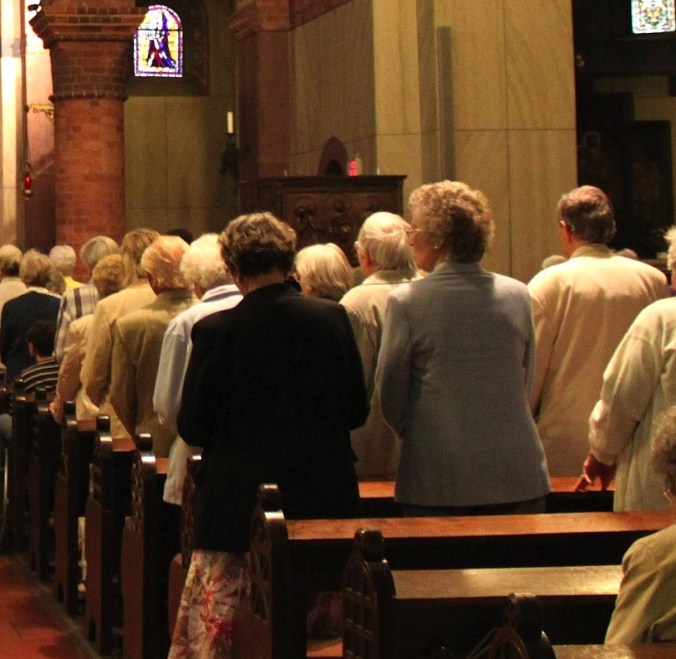
worshipers

Amos 8:4 “Hear this, you who trample the needy and do away with the poor of the land, saying, ‘When will the New Moon be over that we may sell grain, and the Sabbath be ended that we may market wheat?'”

Out of love for his people, God made sure they had a day to rejuvenate their bodies and continue to grow spiritually.  That was the Sabbath. The New Moon festivals were another day the Israelites took off voluntarily.  Once a month it gave them rest and time in God’s word.

Amos was talking to people whose priorities were out of line.  They weren’t so concerned about whether they were growing spiritually.  They didn’t care whether their faith got any stronger.  They didn’t care whom they ran over in their headlong rush to make a buck. They went through the motions of keeping the Sabbath, but their heart wasn’t in it.  All they cared about was making money.  These days off started to look like a nuisance.  “When will they be over?” they asked.  They sound like Ebenezer Scrooge in A Christmas Carol complaining about how much money he was losing by giving Bob Cratchit Christmas Day off with pay and closing the shop.

We are not so different from the people in Amos’s day.  We live in Christian freedom about the specific time we choose to rest our bodies and souls. But money is a concern each of us has. No matter how much of it we have, it is hard to convince ourselves it’s enough.  It’s easy to let money concerns crowd God’s word out of our lives, too.

The issue isn’t just “going to church.” It is being concerned about our spiritual growth.  Do we cheat ourselves out of daily time in God’s word because we are too busy making money?  Do we pass up opportunities to study God’s word in Bible classes because we are too busy making money?  Do we refuse to offer the Lord time to serve him because we are too busy making money?  Not everyone has to be at every worship service or Bible class offered.  But God wants a stronger and deeper faith to be more important than a stronger and deeper pocketbook.

This overdeveloped urge to make money has plagued believers through the ages.  In the sermon on the mount Jesus warned against worrying about “What shall we eat? or What shall we drink? or What shall we wear?”  Martin Luther once overheard a member of his church say after the service, “What do we care about heaven?  What we need is flour!”  To such concerns Jesus replies, “A man’s life does not consist in the abundance of his possessions.”

Rather than focusing life on making money, look at the spiritual wealth and riches we already have. Having the kingdom of heaven is like finding a treasure, or a priceless pearl, Jesus says.  Can you put a value on a soul?  The Bible says the cost of a soul exceeds all human payment.  Yet Jesus purchased each of our souls by his blood. Then he gave them back to us forever.  Paul regards this a treasure, “the grace of our Lord Jesus Christ, that though he was rich, yet for your sake became poor, that you, through his poverty might become rich.”  Our riches are all the wealth of eternal life and heaven.

And God is giving it all away in the next Bible class, the next Sunday service, the next quiet time you have with a Bible or devotional book. Make plans now to attend.

The Way Up

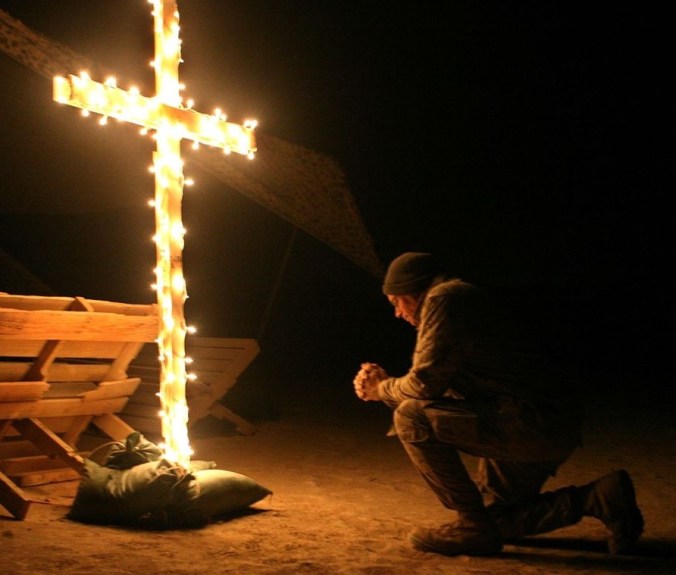
kneeling

Proverbs 25:6-7 “Do not exalt yourself in the king’s presence, and do not claim a place among great men. It is better for him to say to you, ‘Come up here,’ than for him to humiliate you before a nobleman.”

You know how little kids play a game of “one-upmanship.”  “I’m taller than you.”  “I’m faster than you.”  “I have more toys.”  “My toys are more expensive.”  You know how it goes.  Adults aren’t immune to this, either.  Listen closely to people at a dinner party talk about their jobs, or parents brag about their children, or men reminisce about their past athletic achievements.

We are all very insecure creatures by nature.  We want the respect and consideration of everyone around us, but we aren’t so sure that we deserve it.  Boasting, “exalting” ourselves as Solomon says, is just one way we have of trying to find some reason for others to like us, to respect us.

People will grasp at almost anything to feel good about themselves. God’s people can find security in the love that God and fellow Christians have for us. But exalting ourselves to get over our insecurities only sets us up for a fall.

Exalting ourselves doesn’t just affect how people look at us.  The greater problem is with how God looks at us.  Boasting and self-righteousness go hand in hand. God’s plan of salvation, on the other hand, works with the humble and the penitent.  While we are holding ourselves up to God and telling him what good people we are, we are not allowing him to be our Savior.  The solution is for the Lord to crush us with his law, shatter our false pretensions, and drive us to our knees in humility.

Then the Lord has something he can work with.

It is greater to hear our king, our Savior say to us, “Come up here.”  He can exalt the humble. When we come to him with empty hands, then he can fill them.  When we admit that we are unrighteous, then he can fill us with righteousness.  When we admit that we are spiritually poor, he can make us spiritually rich.  When we come to him as slaves to sin, then he can set us free.

Jesus lifts us out of our sin and guilt by carrying the load for us.  He makes us righteous and holy by giving us his righteousness and his holiness.  Jesus invites us to “come up here” beside him, as he raises us to a new status in God’s eyes.  He makes us members of God’s family and sets us alongside himself as brothers and sisters–innocent children God loves as his very own.

We don’t have to run around looking for a way to exalt ourselves.  We don’t have to worry about ourselves at all.  Let Jesus lift you up with his love and grace.  Then get on with the work of humbly serving with the confidence and joy that God gives.

Love for Evil?


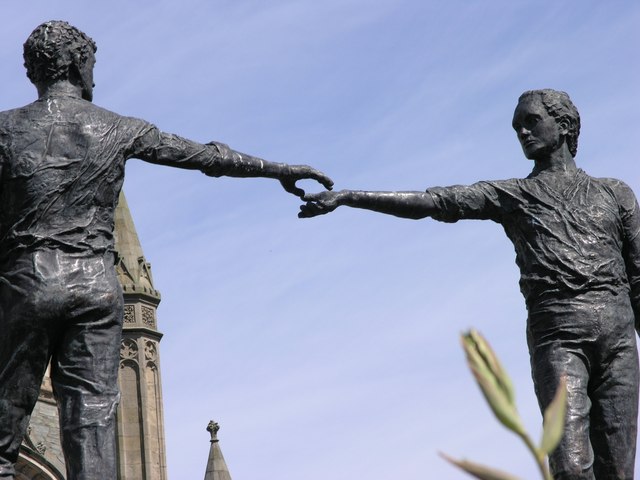
undefined

Luke 6:35 “But love your enemies, do good to them, and lend to them without expecting to get anything back.  Then your reward will be great, and you will be sons of the Most High, because he is kind to the ungrateful and the wicked.”

Why return love for evil?  Isn’t that the way the Lord has been dealing with us since the dawn of time?  He has been returning love for evil.  God had warned our first parents nothing less than death was waiting if they ate of the tree of the knowledge of good and evil.  What Adam and Eve deserved was the same fate that Satan and his angels received for their rebellion.  That is exactly what each of us deserves for the sin that we commit, too.  But the Lord does not treat us as our sins deserve.  In fact, he has just the opposite in mind.  Jesus reminds us that the one who made us his sons and daughters “is kind to the ungrateful and the wicked.”

As Christians, we know God’s love.  That love promises our “reward will be great.”  That reward, Jesus has told us, is worth more than all the wealth and power in this world.  It never rusts or wears out or fades.  It never goes out of style.  It won’t get monotonous or boring.  This great reward is something into which God has poured his very self.  He will surround us with his presence, and in his presence we will always feel his love and his power.

That reward includes our status as “sons of the Most High.”  He considers us his own family.  When you look at statistics about families today, it is painful to see how families are torn apart by child abuse, domestic violence, and even darker sins.  Even the most stable Christian homes can’t provide all the love and nurture we need.  But as Christians, we know God’s love because he has made us “sons of the Most High.” He has made us members of his own family.  What we as parents can’t always provide for our children, and what our parents couldn’t always provide for us, our heavenly Father can provide.  His care gives us a perfect haven to which we can escape, to which we can run from the pressure and betrayal and hatred our world throws at us.  Our heavenly Father’s guidance is always right on the mark.  As sons of the Most High we know that our Father will give us just the support, and sometimes just the discipline, we need.  As his sons, we are also heirs, heirs of the great reward he has promised.

Why return love for evil?  Because we know God’s love and mercy to us.  Jesus says, “Be merciful, just as your Father is merciful.”  He never demanded that we prove our love to him first.  We never offered him anything to suggest that we might be worth saving.  And yet he sympathized with our plight.  He showed compassion and mercy and sacrificed the only Son he had so that wicked and ungrateful people could be his children, too.  Our merciful Father doesn’t pay back our sins with vengeance of his own.  He paid for those sins with the blood of his one and only Son, the Son whom he loved.  He returned love for our evil.

As members of his family, let’s follow in our Father’s footsteps.

Photo By zoocreative, CC BY-SA 2.0, https://commons.wikimedia.org/w/index.php?curid=12997074

By Faith

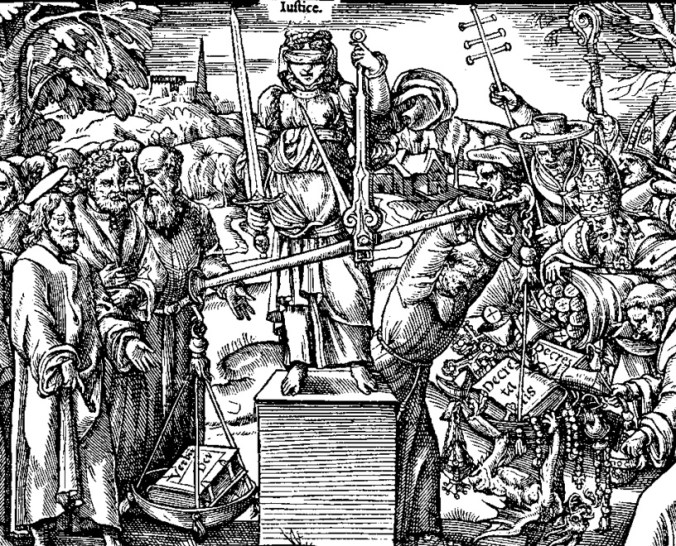
justice

Habakkuk 2:4 “The righteous will live by his faith.”

The book of Habakkuk gives us a conversation, a dialogue, between the prophet and the Lord.  In his part of the conversation, Habakkuk had some complaints about the adversity he sees in his life and among his people.  “How long, O Lord, must I call for help, but you do not listen?  Or cry out to you, ‘Violence!’ but you do not save?  Why do you make me look at injustice?  Why do you tolerate wrong?  Destruction and violence are before me; there is strife, and conflict abounds.”  Habakkuk saw that it was hard for people to get justice.  In fact, unjust things were happening all around.  There was violent crime, but nothing was done about it.  There were strife and conflict in the courts, but no guarantee that justice would prevail.

As concerned as he was about what was happening, his complaint was even more about what was not happening.  When he cried out to the Lord about the violence, it seemed as if the Lord did not save.  He had to ask the Lord, “Why do you tolerate wrong?”  Habakkuk prayed, but he got no answer.

When he finally did get an answer, it was the wrong one.  The Lord’s first answer to Habakkuk just didn’t make any sense.  God told him he was going to send the Babylonians to take care of the violence and injustice in Judah. Habakkuk could only respond, “O Lord, you have appointed THEM to execute judgement!?”  The Babylonians were more immoral, more violent, more ungodly than the Jewish people ever were even at their worst.  What God was proposing just didn’t make sense.

For Habakkuk to live with the injustice, and to live with what the Lord had told him, he needed to live by faith.  The same is true of us.  Like Habakkuk, we see violence going on around us all the time.  So often we feel like real justice is never done. We feel helpless to stop it.

What concerns us about this state of affairs even more is this:  It is no longer a matter of people doing what is wrong.  We are concerned because, in so many areas of life, what God has clearly labelled as wrong is now called right, and what God has clearly labelled as right is now called wrong.  The whole thing has been turned upside down.  People are told they should feel ashamed for simply defending what God has always considered good and moral.  We may worry that our children or grandchildren will be taken in, that they will believe the lie.  Like Habakkuk, we may have a hard time understanding why God seemingly tolerates all this.

For Habakkuk, living by faith meant this: God knew what the Babylonians were like.  But he promised that after he had used the Babylonians to carry out justice in Israel, he would also see to it that justice was done to the Babylonians. In the meantime, God said, “the righteous will live by his faith.”

God has made a promise to us that “the righteous will live by faith” that far outshines the promises he made to Habakkuk.  In the books of Romans (1:17) and Galatians (3:11) Paul quotes Habakkuk’s phrase to show how God gives us real life–eternal life.  We live, we have eternal life as our possession right now, because God has made us righteous by faith.  God’s promise to us centers in all that Jesus has done for us.  God promises Jesus Christ lived a righteous life for us.  God promises Jesus died on a cross to take away our sins.  God promises that Jesus can now present us to God as perfectly righteous, pure, and sinless creatures.  You and I can’t go back and prove any of this.  The cross and the empty tomb are past history.  The resurrection and life in heaven are waiting in the future.  All that we have now are God’s promises–clear and certain promises that make us righteous, give us faith, and give us life.

That same confidence that God has made us righteous and gives us eternal life allows us to step out in faith and live right now.  Maybe we can’t understand why God deals with our world the way he does.  Maybe we don’t have the answer to all the questions we would like to ask.  But we do know how much he loves us.  We know what he has prepared for our future.  God has brought us to real life by faith.  By that same faith we can daily put our lives in his hands and watch what he can do.