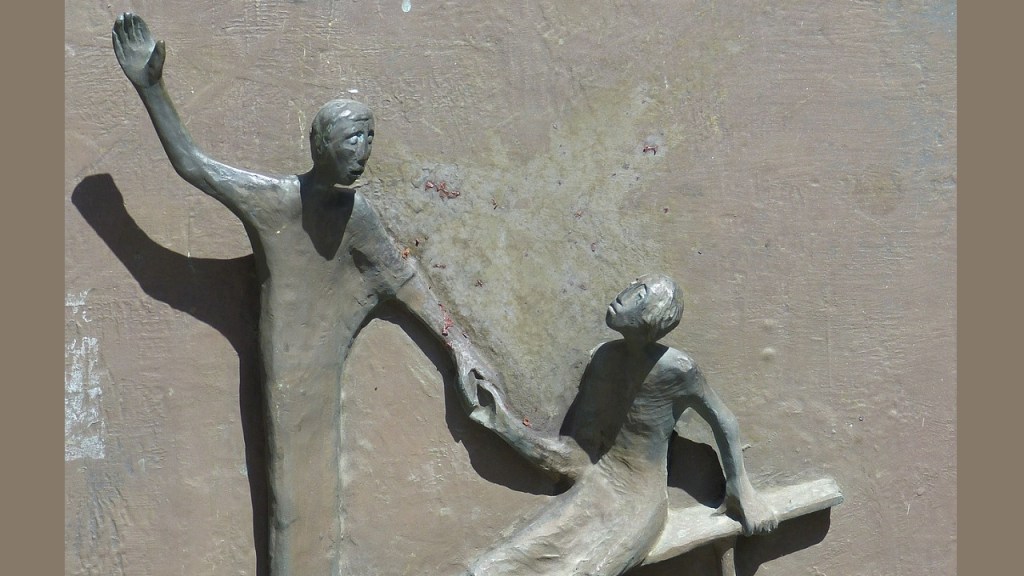
Risky Business?

Luke 10:33-35 “But a Samaritan, as he traveled, came where the man was; and when he saw him, he took pity on him. He went to him and took care of his wounds, pouring on oil and wine. Then he put the man on his own donkey, took him to an inn and took care of him. The next day he took out two silver coins and gave them to the innkeeper. ‘Look after him,’ he said, ‘and when I return, I will reimburse you for any extra expense you may have.’”

How many times don’t we pass up the opportunity to help, and to love? Let me tell you a story from my own life. I wasn’t the man beaten and left for dead alongside the road. I was a stranded motorist whose battery had died along a Georgia highway in the middle of a thunderstorm. This was before ordinary people owned a cell phone. After over an hour, hundreds, maybe thousands of cars, had passed, including two highway patrols. No one stopped to help.

When no help came, I finally got out and started walking in the rain to the next exit. Then a man named pulled over and offered to give me a ride. It turns out that he was an agnostic recovering drug user. He was also dying of AIDS. He had no faith or church. He himself was low on gas. But he had compassion on this stranger walking in a rainstorm looking for help.

The Samaritan in Jesus’ story couldn’t be more different than the priest, the Levite, or even the half-dead man alongside the road. Two thousand years ago Jewish hatred for them was extreme. They publicly prayed in their synagogues that the Samaritans would not share in the resurrection from the dead. They were never accepted as converts. Eating their food was just as bad as eating pork. It was better to suffer than to accept their help.

I don’t know who might be our “Samaritans” today. For some perhaps Muslims, North Koreans, or illegal immigrants? Maybe it would be members of the opposite political party, or white supremacists, or members of Antifa.

At any rate, it is a Samaritan, a religious enemy, who helps. His help is full of sacrifice and risks. It is hardly convenient. The highway robbers had already struck once. The longer the Samaritan pauses to help the beaten man, the greater the chances for him to become the next victim. It isn’t safe.

He applies the standard first aid of the time. Then he gives up his seat on his donkey and walks so that the wounded man can ride. He spends a day caring for the man at an inn. When he leaves, he gives the inn keeper enough money to house and feed his injured friend for up to two months. What it would cost you to stay at even a cheap hotel for 60 nights? This gives us some idea of the Samaritan’s generosity.

As a pastor people often ask me questions about helping others. “I see this panhandler begging for food or money. What if I give him money and he wastes it on booze or uses it to buy meth? It is okay for me not to give him something?” “Someone is stranded along the highway. I have heard of cases in which people were faking their car trouble so that they could rob the person who stops to help. Should I put myself or my family at risk for someone I don’t know?”

I can’t say that it is wrong to be concerned about contributing to someone’s addiction. I can’t say that God wants us to put our children at risk, or that we should ignore potential dangers to ourselves.

I can say that self-interest should not be the greatest concern for the believing child of God. Almost all of Jesus’ twelve disciples ended up being put to death just for sharing their faith. No one I know criticizes them for that. Of course, Jesus himself came to our dangerous world knowing full well it would cost him his life. But he did it because our desperate need for salvation outweighed his concern for his own comfort or safety. Love led him to make the ultimate sacrifice to rescue us from our sins and bring us home to safety with him.

Sometimes showing Christian love will involve risks. Most of the time it calls for sacrifice. If we are taking an honest look at how we love our neighbor, we need to consider which one influences our choices more: self-interest or showing mercy. Self-interest will rarely, if ever, lead to mercy. Christ’s love leads us to risk loving our neighbor as well.

More Than a “Profession”

Luke 10:30-32 “A man was going down from Jerusalem to Jericho, when he fell into the hands of robbers. They stripped him of his clothes, beat him and went away, leaving him half dead. A priest happened to be going down the same road, and when he saw the man, he passed by on the other side. So, too, a Levite, when he came to the place and saw him, passed by on the other side.”

I don’t have to spend much time defending the notion that people have high moral expectations of religious professionals. This was true for ancient Jewish society as much as our own. The priest in Jesus’ story was a religious professional. His life was dedicated to the service of God. No one should have understood what God expects of us better. No one should have been more changed by constant exposure to God’s love for us.

The Levite was a religious worker who served in a support role. We might compare him to the elders or deacons in a church today, or to volunteers in the office or church committees.

Both of these men walk by the severely wounded man who had been robbed. Some believe their excuse might have been concern for ceremonial uncleanness. This is doubtful. Even if it were the case, it was no excuse for refusing to stop and help. There is nothing to suggest the beaten man was “unclean,” even according to Jewish ceremonial law. Nothing suggests he was a leper or a corpse. He was only “half dead.” Neither the priest nor the Levite managed to offer the man along the road basic human consideration.

Does faith make a difference in how we live, and love? Are we any different than the general population? The evidence doesn’t look good. A Barna poll finds a majority of practicing Christians, almost 70%, agree with this statement, “The highest goal of life is to enjoy it as much as possible.” That is similar to their secular counterparts. Jesus says, “Whoever wants to find his life will lose it, but whoever loses his life for me and the gospel will find it.” Again he asks, “What good will it be for a man if he gains the whole world, yet forfeits his soul?” Still, even practicing Christians will say, “God just wants me to be happy, right?” Where is that written?

On moral issues, Christians have often made the most noise about the problems with secular society. Yet Christian teens become sexually active before marriage at about the same rate as their non-believing counterparts. Christian marriages end in divorce more often than atheist ones. Apparently about half the time we find it difficult to love our very nearest neighbor, the one with whom we share a bed and a room.

On issues of kindness and charity we aren’t so different as we might like to think, either. Rosaria Butterfield is a Christian pastor’s wife with children. Before that she was an atheistic lesbian professor. But she says about the days before her conversion: “I strove to stand with the disempowered. I valued morality… The (LGBT) community values hospitality and applies it with skill, sacrifice, and integrity.” Helping others did not first become her concern when she became a Christian.

The main point of Christian faith is not to make us kind, or make us better. It is to make us God’s own. It is to make us safe in his forgiveness. God sacrificed his Son just because we need his grace, just like every other human being.

But God also intends his saving love and sacrifice to change us. Those who know what Jesus endured to come to our rescue will look at inconvenience, risk, and even suffering for others differently. His grace teaches us to put our faith into practice and show compassion. Christianity is not a “profession” confined to temples or churches.

A Better Prayer

Matthew 6:10 “Your will be done on earth as it is in heaven.”

“Your will be done” is an easy thing to say. The words are simple–no running to the dictionary to discover what they mean. They are short words–just one syllable each. These are easy words to pronounce. They are all words we could say and use by the time we began grade school. But together, as a sentence, these words form one of our hardest prayers.

This is a hard prayer because it is hard to want what these words say. “Oh,” we might think, “This isn’t so hard. What Christian doesn’t want what God wants to happen? Love your neighbor and love the Lord with all your heart, feed the poor and spread the good news–who doesn’t want that to happen?” But it isn’t as easy or simple as that.

It’s no secret to you that the people who live in this world have been corrupted by sin–every one of them. You and I have it too. God has never stopped loving us after we became sinners. But because he loves us, he wants, he wills, that there would be consequences for our sins. He knows that sin always hurts us. It messes with our minds and gives us a false view of reality. It is poison to the love that should live in our hearts. It suffocates faith and destroys our relationship with him. It makes us sullen and selfish and sad, and frankly we become generally unpleasant people to be around.

That’s why God created pain. He wanted us to realize that sin is bad for us. He has attached pain to practically every sin there is, even the little ones. It is his will. Sometimes the connection is obvious. For example, he wants us to take care of our bodies and practice a little self-control. It is not to satisfy our every desire. Too much alcohol or food, and in the short term we may suffer from a monster headache, or a stomach ache. Keep it up day after day, and the consequences dial the pain way up: liver disease, heart disease, diabetes, cancer, dementia, arthritic joints. God made it to work that way. It is his will.

But I don’t want to give the impression that the difficulty is the main feature of this prayer. This is a beneficial way for God’s people to pray. More than that, I will go so far as to say that “Your will be done” can be considered our best prayer.

The Greeks had an old saying: “Know thyself.” “To your own self be true.” But do we really understand what makes us tick, why we do what we do? David prays in the psalms, “Who can discern his errors?” Paul confesses in Romans 7, “I do not understand what I do. For what I want to do, I do not do, but what I hate I do.” Jeremiah says, “The heart is deceitful above all things and beyond cure. Who can understand it?” If we don’t even fully understand ourselves, how are we going to know if what we want is best?

Jesus our Savior gives us the greatest proof that “your will be done” is our best prayer. If God had left me to my own will, I would be trying to pay off my sins by myself. My relationship with God would not be based upon his forgiveness but my own hard work. If I could work my little merit system honestly, I would live in constant doubt and despair of ever doing enough. More likely, I would “fix the game” in favor of my strengths and overlook my weaknesses. I would live in the delusion that I was really making it, only to lose the game for all eternity in the end.

God’s will called for his Son to become one of us and die in our place. We would never have dreamed of asking him for that. God’s will works, because the blood of Jesus Christ his Son purifies us from all sin. His will is best, because it always ends with our hope and our future in heaven.

Perhaps you have noticed this slogan used by the Salvation Army: “Doing the most good.” It’s an interesting sentiment, but it is hard to prove. If we really want the most good, a better place to look is the prayer Jesus taught us to pray: “Your will be done.” It may be hard to pray, but God promises us only what is good, if not always easy. That is better than getting what I want.

Our Father

Matthew 6:9 This, then, is how you should pray: “Our Father in heaven…”

I know the picture of a “father,” or even “parent,” isn’t always a pretty one for us. Some of us may have had loving parents who sacrificed the world to raise us. They applied a good balance of discipline and boundaries, encouragement and freedom. Yet even then we can recognize some flaws.

Some of us had parents who drank way too much beer. They loved their careers and hobbies more than their children. They weren’t able to see the line between spanking their children and beating them. They used their children to try to feel better about themselves and soaked up all the love and affection in the relationship for themselves without sharing any of it with their kids.

When Jesus says, “This, then, is how you should pray: Our Father in heaven,” he isn’t saying, “Think of God as a really, really big version of your dad or mom, warts and all.” This is your Father in heaven. He is the perfect parent. That is what gives us the confidence to pray.

Your Father in heaven loves you perfectly, even when it comes time to discipline you. We often think of fathers as the disciplinarian in the family. It is a special kind of love, a perfect love, that loves us enough to set aside our comfort when a little pain or discomfort will do us some good. The writer of Hebrews reminds us, “Endure hardship as discipline; God is treating you as sons… No discipline seems pleasant at the time, but painful. Later on, however, it produces a harvest of righteousness and peace for those who have been trained by it” (Heb. 12:7,10-11).

Because your Father in heaven loves you perfectly, he gives you just what you need for your soul. That starts with the forgiveness of sins. David writes in Psalm 103, “As far as the east is from the west, so far has he removed our transgressions from us. As a father has compassion on his children, so the Lord has compassion on those who fear him.”

But when we look at what our Father did to forgive us, does it seem that the idea of “perfect Parent” and “perfect love” begins to break down? Ordinarily any hint of favoritism in a family is death to the relationships there. If a parent had some children who were “natural” children, and some children who were “adopted”, and the one set received preferential treatment, we would expect all kinds of problems. If anyone was going to receive special treatment and privileges, we would expect it to be the natural children, those who belonged to the family by birth, not the adopted children who were accepted into the family later.

Our Father in heaven sacrificed the only “natural” Son he had to spare the children he wanted to adopt. Our Father had the natural Son, the only innocent member of the family, suffer the punishment for the crimes the adopted children committed. We are the adopted children, Jesus the natural Son, and it doesn’t seem fair. But in our perfect Parent’s family, this wasn’t favoritism gone mad or injustice. It was perfect love, from Jesus who calls himself our brother, and his Father who has also become our Father.

These are the things Jesus wants us to remember as we begin our prayers: Our Brother suffers and dies for our forgiveness and adoption. That makes our God our Father in heaven. That makes us confident to pray as his dear children.

Sanctified Shrewdness

Luke 16:1-9 “There was a rich man whose manager was accused of wasting his possessions. 2 So he called him in and asked him, ‘What is this I hear about you? Give an account of your management, because you cannot be manager any longer.’ 3 “The manager said to himself, ‘What shall I do now? My master is taking away my job. I’m not strong enough to dig, and I’m ashamed to beg– 4 I know what I’ll do so that, when I lose my job here, people will welcome me into their houses.’ 5 “So he called in each one of his master’s debtors. He asked the first, ‘How much do you owe my master?’ 6 ” ‘Eight hundred gallons of olive oil,’ he replied. “The manager told him, ‘Take your bill, sit down quickly, and make it four hundred.’ 7 “Then he asked the second, ‘And how much do you owe?’ ” ‘A thousand bushels of wheat,’ he replied. “He told him, ‘Take your bill and make it eight hundred.’ 8 “The master commended the dishonest manager because he had acted shrewdly. For the people of this world are more shrewd in dealing with their own kind than are the people of the light. 9 I tell you, use worldly wealth to gain friends for yourselves, so that when it is gone, you will be welcomed into eternal dwellings.

“Use worldly wealth to gain friends.” That is not where the manager in the parable began. He used the money he was managing to goof around. When you are spending someone else’s money, you tend not to be so careful with it. You aren’t so motivated to try to preserve it.

Former 20/20 journalist John Stossel once did a feature on a public restroom built by the New York City Parks and Rec department. The little building featured two or three stalls in each bathroom and a couple of sinks. It cost over 2 million dollars. That was much more than most of the upscale homes in the area cost–for just a bathroom. City officials explained that superior materials had to be used because of all the traffic. Stossel pointed out that a nearby city built a better looking facility of comparable materials for about one tenth the price. When the official explained that New York City pays workers a fair wage, Stossel discovered that meant about 100 dollars an hour. New York City is pricey, but even there those wages seem high. But when you are spending someone else’s money…

Sometimes God’s people forget that they are spending someone else’s money. We think that all this stuff is ours to do with as we please. We use God’s gifts like the manager in the parable. We manage and plan and spend as though our possessions have no higher purpose than to let us enjoy ourselves. It doesn’t cross our minds that we have to answer to the Owner someday, and that maybe he had some expectations for what the funds he placed into our keeping were going to accomplish. It would be a scary thing to hear him come and fire us from his service. “Give an account of your management, because you cannot be manager any longer.” If we lose our relationship with our Lord, all is truly lost.

Let’s cut to the chase on the meaning of Jesus’ parable. He is not suggesting that Christians ought to be so self-serving in the way they manage God’s money for him. He is not condoning dishonesty, cheating, or fraud. These are all necessary components of the story to move the story along. They are needed to get to his point. They are not the point itself.

The point is this: the shrewd manager acquired a strong sense of mission and purpose when he heard he was going to be fired (twisted as that mission and purpose might be). He spent a long time thinking about how to use the time and resources he managed to accomplish that mission and purpose, and then he executed his plan. Central to that plan was using his master’s wealth to build relationships, to make friends who would take care of him later.

The manager in the parable was looking at a future which had suddenly become very uncertain for him. His career was over. His prospects were bleak. He didn’t know how he would eat or where he would live. His money decisions were driven by a need to bring some clarity and stability to his future.

We are looking at a future which has been made entirely secure for us. We don’t have to buy our spot in heaven’s courts. Jesus has paid all we owed at the cross. Forgiveness is full and free. We don’t have to scratch and claw to preserve our lives ourselves. Jesus has risen from the dead. His resurrection promises new life for these bodies on the other side of the grave. We don’t have to worry about our future. Eternal life is guaranteed.

Why not spend our money, why not invest ourselves, in the one thing we know is going to last, the one thing we know is going to be there in the end? One of my old teachers used to say, “What you invest in God’s kingdom is the only investment that will be worth a dime the day after judgment day.” We don’t have to purchase a place for ourselves there. But we can invest in ways that help others hear the gospel that secures their eternal future. Someday they will welcome us, as we will welcome them, into our eternal home.

Compassion We Can Count On

Micah 7:19-20 “You will again have compassion on us; you will tread our sins underfoot and hurl all our iniquities into the depths of the sea. You will be true to Jacob and show mercy to Abraham, as you pledged on oath to our fathers in days long ago.”

“You will again have compassion on us,” Micah says. Again. God showing compassion is practically the story of the whole Bible, isn’t it? Adam and Eve fall into sin, and God shows compassion by winning them back to his side from the devil. They lose a son Abel and God replaces him with Seth. Noah lives in a world that has become dark and dangerous for the believer in God, and the Lord shows compassion by sparing him and his family from the flood in the ark. Abraham and Sarah are childless, so God gives them a son in their old age. Joseph is sold into slavery in Egypt, so God raises him up to become prime minister of that country. One story after another recounts God’s compassion.

We may not know the details of God’s plans for our future. But the conclusion he wants us to draw from thousands of years of previous history is this: they all involve compassion. Our pain genuinely moves him, and he cares how we are treated.

Do you want to know how to get a parent riled up? Then hurt one of their children, and see if the claws don’t come out. Do you want to see a parent moved to action? Then see what they do when their children are in distress. By sacrificing his Son and forgiving our sins, God has made us his children. When we hurt, whether in body or in soul, God plans to have compassion.

That doesn’t mean we never suffer now. This has been another year of hurricanes, wild fires, and extreme weather. You know that your own life hasn’t been an endless parade of happy events.

For the believing child of God it does mean that he isn’t punishing us for past indiscretions. “You will tread our sins underfoot and hurl all our iniquities into the depths of the sea,” the prophet promises with two more pictures of grace that need no explaining. Our suffering may present our Lord with a new opportunity to show us compassion, but it is never payback for our sins. That’s not the kind of God he is.

These are all happy thoughts. They make our God truly unique. But we will share the prophet’s praise and optimism only if we can say with him, “Your promise is dependable.” “You will be true to Jacob and show mercy to Abraham, as you pledged on oath to our fathers in days long ago.”

Do you know what Jacob and Abraham had in common, besides being grandson and grandfather? They had the saving promises of God, the promises that involved a Savior, and blessings for all nations on earth, and heaven. We may not be their genetic descendants, but we belong to the same family of faith. We own the same saving promises.

All by itself God’s word is his bond. His promises never fail. Bible scholar Alfred Edersheim documents 456 distinct prophecies Jesus fulfilled, prophecies made hundreds and even thousands of years before his birth. Such accuracy gives us no reason to doubt God’s word.

In case some sliver of doubt remains, the Lord says, “I will go one step further. You have ample evidence that my word is good. But I will put myself under oath. Even though you have no right or reason to question me, because I am God and you are not, I make you my judge and invite you to hold me accountable to my promise.” If you were God, would you make a concession like that to the little creatures you had made?

Do you remember God’s appearance to the prophet Elijah on Mount Horeb after wicked Queen Jezebel threatened to end the prophet’s life? God put Elijah in a cave, and there was a great wind that tore apart the rocks, but the Lord was not in the wind. Then there was an earthquake that shook the mountain, but the Lord was not in the earthquake. Then there was a fire that swept across the mountain. But the Lord was not in the fire. Finally God spoke with a still, small voice–just a gentle whisper of his grace–and God was in that word.

Do you want to know what God is really like? Listen to what Elijah heard, look where Micah looks. In the forgiveness and compassion of an absolutely faithful God, you will find a God like no one else.

God’s Labor Day Project

Micah 7:18b “You do not stay angry forever but delight to show mercy.”

God is not a grudge holder. It’s true that sin does make him angry. Considering the nature of the revolt against him–billions of defiant rebels perverting the laws he gave for their own good, a rebellion stretching back thousands of years and involving every member of the human race–who could fault him if it took a while to get over the offense? Who would be surprised if he let his anger stew and build until it exploded on the ungrateful world he made?

But that is not his nature. Instead of reveling in his anger, he “delights to show mercy.” For our God, mercy is not a mere obligation he feels compelled to meet. It’s not just a job, where every day he has to drag himself out of bed and get ready to go to work and face the countless masses of people begging him for his help. It is more than a timeless principle of good he can’t help doing because it is part of “who he is.” It is his delight. This is what he loves to do. This is how he wants to spend his time.

On Labor Day weekend, most of us get an extra day off with the Monday holiday. It is a day on which we can do what we want. Originally the day was meant to honor those who work hard with their own hands, those who “labor” to make the life we enjoy possible.

For most people today, the day is spent cooking out and spending time with family. For some it may mean that last trip to the lake for the season. A few may tackle a fall project around the house. But whatever it is, it’s a holiday, a day for you to do what you want.

Ask the Lord what he wants to do on Labor Day, or any other day, and his answer is: “I would really like to show someone my mercy. I want to spare some poor sinner the consequence of his sins. I want to find someone who desperately needs my help and spend my time and effort in rescuing them. That’s what I do for fun. That’s how I spend my spare time, and every other moment of time I have.”

Understand the nature of our God, and we will understand, like Micah, that there is no other god whose anger so readily gives way to his mercy. We can count on it every day.

Who Is A God Like You?

Micah 7:18 “Who is a God like you, who pardons sins and forgives the transgression of the remnant of his inheritance?”

The prophet Micah wrote at a time when the nation of Israel was on the decline. They were no longer the world power they once had been. Foreign powers invaded their land. The northern tribes were sitting on the edge of extinction.

But the real catastrophe was the way this people had turned away from God. They were duped by every feel-good religion that came along. Or they just gave up every pretense of religion and faith as they pursued their materialistic dreams. After all he had done for them, after all the miraculous ways he had delivered these people in the past, it was a wonder the Lord hadn’t just given up on them. In fact, that was what prompted Micah’s question.

Micah’s choice of words highlights why God’s grace and patience ought to amaze his people. “Sins” here is literally “bending” or “twisting.” It is the word from which the concept of “perversion” comes. People take God’s good creation, and then they bend and twist it until it becomes a grotesque mutation of itself that is no longer useful or good.

When I was a kid I once used one of my dad’s wood chisels to dig and pry a nail out of a piece of wood. The blade on the chisel was meant for contact with wood, not steal. The damage I did to the tip of the chisel as I pounded it into the nail and pried on the nail head practically ruined it. That’s not what the tool was meant for. My dad was not happy with me.

God gives his people good gifts, useful tools like human sexuality, or material wealth, or pain-relieving chemicals. Then we bend and twist these things for our own purposes. We use them to serve and satisfy our own desires in ways the Lord never intended. And in the process we often turn his good gifts into grotesque mutations that don’t merely fail to do what God made them to do. They even become dangerous to us. And it doesn’t make our Lord happy.

Unfortunately, we often fail to care. Behind the other term Micah uses, “transgressions,” is a word that suggests rebellion or revolt. So often sin is not a matter of ignorance, or carelessness, or weakness. It is a matter of defiance. When it was time for our friends to go home after a visit, we began helping their children pick up the toys. But one of them didn’t want to pick up the toys. He took one container of blocks, looked me in the eye, and then dumped them all over the floor again.

Sometimes we don’t want to stop doing what we were doing. So we look God in the eye, and we do what we want anyway. That’s the way Micah’s people treated him. We put on our own rebellions against his ways.

This is what God pardons. Again, the Hebrew is more colorful than our English translation. He lifts it off our shoulders. He picks it up and carries it for us. No longer do we have to bear the guilt, the responsibility, and the consequences. The Lord makes it his own to carry. I can’t help but think of Jesus words when he invites us, “Come to me, all you who are weary and burdened, and I will give you rest.” Or Peter’s description of Jesus’ sacrifice on the cross. “He himself bore our sins in his body on the tree.”

Who does that sort of thing? What teacher sits in the principal’s office in place of the unruly student in his classroom? What parent sits in the corner or goes to bed without his supper for the child who was lipping off to him? What mugging victim sits in jail for the creep who mugged him?

Our Lord does, that’s who! Like Micah, we stand here in amazement looking at God’s forgiving nature, and we ask, “Who is a God like you?”

Wisdom’s Source

Proverbs 9:10 “The fear of the Lord is the beginning of wisdom, and knowledge of the Holy One is understanding.”

How we look at God affects how we look at all of life. It changes everything about our worldview. This is where real wisdom must begin.

When we get to know God as he really is, when we have a balanced and accurate picture of him, then we know not only him, but we can understand all of life. To the degree that we misunderstand God we will be confused about faith and life as well.

If we see God as only horrible Judge and Dictator, then our life will be joyless, peace-less, driven. We will spend all our time scurrying about trying to keep up with his orders. When something painful happens, we will assume he must be paying us back for something we did to offend him.

If we think of God as some nameless, faceless, distant “it” in the sky, nothing but an impersonal force, then we might conclude that we are an insignificant part of the universe. That makes our lives more or less meaningless.

If we view God as a pansy, a milk-toast, a God who could never find it in him to get angry about anything; if he is only a sugary, grandfatherly Mr. Nice Guy; then we might think sin is no big deal. When trouble comes, we might assume that God is simply too weak to do anything about it.

But when we have a balanced view of the God, we see him as both just and merciful, the God of Law and Gospel. He is, as he so nicely summed it up for Moses, “The Lord, the Lord, the gracious and compassionate God, slow to anger, abounding in love and faithfulness, maintaining love to thousands, and forgiving wickedness, rebellion, and sin. Yet he does not leave the guilty unpunished; he punishes the children and their children for the sin of the fathers to the third and fourth generation.”

This is the God who will not let a single sin go unpunished, but a God who loves us so much that he punished every single sin in his Son Jesus Christ. Know him this way, know his hatred of sin, know his desire to save all people, and we will understand our purpose. We will begin to understand life whether we are experiencing prosperity or hardship, joy or grief.

Do you sometimes find life hard to understand? Sometimes we think that studying our problems long enough will enable us to understand and solve them. That seems to make sense.  It may be helpful to a degree.

But Solomon suggests we turn our attention in another direction. Knowledge of the Holy One is understanding. Get to know God, learn of him, and you will find the wisdom and understanding to deal with everything else as well.