A Present Reward

John 4:36 “Even now the reaper draws his wages, even now he harvests the crop for eternal life, so that the sower and the reaper may be glad together.”

You know as well as I do that some people have gotten financially rich doing “church work.” With few exceptions that has involved some kind of perversion of the gospel. Five hundred years ago it came from making the church a political institution. Beware of those who want to lead it down a path of political power today. In our time we have seen the rise of the rich televangelist and the prosperity gospel. As Jesus once said of the Pharisees, they have already received their reward in full.

In our own circles, the material rewards are more modest. Clergy, teachers, church workers have all they need–shelter, food, clothes. If we are honest, some have more than some of the people they serve. The pastor or teacher is rarely the poorest person in the congregation. But often their gifts and talents could have made them member of the elite if they had decided to pursue a different path.

The joke for church workers goes that the pay may not be much, but the retirement plan is out of this world. It’s true, you can’t improve on eternal life. But Jesus promises a present reward. “Even now the reaper draws his wages.” His promise implies something special. He is teasing us with this offer of present payment. What are these wages he has in mind?  “Even now he harvests the crop for eternal life…” The wages for the Christian who shares his faith are a share of the crop, the souls, the people with whom we are going to share eternal life.

Give your own field a closer look. The communion of saints, the fellowship of believers, the family of faith is a gift Jesus gives you for your work in the harvest of souls.

The Church, you see, is not the University of Phoenix, an online institution giving out degrees to people who have mastered the information, people who otherwise don’t know each other and have no relationship with each other.

The church is not Facebook, where you have virtual friends. I have not counted them, but many of my Facebook friends are people I have never met in my life.

Maybe my illustrations limp a little, because I can’t claim to have met every member of the Holy Christian Church, either. But I will. And the ones I do know are a gift of God’s grace to me. They are love to be shared and enjoyed, “so that the sower and the reaper may be glad together.”

Be glad, be glad to be a part of this little fellowship of humble people broken by their sin and redeemed by God’s forgiveness. Enjoy each new addition you find in your little corner of God’s field, coming with their unique set of gifts, loving you, serving you, and enabling you to reap farther and harvest more. God hasn’t merely given you a task, fellow workers. He has given you an ever-growing family to enjoy.


Open Your Eyes

John 4:35 “Do you not say, ‘Four months more and then the harvest’? I tell you, open your eyes and look at the fields! They are ripe for harvest.”

You know the background for Jesus’ words to the disciples here. It’s the part of the story we know best: Jesus’ conversation with the Samaritan woman at Jacob’s well. It is this fascinating study in evangelism methodology. He breaks the ice with a simple request for a drink, turns it into discussion about our need for spiritual life, weaves a presentation of the law into a brief mention of her family life, uses her attempt to change the subject to focus further on her need to know God better, and finally drops the gospel bombshell on her: He is the Christ that she has been waiting for. Jesus saw his mission field clearly.

Meanwhile the disciples had been off in town buying food. Nothing indicates they even recognized they were in a mission field. And we know there were some obvious reasons for that. John the gospel writer notes the woman’s surprise that Jesus would talk to her because Jews do not associate with Samaritans. These two groups got along like Democrats and Republicans, conservatives and liberals. For the disciples, going to buy that food may have felt a little awkward. These were people you didn’t talk to except to have an argument. “Let’s get our food and get out of here.” The disciples saw their mission field poorly.

The difference between Jew and Samaritan–the moral and spiritual tensions, the cultural differences, the historical resentments– didn’t make them less of a field. In many ways, it made them the field. You don’t have to harvest the grain that is already in the barn. You have to bring in what is outside. And until now, these people had been outside.

Does Jesus’ example help you see the harvest better? Give your field a closer look. I don’t deny that some of the people in it may look, dress, think, and act pretty much like us already. The goal is not to make our church an eclectic mix of people, a motley crew of humanity, for its own sake. Go ahead and reach the white, middle-class family with traditional values and previous Christian background. Don’t feel guilty about doing so for one second. After Jesus ascended, the disciples started with people who looked just like them, too. Jesus told them that they would.

But the gay couple who just moved in next door are part of that field as well. I don’t deny that there is some difficult and delicate work to do there. There are obvious differences to address, issues that can’t be overlooked. But “change” is repentance’s middle name. It is its first and last name, too. I don’t know how exactly you will break the ice and start the conversation, but the gospel harvest tools we’ve been given are sharp and effective.

Maybe you have heard of Rosaria Champaign-Butterfield. She was a lesbian-feminist professor of gender studies at Syracuse. Today she is married to a man who pastors a Christian church, and she is the mother of four children. Another pastor simply started asking her questions about why she thought the way she did, and then he listened to her answers patiently. It opened up the door to conversations that led to the gospel, and conversion. Now she gives her Christian testimony around the country.

Maybe you have heard of Nabeel Qureshi, a descendant of the prophet Mohammed’s own tribe, who studied to be a doctor at Old Dominion University in Virginia. When Christians tried to explain the Trinity to him by calling it a “mystery” he thought, “The only mystery here is how you could believe in something as ridiculous as Christianity.” But he became friends with a Christian classmate named David, whose spiritual passion matched his own. David didn’t give up on his witness to Nabeel, and he didn’t give up on the friendship, either. Nabeel found Jesus and spent his last years as a Christian apologist and speaker.

Our kind were once the fields that were hard to see. It took a special vision to get Peter to visit a Roman centurion, and Paul to cross over to Europe on his Second Missionary Journey. But Jesus bled and died to save worldly Greeks, power-hungry Romans, and pagan Germanic tribes beyond them. Grace enabled early Jewish Christians to see a harvest among people like us. See your neighbor through your own forgiven sins, and see the harvest when you give your field a closer look.

Still Able to Help

Matthew 8:26-27 “Then he got up and rebuked the winds and the waves, and it was completely calm. The men were amazed and asked, ‘What kind of man is this? Even the winds and waves obey him!’”

One of the hang-ups people have about Jesus is his obvious humanity. It bothered so many of his contemporaries. They knew his parents and watched him grow up. He grew tired from his work. They ate and drank with him. The day came when their whips and thorns and spikes tore at his skin and he bled.

Jesus called himself humble and gentle. But then he claimed the authority to forgive sins. He seemed to put his teaching ahead of Moses. He claimed to know Abraham personally. He called himself the “I Am.” Modern day Rabbi Jacob Neusner looks at Jesus’ claims and asks the question that also bothered his contemporaries, “Just who does Jesus think he is, anyway–God?”

The rabbi is on to something. It is for our comfort, to gain our confidence, that Jesus shows himself to us as a man. He belongs to our family and calls us “brother” and “sister.” He is able to sympathize with our weaknesses, because he experienced them. Colds and flu and fever–his body had to fight them just like ours. If the fish hadn’t quite been cooked through, or the milk had been warm a little too long, he might be up all night with vomiting and dry heaves just like us. If playmates made fun of him, when Pharisees mocked or accused him, the rejection stung. He did not shield himself from our pain with his power. He embraced it, because he wants us to know that he gets it. He is one of us.

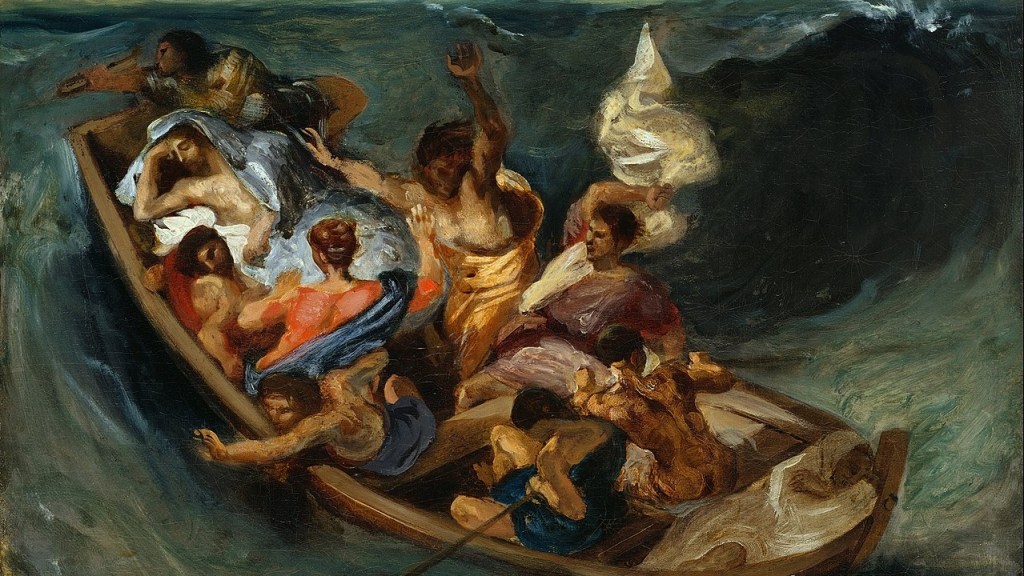
So here he is in the storm with the others, soaked to the skin, chilled to the bone. He is probably clinging to the rails or the seats or the mast so that he doesn’t fall out. He orders the wind to stop and it obeys. He speaks to the sea and it answers with a great calm. This is the work of a god, your God. Just because he is also a man doesn’t mean he can’t work wonders. He still can. You can trust him. He will save you. He is more than us.

It’s Going to Be Alright

Matthew 8:24-26 “Without warning, a furious storm came up on the lake, so that the waves swept over the boat. But Jesus was sleeping. The disciples went and woke him saying, ‘Lord, save us! We’re going to drown!’ He replied, ‘You of little faith, why are you so afraid?’ Then he got up and rebuked the winds and the waves, and it was completely calm.”

Are you a deep sleeper? When I was a little boy, I remember waking up in the basement on a couple of occasions. There were tornadoes, and my parents picked me up and carried me down the stairs. The sirens were blaring, but I hadn’t heard them. When I was a young father, there were times I woke up because of some movement in my bed. Robin was getting back in after tending to one of our children who was hungry or needed a diaper change. My children were bawling, but I hadn’t heard a thing.

I don’t think even I could sleep through such a storm at sea that the boat is about to sink. Jesus had to be wet, as well as thoroughly rocked back and forth. The disciples themselves are surprised at him, maybe also irritated. Mark tells us in his gospel that they asked, “Don’t you care if we drown?” It’s a little unbelievable to them that he could let the situation get this bad and still do nothing to help.

I don’t want to be too critical of these men. I don’t think we would have been any less panicked, or irritated, by Jesus’ inaction. Looking in hindsight from our position outside of the storm, however, we can see they had some clear indicators everything was going to be alright.

First was Jesus’ own reaction. If Jesus is sleeping through this, and he is the Messiah who has not yet completed his mission, doesn’t that say something about how the story is going to turn out? Would they have felt better if he was as panicked as they were, running around trying to secure the mast, bail the water, or row against the wind? If he felt such peace that he was sleeping, couldn’t they take a cue from him?

Then there was his presence. He was their ace in the hole when they needed help. They had seen him cure diseases, control demons, transform water into wine. Admittedly controlling the weather may have seemed bigger, but where did they think his power ended? Why hadn’t they gone to him sooner instead of waiting until the last moment before the boat sank? Maybe they needed things to get so desperate to teach them where to turn for help. Then they learned that just because his help was delayed, that did not mean that they were going to die.

Is it hard to see an application? What’s the storm you’ve got going that seems to find Jesus sleeping in the back of the boat? Have you prayed? What’s the prayer that doesn’t seem to be getting answered? Jesus may seem to be sleeping while we suffer through chronic health issues, family drama, joblessness, loneliness, even temptation. Do you trust him? If he isn’t doing anything yet, that’s an indication the situation is not as desperate as we think. When it needs to be resolved, or if it needs to be resolved, it will. Trust Jesus. Just because he seems to be sleeping doesn’t mean you are going to die.

Keep Calm

Matthew 8:23-25 “Then he got into the boat and his disciples followed him. Without warning, a furious storm came up on the lake, so that the waves swept over the boat. But Jesus was sleeping. The disciples went and woke him, saying, ‘Lord, save us! We’re going to drown!”

Humanly speaking, it’s no surprise to find these men in this storm. This is the Sea of Galilee, after all. But maybe we are surprised to see this happen when they are traveling with Jesus.

Doesn’t the psalm promise us, “If you make the Most High your dwelling–even the Lord, who is my refuge–then no harm will befall you, no disaster will come near your tent”? How much more can you make the Lord your dwelling than to be literally following his Son around all day, eating where he eats, sleeping where he sleeps, listening to him teach and watching the example that he sets?

Even more, this boat trip across the lake was Jesus’ idea. He put these men in this position. “Then he (Jesus) got into the boat and his disciples followed him.” Would Jesus really lead me into danger, or into trouble?

The short and simple answer to that question is “Yes.” Just because you are traveling with Jesus doesn’t mean you won’t have storms. It may come as a surprise to some, but Jesus didn’t come into this world fix it. He didn’t even come to create safe zones for those who follow him. He didn’t magically fix the climate of Northern Galilee to prevent these sudden storms. He could have. He has the power. But that was not his mission. People died in incidents on the lake like this before he came, and they died after he left. Although the circumstances are different, in the last 10 years there have been at least two drownings on this same sea.

The same thing is true for almost everything we experience while we live here. Jesus did not come to make all the people treat each other nice. He preached love, that is true. But he wasn’t interested in forcing anyone to act that way. Change has to be sincere, from the heart. Just because you are traveling with Jesus on your journey through life doesn’t mean you won’t have some stormy relationships. Look at his. His countrymen persecuted him and eventually executed him. His friends abandoned him in his hour of need. The strain in your marriage, the tension with your coworkers or your manager or your classmates, may not be right. But they aren’t a surprise. It’s the way people are.

I could go on with examples like this for hours. Jesus did not come to give us perfect health, fix our broken politics, restore fairness and justice, or create favorable economic conditions. Traveling with Jesus on the journey of faith does not make us exempt from life’s storms. Utopian dreams for the world we live in now will all be crushed. They tend to become a form of idolatry.

But keep calm. Jesus may not fix our world, but he does rescue us from it. His death rescues us from sin. We are forgiven. His resurrection rescues us from death. We have eternal life. His Spirit rescues us from ourselves. We have faith and new love. When it serves his purposes, his power may even rescue us from physical dangers, as he does here. But keep calm. Jesus will rescue us when the time is right.

Kill Them With Kindness

Romans 12:20 “If your enemy hungers, feed him; if he thirsts, give him something to drink. In doing this you will heap burning coals on his head.”

Even the secular world can advise you to deal with difficult people by “killing them with kindness.” My wife works for Pizza Hut. Occasionally the customer complaints are legitimate. Often they are outrageous:

 “My pizza had too much sauce. I want a refund.”

“But you ordered it with extra sauce.”

“I don’t care. It was too much.”

“My pizza was delivered two minutes late. I want credit for another one.”

“But we are in the middle of an ice storm, and we told you that our deliveries were running a little late.”

“That’s not my problem. You should have had it here on time.”

But a happy customer is often a repeat customer, and the best kind of advertising. Company policy is generally to do all you can to accommodate the customer, even if he is being completely unreasonable and more than a little rude. Sometimes he even gets a free pizza out of the deal.

So Paul quotes the proverb here about feeding your enemy and giving him something to drink. Isn’t this consistent with the way that God has treated each of us? “Oh,” we might think, “but I was never God’s enemy. I might not be perfect. I might be a sinner. But I love the Lord!”

Don’t we still have our complaints about how God runs our world and runs our lives? Don’t we maintain our lists of where we disagree with him–those things we think we are going to lecture him about when we get to heaven? Each time we commit a sin, aren’t we functionally opposed to his will and acting like those who are on the other side? Didn’t our sins still put Jesus on the cross? If our sins helped to kill God’s Son, can we still think we haven’t acted like his enemies?

Still, that never stopped the Lord from showing us kindness, even before we came to faith. Earlier in this letter Paul reminds us, “You see, at just the right time, when we were still powerless, Christ died for the ungodly. Very rarely will anyone die for a righteous man, though for a good man someone might possible dare to die. But God demonstrates his own love for us in this: While we were still sinners, Christ died for us…. if, when we were God’s enemies, we were reconciled to him through the death of his Son, how much more, having been reconciled, shall we saved through his life!” (5:6-10). Our Lord killed us with his kindness. He fed us when we were hungry. He gave us something to drink when we were thirsty. And doing so turned us from God’s enemies into his children and friends.

That’s why this is also a key for us to live at peace with everyone. No, it won’t change everyone. Some will still stubbornly dislike us even when we show kindness to them. But we don’t know ahead of time who will or who won’t. We don’t know if today is the day our kindness finally breaks through and softens their heart.

Room for God’s Justice

Romans 12:19 “Do not take revenge, my friends, but leave room for God’s justice, for it is written: ‘It is mine to avenge; I will repay,’ says the Lord.”

We don’t take revenge for ourselves. We are called to live at peace with everyone. That serves God’s purposes better. That kind of example makes us the kind of people who can better communicate God’s grace and forgiveness. We become living demonstrations of grace. Imagine sitting on someone who hurt you, smashing them in the face for something they did to you, and trying to tell them, “Jesus forgives all your sins. He died on the cross to save you. Repent and believe the good news.” Not a very effective method of evangelism, I think.

But the day of God’s vengeance will come. His vengeance isn’t merely mean. When possible, the Lord desires to convert his enemies, to save them, to make them his friends, as he did with Paul. You can’t be a much bigger enemy of God than Paul was. He was an anti-Christian army of one, a one-man church-wrecking machine. He made it his purpose to destroy Christianity, to crush the church and stop its spread.

And he was doing a pretty good job of it until God knocked him off his horse on the way to Damascus to put more believers in jail. The Lord forgave Paul for his murders and persecution, and that grace turned him into the most dedicated promoter of Jesus the world has ever known.

But what if people will not and do not repent? In Moses’ Day, the Pharaoh of Egypt also tried to drive God’s people into extinction. God sent him Moses and Aaron to tell him to stop. When that didn’t work the Lord got tough with him. Ten plagues, ten catastrophes ending in the death of Pharaoh’s son, warned him that God wasn’t kidding. It was time to stop resisting.

Pharaoh wavered only for a moment. He kept defying God and pursuing his plans against Israel until he ended up drowned at the bottom of the Red Sea. God had his vengeance. So did his people. And what other fate would have been appropriate for a man like that? God couldn’t just let the Pharaoh win. He can’t let his enemies succeed.

The enemies of God’s people are the enemies of God himself. Whether now or on Judgment Day, if they won’t convert, if they won’t change sides, then they will face God’s justice. Until that time we try to live at peace with them, on our part, in the hope that God will save them, content that God will bring justice at the proper time.

Let Revenge Go

Romans 12:17-18 “Do not repay anyone evil for evil. Be careful to do what is right in the eyes of everybody. If it is possible, as far as it depends on you, live at peace with everyone.”

It doesn’t take much to push us into revenge mode. A man in my neighborhood didn’t like the neighbor dog constantly barking at him from the other side of the privacy fence. Then one day the dog turned up dead. It was poisoned. I will let you draw your own conclusions.

We think that little children are petty and immature when they slug a playmate for some perceived offense and then plead, “Well, he started it.” Apparently it’s a reaction people are slow to outgrow.

The Christians in Rome to whom Paul was writing had bigger reasons than barking dogs or playground feuds to feel injured and offended. Some of them had been expelled from the city for a time, forced to leave their homes and businesses because of their faith. They were generally regarded as dim-witted, uncultured, and even a threat to Roman civilization. Worse things were on the horizon. Within 10 years the emperor would begin rounding Christians up, feeding them to dogs or burning them alive as living torches.

To these people Paul writes, “Do not repay anyone evil for evil. Be careful to do what is right in the eyes of everybody. If it is possible, as far as it depends on you, live at peace with everyone.” Living at peace with everyone doesn’t mean agreeing with things God’s word identifies to be false or evil. God calls us to stand up for the truth.

But the big truths are “Grace” and “Love.” You know “grace,” the teaching in which God forgives people instead of making them pay for their sins. You know “love,” the teaching in which God rescues the very people who rebelled against him, and provides and cares for a world that does not care for him. “If you love those who love you, what credit is that to you?” Jesus once asked his students. “Even ‘sinners’ love those who love them” (Luke 6:32). Taking revenge isn’t compatible. It isn’t acceptable. “Do not repay evil with evil.”

By all means, stick up for others. Enforce applicable laws. None of this is a commentary on whether criminals should be apprehended and prosecuted. But remember, you have not committed any sin when you are wronged, and you respond with mercy instead of justice.

Jesus carried out our salvation that way, didn’t he? He didn’t compromise any truths. He at times questioned those who abused him. But all the time he kept a cap on his anger, and controlled his tongue–no obscenities or insults from his mouth. He let them lead him all the way to torture and death.

In his first letter, the Apostle Peter specifically tells us that Christ “suffered for you, leaving you an example, that you should follow in his footsteps.” He isn’t saying that Jesus’ sacrifice was primarily an example. A few verses later Peter tells us that “he himself bore our sins in his body on the tree.” This is the payment for sin, the sacrifice that saves us. But when Jesus tells us, “Don’t take revenge,” he knows a little about the subject personally.

Happy Clothes

Isaiah 61:2b-3 “He has sent me…to comfort all who mourn, and provide for those who grieve in Zion–to bestow on them a crown of beauty instead of ashes, the oil of gladness instead of mourning, and a garment of praise instead of a spirit of despair. They will be called oaks of righteousness, a planting of the Lord for the display of his splendor.”

For almost as long as people have been wearing clothes, they have been using them to say something about how they are feeling. If you are “putting on your dancing shoes,” you aren’t going to a funeral. You are going to celebrate and have fun. If your fashion style is “goth,” you aren’t generally bright and cheery. Words like “dark,” “morbid,” maybe even “depressed” might better describe the mood.

Jesus’ good news has the power to adjust our attitude, “to comfort those who mourn.” His message not only addresses our sadness. It not only invites us to feel better. It replaces our negativity and pessimism. He dresses us in the clothing of joy and optimism, a “crown of beauty,” “the oil of gladness,” and “a garment of praise.” This is the native costume, the natural wardrobe, for people who believe the gospel.

Sometimes our surroundings make us forget. We look at the condition of our economy, or the environment, or the state of politics, or the decline of good morals, or our own sin and weakness, and we lose hope. We get depressed.

The good news Jesus brings makes no promises about economy, environment, or politics. It may well be that they are all headed for catastrophe. Our world may remain a moral cesspool, and we may still struggle with sin.

But none of that changes God’s love for us. “Neither death nor life, neither angels nor demons, neither the present nor the future nor any powers, neither height nor depth nor anything else in all creation can separate us from the love of God that is in Christ Jesus our Lord.” That’s his promise. This world may be messed up. The one to come isn’t even slightly affected by it all. Because of the gospel, you can wear your happy tie and party pants every day.