Jesus Only

Galatians 5:2-5 “Mark my words! I Paul tell you that if you let yourselves be circumcised, Christ will be of no value to you at all. You who are trying to be justified by law have been alienated from Christ; you have fallen away from grace. But by faith we eagerly await through the Spirit the righteousness for which we hope.”

Do you know what happens when religion becomes Jesus plus something else? Little by little, Jesus ceases to be the star of the show. More and more the “something else” gets all the attention. That something else needs to be explained, defended, and promoted. How can faith survive when we don’t hear about Jesus anymore? How long would your marriage or friendships last if you never heard from or about the people we love?

Worse yet, Paul says that Christ is really of no value to us at all. Is that hard to understand? If you go to the doctor, but then reject the treatment plan and all the medicine he has proposed, what good is he to you? If you call the fire department to put out the fire in your house, but when they arrive you don’t let them spray water on the fire, how can they help? If you open a bank account, but then you keep all your money in your mattress, what’s the point? If you draft and organize an army, but you don’t arm them or let them fight against the enemy, and you try to face the enemy on the battlefield alone, what’s the value of having an army? I could keep multiplying the illustrations. You see where this is going. If God gives you a Savior, but you reject his way of saving you in favor of trying to save yourself, of what value is that Savior to you anymore? The answer is easy: He is of no value to you at all.

Lose Christ, and you lose God’s grace, too. “You who are trying to be justified by law have been alienated from Christ; you have fallen away from grace.” You know what grace is. Grace is God’s undeserved love. It is his gift-love. Like a gift, you don’t earn it. God just gives it away. He loves you because he chooses to love you. He loves you because Jesus took all our sins away.

If we say to God, “I don’t want you to love me because Jesus took all my sins away. I want to be justified–I want to be considered good, and right, and holy–because I have kept the law myself. I want you to love me because I deserve it…” then we are taking a pass on the gift. As Paul says, then we have fallen from grace, by definition. All that is left for us is the pressure of living perfectly without a single slip until the day we die. Don’t trade Christ and his grace for that kind of slavery. Defend your freedom, and hold on to Christ.

Then we will live in faith’s blessings. “But by faith we eagerly await through the Spirit the righteousness for which we hope.” When we reject the law’s slavery and hold on to Christ by faith, that changes everything. Then we have real freedom. It changes our inner condition. Faith makes us certain and confident.

When you were in school (or those of you who are in school), did you eagerly await tests at the end of a chapter, or at the end of a semester? Or did they give you a little sense of fear and dread, even if you knew the material pretty well? Why is that? Isn’t it because the outcome is always a little uncertain? Maybe the teacher will have questions about something I missed. Maybe I will choke when the time for the test comes. I wish we didn’t have to have tests!

But Paul says that we await the greatest examination of all–standing before God on the day of Judgment–eager and full of hope. Why is that? Because Jesus already took and aced the test for us; because Jesus erased all our mistakes along the way; because we already know the final grade: 100%, A+. By faith we know that even now God regards us as righteous and perfect for Jesus’ sake. By faith we are certain he will publicly declare us righteous in the presence of all humanity when the last day comes.

That confidence sets us free from fear. It keeps Christ and his grace at the center of our faith. Don’t settle for anything less.

Freedom!

Galatians 5:1-2 “It is for freedom that Christ has set us free. Stand firm, then, and do not let yourselves be burdened again by a yoke of slavery. Again, I declare to every man who lets himself be circumcised that he is obligated to keep the whole law.”

“Defend your freedom! Reject slavery!” Paul says. In the context of this letter, the slavery here involves accepting circumcision as a requirement for salvation. People with Jewish background had come to these congregations somewhere in ancient Eastern Turkey and told them, “Jesus is good, yes. You should follow him. But faith in Jesus isn’t enough. If you really want to be saved, you need to be circumcised just like Abraham, and Moses, and the prophets all were.”

That might not sound like such a bad deal at first. All that is standing between you and heaven is a little surgery. It won’t take but a minute. Look at all giants of faith, the heroes of God’s people, who did this before you. Never in your life have you been offered so much for doing so little.

Have you ever signed up for a great deal without reading all the fine print? You thought you were getting the bargain of the century. “Sign up for our cell phone plan and we will give you the smart phone for free.” But there’s an asterisk next to the word “free.” You will walk out of the store without paying for the phone today. But over the next few years you are going to lay down $500 or even $1000 for your “free” phone.

Salvation for circumcision works a lot like that. Paul warned these people, “…do not let yourselves be burdened again by a yoke of slavery.” Again? What did that mean? These Christians in Galatia were Gentiles. They had never been circumcised before.

He explains a verse later: “Again, I declare to every man who lets himself be circumcised that he is obligated to keep the whole law.” There’s the fine print. Today you submit to circumcision. Tomorrow you will be eating only kosher foods, putting yourself through a hundred and one cleansing ceremonies, and offering all kinds of animal sacrifices for special holidays. In fact, the “law” doesn’t stop there. While you are “doing something” to save yourselves, you can throw in the ten commandments. And don’t you dare make any mistakes. Don’t think this contract for heaven is any good if you disobey your parents, use God’s name as a cuss word, get frisky with someone you aren’t married to, or develop a little envy and covet something that belongs to your neighbor, not even once. Now you are obligated to keep the whole law. It’s a package deal.

This is the kind of slavery with which the Galatian Christians were all too familiar. The details were different in their old religion, but the principles were the same: Make God happy by the quality of your personal performance. Base your relationship with God on how well you behave. Do and do, and do and do, and when you are tired of that, do some more. It never stops, and it is never enough. It is a slavery that covers every waking and sleeping moment of your life. It is not the way of Jesus. Defend your freedom, Paul says. Reject the Law’s slavery.

That fight isn’t over. Christians in our time still try to make salvation Jesus plus something else. It is Jesus plus abstaining from having a drink. It is Jesus plus worshiping on Saturday as the true Sabbath. It is Jesus plus using enough water at your baptism or blabbering on in some language you never heard before.

Don’t think we Lutherans are immune to the temptation. Five hundred years after the Reformation we have developed plenty of fine traditions. Make any of those traditions a binding rule, an unchangeable requirement laid on the consciences of God’s people, and we cease to be the church of grace alone, faith alone, and Scripture alone.

Defend your freedom, Paul urges us today. Reject the Law’s slavery. You can never legislate your way to freedom. More laws only increase our bondage.

This call to freedom isn’t an encouragement to embrace immorality. It’s a reminder of our limitations, an admission of our incompetence, and a defense of Christ’s honor. We cannot save ourselves, or even contribute. Only Jesus saves, and he has. All that’s left for us is a life lived in the freedom he already won.

Scripture: Continue In Its Wisdom

2 Timothy 3:14-15 “But as for you, continue in what you have learned and have become convinced of, because you know those from whom you have learned it, and how from infancy you have known the Holy Scriptures which are able to make you wise for salvation through faith in Christ Jesus.”

Sometimes people new to celebrating the Reformation have gotten the impression it is “We’re-better-than-everybody-else” Sunday. This is not a day for patting ourselves on the back just because we are Lutherans. Members of our church will be saved by grace alone, just like everybody else.

No, the Reformation grew out of a much more important concern. We celebrate this day to help ensure that we never give it up. Do you believe Jesus loves you? Are you sure Jesus loves you? It was just these questions that Martin Luther grew up unable to answer from what he had learned in his church. It was just these questions that he learned to answer with a resounding “yes” from the words of God’s Holy Scriptures. We, too, will answer “yes” all our lives if we follow Paul’s encouragement and continue in the teachings we have learned from them.

Paul points out that Timothy did not merely learn the Scriptures. This book and what it teaches were more than answers he had learned for a test. It was more than information about people from a faraway time and place.

Timothy had also become convinced of these things. He had confidence. He had certainty. There is such a thing as objective truth, that truth can be known, and it was known to Timothy himself.

To be certain did not mean that Timothy was arrogant. There are those who believe that all certainty must be proud presumption. With all the competing ideas about what is true, the thought goes, no one can be sure of anything. And because we don’t want to be thought of as proud or arrogant, perhaps we are tempted to believe that it would somehow be better if we were not too sure of what we believe, either.

But what comfort can a person find in something that has no certainty? What peace can be had from what is unclear or unknown? Isn’t it true that we often are filled with more fear, and more anxiety, by the things which are unknown? Isn’t it true, at least very often, that people would even rather know that they have a disease rather than live in uncertainty about what is wrong with them?

How much more necessary it is that we can be certain when it comes to our salvation and eternal life! Faith, the author of Hebrews tells us, is being sure of what we hope for. Doubt and uncertainty are the opposite of faith. If, like Timothy, we are going to continue in the Scriptures we have learned, we need to be convinced that they are true.

Those Scriptures do the convincing themselves through the saving promises they make. They “are able to make you wise for salvation through faith in Christ Jesus.” They teach me that Jesus can be trusted. They tell me not only that someone has to die to pay for my sins. They assure me that, in Jesus, God died to pay for my sins. They reveal not only my inability to save myself with all my good works, sincere intentions, and tear-filled prayers. They show me how Jesus lived the sincere life of good works which does.

These Scriptures promise that God connects me with Jesus life and death in Baptism. They explain to me that he still shares and distributes the benefits of his saving work in his Holy Supper. These are not just doctrines I am told I must fight to defend. They are beautiful truths, life-giving truths, comforting truths, empowering truths I want to believe.

On the basis of the Scriptures I know that, yes, Jesus loves me, and so they have filled me with saving faith. This wisdom is a certainty, not a possibility. Continue to learn its truths and be convinced by its power.

Listen and Live

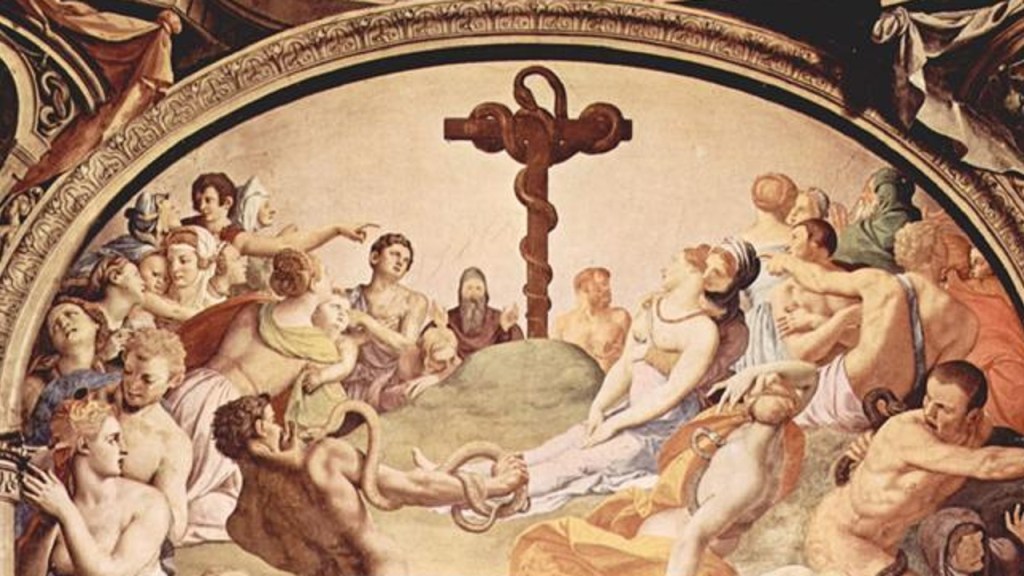
Numbers 21:8-9 “The Lord said to Moses, ‘Make a snake and put it on a pole; anyone who is bitten can look at it and live.’ So Moses made a bronze snake and put it on a pole. Then when anyone was bitten by a snake and looked at the bronze snake, he lived.”

Faith finds the solution to all our problems, because faith listens to God and lives. It receives the help that God himself has to give.

Look at God’s solution for the children of Israel, the solution they received by faith. We first need to note what the word of God does not say. The snakes did not suddenly leave the Israelites alone. It even appears that the people continued to be bitten for a while. The solution God gave was not exactly what the people asked for.

Understanding that God works this way is also a part of faith. When we say that faith has the solution to all our problems, this does not imply that our trust obligates him to do everything our way. Our faith has no magical power of its own to change everything. We can’t simply believe ourselves richer, or healthier.

Faith holds the solution because it receives what God has chosen to do. True faith humbles itself under his decisions. It maintains a childlike trust that, if this is what the Lord has decided, then this must be best for me.

The second thing to understand is that God’s solutions are often difficult for us to understand. God’s ways seem foolish to human reason. In faith we trust them anyway. Take an Israelite bitten by a poisonous snake, for example. The last thing a rational person would want to do under the circumstances is look at a poisonous snake. And since when can looking at a chunk of metal hanging on a pole cure anyone of anything!?

But this was not just a chunk of metal hanging on a pole. God had given his word. He had connected his promise with this bronze snake, and that made all the difference in the world! If God said looking at this snake would heal them, then it must be so. And when people listened in faith, they lived!

This was not a rare or unique way for the Lord to work. The most important truths of our salvation work the same way. Consider the foolishness of what God has done in Christ. The main problems of all mankind are sin and death. These exist because we have rebelled against God. So, when God wants to save us, what does he do? Gather all his armies of angels, muster all his glory and power, and sweep through the earth to purify it from sin?

No. Jesus comes as a modest, even weak-looking human being. He looks just like the ones who started this whole problem in the first place–so much so, in fact, that many people of his day, and many in our own, can’t believe that he was ever anything more than just another man. Then, to top it all off, the one who came to save people from death, dies himself.  They lift him up on a pole, a cross, like this bronze snake. He hangs there for all the world to see. This is God’s solution for death, his formula for eternal life?

Those who listen in faith hear their Savior speaking. They listen to God’s promises. Though they can’t see it with their eyes, they believe God’s word that their sins have been lifted off their backs. Jesus disposed of them on that cross.

And though we still see one believer after another succumb to death, we know that someday they will rise and live. God has promised. In faith we listen and live.

Such a faith which listens and lives knows that all of God’s promises are reliable. Perhaps the most precious word in these verses is the little word “then.” “Then, when anyone was bitten by a snake and looked at the bronze snake, he lived.” In the King James it is translated “It came to pass.” Either way, it tells us that God’s promise worked. Hard as it might be to believe, what the Lord promised would happen, happened.

Isn’t that a comfort? Doesn’t this invite our trust, stir our faith, and give us hope? How many promises of God do we have? Forgiveness and eternal life are certainly the greatest, but a huge list encompassing all of life follows them. He will be with you always. God will provide all you need according to his glorious riches in Christ Jesus. Do not worry about what you will eat or what you will wear: Seek his kingdom first, and he will give you all those things as well. He will answer your prayers. He will not let you be separated from his love. He will not let you be tempted beyond what you can bear. No one can snatch you out of his hands.

Listen to his promise, believe it, and you will live forever. Listen to his promise, believe it, and you will live under his blessing every day.

He Helps His People

Luke 7:16 “They were all filled with awe and praised God. ‘A great prophet has appeared among us,’ they said. ‘God has come to help his people.’”

Does your faith ever feel passionless? You haven’t stopped believing, but your beliefs have become such a routine part of life that they almost seem commonplace. They don’t inspire excitement anymore. Perhaps you have even worried that you are taking your faith and your Savior for granted and slipping into complacency.

At such times we might envy these people filled with a sense of holy awe and spontaneously praising God. They watched Jesus raise a young man from the dead in the city of Nain. If we had just seen a dead person sit up and start talking, I’m sure we would be excited, too. No wonder the news about Jesus spread around the country so quickly.

We don’t have less to make us excited. Every day Jesus forgives the sins that would otherwise send us to hell. Isn’t that you and I receiving our lives back from the dead? That alone is all the reason we need to be filled with awe, praise God, and tell others. Nothing Jesus has done is more worthy of our retelling.

But as exciting and life-changing as this is, he does it for us everyday. Through no fault of our Savior, we become so comfortable with his grace that we don’t find it special anymore. Maybe you can relate to the example a man once gave to his pastor: “Coming to our church,” he said, “was like a man dying of thirst crawling through the desert. Suddenly he creeps over a sand dune, sees an oasis, and goes running down to the water. He jumps in, he yells and splashes around because he is so happy. But all around him are people who have lived at that oasis their whole lives. They stare at him and say, ‘What? Are you nuts?’”

Sometimes our Lord lets us suffer grief and then comes to us with his comforts. He let us find our help in his promises, and in his answers to our prayers. In such cases, one of the blessings he brings is this: he fixes our attention firmly on himself again. We don’t take him for granted anymore. We know that he is our life, our hope, our all. We can’t keep that to ourselves. Our hearts and mouths are filled with awe and praise.

Professor Siegbert Becker once wrote: “…children of God learn to know that God is nearest just at the moment when he seems to be farthest away. At the time when he seems to be most angry, when he sends them afflictions and trials, they know him best as their merciful Savior. When they feel the terrors of sin and death most deeply, then they know best that they have eternal righteousness. And just when they are of all men most miserable they know that they are lords over all things.”

God isn’t missing when tragedy strikes. Look to his word and promises. Look to Jesus, and you will know that God still comes to help his people.

Real Riches

Revelation 3:17-18 “You say, ‘I am rich; I have acquired wealth and to not need a thing.’ But you do not realize that you are wretched, pitiful, poor, blind and naked. I counsel you to buy from me gold refined in the fire, so you can become rich…”

Did you ever see The Family Man? Nicholas Cage plays Jack, a single, wealthy Wall Street Executive. He lives in an expensive apartment. He drives luxury sports cars. He wears pricey clothes. He believes he is living the dream life . On Christmas Eve he talks a would-be thief out of murdering the clerk at a convenience store. Outside the store the thief asks him if he is missing anything, and Jack tells him he has everything he needs.

It turns out the thief is some kind of angel in disguise. He gives Jack a months-long “glimpse” of the life he could have had if he had married his college sweetheart. It’s a middle-class existence without all the perks of wealth, but it is filled with the love of family and friends. Over time he learns what he has been missing. He comes to see the misery in his lonely, unfulfilled life as the wealthy executive.

Jesus wanted the Laodiceans, he wants us, to see that a life with plenty of stuff, but without him, leaves us “wretched, pitiful, poor.” There are huge gaps in our lives. Something truly valuable is missing.

We are spiritually “poor.” We have no great goodness to be proud of. We have no great works by which we can impress God. An honest look at our lives reveals much of what we do driven by selfishness. We may talk about love and charity and kindness. But just watch what happens when someone crosses us. Our spiritual wallets are empty. As Martin Luther said in his dying words: “We are all beggars, this is true.”

If we are so spiritually poor, how can we “buy” anything from Jesus? The answer is, “We can’t.” We are taking the point of his illustration too far if we think he wants us to make him an offer. The things that come from him come only as gifts. But he is the source from whom we can obtain the things we need.

Jesus urges us to buy “gold refined in the fire.” We don’t need more literal gold, of course. His whole point is the inability of that stuff to provide what we need. But in almost every culture across the ages, gold has been a sign and measure of real wealth. God’s grace is the gold standard for real spiritual riches. Jesus’ sacrifice at the cross, the blood he spilled to save us, buys us what nothing else can: full forgiveness for all our sin. It settles our entire debt with God–the whole thing. It leaves no moral demand of God unsatisfied. It bails us out of the hell’s prison, and it secures first class accommodations in heaven. Here is an item for your portfolio that will never lose its value. Here is “stock” that never has a down year.

We live in times of economic uncertainty, but haven’t we always? Should I invest in the stock market, commodities like gold and silver, or real estate? Should I try to start my own business? Should I just put my money in the bank, hide it in my mattress, or bury it in a hole in the back yard? Jesus doesn’t answer questions like that.

He does tell us where to invest our attention, where to put our trust for a blessed present and secure future. “Buy” what he is “selling.” Stock up on grace and forgiveness, faith and love. These are real riches. They offer a return greater than we ever imagined.

Not As Bad As You Think

Numbers 21:4-5 “They traveled from Mount Hor along the route to the Red Sea, to go around Edom. But the people grew impatient on the way; they spoke against God and against Moses, ‘Why have you brought us up out of Egypt to die in the desert? There is no bread! There is no water! And we detest this miserable food!’”

Is it hard for us to understand the Israelites’ reaction? Moses tells us they grew impatient. Put yourselves in their place. They had been wandering for almost forty years now. They were getting tired of it. I like camping, but a week or two is all I need. Imagine forty years in a tent, in all kinds of weather, in a campground with a population in the millions! Besides that, your neighbor didn’t just bring his dog along. He has a couple of dozen sheep. Now news came of another detour ahead. They faced another delay on the way to the Promised Land. That was the straw that broke the camel’s back.

So the people complained. “Why have you brought us up out of Egypt to die in the desert?” The nation faced no immediate threat of death. That was an exaggeration. But why had the Lord led them out of Egypt? That wasn’t hard to answer. After centuries of slavery, Israel had begged God to get them out. Then the Lord answered their prayers. For Israel, Egypt had hardly been the garden spot of the world. Pharaoh attempted to work them to death, literally. When they became stronger instead, he commanded that all their sons be murdered at birth. Life in the desert was a blessing by comparison.

Israel’s reaction shouldn’t strike us as strange. We still pray for things, then complain after we receive them. We see our children do it. Perhaps you know children who have begged to have a pet. “Not unless you take care of it,” mom and dad insisted. But after more pleas and promises, mom and dad finally give in. Not much later, Junior is complaining, “Why do I have to take care of this stupid dog?” Well, it was an answer to his prayers, of course.

Adults do it, too. Someone has trouble making ends meet, or doesn’t get along where they work. They pray and pray for a promotion or a new job. Soon, that’s exactly what happens. But along with the extra income come extra hours and more stress. “Why did this job have to happen to me?” the disgruntled employee moans. Wasn’t it simply an answer to prayers? Things weren’t perfect in the old situation, either.

Israel’s complaints continued: “There is no bread! There is no water! And we detest this miserable food!” The Sinai Peninsula was very dry, and it provided very little water naturally, but these people had never actually had to do without. Rather, the situation led to their witnessing miracles as God provided water by his almighty power on more than one occasion.

And no bread? Again, the manna came by way of miracle. It’s not hard for us to understand how 40 years of boiled manna, baked manna, and fried manna; manna for breakfast, manna for lunch, manna for supper; got old. But they didn’t have to plow, or plant, or cultivate to get it. Harvesting was as easy as stepping out of your tent and picking it up off the ground. Did they really have a reason to complain?

Do we? So many of our problems exist mainly because of our point of view. So many of our problems are a failure to see or appreciate God’s providence. Is the house or apartment really too small? Is the car really too old? Are the children actually too rebellious, the friends too unsympathetic, the spouse too inattentive? Are our health problems as unbearable as we make them out to be? Do we have a right to be so impatient and irritable because of a year and a half of changes COVID 19 has made to our lifestyles?

Or, when we look at how our parents and grandparents lived, when we look at how people in most of the rest of the world live, has God really taken quite miraculous care of us living in 21st Century America? We still enjoy the highest standard of living in history, the least poverty, the best medicine, the fairest government, and a list of further advantages that could go on for pages.

On top of all this, our Lord has remained our loving Savior, our faithful deliverer all along. He forgives no less sins than he forgave a hundred or a thousand years ago. He has not changed the terms of our redemption. It still is his free gift. Our own Promised Land still waits at the end of our own earthly journey. God never said that the trip to the Promised Land would be easy, quick, or pleasant. He doesn’t want us to mistake the wilderness for home. But he also does much to make the journey bearable. Don’t miss the many examples of his grace along the way.

Death and Multiplication

John 12:23-24 “Jesus replied, ‘The hour has come for the Son of Man to be glorified. I tell you the truth, unless a kernel of wheat falls to the ground and dies, it remains only a single seed. But if it dies, it produces many seeds.’”

Jesus draws a beautiful illustration of his death and makes an emotionally charged prediction of his sufferings here. It may not impress us very deeply because we have become more or less comfortable with the idea of his suffering and dying. It’s our own suffering and dying with Jesus that troubles us.

We live in a world obsessed with ending all suffering. Doctors and scientists frantically struggle to hold death off as long as they can. Douglas Taylor Weiss once suggested that “Eliminate pain” and “Have a good day” and “Be entertained” belong in our culture’s new set of 10 commandments. Preachers of the prosperity gospel suggest that becoming a Christian means the end of putting up with life’s unpleasantries. But suffering, and even dying, are tools the heavenly Father uses to bring glory to his name.

The picture Jesus paints of the seed is not difficult to understand. When it is planted, it gives up all it has, its entire existence, to support the new plant. The seed itself “dies.” A new plant emerges. Eventually every trace of the seed disappears as the plant draws its life out of it. But the plant produces a whole crop of new seeds. Death leads to multiplication.

Jesus resembles that seed. Like the seed, Jesus gave up everything. He gave up the privileges of Godhood to live as a common man. He gave up the rights and freedoms of God’s Son to live in obedience under his parents, rabbis, and rulers. He gave up his time to teach, heal, and love the people of Judea and Galilee. He rarely took a day off. His students, his disciples, even lived with him.

Ultimately he gave up his Father’s love to know God’s anger at our sin. He suffered the hell we deserved. After tasting such spiritual death, he gave up his spirit. When they took his naked body down from the cross (for he had given up even his clothes to the Roman soldiers), they placed it in a borrowed tomb, because he had nothing left to give.

What if Jesus had never died? What if he had been spared all this pain, and suffering, and sacrifice? Then he would have remained only a single seed. God would have considered Jesus alone his child and Son. That would certainly have been easier for Jesus. But you and I would have no spiritual existence– at least not a positive one. Our sin made that impossible without him.

“But if it dies, it produces many seeds.” In God’s heavenly system of accounting, Jesus death cancels all the debt we owe for our sins. It sets us free from death itself. It may look weak and worthless, yet this great act of love has such power that the mere news of it miraculously takes hold of human hearts. It transforms rebellious sinners into believing children of God. In all this world, there is no greater power than Christ’s own self-sacrificing love.

You and I are the seeds Jesus’ loving sacrifice produced. We are the adopted sons and daughters of God, and we are only a small part of the family. It is so big, a harvest so fruitful, that when the Apostle John saw it in the book of Revelation, he described it as a great multitude no one could count.

This is the glory of our Savior’s death. It makes it possible to fear our own less as well.

True Story

2 Peter 1:16 “We did not follow cleverly invented stories when we told you about the power and coming of our Lord Jesus Christ, but we were eyewitnesses of his majesty.”

The Apostle Peter not only told the people to whom he wrote and preached how Jesus lived, died, and rose. He taught them Jesus was coming again, coming in power, coming as the almighty Son of God. Jesus was not like the mythological gods, an entertaining story from the distant past. The gospel isn’t a fantasy someone thought up while telling tales around the fire one night. Here was a God he had seen with his own eyes. This God promised to come again. Such a God truly has the power to help.

Peter knew this was true because he had been an eyewitness of Jesus’ majesty. He had seen just a glimpse of it at Jesus’ transfiguration on the mountain. “For (Jesus) received honor and glory from God the Father when the voice came to him from the Majestic Glory, saying, ‘This is my Son, whom I love; with him I am well pleased.’ We ourselves heard this voice that came from heaven when we were with him on the sacred mountain” (2 Peter 1:17-18). Peter heard God’s voice with his own ears. He was not just making it up.

Do you see why it’s important that we still understand this today, that the story of Jesus wasn’t simply made up? We don’t follow Jesus just to learn to live a certain way. The main point of Christian faith isn’t discovering a certain set of principles by which to arrange our lives. If that were the case, it wouldn’t matter how real Jesus is. As long as we learned our lessons, as long as we got the moral of the story, it would not make a difference if Jesus were just a myth.

But the point of all the teaching we have received has been to introduce us to a living person. It gives us contact with a divine being. He cares for us with a real heart, claims us as friends, and involves himself in our lives with his actual presence and concern.

Sometimes, sitting in Bible class or worship, it may seem as though we are learning nothing but a set of religious facts. But each journey into God’s word intends to bring us closer to Christ. The goal doesn’t stop at knowing more information about him. Here is the opportunity to know him more personally and intimately. Here is how we grow closer to him as brother or sister, companion and friend.

He intends to make himself a living part of our lives. Centuries ago, he was a living and breathing man who took responsibility for our sins and gave his life for them. Today he is still the God-man who is here with us at every moment. Though we cannot see him, he personally speaks to us in sermons, classes, or on the written pages of the Bible.

Someday, we will see him with your own eyes. As the Son of God he is coming again with power. He comes to take us home. The Apostle Peter was not making this up, nor am I. Then we will see clearly how our story is intertwined with his, our real story, which never ends.