1 Thessalonians 5:9-10 “For God did not appoint us to suffer wrath, but to receive salvation through our Lord Jesus Christ. He died for us so that, whether we are awake or asleep, we may live together with him.”
One of the great truths the light of the gospel makes possible to see is that, for the Christian, Judgment Day holds only salvation. God did not choose us and call us to faith so that on the last day he could still take his anger at sin out on us. He sacrificed his Son and brought us to faith to guarantee us a place in heaven.
Some have questioned the wisdom, or even the truthfulness, of that promise. If people aren’t kept in fear of Judgment Day, they believe, they will feel free to live a wicked life. But is that true? Do people have to be held in fear of the end to get them to behave properly?
When I was in grade school my parents planned a family vacation to Disney World. As a child, there was nothing I looked forward to more. My parents invested a lot of time planning that vacation. They paid a lot of money to make it reality. Practically nothing I could do would have stopped it from happening.
Just because I knew it was “guaranteed” didn’t make me behave worse in the meantime. On the contrary, in my excitement over going I did a lot of positive things getting ready, not to make the vacation possible, but just because I was sure we were going.
Just because heaven is guaranteed, that doesn’t mean that we will stop taking the coming Judgment seriously. We approach it as children of the light. In our excitement over going, we are more likely to spend our time getting ready, not to make heaven possible, but just because we know we are going to go.
For most people, the term “Judgment Day” sounds like something dark. And that’s how it will be…if we belong to the darkness of unbelief. But this is also the day on which the full light of God’s glory is going to shine. It will be the first time for such light on earth since creation in all its majesty. The entire population of heaven is coming to the big event: saints and angels, our glorified Savior and his holy Father. Don’t be afraid for that day to come. We are only going home to live with him.
1 Thessalonians 5:6-8 “So then, let us not be like others, who are asleep, but let us be alert and self-controlled. For those who sleep, sleep at night, and those who get drunk get drunk at night. But since we belong to the day, let us be self-controlled, putting on faith and love as a breastplate and the hope of salvation as a helmet”
Not everyone who belongs to the darkness is a grand, public, disgusting, dangerous sinner. Many are simply spiritually asleep. Like so many of our neighbors, they raise their children to be friendly and respectful. They work hard and have successful careers. They volunteer in the community. They vote conscientiously. They offer to watch your dog when you go on vacation. Everyone considers them to be good folk.
But spiritually, they are asleep at the wheel. The very ordinariness of their lives has lulled them into a false sense of security. So caught up with raising their family, making a living, saving for retirement, and making the community a better place, they have no sense of the fact that they are rushing headlong toward a fatal crash with God’s justice on the Day of Judgment.
Others are more intentional about living a life that suits their spiritual darkness. “Those who get drunk, get drunk at night.” When a person gets literally drunk, what happens? All the inhibitions come down. Lips starts flapping and saying things they shouldn’t. People don’t restrain themselves sexually. Some lose control of their tempers. Even more self-destructive behavior may follow.
What happens when the spiritually darkened no longer believe God’s word? Their inhibitions begin to drop, don’t they? It’s easier to rationalize their self-gratifying behavior. It’s easier to ignore their conscience. Sexual perversion seems defensible, even “natural.” Dishonesty in the workplace is just “taking care of yourself.” All kinds of self-destructive behavior may follow, with no fear of reprisal.
But why should the apostle Paul remind us of all this? Aren’t we the sons of light? Yes, but isn’t it easy for us find the monotonous grind of ordinary life spiritually deadening? Don’t you find the urgency of 101 little daily responsibilities spiritually distracting? In the parable of the sower Jesus warns about ending up like the seed that fell among the thorns. The cares, worries, and pleasures of this life choked that seed of faith and made it unfruitful. How many pet sins or secret desires wouldn’t we be happy to stop resisting? How much easier to give in to a state of spiritual inebriation.
To combat such temptation, Paul encourages, “But since we belong to the day, let us be self-controlled, putting on faith and love as a breastplate and the hope of salvation as a helmet.” There are two places we need to be careful to protect. First put on a breastplate. What does a breastplate cover? It protects your heart, doesn’t it? If we want to live self-controlled lives, we need to protect our hearts from things that try to take Jesus’ place there.
And what is that breastplate made out of? Faith and love. As long as we are tending to the things that nurture our trust and love for Jesus, reviewing and remembering his promises, receiving his forgiveness and grace, the light of faith keeps burning in our hearts. Jesus remains our heart’s one true love. The temptations of the darkness can’t compete for our affection.
The other thing we need to protect is our head. Our minds are another key battleground for our spiritual lives. If the darkness can lead us into some false belief, we become vulnerable to its temptations.
Against this we put on the hope of salvation as a helmet. When our minds are occupied with God’s saving work, when we are getting to know our Savior better, we are safe from temptation. And do you notice that the protective gear has to do with gospel things? When head and heart are right, a right life will surely follow.
We can see what others can’t. Doesn’t it make more sense to follow the light than follow the blind?
I Thessalonians 5:4-5 “But you, brothers, are not in the darkness, so that this day should surprise you like a thief. You are all sons of the light and sons of the day. We do not belong to the night or to the darkness.”
The point of Paul’s analogy is not difficult to understand. Those who belong to the night or the darkness can’t see. Those in spiritual darkness don’t see who God is, how he works, what he’s done, or what he expects.
This is not a small problem. A blind man is blind wherever he goes. Those who live in spiritual darkness carry their darkness with them into every perception and experience. It affects how they interpret their whole world.
Biblical ignorance is a major ingredient in this spiritual darkness, but it’s not the whole thing. Making people Biblically smarter doesn’t always make them better. If people don’t trust God when he tells them a behavior is sinful, how does the information help them? If people don’t trust God when he tells them the wonderful things he has done for them, how can they benefit from his promises? People who don’t trust God, who won’t let his opinion stand above their own, still can’t see. They are still in the dark, no matter how much Scripture they know.
We do not belong to that darkness, but its shadow continues to creep up on us. We still desire to set ourselves up as judges over God’s word: which parts make sense or sound fair. Wherever we set ourselves up as judges, the darkness is creeping back in. It casts a shadow over our faith.
That is not the nature of our faith, however. “You are all sons of the light and sons of the day.” Jesus once described his disciples as the light of the world. Our lives of love and words of grace reflect God’s love to people around us. They help people see Jesus.
But Paul isn’t thinking of something we do when he calls us “sons of light” and “sons of the day.” He is thinking of something we are. Before we shine, we have to see. Before we reflect God’s love we have to be people who have seen that love and received it ourselves.
This is what it means to be sons of light. Sons of light see their condition as it actually is. They don’t pretend to be super spiritual. They don’t go about like a man whose leg hurts terribly, but he tries to appear as though he isn’t limping. They know they can’t cover up what is broken. The cancer of sin is terminal. It has spread through the whole self. It has strangled the heart. And how do you cover up a dead heart?
Sons of light also see God’s love in all its glory. They know he didn’t waste time waiting for spiritual corpses to revive themselves. He started over with a substitute. He himself became that substitute. He lived a life of love for them. He died the death their sins deserved. He leaves no debt unpaid. He leaves no demand unfulfilled.
Sons of light know that the beating heart of faith is itself God’s gift to them. Can you imagine trying to do transplant surgery on yourself? It doesn’t work spiritually, either. But God has given us a new heart. It believes his love. It has eyes to see things as they actually are.
So here’s the difference between the sons of light and those who belong to the darkness: When tragedy strikes, those who belong to the darkness assume that God must have forsaken them. Worse yet, they suspect there is no God or he would have prevented it. But the sons of light know God must still love us. They realize the Lord disciplines those he loves. They see life as it actually is.
When considering someone’s eternal fate— heaven or hell — those who belong to the darkness consider only the life lived. Did the deceased get along with his neighbors? Did he give to charity? The sons of light are more interested in whether he professed himself a sinner who cast himself on God’s mercy. They know that “if we claim to be without sin, we deceive ourselves, and the truth is not in us. If we confess our sins (God) is faithful and just and will forgive our sins and purify us from all unrighteousness” (1 John 1:8-9). They see how our eternal prospects actually work.
Because we know and trust Jesus, we can see. Live in his light now, and be ready when he returns.
Luke 23:27-31 “A large number of people followed him, including women who mourned and wailed for him. Jesus turned and said to them, ‘Daughters of Jerusalem, do not weep for me; weep for yourselves and for your children. For the time will come when you will say, Blessed are the barren women, the wombs that never bore and the breasts that never nursed! Then they will say to the mountains, ‘Fall on us!’ and to the hills, ‘Cover us!’ For if men do these things when the tree is green, what will happen when it is dry?’”
Jesus’ words to the women weeping for him help to clear up some misconceptions that people have about sin and God today. In the past it was true that people often saw God only as the angry judge. They were driven to approaching him in a works-righteous way. They were never certain of his love or their salvation.
Today, perhaps, the pendulum has swung too far the other way. People forget that God is Judge. They see him as someone who excuses sin instead of forgiving it. Jesus’ words open our eyes to the truth. They help us understand that sin is serious, and so is God’s judgment of it.
How serious? Think about the dearest people you know. Can you imagine wishing they had never even existed? Some watch their loved ones go through such severe pain that they pray for the Lord to let them die and end the suffering. I have never known someone to wish the person they loved never existed.
That is the picture Jesus paints here. Is there a love more tender than the love of a mother for her child? In the Jewish culture of Jesus’ day, it was considered a curse for a woman never to know that love. Jesus warns that, when God visits his judgment on the unrepentant people of Jerusalem, these mothers will see such suffering that they will wish their children never existed in the first place.
Still not sure whether to take his warning so seriously? Jesus has one last way of driving home the horror of the judgment to come. “For if men do these things when the tree is green, what will happen when it is dry?” Jesus was the green tree. He was full of spiritual life, a life of perfection. Look at how he suffers now. If this is what happens to the innocent Son of God, what will happen when those on trial are sin-filled human beings, without any spiritual life in them?
Get the point? God considers sin a serious matter. Nor is there reason for us to think less seriously about our own. Those who face judgment won’t have to be told to weep. Jesus warns many times that those who are thrown into the outer darkness will experience “weeping and gnashing of teeth.”
If all that we produce are tears of sorrow, tears of dread, tears of fear, then we have failed to take in the whole scene again. More was waiting at the end of this road along which Jesus traveled than his executioners. God was waiting there. He was waiting with the very judgment on sin about which Jesus warns. It was the punishment we and all people deserved. Jesus bore it all in our place.
Our story doesn’t have to end with the judgments Jesus describes. All that made him so pitiable that day, all that led those ladies to tears, were things he was suffering so that we might be forgiven. Jesus carried his cross, and then he died on it, so that we can escape God’s judgment.
Jesus’ pain may make us shed a tear. God’s judgment might fill us with a sense of dread. Don’t miss the peace and joy his cross provides as well.
Luke 23:27-28 “A large number of people followed him, including women who mourned and wailed for him. Jesus turned and said to them, ‘Daughters of Jerusalem, do not weep for me; weep for yourselves and for your children.’”
What kind of people were there? Some of them were utterly rebellious. They were Jesus’ enemies. They had plotted his end and orchestrated his trial and execution. Among them were the priests and Pharisees we later hear mocking Christ while he is hanging on the cross. They hated Jesus. They were only too eager to get rid of him–to finally see him die.
Some following to the cross were little more than curiosity seekers. As horrible as a crucifixion is, as severe as the suffering may be, these people had a twisted, morbid interest in going to see someone die. They were not the only ones of their kind. When executions were performed in public in our own country years ago, they always drew crowds. People have a strange interest in seeing someone breath their last, the gorier the better. Isn’t that why violence still draws ratings on television? Isn’t that why slasher movies do well that the box office? It is part of the twisted and perverted nature of fallen humanity to find painful deaths entertaining.
Then there were these women of Jerusalem. It was not wrong to feel sorry for Jesus. But who was being served by their display? They were not leading anyone to confess faith in Jesus and stand up for him. They stopped short of objecting to the injustice he suffered. Feeling sorry for Christ doesn’t save anyone.
Do you see why Jesus says, “…do not weep for me; weep for yourselves and for your children”? This collection of people following him was a collection of the most spiritually privileged people on earth. These people, of this nation, had been the closest people to God. They lived in the shadow of the temple in the holy city of Jerusalem. God chose them to be his own.
Still, what do we find among the most spiritually advantaged people in the world? Hatred of God. Open rebellion. Twisted and perverted minds. Weakness and sentimentality at best. They had a better reason to cry than the pitiful sight of Jesus in front of them. So do we. “Weep for yourselves,” Jesus says. Weep tears of repentance. Cry over the depth of your sin. Go and weep bitterly, like Peter did after he denied Jesus the night before.
Then remember why Jesus was there. The heaviest thing Jesus was carrying through the streets of Jerusalem was not his cross. His greatest pain was not his bleeding wounds. His burden and his pain were our sins–our hatred, our perversion, our weakness. He carried these as our substitute.
Don’t pity him, then. Believe in him! Be certain your sins have been forgiven. Your guilt has been removed! He carries his cross through the streets of Jerusalem to the place of his execution to free us from suffering as he did for our sins.
Then we are seeing this scene the way he wants. Then we are not looking at Jesus as an object of pity. He is our heroic Savior. He carries his cross for you.
Galatians 5:2-5 “Mark my words! I Paul tell you that if you let yourselves be circumcised, Christ will be of no value to you at all. You who are trying to be justified by law have been alienated from Christ; you have fallen away from grace. But by faith we eagerly await through the Spirit the righteousness for which we hope.”
Do you know what happens when religion becomes Jesus plus something else? Little by little, Jesus ceases to be the star of the show. More and more the “something else” gets all the attention. That something else needs to be explained, defended, and promoted. How can faith survive when we don’t hear about Jesus anymore? How long would your marriage or friendships last if you never heard from or about the people we love?
Worse yet, Paul says that Christ is really of no value to us at all. Is that hard to understand? If you go to the doctor, but then reject the treatment plan and all the medicine he has proposed, what good is he to you? If you call the fire department to put out the fire in your house, but when they arrive you don’t let them spray water on the fire, how can they help? If you open a bank account, but then you keep all your money in your mattress, what’s the point? If you draft and organize an army, but you don’t arm them or let them fight against the enemy, and you try to face the enemy on the battlefield alone, what’s the value of having an army? I could keep multiplying the illustrations. You see where this is going. If God gives you a Savior, but you reject his way of saving you in favor of trying to save yourself, of what value is that Savior to you anymore? The answer is easy: He is of no value to you at all.
Lose Christ, and you lose God’s grace, too. “You who are trying to be justified by law have been alienated from Christ; you have fallen away from grace.” You know what grace is. Grace is God’s undeserved love. It is his gift-love. Like a gift, you don’t earn it. God just gives it away. He loves you because he chooses to love you. He loves you because Jesus took all our sins away.
If we say to God, “I don’t want you to love me because Jesus took all my sins away. I want to be justified–I want to be considered good, and right, and holy–because I have kept the law myself. I want you to love me because I deserve it…” then we are taking a pass on the gift. As Paul says, then we have fallen from grace, by definition. All that is left for us is the pressure of living perfectly without a single slip until the day we die. Don’t trade Christ and his grace for that kind of slavery. Defend your freedom, and hold on to Christ.
Then we will live in faith’s blessings. “But by faith we eagerly await through the Spirit the righteousness for which we hope.” When we reject the law’s slavery and hold on to Christ by faith, that changes everything. Then we have real freedom. It changes our inner condition. Faith makes us certain and confident.
When you were in school (or those of you who are in school), did you eagerly await tests at the end of a chapter, or at the end of a semester? Or did they give you a little sense of fear and dread, even if you knew the material pretty well? Why is that? Isn’t it because the outcome is always a little uncertain? Maybe the teacher will have questions about something I missed. Maybe I will choke when the time for the test comes. I wish we didn’t have to have tests!
But Paul says that we await the greatest examination of all–standing before God on the day of Judgment–eager and full of hope. Why is that? Because Jesus already took and aced the test for us; because Jesus erased all our mistakes along the way; because we already know the final grade: 100%, A+. By faith we know that even now God regards us as righteous and perfect for Jesus’ sake. By faith we are certain he will publicly declare us righteous in the presence of all humanity when the last day comes.
That confidence sets us free from fear. It keeps Christ and his grace at the center of our faith. Don’t settle for anything less.
Galatians 5:1-2 “It is for freedom that Christ has set us free. Stand firm, then, and do not let yourselves be burdened again by a yoke of slavery. Again, I declare to every man who lets himself be circumcised that he is obligated to keep the whole law.”
“Defend your freedom! Reject slavery!” Paul says. In the context of this letter, the slavery here involves accepting circumcision as a requirement for salvation. People with Jewish background had come to these congregations somewhere in ancient Eastern Turkey and told them, “Jesus is good, yes. You should follow him. But faith in Jesus isn’t enough. If you really want to be saved, you need to be circumcised just like Abraham, and Moses, and the prophets all were.”
That might not sound like such a bad deal at first. All that is standing between you and heaven is a little surgery. It won’t take but a minute. Look at all giants of faith, the heroes of God’s people, who did this before you. Never in your life have you been offered so much for doing so little.
Have you ever signed up for a great deal without reading all the fine print? You thought you were getting the bargain of the century. “Sign up for our cell phone plan and we will give you the smart phone for free.” But there’s an asterisk next to the word “free.” You will walk out of the store without paying for the phone today. But over the next few years you are going to lay down $500 or even $1000 for your “free” phone.
Salvation for circumcision works a lot like that. Paul warned these people, “…do not let yourselves be burdened again by a yoke of slavery.” Again? What did that mean? These Christians in Galatia were Gentiles. They had never been circumcised before.
He explains a verse later: “Again, I declare to every man who lets himself be circumcised that he is obligated to keep the whole law.” There’s the fine print. Today you submit to circumcision. Tomorrow you will be eating only kosher foods, putting yourself through a hundred and one cleansing ceremonies, and offering all kinds of animal sacrifices for special holidays. In fact, the “law” doesn’t stop there. While you are “doing something” to save yourselves, you can throw in the ten commandments. And don’t you dare make any mistakes. Don’t think this contract for heaven is any good if you disobey your parents, use God’s name as a cuss word, get frisky with someone you aren’t married to, or develop a little envy and covet something that belongs to your neighbor, not even once. Now you are obligated to keep the whole law. It’s a package deal.
This is the kind of slavery with which the Galatian Christians were all too familiar. The details were different in their old religion, but the principles were the same: Make God happy by the quality of your personal performance. Base your relationship with God on how well you behave. Do and do, and do and do, and when you are tired of that, do some more. It never stops, and it is never enough. It is a slavery that covers every waking and sleeping moment of your life. It is not the way of Jesus. Defend your freedom, Paul says. Reject the Law’s slavery.
That fight isn’t over. Christians in our time still try to make salvation Jesus plus something else. It is Jesus plus abstaining from having a drink. It is Jesus plus worshiping on Saturday as the true Sabbath. It is Jesus plus using enough water at your baptism or blabbering on in some language you never heard before.
Don’t think we Lutherans are immune to the temptation. Five hundred years after the Reformation we have developed plenty of fine traditions. Make any of those traditions a binding rule, an unchangeable requirement laid on the consciences of God’s people, and we cease to be the church of grace alone, faith alone, and Scripture alone.
Defend your freedom, Paul urges us today. Reject the Law’s slavery. You can never legislate your way to freedom. More laws only increase our bondage.
This call to freedom isn’t an encouragement to embrace immorality. It’s a reminder of our limitations, an admission of our incompetence, and a defense of Christ’s honor. We cannot save ourselves, or even contribute. Only Jesus saves, and he has. All that’s left for us is a life lived in the freedom he already won.
2 Timothy 3:14-15 “But as for you, continue in what you have learned and have become convinced of, because you know those from whom you have learned it, and how from infancy you have known the Holy Scriptures which are able to make you wise for salvation through faith in Christ Jesus.”
Sometimes people new to celebrating the Reformation have gotten the impression it is “We’re-better-than-everybody-else” Sunday. This is not a day for patting ourselves on the back just because we are Lutherans. Members of our church will be saved by grace alone, just like everybody else.
No, the Reformation grew out of a much more important concern. We celebrate this day to help ensure that we never give it up. Do you believe Jesus loves you? Are you sure Jesus loves you? It was just these questions that Martin Luther grew up unable to answer from what he had learned in his church. It was just these questions that he learned to answer with a resounding “yes” from the words of God’s Holy Scriptures. We, too, will answer “yes” all our lives if we follow Paul’s encouragement and continue in the teachings we have learned from them.
Paul points out that Timothy did not merely learn the Scriptures. This book and what it teaches were more than answers he had learned for a test. It was more than information about people from a faraway time and place.
Timothy had also become convinced of these things. He had confidence. He had certainty. There is such a thing as objective truth, that truth can be known, and it was known to Timothy himself.
To be certain did not mean that Timothy was arrogant. There are those who believe that all certainty must be proud presumption. With all the competing ideas about what is true, the thought goes, no one can be sure of anything. And because we don’t want to be thought of as proud or arrogant, perhaps we are tempted to believe that it would somehow be better if we were not too sure of what we believe, either.
But what comfort can a person find in something that has no certainty? What peace can be had from what is unclear or unknown? Isn’t it true that we often are filled with more fear, and more anxiety, by the things which are unknown? Isn’t it true, at least very often, that people would even rather know that they have a disease rather than live in uncertainty about what is wrong with them?
How much more necessary it is that we can be certain when it comes to our salvation and eternal life! Faith, the author of Hebrews tells us, is being sure of what we hope for. Doubt and uncertainty are the opposite of faith. If, like Timothy, we are going to continue in the Scriptures we have learned, we need to be convinced that they are true.
Those Scriptures do the convincing themselves through the saving promises they make. They “are able to make you wise for salvation through faith in Christ Jesus.” They teach me that Jesus can be trusted. They tell me not only that someone has to die to pay for my sins. They assure me that, in Jesus, God died to pay for my sins. They reveal not only my inability to save myself with all my good works, sincere intentions, and tear-filled prayers. They show me how Jesus lived the sincere life of good works which does.
These Scriptures promise that God connects me with Jesus life and death in Baptism. They explain to me that he still shares and distributes the benefits of his saving work in his Holy Supper. These are not just doctrines I am told I must fight to defend. They are beautiful truths, life-giving truths, comforting truths, empowering truths I want to believe.
On the basis of the Scriptures I know that, yes, Jesus loves me, and so they have filled me with saving faith. This wisdom is a certainty, not a possibility. Continue to learn its truths and be convinced by its power.
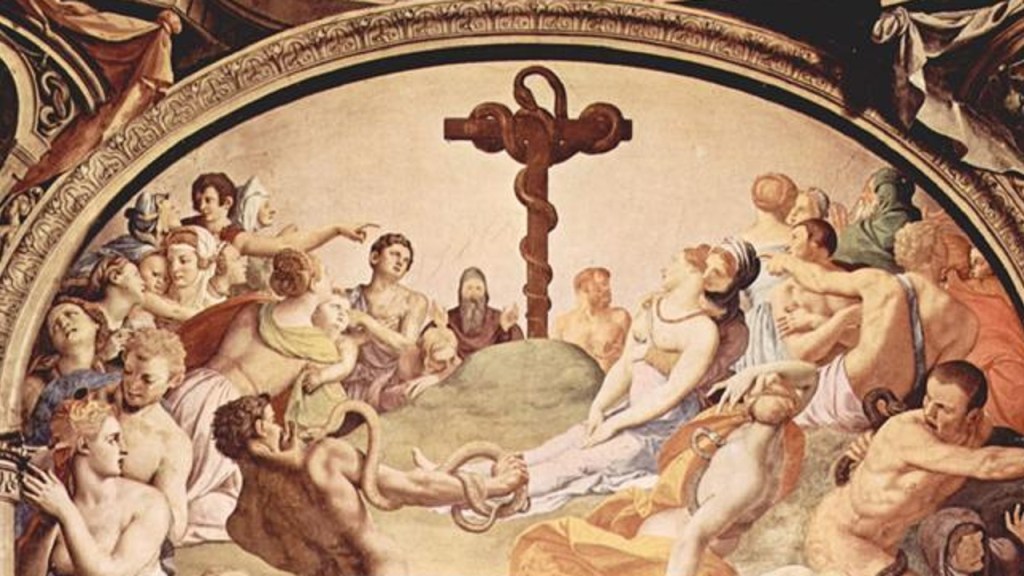
Numbers 21:8-9 “The Lord said to Moses, ‘Make a snake and put it on a pole; anyone who is bitten can look at it and live.’ So Moses made a bronze snake and put it on a pole. Then when anyone was bitten by a snake and looked at the bronze snake, he lived.”
Faith finds the solution to all our problems, because faith listens to God and lives. It receives the help that God himself has to give.
Look at God’s solution for the children of Israel, the solution they received by faith. We first need to note what the word of God does not say. The snakes did not suddenly leave the Israelites alone. It even appears that the people continued to be bitten for a while. The solution God gave was not exactly what the people asked for.
Understanding that God works this way is also a part of faith. When we say that faith has the solution to all our problems, this does not imply that our trust obligates him to do everything our way. Our faith has no magical power of its own to change everything. We can’t simply believe ourselves richer, or healthier.
Faith holds the solution because it receives what God has chosen to do. True faith humbles itself under his decisions. It maintains a childlike trust that, if this is what the Lord has decided, then this must be best for me.
The second thing to understand is that God’s solutions are often difficult for us to understand. God’s ways seem foolish to human reason. In faith we trust them anyway. Take an Israelite bitten by a poisonous snake, for example. The last thing a rational person would want to do under the circumstances is look at a poisonous snake. And since when can looking at a chunk of metal hanging on a pole cure anyone of anything!?
But this was not just a chunk of metal hanging on a pole. God had given his word. He had connected his promise with this bronze snake, and that made all the difference in the world! If God said looking at this snake would heal them, then it must be so. And when people listened in faith, they lived!
This was not a rare or unique way for the Lord to work. The most important truths of our salvation work the same way. Consider the foolishness of what God has done in Christ. The main problems of all mankind are sin and death. These exist because we have rebelled against God. So, when God wants to save us, what does he do? Gather all his armies of angels, muster all his glory and power, and sweep through the earth to purify it from sin?
No. Jesus comes as a modest, even weak-looking human being. He looks just like the ones who started this whole problem in the first place–so much so, in fact, that many people of his day, and many in our own, can’t believe that he was ever anything more than just another man. Then, to top it all off, the one who came to save people from death, dies himself. They lift him up on a pole, a cross, like this bronze snake. He hangs there for all the world to see. This is God’s solution for death, his formula for eternal life?
Those who listen in faith hear their Savior speaking. They listen to God’s promises. Though they can’t see it with their eyes, they believe God’s word that their sins have been lifted off their backs. Jesus disposed of them on that cross.
And though we still see one believer after another succumb to death, we know that someday they will rise and live. God has promised. In faith we listen and live.
Such a faith which listens and lives knows that all of God’s promises are reliable. Perhaps the most precious word in these verses is the little word “then.” “Then, when anyone was bitten by a snake and looked at the bronze snake, he lived.” In the King James it is translated “It came to pass.” Either way, it tells us that God’s promise worked. Hard as it might be to believe, what the Lord promised would happen, happened.
Isn’t that a comfort? Doesn’t this invite our trust, stir our faith, and give us hope? How many promises of God do we have? Forgiveness and eternal life are certainly the greatest, but a huge list encompassing all of life follows them. He will be with you always. God will provide all you need according to his glorious riches in Christ Jesus. Do not worry about what you will eat or what you will wear: Seek his kingdom first, and he will give you all those things as well. He will answer your prayers. He will not let you be separated from his love. He will not let you be tempted beyond what you can bear. No one can snatch you out of his hands.
Listen to his promise, believe it, and you will live forever. Listen to his promise, believe it, and you will live under his blessing every day.






 Bits of Bread