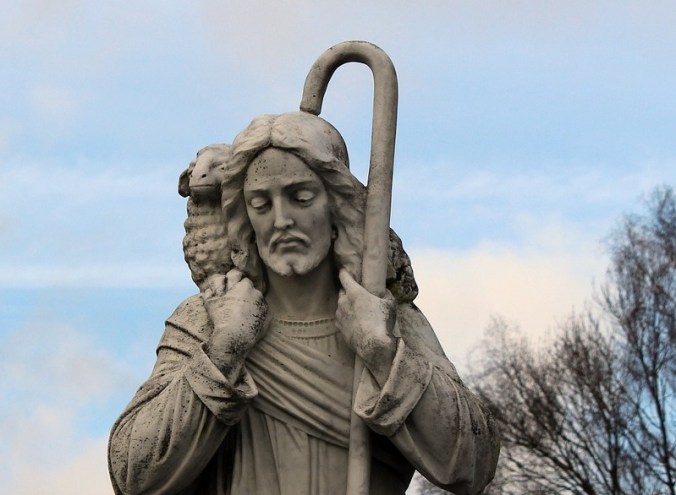
Jesus Knows

Good Shepherd

John 10:14 “I am the Good Shepherd; I know my sheep and my sheep know me.”

Jesus is the Good Shepherd. The word he uses for “good” does not emphasize his goodness in the moral sense. Certainly Jesus is morally good, too. But Jesus is the Good Shepherd because he is capable, he is competent: he cares for his sheep the way it is supposed to be done.

That’s because Jesus knows his knows his sheep. When I worked on my uncle’s dairy farm, he knew about cows. He attended the University of Minnesota where he earned a Bachelor of Science degree in animal husbandry–the science of taking care of animals. He subscribed to the leading professional magazines and journals for dairy farmers. He attended trade shows to stay on top of the latest technology and research. My uncle knew cows.

But more than that, he knew his cows. Instead of numbers, he gave them names. When I started working for him, they all looked the same to me. But he knew his own by sight, whether they were standing in the stall or grazing in the pasture. He knew their age and how much they were producing. He had a specially developed diet for each one. He could describe to you the differences in their personalities. My uncle knew his cows, you might say, personally.

That’s how Jesus knows his sheep, his people like you and me. He knows all about sheep, of course, because he invented us and designed us himself. But more than that, he knows us as his sheep–personally, by sight, by name. He knows our strengths, weaknesses, and special needs. As a result, he is constantly adjusting his care to fit our life and circumstances individually.

So something goes wrong in your life (and something is always going wrong, isn’t it?). We pour out our hearts in prayer to our Good Shepherd to help us, and he listens. He knows us and our need, but that is not the first he heard of it. Whether we think to pray or not, Jesus knows his own. He knows things about our situation we don’t even know ourselves. He knows how it will affect us. He knows what we can stand.

Then he goes to work caring for our souls just the way we need, because the Good Shepherd knows his sheep.


Holy People

Woman in Wash

Ephesians 5:3 “But among you there must not be even a hint of sexual immorality, or of any kind of impurity, or of greed, because these are improper for God’s holy people.”

You are not animals. Hopefully that’s not news to you. But you probably know that the majority of this country’s scientific establishment would like to convince you and your children that you are nothing more than highly developed animals. Then you are no more important, no more valuable, no more meaningful than the pets that live in your house, or the pests that live in your house. But you are not animals. As human beings, God made you something more.

As a Christian, you are not mere human being. When Paul wrote to the Christians in the city of Corinth about their quarreling and jealousy, he asked them, “Are you not acting like mere men?” (1 Cor. 3:3). The question implies that we are more than mere men. We are something more, and our behavior ought to reflect that.

Paul shares a similar concern when he writes to the church in Ephesus. “But among you there must not be even a hint of sexual immorality, or of any kind of impurity, or of greed, because these are improper for God’s holy people.” “Don’t do those things,” Paul is saying, “Because that is not who you are.” God’s holy people are not some super class of Christians. Paul isn’t writing to the church council, the board of elders, the officers of the women’s group, or the members of the choir. He isn’t addressing people who never sinned in the past, or who will never sin in the future. He’s talking to people like you and me. We are holy people.

There are basically two ways a person can be clean: don’t get dirty in the first place, or get a good bath. God’s people are holy because God has given them a good bath. We have “washed our robes and made them white in the blood of the Lamb.” “The blood of Jesus Christ, his Son, purifies us from all sin.”

Being holy means that God has set us apart from the rest of the world. He has claimed us as his very own. He picked us up, and brought us home, and cleaned us off because he had an idea about how he could use us. God’s holy people have purpose.

Let that sink in a little. Have you ever rescued an item from the curb–maybe a piece of furniture or a small appliance? Over the years my family has brought a number of things like that home–a TV stand, a dresser, some patio furniture. All of that stuff was just hours away from spending the rest of its earthly existence at the dump. But we took it home, and cleaned it up, and gave it a new life and a new purpose. Isn’t that a picture of God’s holy people? Destined for the dump, we were rescued, and cleaned, and God gave us a new life and a new purpose.

We are God’s holy people. We will live a new life if we will simply be who we are.

An Unchanging Word

Oldsmobile

Psalm 119:89-90  “Your word, O LORD, is eternal; it stands firm in the heavens. Your faithfulness continues through all generations; you established the earth, and it endures.

Back in 1998 Oldsmobile came up with the idea of trying to reach a new generation of consumers with the slogan, “This is not your father’s Oldsmobile.” Unfortunately, their advertising campaign backfired. In the minds of younger car buyers, it solidified the idea that Oldsmobiles were for older people. At the same time it suggested to the generation that had been buying their cars that there was something wrong with them and their choice. In 2004 the last Oldsmobile rolled off the assembly line in Lansing Michigan.

Unaware of the potential pitfalls, some churches seem to advertise, “This is not your grandfather’s church.” Now of course, there are always things that are changing about churches. Programs come and go. Every 30 to 40 years there’s a new hymnal with some new songs. More and more hymnals are being replaced by screens. Buildings change. People change.

But in the essentials–the message that is taught, the Word that is preached– there needs to be a wholesome sameness. There are no new promises God has given to sustain the faith of his people other than the same ones that got Abraham, Moses, David, Peter, and Paul through life. You can no more earn your way to heaven today than you could 5000 years ago. The number of sins that God forgives for Jesus’ sake has remained constant across the millennia: All of them.

People may think that the challenges facing our generation are new and different. They may believe that the temptations we fight have never been seen before. Not so. Solomon promised us nearly 3000 years ago, “There is nothing new under the sun.”

That is why we need to turn back to the changeless word of God for our help and strength. It provides so much more than a dependable standard of morals, an unwavering distinction between right and wrong. It brings to us the love and grace of God that saves us and preserves our lives.