
Confident To Declare His Praise

Megaphone

1 Peter 2:9 “But you are a chosen people, a royal priesthood, a holy nation, a people belonging to God that you may declare the praises of him who called you out of darkness into his wonderful light.”

Some people go on and on about themselves, about their hobbies or opinions or tastes. Jesus has given you something actually worth talking about. He has called you to be his spokesmen, to do endorsements for him. He didn’t hire a supermodel or the number one rated athlete in the world. He called you. He has not made us all his door to door salesmen, but he calls us to speak from the heart, and tell what we know, when the opportunity presents itself. Nationwide Insurance once claimed to have “the world’s greatest spokesperson in the world” in its commercials. Jesus has called you to be the world’s most important ones.

What we declare are his “praises.” The word Peter uses for “praises” does not refer so much to the act of worship, words or songs that express, “Our God is awesome.” They include the record of his deeds, the accounts of his kindness, the characteristics of his person that make it so. We are talking of the hand he has had in all human history: sending us a Savior, and seeing to it that the message salvation in Jesus has reached you and me.

These are the praiseworthy qualities and deeds of the God we worship, the things that bring him fame and praise. Jesus has called you to tell this story. He calls you to tell people who he is and what he is like. It’s not a hard thing to understand, not a complicated message to deliver. If you can talk about the great game your child had on the soccer or baseball field, if you can describe your favorite qualities in your best friend, you can do this. As a Christian, it is part of your calling. It is one of the reasons that Jesus’ made you one of his distinguished people.

A few decades ago one of my professors was applying to enter a doctoral program at the University of Minnesota. The director of the program scoffed at first. He thought he was just a backwards fundamentalist from a Bible college.  “You don’t seem to have the academic background,” he said. “To even enter the program you have to know ancient Akkadian.” That’s a language used in parts of the ancient Middle East and written with a stylus on little tablets of clay. It looks like a collection of triangles. “That’s okay,” said my professor. “I’ll teach myself over the summer.” And he did! Later this program director was heard quipping to a colleague, “The guy knew more than I did.”

My professor had a rare gift, but you couldn’t see it. What distinguished him was real, but it was hidden for the most part. So it is with you. You have a rare gift: your faith, your identity, your calling, your privilege. These impact how you live. They make a difference in your life. But to most people, most of the time, they are hidden. That makes them no less real, and no less important. Own your new identity as God’s people. Know that you are special to him. Then be confident to declare his praises to others.

The Christian’s New Look

Bride-Mirror

1 Peter 2:9 “But you are a chosen people, a royal priesthood, a holy nation, a people belonging to God, that you may declare the praises of him who called you out of darkness into his wonderful light.”

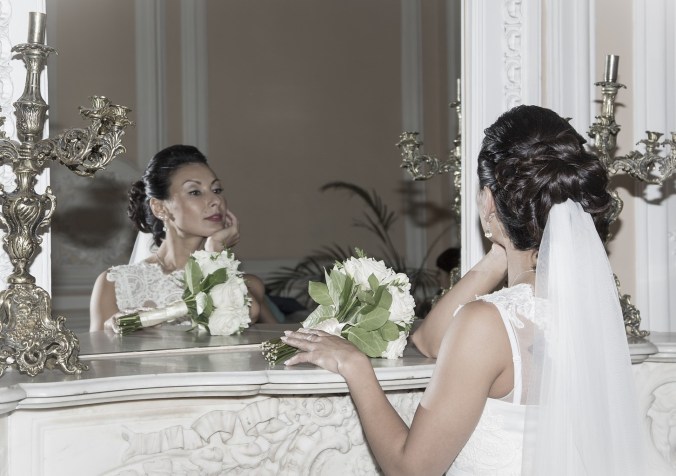
If God has forgiven all of our sins for Jesus’ sake, if he has declared that not a single mistake stands against us, then we must look different to him than we did before. This is why he starts referring to us with terms of endearment like “children,” or terms of respect like “saints,” in the Bible.  It’s not that we have stopped sinning, or that our old sinful nature is any less real, or any less bad, but with all our sins forgiven God holds a different image of us in his mind now.

And he invites us to start looking at ourselves the way he sees us. Peter says that you are a chosen people. That is a powerful statement of how God feels about us. Why is it that children take it so hard when they are chosen last for a team, or not chosen at all? Why is it that adults take it so hard when they lose an election? Is it not because there are feelings of rejection here? It seems as though nobody likes us or wants us. Our election by God is more than a cold, hard fact, like some mathematical principle. We are people that God wanted to be his own. We are the desire of his heart.

You are also a royal priesthood. To have God declare us royalty makes all the difference in the world. Royalty rules. God’s royalty rules all things. It isn’t always obvious to us, it isn’t even usually obvious to us, but as God’s royalty we rule and all things serve us–all things! Jesus promises his kings and queens by faith, “Do not be afraid, little flock, for your Father has been pleased to give you the kingdom.” Paul assures us, “We know that in all things God works for the good of those who love him, who have been called according to his purpose.” The letter to the Corinthians pledges, “All things are yours, whether Paul or Apollos or Cephas or the world or life or death or the present or the future–all are yours, and you are of Christ, and Christ is of God.”

As royalty, nothing and no one stands above us in our relationship with God. As priests, no one stands between us and God. Each and every priest, each and every Christian, can take his needs, or his requests, or his service to God directly since Jesus has given us all direct access to the Father.

Again, by forgiveness and faith, you are a holy nation. You are purer in God’s eyes than the most sterile environment on earth could make you. And not only has the last whisper, the last trace of impurity been removed by Jesus’ holy blood, but as a holy nation you have also been set aside by God for his special purposes. There is nothing common, or ordinary about any of you. Do you have dishes at home that only come out for a very special meal, clothes in your closet that only come out for a very special occasion, heirlooms you use only under special circumstances? In a similar way God has made you his holy nation not for any run of the mill purpose in his creation, but to be holy means to be set apart, and the special purpose for which God has set you apart will be made more clear in just a moment.

Peter concludes his list by calling you a people belonging to God. God looks at you as his own treasured possession. Cruel images of slavery may get in the way of appreciating the privilege of belonging to someone else, so think of God’s claim on you this way: When children have a favorite toy, what do they do? They put their name on it and you drag it along everywhere they go. When adults have some favorite tool or utensil, what do they do? You put their name on it, and guard it a little, and don’t lend it out very willingly. Or this is even better: if you can find that one other person with whom you would like to share the rest of your life, what do you do? You put your ring on his or her finger. You claim him or her for life. You treat this one as your most treasured possession. When Jesus found you he put his name on you, and made you a Christian, and now he treats you like the dearest thing he has in all the world.

This new identity, this new image that God has given to us by grace, is not merely a potential. It is not something he hopes you will become someday. In Christ, by faith, this already is the Christian’s new look.

The People of God

Fantasia-Heaven

1 Peter 2:10 “Once, you were not a people, but now you are the people of God; once you had not received mercy, but now you have received mercy.”

The people to whom Peter was writing these words were Gentiles. They were scattered through Roman provinces like Pontus, Galatia, Cappadocia, Asia, and Bithynia, areas that make up the modern nation of Turkey. Like us, each of these Christians had grown up as part of a certain family, a certain race, and a certain nation. They had a history and a culture that bound them together with other people. No doubt they took pride in the nation of their birth. How could Peter say that they were not a people?

Let’s look at this from God’s point of view for a moment. In the past there had been nothing that united these individuals from Pontus, Galatia, Cappadocia, Asia, and Bithynia with each other, with the possible exception that by nature they were all God’s enemies. There was nothing about being born a Cappadocian, or a Bithynian, that made you any closer to God. Whether individually, or as citizens of their native land, to God they were simply part of that great mass of people who followed idols. They were lost. Before God, they were nobodies.

Now let’s update the setting to our own day for a moment. Many who are reading this are citizens of the United States of America. There is nothing wrong with appreciating the fact that you are a citizen of one of the most powerful nations on earth, the land of the free and the home of the brave, the great melting pot. But none of this means anything to God. I used to live in Texas. There was a joke about a phone call from Texas to heaven being cheap, because it was a “local” call, not long distance. There may be very good civic reasons for taking a certain pride in the state of one’s birth or residence, but Texas is no closer to heaven than any other spot on earth. (I am sorry if that comes as a surprise or disappointment to some of you). Other points of pride get us no closer to the Lord. It makes no difference to him that your grandfather was a minister, or that you are a shirt-tail relative of the president, or that you graduated with the highest GPA in your class, or that you have a six-figures income.

Why? Jesus once told Nicodemus, “Flesh gives birth to flesh, but the Spirit gives birth to spirit.” Our flesh and blood birth or existence doesn’t make us spiritual children of God. Regardless of who we are or where we come from, by birth we are no different than members of Al-Qaeda, or shooters who commit mass murder at an elementary school, or any number of other sinister characters. To God we were not a people. We were lost. We were nobodies.

So what’s God trying to do, damage my already fragile self-image? In one sense, yes. He wants to destroy it altogether. But in another sense, no. He simply wants us to stop trying to find it in the sinful and prideful places we go looking all too often.

You see, Peter reminds us, “Once you were not a people, but now you are the people of God; once you had not received mercy, but now you have received mercy.” Now you and I are God’s people. Now you and I have been shown mercy. Now we are somebodies! Jesus has made us very important persons (or people) in God’s eyes. When he redeemed us from our sins at the cross, he did more than free us. He claimed us. He made us citizens of a better country, a heavenly one (Hebrews 11:14-16). He made us members of his own noble family. It is not arrogance to say that this citizenship and this family truly are better than any other on earth. It’s not bragging. It’s just a fact.

We wear this new status with humility since we know God took us from nothing. Our place among God’s people is purely a gift. Still, this new identity belongs to us now, and it is only proper that we embrace it, enjoy it, and put it to use. It is no small honor to be the people of God.