An Unlikely Success

RIP

Judges 16:29-30 “Then Samson reached toward the two central pillars on which the temple stood. Bracing himself against them, his right hand on the one and his left hand on the other, Samson said, ‘Let me die with the Philistines!’ Then he pushed with all his might, and down came the temple on the rulers and all the people in it. Thus he killed many more when he died than while he lived.”

At the end of his life, Samson performed one last act of great strength. He didn’t do this for himself. He didn’t ask for his sight back. He didn’t ask to go free and continue to lead Israel after he’s was done. He realized that what he was about to do would take his own life. But he was willing to make the ultimate sacrifice–as Lincoln described the soldiers at Gettysburg, “to give the last full measure of devotion”– to defend his nation and deliver a crushing blow to the enemies of Israel.

You see, the Christian faith is not a scheme to make our earthly lives easier, a way to manipulate God into giving us whatever we want here and now. Sometimes it actually makes our lives harder. Wherever the gospel renews faith and restores spiritual strength, it frees us from our attachment to this world and its treasures. It releases us from our petty, selfish concerns. It inspires us to serve, to sacrifice, for the one who made the ultimate sacrifice for you and me.

And when weak servants find the faith to lean on God’s strength and live sacrificially, the Lord produces success. “Thus he killed many more when he died than while he lived.”

Does this seem like a sad ending to the story–the death of Samson with his Philistine enemies? Is it a strange measure of success to say that this life ended in success–a blind prisoner who died with 3000 people when a building collapsed? Sounds more like a tragedy, doesn’t it?

In order to see the success, we have to see death from God’s point of view. “Precious in the sight of the Lord is the death of his saints,” states Psalm 116. “For me to live is Christ, to die is gain,” is the faith that Paul expresses in Philippians chapter 1. “Blessed are the dead who die in the Lord from now on,” the voice from heaven says in Revelation 14. When the Lord has brought someone all the way through life to die in faith, as he did with Samson, that’s success. That means heaven and never ending life for those who believe. That’s why our Christian funerals are about victory and celebration of life even more than they are about grief and loss.

But most of all they are about the gracious work of God. A highly decorated life that ends without faith is a tragedy. An unsteady and disappointing life that ends clutching to faith in God rates an ultimate success.


Made Weak to Find New Faith

Boy-Bible-Prayer

Judges 16:26-28 “Samson said to the servant who held his hand, ‘Put me where I can feel the pillars that support the temple, so that I may lean against them.’ Now the temple was crowded with men and women; all the rulers of the Philistines were there, and on the roof were about three thousand men and women watching Samson perform. Then Samson prayed to the Lord, ‘O Sovereign Lord, remember me. O God, please strengthen me just once more, and let me with one blow get revenge on the Philistines for my two eyes.’”

On whom is Samson depending now? If you follow his life until his capture, we see an impetuous man who simply does what he is inclined to do. He acts like a spoiled child without much concern for God or others. Now we see something different.

Commentators disagree on whether his request for revenge for his eyes is legitimate and godly in light of the fact that the Philistines were the idolatrous enemies of God’s people, or whether it is more of Samson’s selfishness and pride looking out for himself. It’s not a question we need to settle. It’s hard to play psychologist 3000 years after the fact. No one is suggesting Samson became sinless in the end. But he is changed. For the first time recorded, he is seeking God’s will before he acts. He is acknowledging the Lord as his strength. Here at the end, the Lord has renewed Samson’s faith.

How was God working here? How come Samson didn’t just become a bitter and defeated prisoner? From his new perspective of humility, Samson not only saw himself more clearly. He could see the Lord more clearly. He saw more than a mighty Spirit who gave him superhuman strength. He saw a gracious and forgiving God who had patiently dealt with Samson’s headstrong and self-motivated ways. He saw a God who had not abandoned him after so many sinful choices and the reckless disregard of God’s commands. He saw a God who even now had spared his life.

What we need in our weakness is not an infusion of otherworldly power. Like Samson, we need a clearer vision of God’s forgiving grace. We need him to answer the prayer of the old hymn Abide with Me, “Hold thou thy cross before my closing eyes. Shine through the gloom and point me to the skies.”

And he does. In the cross, in the preaching of Jesus Christ and him crucified, our Lord continues to smile on us with his forgiveness and grace. There we see our whole lifetime of sins, no matter how often repeated, no matter how selfish or hurtful, paid for and disposed of by Jesus’ sacrificial death. There we see why he has been so patient with us, why he doesn’t treat us as our sins deserve, why he even seems to treat us as though he sees no sin in us at all.

For Jesus’ sake, God doesn’t see our past anymore. He points us to the skies, where our vision isn’t blurred by or pride, or darkened by misery and sin. Our sight is focused by his love, brightened by his grace, and heartened by his promise of unending life to come. That’s how the Lord renews our faith, a faith has stopped depending on ourselves to depend on him.

Made Weak to be Made Strong

Tired Hikers

Judges 16:23 “Now the rulers of the Philistines assembled to offer a great sacrifice to Dagon their god and to celebrate, saying, ‘Our god has delivered Samson, our enemy, into our hands.’”

You know the stories of Samson’s great strength, don’t you? He tore an attacking lion apart with his bare hands. He killed a thousand Philistine soldiers with the jawbone of a donkey. When tied with ropes, he broke them like they were threads. He tore the city gates of the city of Gaza right out of the city wall. As a result of his great feats of strength, Samson came to think that he was invincible. He lost sight of the fact that his real strength came from God.

That’s where the story of Samson and Delilah comes in. He let her nag him into revealing the connection between his hair and his strength. After she shaved off all his hair in his sleep, and he woke up to the threat of his Philistine enemies, he thought, “I’ll go out as before and shake myself free.” You see, he thought his ability was all him. He did not realize that the Lord had left him, and with the Lord went his strength. That’s foolish pride. That’s why Samson was now the weak and blind prisoner of his enemies. But the spiritual weakness he displayed was even worse.

Samson’s arrogance hurt more than just himself. God had given him his strength so that he could lead God’s people Israel and protect them. It wasn’t just to serve Samson. It was a gift, so that the man could serve others. It was a gift Samson had squandered in astounding ways, and that put God’s people in danger. Even the Lord’s own reputation took a hit because of Samson’s conceit. To the Philistines, it appeared as if their false god, Dagon, was even greater. “When the people saw him, they praised their god, saying, ‘Our god has delivered our enemy into our hands, the one who laid waste our land and multiplied our slain’” (Judges 16:24).

Your strength may not be raw physical power. It may be outstanding intellectual gifts, social and interpersonal gifts, monetary gifts, artistic gifts and gifts of craftsmanship, musical gifts, or technological gifts, just to name a few. It is good and right that we recognize these things, thank God for them, enjoy them, and put them to good use.

But how easy it is for us to slip from recognition to pride! These have all been given to serve. It’s not all about me. We do more harm than good if we squander our various gifts on self, if we let them fill us with a false sense of superiority, if we develop an empty belief in our own invincibility. God can take them all back in an instant, just like he did with Samson. Prideful and selfish use of our gifts only divides and impoverishes Christians, obscures their witness, strengthens the case of their critics, and damages God’s own reputation. Such pride is death to our own souls, a danger to our Christian brothers and sisters, and a huge obstacle in our attempts to reach the lost. God have mercy on us when we believe his gifts are our creation!

God did have mercy on Samson. He taught him humility. But the lesson required a rather severe mercy. “While they were in high spirits, they shouted, ‘Bring out Samson to entertain us.’ So they called Samson out of the prison, and he performed for them” (Judges 16:25). In his mercy, the Lord stripped Samson of his delusions of independent and irrevocable strength. His eyes had been put out by his captors. He was imprisoned. The man who once killed 1000 men with the jawbone of a donkey was given a donkey’s task of pushing a millstone to grind the Philistines’ flour–walking in endless circles day after day. Samson was forced to become the butt of their jokes, an unwilling court jester, a reluctant performer who could not escape the shame of his fall from power and grace. The Lord was teaching him humility. It was necessary if this weak servant was going to find new strength to serve him.

We rarely think of shame as a good thing. It almost always comes as a result of some great sin or failure on our part. Those who impose shame on others mostly do it with a mean spirit, like the Philistines did. But the shame itself can be a tool God uses to serve us. Like pain, shame forces us to notice that something is horribly wrong, something that must be corrected. It makes us see our sinful weaknesses. It teaches us humility. It prepares us for God’s greater work, the work of showing us his grace and forgiving our sins. Then we are ready to receive his greater gifts, and in the gospel weak servants like you and me find strength to serve him once again.

See His Deliverance

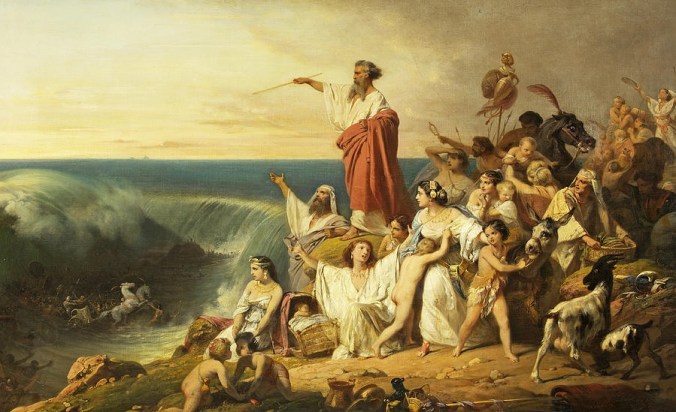
Red Sea

Exodus 14:13 “Moses answered the people, ‘Do not be afraid. Stand firm and you will see the deliverance the Lord will bring you today.’”

“Do not be afraid.” Even before delivering these people from the Egyptians, the Lord wanted to deliver them from their fears. How many times don’t we hear the Lord or his agents express God’s intention to take our fear away? “Fear not!” the angels say to the shepherds at Jesus’ birth, or the ladies at his tomb. “Don’t be afraid,” Jesus told the disciples just before he invited Peter to get out of the boat and walk to him on the water. The author of Hebrews tells us that Jesus came to free us from our fear of death, by which the devil has kept us in slavery to him.

Isn’t that the nature of the God we worship? Fear can be a very effective tool if you want to control someone else. How many evil dictators haven’t used that truth to stay in power? That also explains why Christianity is rarely welcome in their countries. Although Christian faith generally produces obedient citizens, it is hard to control people who have been freed from their fears.

But with fear, control is all you get. You do not trust someone you fear. You certainly cannot love them. Because our Lord wants to live with us in a relationship of trust and love, he comes to take our fears away. He does not stop at alleviating the fear of our enemies. He removes the terror he himself could hold over us. While he still promotes fear in the sense of respect, he wants us to know that he loves us. We can come to him with confidence, as we would go to a father or friend.

For God’s Old Testament people, this very story of God’s deliverance at the Red Sea would become the gold standard for understanding that the Lord was someone they could trust and love. He cared about them and delivered them. They didn’t need to be afraid every moment of their lives. For us, the life and death of Jesus reveals just that much more clearly that the God of all grace delivers us and frees us from our fears.

Deliverance from fear comes just because he delivers us from our enemies. Moses continues, “The Egyptians you see today you will never see again.” I think you all know how this story ends. Israel walks through the middle of the Red Sea on a dry path that miraculously appears in the middle of the waters. But when the Egyptian army tries to follow them, the waters close in and drown them all. The Lord turned an impossible situation and certain death into complete victory and deliverance from their enemies.

For us, the great story of God’s salvation lifts our eyes to a cross where our God is hanging in indescribable anguish, dying for our sins. It looks as though he is suffering total defeat at the hands of his enemies. Then we see that Jesus lives again, body and soul, the conqueror of sin and death. His grave is empty, his fight is finished, his victory is secure. As a result, it’s not the Egyptians, but the sins you see today that you will never see again. Christ has taken them away, drowned them in the waters of your baptism, freed you from their slavery, locked them away in your past where they can never trouble you again. He has turned death into a safe path through the skies, leading all the way to the safety of heaven. None of your enemies can follow you there. The same death that brings you deliverance washes over them bringing only defeat.

And as with Israel, God does everything for us in his grace. “The Lord will fight for you; you need only to be still” (Exodus 14:14). Not a single Israelite drew a sword in the crossing of the Red Sea, or shot an arrow or threw a spear. That’s still how his saving gifts work. He gives us forgiveness. He gives us eternal life. He gives us the very faith that receives it. He gives us patience to endure hardship, wisdom to turn to him, and peace that he will turn all things for our good. “I can do all things through him who gives me strength” (Philippians 4:13).

A little proverb about life and success says, “It’s not what you know. It’s who you know.” That couldn’t be more true if who you know is the Lord. Look to him, and he will deliver you.

Look Higher

Looking Up

Exodus 14:10-12 “As Pharaoh approached, the Israelites looked up, and there were the Egyptians, marching after them. They were terrified and cried out to the Lord. They said to Moses, ‘Was it because there were no graves in Egypt that you have brought us to the desert to die?’ What have you done to us by bringing us out of Egypt? Didn’t we say to you in Egypt, ‘Leave us alone; let us serve the Egyptians’? It would have been better for us to serve the Egyptians than to die in the desert!”

What could a nation of slaves and shepherds do against the experienced army of Egypt and its chariots? Attack with their sheep? Hope that their goats might chew the Egyptians to death? In spite of the miracles they had seen the Lord perform in Egypt, they were convinced that now they were going to die.

Are we free from such a defeatist attitude? We, too, paint doomsday scenarios because our enemies and obstacles look bigger than us. That might seem like a perfectly logical reaction if it weren’t for one thing: We aren’t fighting alone. Is anyone or anything bigger than our God? If we lift our eyes and look a little higher than the problems sitting in front of us, we will find the comfort of having him on our side. All the fear and terror and despair our various enemies show us will melt under his love and promises.

But the more convinced we are that we are going down in defeat, the more the blame game gets going. “What have you done to us by bringing us out of Egypt? Didn’t we say to you in Egypt, ‘Leave us alone; let us serve the Egyptians?” Really? Is that what they said? Exodus chapter 2 records them singing a different tune. “The Israelites groaned in their slavery and cried out, and their cry for help because of their slavery went up to God” (2:23).

So it is that just when we need each other the most, when we should be pulling together and working as a team, our failure to look to the Lord drives us apart. History is littered with examples of families fractured in the face of enemies like life threatening diseases or financial hardships. Instead of pulling together, they blame each other for their misery. Churches are pulled apart when members fail to rally together to tackle moral issues or meet their stewardship challenges. Too much time is spent on who’s to blame, too little on how to fix it. Alone against our enemies, divided by fear and accusation, all we can see is defeat.

Worse still, we are tempted to stop following God’s plans. “It would have been better for us to serve the Egyptians than to die in the desert.” Stop and think about what they were saying. Who had led them into this predicament? Maybe it didn’t seem sensible, humanly speaking, to journey out into the desert until they were pinned against a vast body of water with the chariots of Egypt hot on their tail. But hadn’t they been led to just this spot, to just this situation, to just this time and place by the Lord himself? He led them into this mess. Couldn’t he be trusted to lead them back out?

If we will only lift our eyes, and look a little higher than the enemy that is staring us in the face, we will be able to see the wisdom of doing it God’s way. If we bolt and run, if we abandon God’s plans for our lives, no matter how strange or hard to understand, our faith becomes easy prey for the Archenemy.

But God’s grace can remove the weight that is holding our heads down and keeping us from looking to him. It can lift our heads to see that the Lord is working on our side. And when we look higher, he shows us deliverance. He doesn’t abandon us though we are tempted to abandon him. He hasn’t given up on us though we have rebelled against him. We are his children. He paid dearly to make us his own. He has no intention of losing us now.

And he can use the very obstacles we face as the means to save us. Look up! Deliverance is on its way.

Beware the Love that Loses

Greed-Eye

1 John 2:15-17 “Do not love the world or anything in the world. If anyone loves the world, the love of the Father is not in him. For everything in the world–the cravings of sinful man, the lust of his eyes, and the boasting of what he has and does–comes not from the Father but from the world. The world and its desires pass away, but the man who does the will of God lives forever.”

What does John mean when he talks about the things in the world? These are things that appeal to our senses. We associate cravings with food, maybe also sex. But other senses may be involved. For our hearing there are music or stories. For our smell there are colognes and perfumes. For “the lust of our eyes” there are the beautiful form of the human body, the exotic sights of faraway places, and the entertaining displays of talent that take place on the stage, the silver screen, or the athletic field.

In their proper place and amount, none of these things is wrong. But as the cravings of sinful man they become perverted. They are separated from their useful purpose. They are made the center of all life, the purpose for living. When satisfying these cravings and desires, even the wholesome ones, becomes the reason for getting up in the morning, the focus of our lives, then we lose our focus on the love of God who sent his Son to save us.

C.S. Lewis once illustrated the danger John is describing this way: “One great piece of mischief has been done by the restriction of the word Temperance to the question of drink. It helps people to forget that you can be just as intemperate about lots of other things. A man who makes his golf or his motorcycle the center of his life, or a woman who devotes all her thoughts to her clothes or bridge or her dog, is being just as ‘intemperate’ as someone who gets drunk every evening. Of course, it does not show on the outside so easily: bridge-mania or golf-mania do not make you fall down in the middle of the road. But God is not deceived by externals.”

It’s not as though these two competing loves–the world or the Lord– are simply different but equal choices. They end in two vastly different ways. “The world and its desires pass away, but the man who does the will of God lives forever.”

The world and its desires pass away. Do we need much convincing? A house will last a long time, but it requires constant maintenance. I used to store my favorite music on vinyl platters. We called them “record albums” for those of you born after the 1980’s. Then came compact discs. Today it’s microchips no bigger than the size of your fingernail. They say our computers become obsolete in only about 18 months. Cell phones last about 2 years. If our clothes don’t wear out they go out of fashion.

If we attach our hearts to the world and its things, we will share the same fate. Driving past a cemetery near Fredericksburg, TX, many years ago, I was struck by its size. It stretched along the highway for nearly a mile. Fredericksburg isn’t a very large town– only about 10,000 people. But marker after marker in the cemetery tells us that thousands more have died there over the years. Death is not the absolute end of our human existence, but for those who die in love with the world, what follows is not better.

“But the man who does the will of God lives forever.” John isn’t saying that doing God’s will is the way to receive eternal life. But those who are going to live forever become the kind of people who do God’s will. Putting our hope of eternal life in our own actions, our own love, even our own act of believing, is just another form of worldliness.

But God loves you so much that he gave the only Son he had to rescue us from the world and save us from ourselves. Jesus gave up heaven, every divine privilege, his own comforts, and finally his own life on the cross to give us the forgiveness of sins. This was purely an act of love on his part because he did it all for free and demanded nothing of us in return. He left no requirement for our salvation unfulfilled. He left no features of God’s plan incomplete. He left no conditions that we have to meet. It was pure, unconditional love. And since every sin has been forgiven in its entirety, sin can no longer condemn us. We are going to live forever. Someday we will be buried in a cemetery like the one I passed in Fredericksburg, but even after death, we will rise to live a life that never ends. The world can’t give you life like that.

There’s only room for one first love in our hearts. Let it be the God and Savior who gave us first place in his.

I Want You to Know…

Secret

Acts 13:38 “Therefore, my brothers, I want you to know that through Jesus the forgiveness of sins is proclaimed to you.”

Forgiveness was the heart and center of everything Paul preached and taught. He understood that everything else in the Christian message hinged on this one central truth. Today, it is still your pastor’s earnest desire for you to know Jesus forgives.

“But pastor,” you may think to yourselves, “we hear it all the time. We already know that Jesus forgives.” Do we? The Greek word for “know” here is a word which means more than learning information. It is more than the head knowledge we gain from hearing or studying something. This is knowing that involves our head and heart and whole person. This is a more intimate knowing, a knowing that involves personal contact. This is knowing that changes us.

How might lives be different for people who know–this kind of deeper knowing–that Jesus forgives? When someone does something really thoughtless and inconsiderate, something that puts you out and creates a huge inconvenience for you, how would you react? It could be someone cutting you off in traffic and making you miss your exit. It could be someone not showing up when they promised. It could be someone leaving you with all the work, or making more work for you. How would you react?

I commit countless sins every day. My sins didn’t merely inconvenience Christ. They cost him his life. They hung him on a cross. Still, Jesus forgives. He doesn’t get so irritated that he rips us up one side and down the other. He doesn’t develop an attitude or go off and sulk. He doesn’t subject us to the silent treatment. He forgives. If we know the break that we are given over and over again, day after day–if we take it to heart–might we be not so annoyed at the people around us, not so vindictive? German pastor Friedrich Zundel once noted, “It is no help to an unrepentant one to be annoyed with him. What he needs is seeking love.” How about us? Do we consistently know Jesus’ forgiveness this way?

Or what about when trouble strikes? How easily we despair when misfortune comes. We are out of work and staring at the bills. We have been suffering through some chronic pain, and now we are waiting for the test results, or they reveal an incurable condition. We are being mercilessly persecuted by someone at work or at school. What starts going through our heads? Is God paying me back for something I did? Has he forgotten about me? Has he stopped loving me? Is he going to let me go to my doom? Isn’t he unfairly singling me out for bad treatment? All kinds of fears flit through our minds.

But wouldn’t we know that none of those things is possible if we knew, with all our heart and soul, that Jesus forgives us? After giving up heaven to suffer hunger, and cold, and heat, and rejection; after enduring hell and his heavenly Father’s abandonment; after giving up his life to take away our sins, now he is going to turn against us? Now he is going to let us slip through his fingers?  Martin Luther once said in a Christmas sermon that if we believed Jesus and his grace are ours, then “a man becomes suddenly so strong that to him life and death are the same.” That’s what the Apostle Paul felt when he said, “For to me, to live is Christ and to die is gain.” How can it be any other way if Jesus has taken our sins away and saved us? Maybe we think we know Jesus forgives us. But if we harbor anger and find it hard to forgive, if we struggle with fear and worry about our future, we still don’t know it well enough.

And if we are starting to know it better, then we know that there is no sweeter message in all the world. It’s like a favorite song that strikes a chord inside of us every time it’s played. The first time we hear it, at one and the same time it creates a sense of satisfaction and fills us with a hunger for more. It’s not enough to hear it just once. We could play it over and over again. The only difference is that eventually we may tire of the song. But Jesus’ forgiveness? That we always long for. It’s like the love of a good marriage that matures from the initial infatuation to the steady, dependable, and comfortable support and care of committed partners.

Like Paul “I want you to know that through Jesus the forgiveness of sins is proclaimed to you.” He has removed all your guilt. You stand, at every moment, under a loving God’s grace and mercy. None of us can hear it too much or know this too well.

The Promise Comes by Faith

Heart-Hand-Cross

Romans 4:16 “Therefore the promise comes by faith, so that it may be by grace and may be guaranteed to all Abraham’s offspring—not only to those who are of the law but also to those who are of the faith of Abraham. He is the father of us all.”

If the things God promises are merely rewards for good behavior, then we have little more than a business contract. It is a cold obligation, and nothing more. But if it is a gift we receive by faith, then it expresses God’s grace. Now we have the warm love of God setting his heart on us, choosing us for his blessings, loving us as his own. Then he is giving to us freely, because he wants to, even though we have not given him any reason to do so.

Still more, then we have a guarantee: “Therefore the promise comes by faith, so that it may be by grace and may be guaranteed to all Abraham’s offspring…” If we possessed God’s promises by law, we could never be sure that we would get them, at best. We would live in never ending uncertainty about whether we had done enough, or whether we would blow it in the future. That’s at best. Actually, if we are honest enough to admit our sins, we would be certain that we had lost the promises. Either way, we would live in fear and doubt of God, not faith.

But since the promise comes by faith as a gift of God’s grace, it is guaranteed. God isn’t going to change, and what he does never fails. Forgiveness will never be exhausted. Love will always be our lot. Heaven will always be the home waiting for us at the end of our journey. Then we live in the happy security of children who are convinced their parents love him. They know mom and dad will always give them everything they needs. They never need to be afraid to ask. Even the household rules and discipline, which they may test, are setting loving boundaries around them that keep them safe. They never lose their trust and love for their parents, because the love they give is so certain. Even stronger is the faith God is building in the hearts of those who know that his gracious promises are guaranteed.

Finally, since the promises are possessed by faith, it brings a certain universality to them. “Therefore, the promise comes by faith, so that it may be by grace and may be guaranteed to all Abraham’s offspring–not only those who are of the law but also to those who are of the faith of Abraham. He is the father of us all.” Today we Bible-believing Christians often need to emphasize the exclusivity of Christianity in comparison to all the other religions of the world. Even some Christians ignore Jesus’ words, “I am the way, the truth, and the life. No one comes to the Father, except through me.”

But there is an inclusivity here as well. The road to God and heaven through faith in Jesus is available to all. Since the promise comes by faith, not by keeping the Law, Paul recognized that this bridged the gap between Jews and Gentiles. Wherever there was faith in Jesus, there were children of Abraham, and they all received the same gospel promises once possessed by our common spiritual father. Regardless of race, or gender, or age, they found that faith, not law-keeping, was the key.

That’s still a truth worth making our cause, stirring our passions, even inspiring our sacrifice. God give us the faith to possess his promises, experience their power, and proclaim them to all.

The Problem with Performance-Based Religion

Circus

Romans 4:14-16 “For if those who live by law are heirs, faith has no value and the promise is worthless, because the law brings wrath. And where there is no law there is no transgression. Therefore, the promise comes by faith…”

God’s law is good for the purposes he gave it, as Paul confirms later in his letter to the Romans 7:7, 12). But if keeping God’s law was the only way to possess God’s promise, that would introduce some big problems.

The first problem would be this: “For if those who live by the law are heirs, faith has no value and the promise is worthless.” If God’s promises are something we possess through keeping the law, then we have lost the promise, and it does us no good for God to make it. If I said to my children, “I will take you out for ice cream, but first you must solve this problem in quantum physics,” or “first you must play this Paganini violin concerto flawlessly,” or “first you must dunk this basketball,” what would be the use? It would be a waste of my breath. The promise would be useless to them. My children have their own gifts, but none can do any of the things I just listed. If God were to say to us, “You can have my promises when you keep all my commandments,” He may as well just say, “You can all go to hell.” We don’t keep his law. That’s is just the reason that we need his promises of grace and forgiveness.

The second problem is this: far from bringing sinners like us closer to possessing God’s promises, the law produces the opposite: “…because law brings wrath.” The law itself isn’t a bad thing, but it doesn’t make for a happy relationship between God and man. People get mad at God because his law puts things off limits that they want. They get mad that God demands a perfect keeping of his law that they can’t achieve, like Jesus said in the sermon on the mount: “Be perfect, therefore, as your heavenly Father is perfect.” Thomas Jefferson said, “That kind of God is a monster.” Unitarian minister William Channing said, “The God of the Bible is the kind of a God in whom we ought not to believe. We could not believe if we wanted to, and if we do we ought to be ashamed of ourselves.”

On the other side, our law-breaking makes God mad. Back in chapter one of this letter Paul had begun this whole discussion, “The wrath of God is being revealed from heaven against all the godlessness and wickedness of men…” God’s wrath is not exactly what we hope to obtain.

Is that any less important for us to understand today than in the past? Is this any less practical for Christian faith and life? One popular Christian author would like to skip past this kind of theology and get right to the details of daily life. “I’m not called to…expound on deep theological doctrines or disputes that don’t touch where people live,” he says. But doesn’t this touch us right at the source of Christian life? We can talk until we are blue in the face about good behavior, but what good will it do if we don’t understand its failure to bring us closer to God and his promises? We may as well try to teach people how to breath in outer space without a space suit. That’s the problem with performance-based religion. The law lacks the power to enable us to claim and enjoy God’s promises.

If not the law, then what? Faith fits the bill: “Therefore, the promise comes by faith.”

A righteousness that comes by faith is a righteousness that starts outside of us. It is not an innocence, an absence of guilt, we produce. Then we would be back to keeping a law of some kind. It is something we receive. It begins outside of us. Everything that I have ever received existed outside of me before I ever received it–gifts, money, applause, affection. The same is true of God’s gift of righteousness. Jesus produced it on the cross before I even existed. There, the forgiveness he purchased produced a sinless image of me that God gives as a gift. When God led you and me to faith, that sinless image became our very own. And with that gift comes every other promise he has made.

It is faith in Jesus’ performance—his perfection and sacrifice—that makes us confident God’s promises belong to me.