Mark 4:40 “He said to the disciples, ‘Why are you so afraid? Do you still have no faith?’”
There is a tone of accusation in Jesus’ question to the disciples who endured the storm on the Sea of Galilee with him in the boat. He isn’t merely asking them why they experienced the emotion of fear. That, I suppose, is clear enough. He is accusing them of being cowards in the Greek. That is a moral failing, not just an emotional one. Deadly storm or not, Jesus expected more of them.
If you are like me, your sympathies may lie more with the disciples on this issue at first. Their reaction didn’t seem so extreme considering the circumstances. We may wonder how Jesus could have expected more of them when the boat was about to sink.
The answer lies outside the story. They heard Jesus speak so many promises. They watched him perform so many miracles. By this time they had seen him command demons, heal the sick, and raise the dead. He had promised to make them fishers of men. Was he just going to let them die without fulfilling his promise? Did they believe his promises or not? Did they believe he was the one he claimed to be or not?
The words he spoke had the power to stop this storm. Didn’t they have the power to change their hearts as well? Didn’t they have the power to convince them that yes, Jesus cared, even if it looked like they were about to drown?
Jesus’ words, his promises, are still the secret to maintaining our trust in him, though it looks as if our problems are going to sink and drown us. Would he lay down his life to pay for our sins if he intended to hurt us? Would he suffer all he did to save us and then decide to stop working for our good, when it costs him nothing additional to offer his continued help and care? Is he less powerful now that he has returned to heaven?
Jesus has promised to save you, forgive you, and raise you to eternal life. He promises to be with you, to make you strong, to rule the universe for your good. In short, he promises to love you. You know that he does. Have faith. We have every reason to believe that he cares.
Mark 4:39 “He got up and rebuked the wind and said to the waves, ‘Quiet! Be still!’ Then the wind died down and it was completely calm.”
If what Jesus did hadn’t worked, perhaps the disciples would have been concerned about his sanity. Here he is, talking to the storm. It isn’t a person. It has no ears. Jesus isn’t dealing with an unruly teenager whose party got out of control, so now he acts as the stern parent.
It reminds one of the earliest chapters of the Bible. The Maker of the Universe speaks to the world he is making, and things happen. Light, and land, and plants and animals appear. The surface and the skies and the stars get themselves organized.
You see, God’s word is more than an intriguing set of ideas, a collection of timeless truths, a convincing argument in a spiritual debate, or a Jewish take on ancient Middle Eastern history. It is a power. It is a force. It accomplishes what it says.
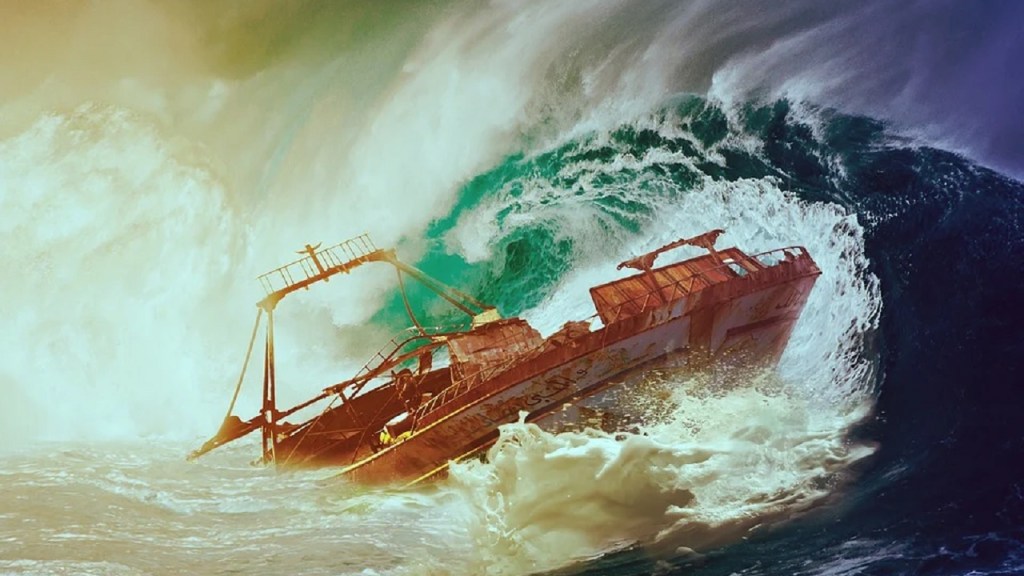
So we see with the storm. The wind died down. Mark’s Greek pictures something quite dramatic. The winds didn’t blow softer and softer until there was just a gentle breeze. No, the winds stopped dead. One moment you have the kind of driving, damaging winds that get our weathermen to interrupt your regular programming. The next moment there is a dead calm. The air is still. One moment the waves are so high they are breaking over the sides of the boat and filling it with water. The next instant Jesus and his disciples are floating on a sea of glass. This was no natural passing of the storm. This is the power of every word God speaks.
What, then, does this tell us about the man who had been sleeping in the boat? The disciples asked the question, too: “Who is this? Even the wind and the waves obey him.” That can be only one person. This isn’t a great prophet requesting God’s help and getting a miracle, like Moses when the Red Sea parted. This is the one who gives the command directly, “Quiet! Be Still!” The wind and the waves obey him. The one they called their teacher, the one you call your Savior, is the God who controls your world.
He still controls your world. The storm you fear so much, that has you feeling so helpless, that has you wondering whether Jesus cares, no matter what kind of storm it is, is still a storm he can turn off in an instant. He promises, “All power in heaven and on earth has been given to me.” He sits at his Father’s right hand in glory. He rules all things for the good of his church. That’s you! Maybe it looks as though everything is out of control. But Jesus still controls every moment you live, every experience you have.
Sometimes the storms will soak you to the bone. You will get a mouth full of sea water in the process. But Jesus is still in control, and he will not let you be lost.
If there is one idea, one concept, associated with the United States of America, it is freedom. Years ago I had a lengthy conversation with a woman from another country who wondered why the United States didn’t have stronger social programs. Why was there such resistance to socialized medicine? Why didn’t the government mandate more maternity and paternity leave? Why should college students have to pay for their own tuition? Didn’t these things make life better for everyone? Wouldn’t we all feel more safe and secure?
Perhaps she was right about feeling safe and secure. I didn’t debate the relative advantages and disadvantages of the government programs for which she was advocating. But I could point out that the great vision that captured most Americans’ hearts and minds was freedom. Our national anthem doesn’t celebrate “the land of the secure and home of the safe.” It calls our country “the land of the free and the home of the brave.”
Freedom also lies close to the heart of the Christian faith. It is, we should remember, a different kind of freedom than that enshrined in our political documents. It is not the liberty promoted in The Declaration of Independence or protected by the U.S. Constitution. It is not a guarantee that we will be able to speak as we wish, worship as we wish, or gather with whom we wish without being molested. It does not protect us from unreasonable intrusion and treatment by our criminal justice system. It is a freedom the Christian enjoys, that cannot be taken away, even if an oppressive government denies us all the freedoms of life and citizenship we have come to expect.
Jesus provides this indestructible freedom through “the truth.” This isn’t truth in the abstract. He isn’t promising that correct knowledge will free you and empower you to make correct decisions. That may often be true, but these are neither the truth nor the freedom with which he is concerned.
Nor is he commenting on the importance of telling the truth as opposed to obscuring it with lies. It may be true that telling lies constructs a prison of our own making around us. The more we lie, the more fear of exposure imprisons us. Keeping our story straight becomes increasingly difficult. Telling the truth may free us from the trap our lies have created, but Jesus has something else in mind when he promises, “The truth will set you free.”
The truth Jesus promotes is the gospel of grace. The freedom he offers liberates us from sin and death. In his next breath he told the Jews to whom he was speaking, “Everyone who sins is a slave to sin.” But the truth will set you free. It does more than uncover a path to freedom for us to navigate on our own. It picks us up and carries us to freedom in its own arms. It delivers us. In the opening verses of his Revelation, the Apostle John praises Jesus because he loves us “and has freed us from our sins by his blood.” The writer of Hebrews assures us Jesus became a man to “free those who all their lives were held in slavery by their fear of death.” This gospel not only sets us free. It is a gift, a blessing God provides for free.
As American Christians celebrate Independence Day, we thank God for the freedoms that allow us to live our faith and share it with relative safety and ease. But even if these freedoms fail, Jesus’ truth has set our souls free. No government or power can take that freedom away.
Mark 4:37-38 “A furious squall came up, and the waves broke over the boat, so that it was nearly swamped. Jesus was in the stern, sleeping on a cushion. The disciples woke him and said to him, ‘Teacher, don’t you care if we drown?’”
Radio personality and consumer advice expert Clark Howard (now retired) coined the phrase, “customer no-service.” It refers to the lack of help on the other end of the phone. I’m sure you are familiar with this scenario: You dial the help number, and you get a pre-recorded voice. It provides a menu of choices for different situations. Each number takes you to another menu of pre-recorded choices. Some of those take you to still another set. Where does it end?
Sometimes you talk to a live person, but it is clear they are speaking to you from the other side of some ocean. And they aren’t really listening to you. They are working from a script. Maybe you feel you were making more progress with the robo-voice and the numbers on your phone’s keypad.
There’s nothing worse than being put on hold for the rest of your day, consigned to a purgatory where you have to listen to hours of elevator music while you wait for a person to come back on the line. Does anyone care about my problem? Is customer service actually going to help?
Maybe you have felt the same way about your prayers. You dial up the Lord for help, but it seems as though your request is met with silence. Jesus’ disciples got to that point fighting a storm that was about to sink their boat. Desperate for help, they ask, “Teacher, don’t you care if we drown?”
We never expect Jesus to ignore us. His lack of attention may have surprised the disciples even more. This little boat trip had been his idea in the first place! Have you ever gone on a trip your children were so excited to make that they were already in their seats buckled in while you were still loading the car? Jesus is sitting in the boat, waiting for his disciples to get going.
Do your troubles have that kind of feel sometimes? “Lord, I didn’t do something wrong to end up in this situation. You put me here.” Relationships can work that way. In my ministry I have tried to serve people who fought against the very help they were asking for. They pressured me to do things that weren’t right. And they didn’t go away. “Lord, you put them here. What am I supposed to do?”
Maybe, like the twelve disciples, following Jesus has put you in a place of real physical danger. You might think that Jesus would be quick to come to the rescue then. You wouldn’t expect him to ignore you in your time of need.
But there are other things he has for us to learn. Sometimes our experience, our skill, and our strength are our downfall. The disciples don’t go to Jesus for help immediately. They try to fight this themselves. If anyone on earth knew what to do in a storm on the Sea of Galilee, it was these men. Most of them were fishermen. The sea was their life. This was the very kind of boat they sailed. This was the lake where they had made their living.
When they do turn to Jesus for help, their attitude isn’t confident trust or humble submission. There is a tone of accusation in their voice, implying Jesus doesn’t care. They have lost hope. They are full of despair. They are convinced they are going to drown.
Does it ever seem like Jesus is sleeping in the back of your boat, ignoring you and the storm you are fighting? We want to see his power bailing us out, cleaning up the mess, setting everything right in dramatic fashion. We pray. We plead. Nothing.
We don’t consider that our greater need may be to experience how weak and helpless we are. We sing about it in “Jesus Loves Me, This I Know.” “Little ones to him belong. They are weak but he is strong.” We can read examples of it in a dozen Bible stories. We hear the words directly from Jesus’ mouth. “Apart from me you can do nothing.” But nothing drives the point home like the school of experience. There are no lessons we learn better than the ones we actually live.
And the “I-can-do-it-all-by-myself” spirit is nowhere more dangerous than it is in our spiritual lives. It may be cute when toddlers and preschoolers are trying to be like their parents. It is deadly to faith when children of God think, “I’ve got the power to conquer this sin,” or “I can cope with what life throws at me without growing deeper in prayer and Scripture,” or “my skills and abilities alone will get me through anything.”
Only Jesus saves. He forgives sins, and he alone. He rescues us from the messes we create, and the ones that seem to be foisted upon us. He isn’t sleeping. He is waiting for us to set aside our self-reliance and put our trust in him.
Yes, Jesus cares if you drown. If it seems like he isn’t helping, it’s not because he is ignoring you. He may be letting you see, really see, how much you need him after all.



 Bits of Bread