Scripture Says: “By Faith”

Bible Hold Out

Romans 4:3 “What does the Scripture say? ‘Abraham believed God, and it was credited to him as righteousness.

How do Christians, how do God’s people, settle an issue? It is not a matter of our own opinions, no matter how passionately we may cling to them, nor how loudly we proclaim them. “I think” is never equal to “God says.”

It is not a matter of which position sounds most reasonable or has the tightest logic. God reserves the right to defy our logic. His thoughts are not our thoughts.

It is not a matter of who has the best scientific research. There are more ways of knowing things, more ways of learning the truth, than what comes out of a laboratory. God does not make himself our laboratory rat to be dissected and examined. “How unsearchable his judgments and his paths beyond tracing out.” If personal opinion, human reason, and the scientific method had the final say, most of the Christian faith as we know it would completely disappear.

So no personal opinion, or logical argument, or laboratory experiment would ever lead us to the idea that justifies us by faith. Only Scripture can teach us this. Here Paul tells us what the book of Genesis had to say about Abraham: “Abraham believed God and it was credited to him as righteousness.” God regarded sinful Abraham a righteous man. Abraham received his righteous status from God by trusting him. That is from the first book of the Bible.

The examples don’t stop there. Paul goes on to make the same case for David, who confesses in the Psalms, “Blessed is the man whose sin the Lord will never count against him.” The prophet Jeremiah calls the coming Christ “the Lord is our righteousness” in his book. The prophet Habakkuk says that the righteous live by faith. Jesus says that whoever believes will be saved, whoever believes will not perish but have everlasting life. In each case it is not what we do. God gives righteousness, he credits it, to the person who has faith in him.

We do not have to be ashamed to believe this because the Scriptures say. How else would we know? It is God’s own Word. We do not have to be afraid to believe that we are God’s righteous people, not guilty, acquitted of all our sins. We, too, have received the gift by faith. It’s what the Scriptures say. We are “the man (or woman) whose sin the Lord will never count against him.” We are the ones whose Lord is our righteousness. We are the righteous who will live by faith.

Like Abraham, we believe God, and it is credited to us as righteousness.
Abraham’s Case for Faith

Abraham Sacrifice

Romans 4:1-2 “What then shall we say that Abraham, our forefather, discovered in this matter? If, in fact, Abraham was justified by works, he had something to boast about–but not before God.”

When something is hard to understand or believe, we have to work harder to defend the idea. We have to make a case for it. In our skeptical world, many people question traditional, biblical beliefs. As a result, we have books today with titles like The Case for Christ, or The Case for the Real Jesus, or The Case for a Creator, or The Case for Faith. Books like this try to scrape together all the evidence they can find for the truth they are trying to defend.

Paul makes this kind of defense in the words of Romans 4. In the previous chapter he has led his readers to understand that the only way to be considered righteous in God’s eyes, forgiven all sins, not guilty in God’s court, is by faith in Jesus’ saving sacrifice. No collection of our own good works is ever enough to secure God’s acquittal. Only faith in Jesus’ works and Jesus’ payment gets us off the hook.

This is extremely difficult for people to believe. It goes against all our instincts, all our human experience. Thus, Paul goes on to defend this teaching in Romans chapter 4 by appealing to other biblical evidence for it.

He chooses Abraham as Exhibit A. Why use Abraham as an example? Abraham was considered the father of the Old Testament people of God. Before his time, God had not focused his attentions on one family. But Abraham was called by God in a special way. If anyone was saved, one has to believe that Abraham was.

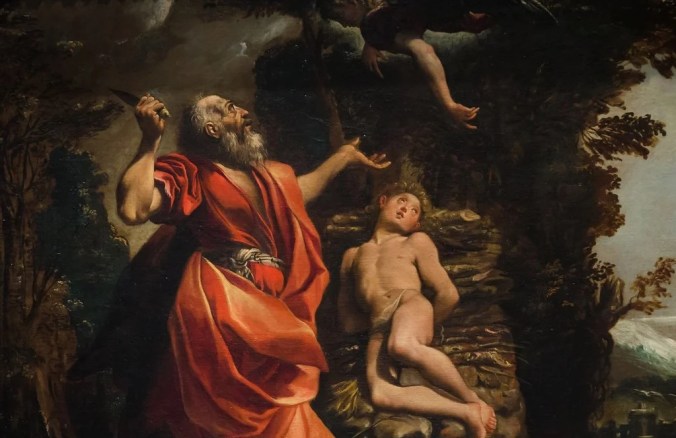
What about Abraham’s life? Was it a godly one? Abraham was generally willing to do what the Lord asked of him. At the age of 75 he moved his entire family 1000 miles from their native country when the Lord told him to go. He lived the rest of his life in tents. He wandered around with his flocks and herds like a man without a country. Note that this wasn’t camping trip for a couple of weeks. It was his way of life for more than 100 years. When God told him to be circumcised at the age of 99, and all of the males in his household with him, he raised no objection. When God asked him to sacrifice his only son as a burn offering, Abraham was ready to follow through.

Compared to most people, Abraham did some impressive things. He was obedient when many people would have been complaining about God’s program. As Paul says, “If, in fact, Abraham was justified by works, he had something to boast about.” He was no ordinary man.

But he was not justified by works. He did not have anything to boast about before God. Abraham also had his obvious faults. Twice he tried to pass his wife off as his sister because he feared powerful men might try to kill him for her. He slept with his wife’s maid in an early kind of surrogate motherhood. Compared to many other people Abraham lived a good life. But his life wasn’t good enough for God to grant him acquittal, to forgive him for his sins.

“I’m a good person” is still one of the first things people say if you ask them why they can be sure they are going to heaven. They still want to make a case for being acquitted based on good behavior.

Even Christians who should know better slip into this kind of thinking. They don’t always make it a verbal claim. They are thinking this way when they want to hold out heavenly hope for some moral unbeliever. If our minds wander during the gospel parts of the sermon that promise God’s grace, that may be a sign we have started to think along these lines. We don’t feel so much need because we don’t see ourselves as being all that bad. As a result, our hearts don’t thrill to know forgiveness is free.

Maybe you and I could build a list of good deeds and outstanding acts of obedience that rival Abraham’s. We are only deceiving ourselves if we pay ourselves the compliment of thinking we are any better. We are living in a delusion if we think we have lived so well we have something to boast about before God. Abraham’s life makes the case that God’s acquittal is credited only to faith. We cannot expect to be exceptions.

God’s Faith in You

Parable Talents Glass

1 Peter 4:10b “Each one should use whatever gift he has received to serve others, faithfully administering God’s grace in its various forms.”

The NIV translation is a little free at this point. “Faithfully administering God’s grace” reads more literally, “a good steward of God’s grace.” As much as it wants to emphasize what you do, it wants to describe who you are even more. When you use your gifts to serve, you are a God’s steward, a good steward who cares for God’s gifts the way he intends.

Stewardship is not a new concept to most of us around the church. In the household of a wealthy man, the steward was the master’s most trusted servant, the one to whom he could entrust everything else he owned. Joseph was the steward in Potiphar’s house. Joseph was responsible for overseeing and taking care of everything Potiphar owned.

It comes as no surprise that God asks us to trust him. No being has ever proved more trustworthy than our Lord who still loves us even when we have despised him, graciously saved us from our sin, and faithfully provides for us every day. What’s not to trust? Peter is right when he says two chapters earlier, “The one who trusts in him will never be put to shame” (2:6).

It beggars belief that God should trust us as his stewards. But that is exactly what he does. And the trust he has placed into our hands affects more than the smooth running of a home or the success of a business. How we use his gifts to serve others, whether we use his gifts to serve others, can affect the eternal fate of the souls he died to save.

Just the same, you and I are his stewards, servants of the living God into whose hands he has placed gifts for the service of his kingdom. And no king has ever claimed a higher title, no celebrity has ever claimed a higher honor, than the one that God has graciously entrusted to us. We are stewards of God’s grace, and that trust is one that ennobles you and me.

Gifted to Serve

Good Samaritan Glass

1 Peter 4:10 “Each one should use whatever gift he has received to serve others.”

Service is something we like, critique, and complain about. If you go out to eat, you probably rate the experience on more than the quality of the food. You also evaluate the service. Did they get your order right? Did they bring it to your table promptly? Did they check on your table throughout the meal? You may adjust your tip at the end of the evening depending on what you thought of the service.

In and of itself, there is nothing wrong with wanting and appreciating good service. But can we fall victim to becoming too comfortable, too accustomed, to receiving the service of others? Do we begin to see others, to see our world, as existing only to serve my desires? Dave Barry quips that the person who is nice to you, but is not nice to the waiter, is not a nice person. The problem lies as much with how we begin to see ourselves as it does with how we look at those who serve us.

Aren’t we servants, too? Especially as we live as God’s children, who live and work in God’s kingdom, service is something we offer as much as we receive. Yes, the church is someplace where my needs are being served. Yes, God wants my fellow Christians to serve the needs of my soul, too. But can we treat the church like a restaurant, someplace we come, and receive, and then just get up and leave after we get what we want? The Apostle Peter has a different idea. “Each one should use whatever gift he has received to serve others.”

The key to serving is understanding “the gifts we have received.” It isn’t necessary for us to venture into areas where we have no gift. That is why he has given us each other. But if those who have received the gift aren’t using it, that causes a problem for the rest of us. Some need goes unfilled. Some work goes undone. In some way or another, that hurts my neighbor.

Think about the big gift God has given you. Someone was once impressed that my father gave me a car. I have to admit that is a pretty big gift. I know people whose parents have given them an entire house! If your family is super wealthy, that might not seem like such a big deal.

I don’t know any human who offered to give away their only Son the way that God did. He didn’t give his Son up for adoption to a nice family that was going to care for him in a better way than he could care for him himself. He gave his Son to a world he knew was going to abuse and torture his Son. He knew that this was the only way he could rescue that world. Jesus gave the world the purest, sincerest life of love ever lived. He traced every detail of God’s law in his ministry of mercy. It is a privilege that people got to see it, and we get to read about it in action. But God did more. He gave the credit for that life to you, as though you were the one who lived it, as though it were your very own.

God did still more. After three years of uninterrupted, selfless love, Jesus gave over control of his life to his enemies. They beat and whipped him mercilessly. They pinned him to a cross with iron spikes. They hung his body up until he died. Jesus died so that we could live. He died in our place. He wasn’t so much like the soldier who jumps on the grenade to spare his friends. He was like a soldier who jumps on the grenade to save his enemies. Paul says in Romans 5, “…when we were God’s enemies, we were reconciled to him through the death of his Son…” Jesus’ death satisfies God’s justice. It gives us complete forgiveness. It restores peace with God.

God’s grace, as Peter points out, has various forms. Our talents and abilities are not just skills we have developed. These, too, are gifts–gifts of the God who does all this to serve us. We are the special objects of God’s grace. He has heaped on each of us one gift after another. He made himself our servant in time and in eternity. Can we, then, come to any other conclusion than the one Peter makes for us here? “Each one should use whatever gift he has received to serve others.” How could we do anything else?

Called to Riches

Jewels

Ephesians 1:18c “I pray also that the eyes of your heart may be enlightened in order that you man know the hope to which he has called you, the riches of his glorious inheritance in the saints.

God has riches waiting for you, glorious riches in heaven. This is your inheritance, your “new-birth” right as God’s children. That sounds good. It sounds great. But it may seem a little vague. Have you ever noticed that when God describe heaven, he usually talks about the absence of the things we don’t like? It is the place with no more sorrow, no more pain, no more hunger, no more tears, no more sin, no more death.

When it comes to describing what heaven is in a positive way, God himself seems to be at a loss for words. Later in this same letter Paul says that God is able to do immeasurably more than all we ask or imagine. And heaven is one of those things that defy human words, because it is more than our little brains are even capable of imagining.

So Paul tells us it is the riches of a glorious inheritance. What do “riches” mean to you? Is a millionaire rich? Is a billionaire rich? Do we even know how much that really is? If a billion people made a human tower, they would stand up past the moon. If you started counting from one to a billion, it would take you 95 years to finish. If you found a goldfish bowl large enough to hold a billion goldfish, it would be as big as a football stadium. A billion seconds ago it was 1980. A billion minutes ago the Apostle John was still alive. A billion hours ago our world hadn’t been created yet. A billion dollars ago was earlier this morning at the rate dollars are spent in Washington D.C.

Of course, the riches of heaven aren’t measured in dollars. And a billion is something we can imagine, as we have just demonstrated. The riches of our glorious inheritance far exceed all this, more than we can even imagine. And yet, it is not more than we can hope or believe. Another place Paul writes the Corinthians, “No eye has seen, no ear has heard, no mind has conceived what God has prepared for those who love him–but God has revealed it to us by his Spirit.” Maybe human words can’t describe it. Maybe our minds can’t fully picture it. But God’s Spirit has still revealed it in a way that our believing hearts embrace and long for. Though the eyes of my body don’t see the riches of my glorious inheritance, the enlightened eyes of my heart and faith do. I believe that yours do, too. It is part of your Christian calling–to see that your future is full of glorious riches now, and to know that you will live in them forever.

As much as we ought to be fighting for a place in line to receive what he is giving away, he doesn’t wait for that to happen. He has found us and called us to receive it all by faith. Doesn’t that calling speak to our situation now? I want to hear God’s word at every opportunity, because that is how he flips the switches in my soul and turns the lights on for my faith.

I am not going to expect a life free from trouble or trial. I am not going to let them destroy my hope, either. The fires of affliction refine my faith. I know that God is on my side through them, because he has called me to his side. There may be battles ahead, but in the end the Lord doesn’t lose.

I am more than the graying, middle-aged has been with poor eyesight that the world sees. In Christ I am far richer than the world’s super rich, because all the treasures of heaven belong to me. Don’t we, then, have confidence for our life of service now as well as the life of glory to come? Christian, this is your calling. See it. Believe it. Let it change your life.

Called to Hope

Rail to Hope

Ephesians 1:18b “I pray also that the eyes of your heart may be enlightened in order that you may know the hope to which he has called you…

If God has called you, that makes you a special person. When I receive a call to go and serve some other congregation as its pastor, sometimes it seems like a nuisance. Many hours will be needed to investigate the two ministries before me: the one I have and the one inviting me to come and serve. There will be phone calls, searching questions, sometimes a gut-wrenching decision. It can seem like a distraction from the work of the ministry.

But that is wrong. In the call God is telling me, “I haven’t forgotten about you. I still have a special purpose for your life. I have singled you out to serve me, and I want you to think about what that means for a little while.”

Most of you haven’t been called to be pastors, but God has given you an even more important and more fundamental call. He has called you to be his children by faith. He has singled you out to know him as your dear Father, to see his Son Jesus become your real brother, to discover the ultimate act of love for you in Jesus’ death on the cross, to receive forgiveness for all your sins, to be free from every guilty burden that has weighed on your soul, to live each moment of your life under the smiling face of a gracious God, and to know that it all only gets better after you die.

In short, he has called you to hope. You may not look any different after you have been called to faith. Your skin tone doesn’t change with the removal of sin. You don’t stretch up several inches after the guilty burden has been removed. You aren’t suddenly immune to all the world’s dangers, and the grass doesn’t turn gold beneath your feet. Yet somehow, the world looks different. Your life looks different. Everything that happens looks different. To borrow a turn of phrase from the movie The Santa Clause, it’s not that seeing is believing. Rather, believing is seeing. By bringing you his gospel, and calling you to faith, God has given you hope.

God’s hope makes all the difference, because God’s hope is certain. Everybody wants a better future. That’s why politicians try to inspire a sense of hope in their political campaigns. That’s why people from so many parts of the world bring their hopes for a better life to America. But hope that is built on human calculations and planning is nothing more than a wish. We neither know nor control the future. It is a dream that offers comfort, but it may be nothing more than an illusion.

The hope to which God has called us cannot fail. No one controls God, but God himself controls the future. He does exactly what he pleases, and he never changes. If he makes a promise, he always keeps it. Nothing can stand in his way. If he says he forgives our sins, he does–every time! If he says he will give us eternal life, he does! We are living in it already! The hope we have in him is the only hope that comes with an absolutely unbreakable, unfailing guarantee.

Do you know what that means? It means that Lutheran Church Father C.F.W. Walther was 100 percent correct when he said, “Der Christ ist ein optimist.” I’ll bet you can already translate the German. “The Christian is an optimist.” We know that the future is good. For those God has called, with fists full of his promises, even the parts of the future that are bad are good. We have certain hope! This hope frees us from anxiety. It makes us patient as we struggle through more difficult days now in anticipation of what lies ahead. At all times, in every circumstance, we have hope because God has called us to be his own.

Gospel Glasses

gospel glasses

Ephesians 1:18 “I pray also that the eyes of your heart may be enlightened in order that you may know the hope to which he has called you…”

God doesn’t wait for volunteers. When he needed a nation to carry on the promise and the bloodline of the Savior, he didn’t travel from one part of the ancient world to another, asking whether anyone was interested. He told Abraham, “Leave your country, your people and your father’s household and go to the land I will show you. I will make you into a great nation…”

When he needed a king to lead his people, he didn’t ask David, “Would you like to do something other than watch sheep?” He sent Samuel to anoint this teenager king, almost before David knew what was happening.

When Jesus needed 12 men to lead his church as apostles after him, he didn’t post a sign-up list and wait for volunteers. He found men at work, and in the middle of the day he told them to put everything down and follow him.

God doesn’t wait for volunteers. He calls people. He calls them to faith. He calls them to service. The reason you believe in Jesus as Lord and Savior is that God has called you. His gospel made your unwilling heart willing. It has turned you from fear and doubt to trust and confidence.

Seeing our Christian calling isn’t a natural thing. Have you ever seen the movie National Treasure? In the movie, in order to read clues hidden on the back of the original Declaration of Independence, clues that lead to a treasure hidden by America’s founding fathers, the hero of the movie, Benjamin Gates, needs special glasses with colored lenses invented by Ben Franklin. Without the glasses, all you see is parchment.

In order for us to understand what is really going on in the world, we need God’s clues. But we can’t see them at all without his special “glasses.” That’s why the Bible often describes our natural spiritual condition as “blindness” or “darkness.” We just can’t see. That’s why the Lord gives us his gospel and calls us to faith. Even then our vision is often blurred by our sinful nature. That’s why Paul prays that our hearts may be enlightened. Then we can see the hope to which God has called us.

Are you aware of the darkness of which I am speaking? We still fight it in our own lives. It creeps into our thinking in subtle and not-so-subtle ways. If you became deathly ill and suffered from chronic pain with no relief, if your family was coming apart at the seams, if you lost your job, if one of these sink holes you hear about on the news from time to time opened up right under your house and swallowed it whole, what would you conclude? You might start wondering what you ever did to make God so mad. You might even start to question his fairness. Your faith in God’s goodness and love might be seriously shaken.

And you would be wrong. That is the unenlightened thinking of spiritual darkness. That’s your sinful nature talking. It is a serious threat to your faith.

If you are like me, your first thought would not be, “How deeply God must love me to go to such lengths to loosen my grip on this world, to teach me that there is no heaven on earth, to leave me nothing on which I can rely except him alone, and to give me this opportunity to know his all-encompassing love even better.” To us, the parchment looks blank. The darkness makes it impossible to see.

For this, we need to put on the special glasses. Eyes of faith looking through gospel lenses interpret everything in the light of Christ’s cross and God’s promises. Then we can conclude with Dr. Becker, “In this way the children of God learn to know that God is nearest just at the moment when he seems to be farthest away. At the time when he seems to be most angry, when he sends them afflictions and trials, they know him best as their merciful Savior. When they feel the terrors of sin and death most deeply, then they know best that they have eternal righteousness. And just when they are of all men the most miserable, they know that they are lords over all things.”

May the eyes of our hearts be enlightened, so that we see everything through the lenses of God’s love.

Face to Face

Sun rays

Revelation 22:4-5 “They will see his face, and his name will be on their foreheads. There will be no more night. They will not need the light of a lamp or the light of the sun, for the Lord God will give them light. And they will reign for ever and ever.”

Do you remember how Moses once asked to see God’s face, and God told him “…no man may see me and live”? Do you remember how practically everyone who saw God or his angels in visions was terrified? The great gulf between his holiness and our sinfulness is why the relationship must be carried on by faith rather than sight at this time. It is almost like a long distance relationship between two pen pals. They write, but never see each other. That is how we relate to God, at least on our part. He has written to us in his word. We never see him. The words that connect us lead us to care about each other deeply. But now, there is always that distance, at least for us who cannot see him.

One of the many blessings of living at home with God is the end of that distance. He will live life with us, and we will see him face to face. Writing is great when you can’t see the one you love. I once lived for the next letter from my wife to appear in my mailbox. Hearing a live voice over the phone is even better. But only being together, in the same place, where you can see or touch, as well as read or hear, makes the relationship complete. Only seeing each other face to face allows you to connect and communicate in the way you long to do. That is waiting for us in God’s home, and it may be the very greatest blessing of them all.

Since God and the Lamb will live life with us face to face, we will forever live in their light. “There will be no more night. They will not need the light of a lamp or the light of the sun, for the Lord God will give them light.” What will it be like to live in such unending light? Will we sleep in heaven, but sleep in spite of the persistent light? It is also described as a place of perfect rest. You certainly can’t ask God to turn it down. That light is part of who he is.

Will we be so changed that sleep itself is no longer necessary? One thing is certain: no multicolored sunrise or sunset, no glorious view of the sun’s rays shining through a hole in the clouds, no warm glow of a fire, no dazzling display of fireworks, no light we can conceive of here will be as beautiful to see, or warming to soak in, as the light that shines from God’s face when he lives life with his people.

You have heard the saying, “A man’s home is his castle.” In our own home, each one of us rules. Ironically, in God’s home, each of us rules as well. “They will reign forever and ever.” When you look at the life God gives in his presence, ruling is an apt description of how we live. We will live like kings, in the presence of the King, because we are home with God, and live with him face to face.

God rules. We serve.

throne

Revelation 22:3 “The throne of God and of the Lamb will be in the city, and his servants will serve him.”

What does God do when he lives with his people? What is that relationship in the heavenly city God makes his home? He rules, and his people serve. Does that seem like a letdown for heaven–even a bait and switch? Our sinful nature chafes at the idea of chasing around doing what God wants. We want freedom. We want to do what we want. We want the otherworldly luxury resort and spa to pamper us the way we always imagined heaven. God rules and we serve? Maybe we find ourselves thinking like the devil in Milton’s Paradise Lost, “Better to rule in hell than to serve in heaven,” (even though the devil doesn’t actually rule in hell).

All of this misunderstands how God rules, and what it means for us to serve him. God’s rule doesn’t make us do all the unpleasant, menial tasks so that he can sit back and take it easy. This is the God who did everything to save us. He left heaven and became a man for us. He kept the law perfectly and died for sins and defeated death for us. This is the God whose power gives all things life and keeps all things going. He needs no help from us. His rule runs the universe to take care of our needs. His rule will run heaven for the same reasons.

Where his rule touches our behavior, it has less to do with getting his needs met. It has more to do with how we treat each other. As a father, you might say that I also “rule” my children. But I am not so interested in having them do my work for me. I am interested in teaching them how to take care of themselves someday, and how to get along with each other and other people. That is why I tell them to do certain chores, or behave in certain ways. God’s rule has us behaving in ways that show we respect him for his great love to us. It leads us to care for each other. In heaven, that won’t seem like any burden.

Let’s also not be so naive as to think that heaven would be a place we can enjoy if all we did was lay around, stuff our faces, and try to keep entertained. Doesn’t that lifestyle leave so many people feeling bored and unfulfilled in this world? Heaven will be perfect pleasure, but everlasting laziness and selfishness are not fun. God created human beings to have a sense of purpose. In order to be fulfilled, we need a way to serve. That is why the Lord will give us interesting, satisfying work to do. He will make use of the gifts that make each one of us unique. We will know, in a way we never fully realize here, that we are important, that there is a reason for us to exist. When God lives life with his people, he rules and we serve. We wouldn’t want it any other way.