Resurrection Faith and Determined Disciples

matterhorn

Acts 5:29-31 “Peter and the other apostles replied, ‘We must obey God rather than men! The God of our fathers raised Jesus from the dead–whom you had killed by hanging him on a tree. God exalted him to his own right hand as Prince and Savior that he might give repentance and forgiveness of sins to Israel.”

An astounding change had taken place in these men since the morning Jesus rose from the dead. John described their earlier lack of courage: “On the evening of that first day of the week, when the disciples were together, with the doors locked for fear of the Jews…” Not much confidence or determination there. Their only determination then was not to end up executed as Jesus was.

Now they were ready to stand before the highest ruling body of their people and defy their orders with no apparent concern for what happened to them. In the course of time, all but one of them would die an unnatural death, executed for their refusal to stop preaching Jesus’ death and resurrection. What inspires men to display such determination? Certainly not a hoax, a cover-up, something you know to be false. You don’t sacrifice every earthly advantage, you don’t accept rejection, torture, and even death for something you know to be a lie.

Wasn’t their determination the result of the resurrection of Jesus they had witnessed, and concerning which they now gave their witness? “The God of our fathers raised Jesus from the dead.” Here is an event that puts an end to every fear. Here was living proof that life after death is not just a possibility. It is a certainty. In Jesus they had seen what would become of their own bodies. In Jesus they had the promise that God himself was on their side and fully intended to raise their bodies.

For Jesus’ resurrection is more than a display of the raw power of God. That might be a rather frightening thing. You better watch out for a God who can bring dead bodies back to life, if that is all you know about him. Nor was Jesus’ resurrection merely an entertaining magic trick. Of what value is that? “Hey, that was fun. Do it again!”

No, these men understood more than the fact of the resurrection. They understood its meaning. Yes, it demonstrated God’s power and Jesus’ glory, “God exalted him to his own right hand as Prince…” But the main intent was to demonstrate their love and grace. “God exalted him to his own right hand as Prince and Savior that me might give repentance and forgiveness to Israel.” By his death and resurrection and ascension to God’s right hand Jesus is the Savior who brings us to repent of our sins and grants us full forgiveness for them. Here we know that God loves us. Here we know that we are safe with him no matter what happens. Here we know that he has secured our eternal future. Here we find the determination to obey him no matter what men threaten to do to us. Here we reap the results of witnessing Jesus’ resurrection–they through their eyes, we through their words.

This determination can carry through to every other Christian service or endeavor. Have you ever heard anyone speak of a resurrection faith? Of course, all true Christian faith believes in Jesus’ resurrection, and in ours as well. But when people speak of a resurrection faith, they are talking about letting our faith live out the implications of that wonderful truth. That is what the apostles were demonstrating here. A resurrection faith is brimming with confidence, confident that God is on our side and God is the winner, so in the end we win, too.

That does not mean that our service to him will always be easy. It doesn’t mean that we will always meet with earthly success. It means that even if our service is filled with opposition, and ridicule, and heartache, and setbacks, and even ends in death, we don’t lose our determination because Jesus lives and we win.

Miracles with a Message

Jesus heals

Matthew 11:4-5 “Go back and report to John what you hear and see: The blind receive sight, the lame walk, those who have leprosy are cured, the deaf hear, the dead are raised, and the good news is preached to the poor. Blessed is the man who does not fall away on account of me.”

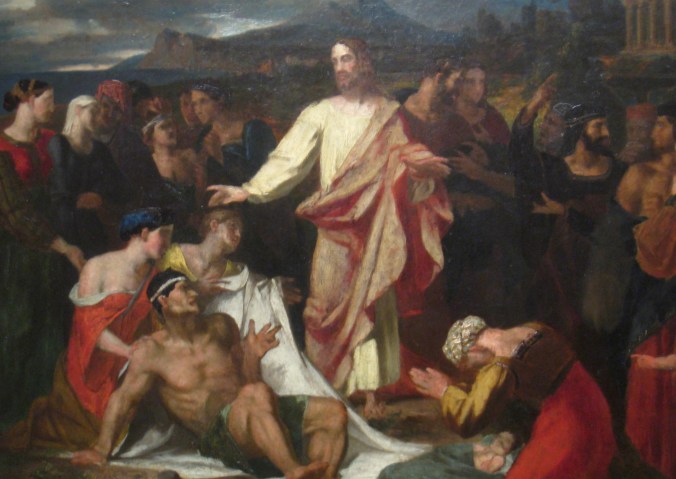
What does Jesus’ list reveal about himself? In Christ, we have a God who does care about the earthly plight of his people. None of these rescues are the big rescue–the rescue from sin and death, Satan and hell. That was coming later. But they do reveal someone who rescues his people. These little rescues from the suffering imposed on our lives by sin reveal Christ’s heart of compassion. Think of the tears he would later shed when he saw the grief of Mary and Martha at the death of their brother Lazarus. Think of Jesus reaching out and touching the untouchable leper to heal him. Think of Jesus seeing the widow of Nain carrying her dead son out of the city to bury him. “When the Lord saw her, his heart went out to her and he said, ‘Don’t cry’” (Luke 7:13). Then he raises that young man from the dead. Doesn’t such compassion inspire our trust in him?

These miracles also reveal that Jesus is the powerful Son of God who has the ability to help. It’s nice to talk to a sympathetic friend about your problems. But it doesn’t change anything if he or she lacks the power to do something about it. Jesus lacked no power to help his people. Jesus referred John the Baptist to these powerful miracles to assure him his faith in Jesus was not misplaced.

Yet someone might object that miracles themselves don’t have the ability to convince the skeptic or create faith in the hearts of doubters. In the story of the rich man and poor Lazarus, Abraham told the rich man in hell that if his brothers wouldn’t listen to Moses and the prophets, they would not believe even if a man were raised from the dead. At most, mere acts of supernatural power will only entertain those who do not believe.

But Jesus’ works of mercy were not mere acts of power, nor was John the Baptist a hardened unbeliever. These were expressions of God’s love for his people, a little foretaste of the even greater deliverance to follow. They fulfilled prophecy, promises God had made about the times when he would come to save his people: “Be strong and do not fear; your God will come, he will come with vengeance; with divine retribution he will come to save you. Then will the eyes of the blind be opened and the ears of the deaf unstopped. Then will the lame leap like a dear, and the mute tongue shout for joy” (Isaiah 35:4-6). The miracles preached a message. That message assures us that Jesus is the One God sent to save his people.

And don’t these same things apply to the great rescue? Peter Kreeft once noted that if you take miracles out of religions like Islam or Buddhism, you end up with basically the same religion. They remain the same lists of rules, the same guidelines for human behavior they have always been.

But take the miracles out of Christianity, and you lose all the essential elements of Christianity. Our faith is not primarily a list of rules or guide for human behavior. It is the supernatural, miracle-working love of God breaking into our world to save us. God entered our world in the miracle of the virgin birth, by which he became a man to live and die for us. He takes our sins away by his sacrificial death on the cross, where he supernaturally applied all our guilt to himself, and paid the full penalty of our sins, setting us free. Our confidence of heaven and eternal life springs from Jesus’ resurrection. You can hardly imagine a more miraculous event than a dead man taking his life back again and walking out of the grave. These are all more than mere acts of power. These miracles are God’s work of saving us. They deliver the message that Jesus is worthy of our trust. Just look at what he has done.

So Jesus ends this listing of miracles with “…the good news is preached to the poor.” When we consider just how good Jesus has been to us, it is very nearly understatement to describe his life and message as “good news.” For poor prisoners in a hard and hostile world, no news can be better. In his love and by his power, Jesus is the one who sets us free. “Blessed is the man who does not fall away on account of me.”

The Christ We Expect?

Prison

Matthew 11:2-3 “When John heard in prison what Christ was doing, he sent his disciples to ask him, ‘Are you the one who was to come, or should we expect someone else?’”

If John’s imprisonment prompted his question, it wasn’t necessarily because he was complaining about his condition. He was not a man looking for great things for himself. Unlike the prosperity preachers of our day, he didn’t live a lavish lifestyle on the gifts of his followers. His food was locusts and wild honey. He didn’t wear custom-tailored suits with a Rolex watch and expensive rings. He wore rough, simple, cheap clothing made of camel’s hair. He showed no attachment to the things of the world.

Nor was he a self-promoter. He told his own disciples, jealous of the larger crowds Jesus was drawing: “He must become greater; I must become less.” He was willing to sacrifice and suffer for the Messiah’s cause.

John didn’t expect great things for himself. But was Jesus going to let the bad guys win? Should the king who put John in prison for preaching against his sexual immorality get away with it? Where was the judgment John had been sent to preach? Where was the unquenchable fire that was going to burn up the chaff? It seemed like something was missing from Christ’s ministry.

None of us live a life as stark and simple as John the Baptist. But that doesn’t mean our lives are free from crosses and trials. Many of those who don’t share our faith work hard to portray our beliefs in a negative light. Those who mock Christian belief try to turn godly morals upside down. The defense of life from conception to old age, promotion of monogamous heterosexual marriage as the only place for godly sexual practice—these beliefs aren’t merely rejected. They are vilified. Yet those who do so don’t seem to be suffering. They are respected members of their communities. Often they have the ear of those in power. A growing number of churches are switching to their side. How can our Savior tolerate such contradiction of his word? Is he going to let the bad guys win? Where’s the judgment he promised?

John had more reason to wonder. He heard what Jesus was doing. He was healing and driving out demons and raising the dead. He was having mercy on all kinds of people. Like the crowd of 5000 he fed, their interest often stopped at the help they could get for their bodies. They only wanted Jesus to enrich their lives now. They weren’t tuned in to spiritual matters. They weren’t focused on repentance and faith. Still, they were healed. They were fed. They found help while John rotted in prison. Was that fair? What about me?

What about me? Jesus still hands out blessings in ways that strike us as inconsistent. How come I don’t have as much money as he does? I’m just as good as she is. How come I don’t enjoy the business success of other Christians I know? I work harder than they do. How come God hasn’t blessed me with a big happy family, never failing health, a circle of close friends when others have them? Is Jesus fair? Is he the One we expect?

Our complaints and concerns about the way the Lord treats his enemies, or the faithful, meddle in issues that are none of our business. Whether or not we perceive it, he governs the world flawlessly, and everything he does will benefit us in the end. Questioning his ways is evidence of weakening faith. It erodes our trust. It is a sin to be repented. It will only lead us away from him.

The problem isn’t that Jesus acts in ways we don’t expect. It’s that we fail to see that this is better. Paul said it this way to the Romans: “You see, at just the right time, when we were still powerless, Christ died for the ungodly. Very rarely will anyone die for a righteous man, though for a good man someone might possibly dare to die. But God demonstrates his own love for us in this: While we were still sinners, Christ died for us” (Romans 5:6-8).

We want a gracious and merciful God, don’t we, not just one who is “fair”? He may not always be what we expect. But that is what makes him always the One we need.

Reason to Live

hand hold

Philippians 1:23-25 “I desire to depart and be with Christ, which is better by far; but it is more necessary for you that I remain in the body. Convinced of this, I know that I will remain, and I will continue with all of you for your progress and joy in the faith.”

One of the great gifts of God we don’t think about very much is a purpose. In serving others, whether our employers, or our families, or our church, or our neighbors, or our community, or our country, our lives find meaning. Some of us may feel like our lives have too much purpose, too much meaning. It is hard to keep up with all the demands that all the people around us put on our time and energy.

But that is why the Lord has chosen to leave us here for now. It is why he hasn’t taken us to heaven yet. He still has a purpose for us. He may well have many purposes. Paul understood this. The Lord hadn’t left him here for himself. “It is more necessary for you that I remain in the body.” As he carried out his gospel work, he had come to see that his life was lived for Christ’s people.

For Paul life lived for God’s people resulted in “your progress and joy in faith.” As he wrote to these people, when he got out of prison and could see them again, his teaching and instruction moved them along the road to Christian maturity and strengthened the faith that would save them. That’s a high calling and purpose. It’s not hard to see why Christ’s choice for Paul would be to leave him here and let him live his life for the people he served.

Maybe we don’t feel so important, but that’s not true. Maybe you don’t see how your life is making such a difference. Maybe you aren’t a leader and teacher like Paul. The main way you serve others is by pressing keys on a computer keyboard, or changing diapers and keeping house, or making sure debits and credits all stay in balance, or selling stuff people could get by without. It pays the bills and puts food on the table, but it doesn’t seem to make a big difference, especially not in the kingdom of God.

Wrong. First of all, you have no idea how you fit in the Lord’s grand scheme of things. Your faithful work, no matter how ordinary and mundane it seems, might play a role in someone’s life that puts them in just the right time and place to hear the gospel. Without you and what you do, the chain of events would be different, and the opportunity missed. Second, even if what you do isn’t preaching the gospel directly, your hands are the hands God is using to love the people with whom you work, the people in your family, and everyone else with whom you come into contact. When I see that God is using what I do that way, then I come to see Christ’s choice for me in leaving me here to live my life for his people.

Author and motivational speaker Stephen Covey says that one of the secrets to success it to think “win-win.” It appears from Paul’s words here that he thought of it long before. “To live is Christ, to die is gain.” It’s not really my choice. It’s Christ’s. May we glorify him either way.

A Choice We Can Prefer

Tombstone

Philippians 1:21-22 “For to me, to live is Christ and to die is gain. If I am going to go on living in the body, this will mean fruitful labor for me. Yet what shall I choose? I do not know! I am torn between the two. I desire to depart and be with Christ, which is better by far.”

To die is gain. More and more people seem to agree with that statement. So long as they aren’t suffering intensely, life is going well, or there is the potential for it to get better, no one wants to die. But for those coping with pain that can’t be relieved, or facing a future they fear to face, death may seem like escape or relief.

Escape and relief are not what Paul means by “to die is gain.” For the believer in Jesus, he means that there is something positive to be had. It doesn’t lead to nothing. It leads to something. It doesn’t merely end something terrible. It begins something wonderful.

That may seem strange in light of the fact that God originally imposed death as part of the ultimate punishment for our sin. Its original purpose was not to give us something. It was to put us out of God’s presence forever.

Jesus changed all of that by dying instead of us. As our Savior, he was dying for us, in our place, when he gave up his life on the cross. His death served out the death penalty for our sins. It satisfied God’s justice and wiped our record completely clean–not only the felonies, but the misdemeanors and petty sins as well. As a result, God has nothing for which to be angry at us anymore, not even mildly irritated, and we have been reconciled.

Since death has been emptied of its original purpose for the believer, Jesus has invested it with a new one: It is the doorway to eternal life. His own resurrection from the dead assures us that death is not the end of life. It is the beginning of a new life. To die is gain. Death is not a bad choice when Jesus chooses it for me.

Only those who know the whole story of how Jesus has dealt with death for us can be so confident of their future after death that, like Paul, life and death hold equal appeal for them. “Yet what shall I choose? I do not know! I am torn between the two…” In fact, death is actually the better alternative. “I desire to depart and be with Christ, which is better by far.” Death leads to life lived in his presence.

If that is the gain Paul has in mind, to be with Christ, to live in his presence, maybe that leads some of us to say, “Hmm. Must be an acquired taste.” We were thinking more along the lines of a heaven that is a garden of eternal delights and pleasures, an endless romp in the lap of luxury. And the Bible does promise us “eternal pleasures at (God’s) right hand,” Psalm 16.

But you know from experience that having things and doing things doesn’t satisfy. Things don’t fill what our hearts are truly seeking. From the time we are children and get that toy we yearned to have, to the time we become adults and we get that coveted tool for Father’s Day, or we can finally afford our dream car, we learn that things make you feel happy and fulfilled for a few days, a few weeks, at most a few months. Then, long before they wear out or become unserviceable, they just don’t have the same effect. Our hearts feel a yearning these things can’t fill.

It is the people we love that fills that spot. We long to be with those who love us, and those we have come to love. A young man in love would sacrifice everything he has to be with the one he loves. Grandparents don’t want things. They want the family they love to come and spend time with them. The more we come to know the incomparable love Christ has for us, the more we come to see that heaven is to be with him. It is life lived in his presence, and it is better by far than any other choice he could make for us.

That is a future worth having. That can make even death the outcome we prefer.

Thankful for Those God Makes Rich

Treasure Chest

1 Corinthians 1:4-5 “I always thank God for you because of his grace given you in Christ Jesus. For in him you have been enriched in every way–in all your speaking and in all your knowledge–because our testimony about Christ was confirmed in you.”

We might be amazed at Paul’s words of thanksgiving here. Usually we think of giving thanks for the good things in life. But these Corinthian Christians had become a pain in the neck. They were making all kinds of problems for Paul in the church. Still, he says, “I always thank God for you.” Can we thank God for the people who sometimes make our lives harder, people we can hardly get along with?

We can if we learn to see past their shortcomings and failures to the great riches of God. Paul gave thanks “because of his grace given you in Christ Jesus.” The apostle introduces us to the work of our Lord Jesus Christ. For all their faults, these people were people to whom Christ had shown his grace and love. Even more, it was just because of their faults that they needed his grace. Isn’t that what grace is all about? In showing them his grace, our Savior had also made them very rich, something for which Paul gave thanks.

First he says that they had been enriched, “in all your speaking.” Before they became believers, what did they have to talk about? “How’s the weather? It’s been a cool and wet summer, don’t you think?” They could talk about political issues. “Who makes a better emperor, Claudius or Caligula?” “I don’t think the empire should be sending soldiers into the middle east. Do you?” They could talk about the economy or business or philosophy or sports, but what did these things really matter?

Now God had given them the message of Jesus Christ. That was something infinitely valuable to talk about. Even if all they could manage was a stuttering, stammering, monotone whisper, how could anyone not be interested in listening to every word they had to say? They had found the ultimate cure, not just for cancer or heart disease or lower back pain or wrinkles or nearsightedness. They had found the cure for death. They had found the cure for guilt. And because of Jesus Christ, God was giving it away for free! They had been made rich beyond their wildest imaginations in all their speaking.

Don’t we share that same wealth? When I started studying for the ministry, one of my biggest fears was having enough to say. I wondered how I could enter the pulpit 52 or more times a year and have something to talk about for twenty minutes. How many ways could you say that we are all sinners, but Jesus died on the cross to forgive all our sins?

But the more that we are introduced to our Lord Jesus Christ and look into his love…the more treasures we discover, the more strength and comfort God provides, the more ways we discover that he has provided all we need for life and eternity, and the more certain he makes us that the riches he promises are really ours. I don’t have to come up with something to say. God has supplied that, and he does the same for all of us. In Jesus Christ he has made us rich in our speech.

Closely related to this treasure are the riches God gives “in all your knowledge.” For all their problems, the people in Corinth apparently had a great store of Bible knowledge. They had had some impressive teachers: Paul and Peter and Apollos. But more importantly, they had the word of God, and they knew about the work and the love of their Lord Jesus Christ.

Do we appreciate the riches we have been given in knowledge about God’s word and our Savior’s work? Even those who aren’t theological scholars can draw on a wealth of comfort in knowing Jesus forgives every sin, a wealth of strength in knowing that God will lovingly supply everything we need. Do we realize how different our lives might be every day without such faith? It is a marvel of God’s grace that, as rich as he has already made us, he allows us to add to that wealth daily at home and weekly at church.

We have plenty for which to be thankful in the riches the Lord has given to his church. Treasure them, and the people with whom we share them.

“Mercy, Not Sacrifice”

Stethoscope 2

Matthew 9: 11-13 “When the Pharisees saw this, they asked his disciples, ‘Why does your teacher eat with tax collectors and sinners?’ On hearing this, Jesus said, ‘It is not the healthy who need a doctor, but the sick. But go and learn what this means, ‘I desire mercy, not sacrifice.’ For I have not come to call the righteous, but sinners.”

The Pharisees proposed a question aimed at deflating our joy and defeating our faith. The problem is not so much in the reminder that we who follow Jesus are lowly sinners. We know we are. There’s no use denying it.

No, the problem with the question is that it plays on a bigger fear we have to fight. “Why should Jesus, the Holy Son of God, want to be so close to me?” Does he really want to? Do I need to be better first? Those questions can only send us down the road of doubt.

Our options seem sorely limited at first. We can pretend to be something we are not, just like the Pharisees. Then we add hypocrisy to all our other sins. We can despair that Jesus really loves us. Maybe his friendship is all a sham. We can conclude that Jesus has misrepresented himself. He’s not the Son of God he claims to be. In any case, we can expect the world to keep attacking our faith by pounding the slogan, “God loves good little boys and girls.” In response, we must follow Jesus closely, and hear him often, to hold on to the truth that God loves all little boys and girls.

That’s where Jesus led with his reply. “It is not the healthy who need a doctor, but the sick. But go and learn what this means, ‘I desire mercy, not sacrifice.’ For I have not come to call the righteous, but sinners.”

Jesus had not come to Matthew’s house to approve of Matthew’s sins, or the sins of his friends. That should be clear enough. That’s not the life we find when we follow him, either. Those who want an excuse to continue to indulge their favorite sins aren’t going to find it by following Jesus.

The secret to understanding how Jesus could fraternize with Matthew and his friends was found in the words of the prophet Hosea: “I desire mercy, not sacrifice.” Far more than God is interested in seeing people go through the motions of religious ritual, he wants to see his people treat each other with love and mercy. That’s not to say that worship is unimportant. He himself commanded the sacrifices mentioned by the prophet. But worship and sacrifice are not ends in themselves. They are intended to work a change in us. He wants them to fill us with faith and move us to the same mercy on others that he has had on each of us.

That is what Jesus was doing here. He was here for mercy. He was the Good Doctor bringing the spiritual cure for sins. And when you know the pain of your sins, there is nothing you want from him more. I once dislocated my left elbow playing softball. Ordinarily, I don’t relish going to the doctor. They poke and they prod. They sometimes find problems where things seemed to be working. They don’t leave well enough alone.

But when the upper end of my forearm was removed from the elbow joint by about an inch, I couldn’t get to the emergency room fast enough. No matter how I moved my arm, no matter how I positioned my body, there was simply no relief from the pain and discomfort until the doctor saw me and put it all back into place.

Every one of us is thoroughly sick with sin. The pain is unrelenting. But follow Jesus, and this is what you will find: Life with a merciful Doctor who relieves you of your painful guilt by taking your sins away. He hasn’t come to call the righteous. But he does come to declare you righteous through the forgiveness of your sins.

“Follow Me”

Follow Me

Matthew 9:9 “As Jesus went on from there, he saw a man named Matthew sitting at the tax collector’s booth. ‘Follow me,’ he told him, and Matthew got up and followed him.”

Matthew had paid a horrible price to have a life of ease. As far as his fellow Jews were concerned, he might just as well have sold his soul to the devil. He had sold it to the Romans to get rich off of tax money. Now Jesus’ call “Follow me!” meant leaving the tax collector life, with its easy money and shabby reputation, behind.”

You may be faced with the same kinds of choices Matthew had. The question then will be, “Will I follow the path of faithfulness, or will I compromise myself to follow the path of pleasure or success?” Maybe it’s money that would lead you to sell out like Matthew. Maybe it’s something else. It could be power. You don’t have to become a dictator in some third world country to abuse power. You can throw such a fit when you don’t get your way that you control the members of your own family instead of serving them in love. You get your way, but look at what it does to others.

It can be love. “How can there be anything wrong with love?” we wonder. It’s true that it’s hard to have too much of the kind of love that selflessly serves others. But the kind of love celebrated in popular songs, love for a man or a woman, can be a very selfish thing. It has led more than one person to compromise their morals for a few moments of pleasure. And that path leads to a whole host of problems– disease, premature parenthood, broken hearts, poverty, and lost respect– besides the spiritual wreckage it has caused.

In the end, it’s a question of who will lead, and who will follow. You can put yourself first, and hope that Jesus will trail behind. But I can tell you that path never leads to heaven-ever. Jesus still calls you, like he called Matthew, “Follow me.” That means leaving your self-directed and sin-directed life behind. Nothing else can be number one. Nothing else can be your first love. That’s the life we leave behind.

Do you think that Matthew regretted the change? That’s not the impression he gives “While Jesus was having dinner at Matthew’s house, many tax collectors and ‘sinners’ came and ate with him and his disciples.”

Look at the dinner Matthew held at his home that evening. Luke’s gospel tells us it was more than just another supper. “Then Levi (Matthew) held a great banquet for Jesus at his house.” Matthew’s new found life of following Jesus was a gift worth celebrating! They feasted. They celebrated. He and his friends and Jesus and his disciples enjoyed good food, good company and had a good time.

Albert Nolan comments on the meal at Matthew’s, “It would be impossible to overestimate the impact these meals had upon the poor and the sinners. By accepting them as equals, Jesus had taken away their shame, their humiliation, and guilt. By showing them that they mattered to him as people he gave them a sense of dignity and released them from their old captivity. The physical contact he must have had with them at the table…must have made them feel clean and acceptable. Moreover, because Jesus was looked upon as a man of God and a prophet, they would have interpreted his gesture of friendship as God’s approval on them. They were now acceptable to God.” This joyful meal in Jesus’ presence was a happy application of the forgiveness he would soon purchase for them by his death on the cross. This was the life they found in response to his invitation, “Follow me.”

This is still the life we find in response to his invitation to follow him. If you are following Jesus, you are doing more than learning, though you are certainly learning. You are living in the joy and blessing of Jesus’ presence. Where two are three are gathered in his name, around his word, he still promises, “There I am with them.” He still meets with those who follow him in a joyful meal where he comes to us in bread and wine to apply the forgiveness he purchased for us by his death on the cross. We still feast and celebrate that he came to live with us at Christmas, that he gave his life and rose for us at Easter. This is the joyful life we find because Jesus still calls to us today, “Follow me.”

Heirs…and Sufferers

Depressed

Romans 8:16-17 “The Spirit himself testifies with our spirit that we are God’s children. Now if we are children, then we are heirs–heirs of God and coheirs with Christ, if indeed we share in his sufferings in order that we may also share in his glory.”

As God’s sons, we are heirs. As good as it is to be God’s children now, there are better gifts waiting in our future. But like most heirs, we don’t know all the details about what is to come.

Are you an heir in someone’s last will on and testament? As far as I know, I am included in the will of my earthly father. I assume that about one fourth of what’s left when my parents die will be mine. I have some vague ideas about what that will include, but time can change things, and I don’t know the specifics of much of what they have or plan.

There is no doubt that you and I are included in the will of our heavenly Father. He has been very specific in promising us a piece of heaven, a resurrected and perfected body, and life that never ends. This inheritance isn’t an exclusive gift for a few special saints who have lived distinguished lives. As believers in our Lord Jesus we are all God’s children, and we all share that sacred status that makes us heirs of God and coheirs with Christ.

Paul also reminds us of a sobering truth now that we are God’s children. While God loves us deeply, in this life we also share our Savior’s suffering. Paul slipped that in when he said, “Now if we are children, then we are heirs–heirs of God and co-heirs with Christ, if indeed we share in his sufferings in order that we may also share in his glory.”

If we are God’s children and heirs of heaven, why should we have to suffer? If my dad owned the grocery store, I wouldn’t expect to go hungry. If my dad owned the factory, I wouldn’t think it would be hard to find a job. If my dad ran the universe, wouldn’t you think my life would be easier?

But it’s not easy. We suffer. Whether we like to think about that or not, at least Paul is being real. He spoke from personal experience. He himself had been imprisoned, flogged, pelted with stones, and beaten by the enemies of the gospel. He knew what it was like to suffer, and he knew that he wasn’t alone.

Our own suffering as God’s children may take different forms, but it hasn’t ceased. I can name a half dozen men who worked for major corporations, who weren’t allowed to rise as high as their skills could have taken them because they refused to compromise their personal morals. They lived as God’s children and they suffered for it. I could walk you through the membership list of my congregation, and for each active family I could mention at least one serious tragedy they have endured. They are God’s children, but they suffer, and that’s hard for us to understand.

Individually, why any of us suffer this particular way, or this much compared to everyone else, is information our Father hasn’t shared. But this much he has revealed: Our suffering helps us to realize how helpless our sin has made us. Over and over again it rehearses us in our utter dependence on our heavenly Father for all things. It leads us to repent of the pride that thinks, “I can do this all by myself.”

In the twelfth chapter of his second letter to the Corinthians Paul says that God uses suffering to make us weak so that we won’t become conceited. But then something wonderful happens. We discover God’s sufficient grace. We find the love that justifies us and forgives our sins sustaining our faith. We experience his steady, quiet power resting on us and supplying our needs. We are God’s children, who share our Savior’s suffering. Since the Spirit convinces us we are God’s children, we can be certain our suffering will bless us in the end.