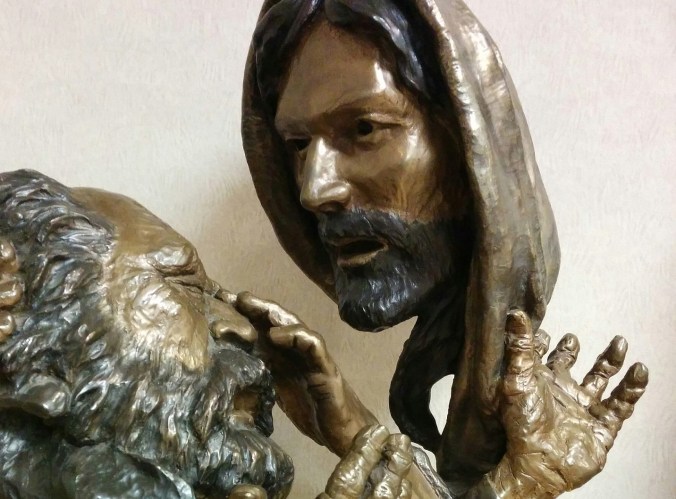
Found In Him

TrickorTreat

Philippians 3:8-9 “What is more, I consider everything a loss compared to the surpassing greatness of knowing Jesus Christ my Lord, for whose sake I have lost all things. I consider them rubbish that I may gain Christ, and be found in him, not having a righteousness of my own that comes from the law, but that which is through faith in Christ–the righteousness that comes from God and is by faith.”

The true Christian faith is not a moral philosophy about how we must live. It is knowing Jesus Christ as our Lord. It is not just studying Jesus like studying some historic figure in a book. It is actually meeting Jesus in his word, being introduced to him, and living life with him as our Savior, our friend, and our brother.

Paul describes our knowing Jesus this way as a “surpassing greatness.” Do you understand why? When we know Jesus, then we truly know God. Knowing Jesus is the only way we can know God the way he really is. When you sit down on the hillside, and listen to Jesus preach his sermon on the mount, then you see how high God has set his standards for our keeping of his law, and how far short of his perfection we have fallen. But when you follow him down from the hillside, and you see him actually reach out and touch the unclean leper to heal him, you know the depth of his concern for your suffering, and the extent of his power to fill your needs. When you stand with Jesus at the tomb of Lazarus, and you see the tears burning down his cheeks, and you hear his voice commanding Lazarus back to life, you know the intensity with which he feels your pain, and the authority with which he controls your world. When you kneel at the foot of his cross, and the blood running from his hands and feet carries his life mingled with your sins away past your knees, and his dying breath cries out, “It is finished,” you know that in his unsurpassed love for you he has left nothing more for you to pay or do.

We lose our own life not only to find and know Jesus in this way, but to be found in him. “I consider them rubbish that I may gain Christ, and be found in him, not having a righteousness of my own that comes from the law, but that which is through faith in Christ–the righteousness that comes from God and is by faith.” Do you want to be sure, really sure that God’s love and grace are yours, that your sins are forgiven, that you will live again after you die? Then we need to be found in Jesus, wrapped in the righteousness of his holy life, cleansed in the blood of his innocent death. A righteousness of our own that comes from our own keeping of the law is only a so-called righteousness. We never live our lives completely guilt free, and as long as we are still producing sin, we aren’t really righteous.

But then God comes and he gives us a righteousness of his own making. He gives us an innocence that comes to us from the outside. He takes and he hides our sinful selves in the perfect love of Christ. He so covers over the content of our lives with Jesus’ life and death that he can no longer see us at all. We are all little Christ’s to him. At Halloween we see little children walking around who have hidden their identity temporarily, hidden behind costumes and masks. By bringing us to faith, the Lord has dressed each one of us up as Jesus, only our new identity is more than a flimsy costume. We wear it every day for the rest of our believing lives. This is part of our great find, not only to find and know Jesus, but to be found in him, with this righteousness that comes from God. He has dressed us in a new identity: the precious, holy, dear, innocent children of God himself.

Confidence Properly Placed

burning-money-2113914_1920

Philippians 3:4 “If anyone else thinks he has reason to put confidence in the flesh, I have more…”

Paul was battling with Christians who wanted people to believe that you needed more than just Jesus to be saved. You needed to be circumcised. You needed to “do something” to get into heaven.

Circumcision isn’t an issue in any part of the Christian church today as far as I know. But the underlying attitude Paul combated is always trying to sneak back in among God’s people. It appeals to our pride to think there is something I can contribute to a restored relationship with God. When a church shows more interest in “what you do” than in “what you believe,” the attitude which puts confidence in the flesh is trying to push its way back in.

It also appeals to our sense of fairness to think the most moral people, even if they are unbelievers, might somehow be saved. Many years ago my friend Frank insisted that former Indian leader Mahatma Gandhi would be in heaven. Gandhi lived such a kind, self-sacrificing life that Frank just couldn’t believe God would condemn him, even if he was Hindu.

But there was probably never a more moral unbeliever than Paul himself had been. That is why he says, “If anyone else thinks he has reasons to put confidence in the flesh, I have more: circumcised on the eighth day, of the people of Israel, of the tribe of Benjamin, a Hebrew of Hebrews; in regard to the law, a Pharisee; as for religious zeal, persecuting the church; as for legalistic righteousness, faultless.” Look at his credentials. Not only was this man a natural-born member of God’s chosen people. His theological leanings were the right ones, at least as the majority of the Jews of his day would have seen it. He was a faithful, Bible-believing conservative, not one of those liberals who were trying to change everything.

Martin Luther once followed a similar road. He said of his years before the Reformation, “I was a pious monk, and so strictly did I observe the rules of my order that I may say: If ever a monk got to heaven through monasticism I, too, would have got there…If this life had lasted longer, I would have martyred myself to death with vigils, praying, reading, and other labor.”

Why is it that, at least deep down inside, we would like to think that God can find such “good” people, whether Bible characters or heroes of history, acceptable for the great things they have done? I suspect that it has less to do with our concern for their fate. It has more to do with our own. We may not live such outstanding, self-sacrificing lives as some have lived, but we would still like to think our best efforts gain us some favor with God. We still like to think of ourselves as “good” people.

That is why we need to suffer a great loss in this regard. Paul continues, “But whatever was to my profit, I now consider a loss for the sake of Christ.” Paul is speaking the language of business and trade. Once he saw his “good” and “religious” and “spiritual” life as money in the bank, interest on his investment. These were the riches with which he would stand before God and be sure of his eternity. But God changed his point of view. Now he saw them as a loss. He wasn’t rich. He was in debt, and this false hope in his own life, and his own goodness, had put him there.

However, Paul had found a new source of wealth. Jesus Christ and his grace more than covered the losses Paul recognized in his own worthless life. He experienced the joy and discovery of the men in two of Jesus’ parables: “The kingdom of heaven is like treasure hidden in a field. When a man found it, he hid it again, and then in his joy he went and sold all he had and bought that field. Again, the kingdom of heaven is like a merchant looking for fine pearls. When he found one of great value, he went away and sold everything he had and bought it” (Matthew 13:44-46).

The gospel of free forgiveness, the Savior who gives life and salvation as a gift—these lead us to let go of our dependence on cheap trinkets and plastic counterfeits coming from our own spiritual efforts. We give them up for the sake of real treasure, for the sake of Christ. That’s where Christian confidence properly rests.

All Useful

Bible Notes

2 Timothy 3:16-17 “All Scripture is God-breathed and is useful for teaching, rebuking, correcting and training in righteousness, so that the man of God may be thoroughly equipped for every good work.”

There are many ways God could try to get our noses into his Book every day. He could simply command us to read it, as Paul had earlier commanded Timothy to devote himself to the public reading of Scripture. He could warn us of the consequences of not reading it, as Jesus does in the parable of the sower and the seed. There he points out that those who don’t get their roots down into the word, who fail to get their life and faith thoroughly founded upon it, are in danger of losing their faith

But we Americans are practical, pragmatic people. If we are going to spend our time on something, we want to be sure it will be time well spent. In a way, the Lord condescends to just this concern when he assures us that all Scripture is useful. All of it, from cover to cover, is helpful for us. It has a place in our every-day lives.

That may not be obvious to us when we read or study some portions of it. Some parts may be hard to understand. Maybe you are one of those people who decided to read your Bible from cover to cover. You started in Genesis and ended in Exodus or Leviticus, because all of those laws and instructions about Old Testament worship and life were just too much.

Maybe you have noticed that some portions of Scripture deal with topics that don’t have much to do with your life right now.

That doesn’t mean these passages aren’t useful. They are simply preparing us for future situations. We all learned things in school that we didn’t see an immediate need for. Later we saw how practical they were. When I went to college to get ready for the seminary, I sometimes wondered why the curriculum was so heavy on the classics and led to a degree in liberal arts. It seemed to me that we should graduate with some sort of Bible degree. Now I see that in addition to the Biblical languages, they were trying to teach us to think for ourselves and use good judgment.

In a similar way, sometimes we have to wait to see when some part of Scripture will come in handy. In the meantime, Paul assures us that it is useful for teaching, rebuking, correcting and training in righteousness.

That first term, teaching, is a very general term. It could refer to the entire body of information the Bible reveals.

But the next three terms deal with the Christian life of faith in a very logical order. God’s word is good for rebuking people. This word pictures bringing the evidence that convicts someone of wrongdoing. In other words, God’s word makes it clear to people when they have sinned.

With all the sin we have in our world, and in ourselves, one could conclude that this alone proves the Holy Scriptures useful. Unfortunately, our world not want to hear about its sin. Even many Christians don’t believe it is useful to be shown their sins, at least not after conversion. But how will we grow in our Christian faith and life if we won’t listen to what’s wrong in the first place?

After rebuking, God’s word is useful for correcting. This word speaks of a very evangelical, very loving correction. It is that kind of correction that restores a person to a willing heart and mind by leading him again to the foot of the cross to see all his sins laid on Jesus, so that in faith and love he resolves to do God’s will again.

Finally, God’s word trains us in righteousness. What does it mean to live as God’s forgiven people? How can I thank the Lord for all his goodness to me? How can I live my life so that more and more I look like the righteous person that God declares I already am for Jesus sake? The Scriptures are useful to train us in just how these questions can be answered.

Convicted. Restored. Trained in Righteousness. God’s word is not only useful for me. It makes me useful, “thoroughly equipped for every good work.” What could be more practical than that?

Inspired

Bible Light

2 Timothy 3:16 “All Scripture is God-breathed.”

Timothy’s Spiritual training came from several reliable sources. His faith had been handed down to him by his grandmother Lois and his mother Eunice. The Apostle Paul had personally tutored Timothy in the saving truth about Jesus. But what good would all that spiritual training have been if the Christian faith were nothing more than another man-made religion, a collection of fables and myths?

It is not. All Scripture is God-breathed. The term “God-breathed” (or “inspired” as many have learned it from the King James Version) vividly pictures the source of the words. Before you or I can say anything, we must be able to breathe. Without breath behind our words, we are only moving our lips. No sound comes out. Our breath pushes our words out of our mouths, projects them into the air, and there they can be heard and known.

Every word recorded for us in Scripture is there because God himself made that word known to us. He made it possible for each of those words to be heard. As a spirit, our God does not have literal lungs, but he is the source and the power behind everything the Bible reveals. Whether we are hearing those words read, or reading them for ourselves, he wants us to understand and regard every word as a word which he himself is speaking to us. This is so whether they were recorded by Moses, or one of the prophets, or one of Jesus’ apostles.

Do you see why that reminder is so important for us if we hope to hold on to our Bible-based beliefs? Faith rests on things that are certain. Faith itself IS certain. If the words of Scripture cannot be trusted to be God’s own, how can they produce faith in him? But when we know that God is speaking to us here, we know our faith is well-founded. We know that our answer to that nagging question, “Does Jesus love me?” can be a confident one, because our answer is found in his inspired Scriptures.

Higher Ways

space-trees

Isaiah 55:8-9 “’For my thoughts are not your thoughts, neither are your ways my ways,’ declares the Lord. ‘As the heavens are higher than the earth, so are my ways higher than your ways and my thoughts than your thoughts.’”

God’s ways and thoughts are not our ways and thoughts. There wasn’t always such great a difference between them. When God first created Adam in his image, Adam did not know everything God knew, but he never found anything God did or said hard to accept. His mind and will were in perfect harmony with the Lord. Whatever the Lord decided was just fine with him.

That’s not true of us anymore. Sin has introduced a gap, a vast canyon between God’s ways and our ways. Only the Lord in his grace can lead us back across. Sometimes we would like to shake our fists at God in anger, or turn our backs on him in frustration. Our careers, families, or ministries don’t go the way we plan. We are no better than Elijah, so full of self-pity when he defeated the prophets of Baal on Mount Carmel. It failed to turn the whole nation around. It failed to change the heart of the king and queen. So he ran away into the desert and asked to die.

We are no different than Peter, who took Jesus aside and rebuked him for all this talk about suffering, humiliation, and death. He saw his own dreams of glory and power flushing down the commode. Jesus’ words about denying ourselves, taking up our crosses, and following him don’t fill us with giddy joy, either. Maybe you have a spot in your office or in your home where the carpet is worn into a path from pacing when problems come up. I do. That’s not a path I created because I am getting my way so much of the time.

But doesn’t the Lord share this truth for our comfort? Thank God we don’t get our way. Who of us would have had the gall to ask the Lord, “Excuse me sir, but would you take your only Son, the one you love with a perfect, unfathomable love; your Son whose love and will are perfectly united with your own; and would you kill him for me? Before you kill him, could you torture him first with all the pain, horror, and forsakenness of hell my sins deserve? And I know that have despised and defied you millions of times. But could you treat me like my sins never even existed?”

Who of us would have even thought of the way of salvation God had been planning from eternity? Even if we did, who would have dared ask him for it? God’s promise of forgiveness, life, and love in Christ is something we would never have imagined. Things about it surpass our understanding. But it is God’s promise just the same, far above anything our little brains could conceive. Blessedly, thankfully, God’s ways are not our own.

Grace not Judgment

argue

James 5:9 “Don’t grumble against each other, brothers, or you will be judged. The Judge is standing at the door.”

People say that “charity starts at home.” The same is true of patience. Nothing requires more patience of us than putting up with the people who are closest to us, the people who are fellow members of the family of God. Living and serving together with our brothers and sisters in the faith can test our patience for several reasons.

Sometimes we are tempted to grumble and complain because others are breathing down our necks. When we volunteer to serve in some way, the joy of Christian service is lost to the pressure others put upon us to perform. They criticize (sometimes only whispered behind our backs) when our service doesn’t live up to their expectations. “I’m not a professional. I’m just a volunteer doing my best,” we think to ourselves, and our patience grows thin.

On the flip side, we become frustrated when others don’t take their responsibilities seriously. Their work never seems to get done. Plans are laid, and projects are started, but the necessary follow through is missing. Maybe it makes more work for us. Maybe it keeps us from being able to finish the things we want to do. Maybe we just feel frustrated when the work of the church stalls and fails to go forward. It doesn’t take too many dead ends like this before the grumbling begins.

Perhaps you are one of those who faithfully presses ahead despite the pressures or the letdowns. But when the task is done, nobody seems to notice. It’s not that you are looking for a special awards ceremony, but it would be nice if at least someone noticed something happened. Everyone goes on their way as though you and your offering of time and ability never even existed.

Add it all together, and maybe we find ourselves in the same state of mind as a church council member of a congregation I served for a short time. He stormed out of the meeting after single-handedly planning the church picnic, arranging the activities, purchasing all the supplies, taking care of the publicity. All that the other council members had to say was that he chose a bad location for the volleyball net.

James isn’t warning us about grumbling about each other here to approve of the shabby treatment we receive. His point is this: our grumbling about each other involves us in loveless judging of each other. This sin opens us up to God’s judgment. Every day we live under God’s own grace to us. He is patient with you, not wanting anyone to perish, but everyone to come to repentance. Let’s be so patient, too, and live in a state of grace in our relationship with one another.

Where To Look

Cross Black White

Hebrews 12:2 “Let us fix our eyes on Jesus, the author and perfecter of our faith, who for the joy set before him endured the cross, scorning its shame, and sat down at the right hand of God.”

People look in many different directions to find the secret to a successful life. Some fix their attention on making money. Everything in their education, in their career choice, and in even in their personal relationships is driven by making as much cash as they can.

But you can’t buy God’s love through life. There are no “for sale” signs in front of the mansions in heaven. King Solomon’s proverbs are still true: “Better a little with the fear of the Lord than great wealth with turmoil. Better a meal of vegetables where there is love than a fattened calf with hatred.”

Some people try to make their lives meaningful by turning to a life of activism. They take up every cause to try to save the planet, but they end up a champion of every cause except God’s own. I don’t want to discourage you from a life which shows a proper concern for God’s creation and the people who populate it, but finding God’s kind of success demands that your attention be focused someplace else.

Fix your eyes on Jesus. Remember that he is ahead of you. If you want to stay in God’s race, if you want to stay in the Christian faith, doesn’t it make sense to keep your eyes on faith’s author? Our faith has a source. It’s not something our bodies naturally produce, like the pigment in our skin or the wax in our ears. Faith looks to Jesus for its life. Not only did he author and create our faith. He is the one who perfects it. He is the one who makes our faith complete, and intense, and enduring, so that it can keep us close to Jesus through this life and on to the next.

Fix your eyes on Jesus, who endured the cross and scorned its shame. Do you think that your life is sometimes hard? Consider the race Jesus had to run. Our God was not like some cold, detached scientist in a laboratory, concocting a plan of salvation which would never involve him in any way, and then feeding it to his rats down on earth. Our salvation cost him everything! Jesus not only became one of us and joined us in our world, he made our sins his very own. He endured the agony of the cross for the joy of returning to heaven, not to live their alone, but with each of us as his eternal companions.

Need some encouragement to stay in God’s race? Need to be sure someone cares for you all along the way? Need to be sure it is really worth it? Then remember who’s ahead of you. Fix your eyes on Jesus. He endured the cross just to make you his. You can be certain he has made heaven yours.

The Value of a Name

gold bars

Proverbs 22:1 “A good name is more desirable than great riches; to be esteemed is better than silver or gold.”

We put a high value on riches, silver and gold. That is the only way I can explain the great personal sacrifice people make to try to win a lottery prize worth more than a billion dollars. Odds of winning are infinitesimally small. Still, they make long trips across state lines, wait in lines for hours, and even fork over hundreds of dollars in cash for the chance to be rich. If only Christians made such sacrifices for the mission of the church, or to help their needy neighbors!

This proverb is not denying that money is a gift from God. But it assures us there are things so much more valuable. John Jeske once observed that our world resembles a store into which someone has come and switched all the price tags. The cheapest junk is valued the most, and those things which have truly lasting value are treated as though they belonged in the bargain bin. Some people even think that way about their names and reputations! During a scandal in the entertainment industry years ago, I heard a reporter quip that there is no such thing as bad publicity. Today’s celebrities test this theory over and over again. Scandal, at times, seems to be good for business even if it sullies your reputation.

But even our scandal-plagued world understands it can turn out the other way. The “Me, too” movement has cost hundreds of entertainers, businessmen, athletes, and politicians their careers and fortunes. Their own names have suddenly become a liability to them.

Of course, our names have never been worth so much, monetarily speaking, but it’s not merely money which Solomon has in mind. He says a good name is worth more than such things. Our good names, our reputations, provide us with things more precious, and more dear, than money could ever buy.

For one thing, our good name leads other people to trust us. When we are deciding whether or not to get to know people better, or whether or not to entrust some responsibility to them, their reputation, their good name, is usually our starting place. It makes a difference to us what others have to say about them.

That means that our good name is also an important part of our human relationships. For someone whose reputation has been damaged, the world can be a lonely place. You don’t want your children hanging around with children who have a reputation for trouble making. You limit how close you get to others based on their reputation and character. A good name can have a profound effect on our basic human need for love and friendship.

Let’s also not forget that the Lord himself has an interest in seeing to it his children enjoy a good reputation. If others don’t trust us, they aren’t going to listen to what we have to say. That puts up walls which keep the gospel from spreading. God doesn’t send angels to evangelize the world. He has given this task to each one of us, and a good name is a valuable tool for getting others to listen.

Whether we or others make a mess of our reputations on earth, they remain unblemished before our Father in heaven. Jesus speaks up on our behalf. He pleads that our sins and scandals don’t exist. His sacrifice has wiped our record clean. If Jesus has made such a sacrifice for us, and speaks in our defense, then the Lord must esteem our entire selves, not just our names.

From Frustration to Liberation

freedom chains

Romans 8:20-21 “For the creation was subjected to frustration, not by its own choice, but by the will of the one who subjected it, in the hope that the creation itself will be liberated from its bondage to decay and brought into the glorious freedom of the children of God.”

I have personally witnessed the aftermath of killer tornadoes in Oklahoma and Missouri. Months later debris was still scattered around. Buildings were nothing more than piles of rubble, or simply missing altogether. Pictures of the destruction in the Florida panhandle after Hurricane Michael struck look like ground zero from some atomic blast.

God’s creation doesn’t want to do this. It wasn’t supposed to work this way. It is frustrated when it doesn’t serve God’s people the way God originally intended. The wild, untamed forces of nature are not “free.” They have been subjected by God to work in a negative way because of our sin. Remember God’s word’s to Adam after the fall? “Cursed is the ground for your sake.”

God didn’t do this because he didn’t love us or his creation. He did it because he couldn’t let this world remain a paradise for his sinful people–a paradise that would stand in the way of our return to him. That means God’s love is there, even in the decay and destruction and frustration around us.

We may not know everything God has planned for us, and we may not see all the good he is working for us now. But one thing we do know about our heavenly future: A glorious freedom is waiting: “…the creation itself will be liberated from its bondage to decay and brought into the glorious freedom of the children of God.”

Freedom is something for which Americans have long believed it is worth suffering. Remember the last line of the Declaration of Independence? “And for the support of this Declaration, with a firm reliance on the protection of divine Providence, we mutually pledge to each other our Lives, our Fortunes and our sacred Honor.” Some of those signers like John Adams and Thomas Jefferson went on to become presidents. But some of them ended up losing their fortunes. William Hooper is an example. Others, such as Thomas Lynch and Richard Stockton, even gave their lives for freedom.

Of course, with creation we are hoping for an entirely different freedom. God doesn’t set us free to indulge our personal desires. He sets us free from the desires that control our lives. When he finally returns and takes us to glory, we will at last be free from every trace of sin left in us. Together with that freedom from sin we will find freedom from all the frustration, death and decay sin brought along with it. That is the glorious freedom waiting for us children of God. That is the freedom God’s creation hopes to enjoy along with us.

We don’t suffer now to deserve freedom later. The one does not equal the other. Rather, we are on a journey. As long as we are traveling the straight and narrow way to heaven, as long as our time spent in this world is time spent in faith in Jesus, suffering is part of the landscape along the road. It doesn’t get us where we are going, but it is part of the country through which we are traveling.

Once we arrive at our heavenly goal, the suffering will all be left behind.