Forgiven Too Much?

Folded hands

Matthew 6:12 “Forgive us our trespasses.”

This isn’t a prayer taught to the world out there. It is you and me, the Christians, who need to ask God to forgive our sins. We need to ask him regularly. Sometimes people wonder if we really need to bother about forgiveness after we have become believers. Wasn’t that all taken care of at the cross thousands of years ago? Didn’t I personally receive my pardon when I first came to faith? The answer to those questions is, “Yes, of course, God has already forgiven us.” But have our new sins become any less serious?

Repentance isn’t a one-time experience. It is a way of life, an ongoing way of regarding sin. If we continue to see our sins the way that God sees them, we will want to hear that they are forgiven. They are frightening. Jesus teaches us to pray, “Forgive us, forgive us, forgive us,” every time we pray his prayer.

This prayer also humbles those who use it. It puts us all in the same boat. We may be tempted to look around and see others we believe are just a little less sanctified than we are. But when we pray forgive us our trespasses, we all drop to the same level. Their sins are lumped together with ours, and we stand together as people deeply in debt to God, in desperate need of his grace.

Jesus’ words also teach us about God’s place in the relationship. He is eager to give us all the things he teaches us to ask for in the Lord’s prayer. Sometimes we pray for things we can’t be certain God wants us to have. But when Jesus teaches to pray “forgive us our trespasses,” he isn’t an insecure parent dropping hints about a gift he has chosen for his children: “Wouldn’t it be nice if you had one of these? Wouldn’t you like to get this or that for your birthday?” He is flat out telling us: “Ask for this! This is exactly what your heavenly Father wants to give you!”

Can there be any doubt he wants to forgive our sins? Look at what he was willing to pay to get us this gift! Would God give up his own perfect Son for us if he was not fully devoted to forgiving our sins? More than the diamond on your finger, or the car in your driveway, or the house in which you live, or the job that pays your bills, the most expensive gift that we have ever received is the forgiveness of our sins. God’s Son died on a cross for it. As gifts go, it knows no equal.

Is it any wonder that he wants us to take this gift out and enjoy it again and again? We might sooner get sick of breathing air and drinking water. We might sooner grow tired of being loved and cared for. God’s children live for the forgiveness of sins. Take everything else we enjoy away. If we have only forgiveness for our sins, God has taken care of our every need.

“They Are Weak But He Is Strong”

Muscle

Zechariah 4:6 This is the word of the Lord to Zerubbabel: “Not by might nor by power, but by my Spirit, says the Lord Almighty.”

The Hebrew words behind “might” and “power” suggest a wide variety of human resources. The word “might” can refer to the strength of a warrior, or the strength of a nation in terms of its army, or the strength of a people in terms of its wealth. The term “power” can refer to physical strength, or the talents to be able to do something, or the stamina and courage to stand up under some hardship.

Personal skills, armies of people, a healthy supply of money, boundless energy and tireless workers–all of these are valuable assets no matter what people set out to do. Zerubbabel needed them for his project: rebuilding God’s temple. But he had become discouraged and let the project languish. He let the whole thing sit and collect dust when his supplies seemed to run short.

Did Zerubbabel understand how the Lord gets his work done? Does the Lord let his people live under the impression that their service to him is a “do-it-yourself” project? When you look at the great things God’s people accomplished in the Bible, was it because they were so well supplied with worldly resources? Is that how Abraham got a family, or Moses got the people of Israel out of Egypt, or Joshua conquered the Promised Land, or Gideon defeated the Midianites, or David became the King and led Israel to glory? When the Lord told Zerubbabel, “Not by might nor by power…” he was revealing nothing new. But God’s people need to hear the same old lessons over and over again.

Like Zerubbabel, we put too much stock in our tangible, earthly resources. That can be spiritually deadening. It leads to a misplaced trust. We idolize things that are no more than tools, no more than means to an end. We begin to believe that our investment, our handiwork, our materials, our technology, our skills are what make our service to God so successful. We take pride in the wrong things.

Zerubbabel had a more important resource at his disposal, and that was the Spirit of God. The importance and practicality of this for building a physical temple may not be immediately obvious to us. In order to explain, the Lord had given the prophet a vision.

In the vision Zerubbabel was one of the two olive trees standing by a lampstand and providing its oil. His associate Joshua the High Priest was the other. These two men had been anointed by God to feed the faith of the Jews in Jerusalem from God’s word. Where God’s word is preached, God’s Spirit is at work. As long as these men kept holding God’s promises before the eyes of their fellow citizens, hope would live, faith would burn, and that faith would shine in the lives of God’s people.

You see, Zerubbabel’s building project was first of all a spiritual building project. What he needed more than stones, or money, or laborers, or ways to cut through government red tape were people who knew God’s promises for them and for this temple, and believed them. Someday this temple would be the place to which their Savior came. Here Jesus would bring salvation. A people who believed the promises of God, and could see their own role in God’s plan, would be eager to finish the project God had given them.

God builds us into temples where he himself still lives through his Spirit. And where is that Spirit of God at work? When a child is brought to baptism, God is building by his Spirit. When the nursery class learns to sing “Jesus loves me, this I know, for the Bible tells me so,” God is working by his Spirit. When adult Christians are led to ponder how God’s anger and love met at the cross of Jesus Christ to accomplish our full forgiveness, God is building by his Spirit. Our God has tied the work of his Spirit to the message of his forgiving love in Jesus Christ.

God’s Spirit working through this good news is the power by which God’s real work gets done. The Lord invites us to trust his tools for building people. The Spirit may look weak, but he is strong. The Gospel message may look weak, but it is strong.

And we may look weak and insignificant in the grand view of history and before all the giants of our age. But then we are just the kind of people God chooses so that his power and glory might be magnified, and so that we might be built into his living temples today.

Soon To Be Dust

dust bowl

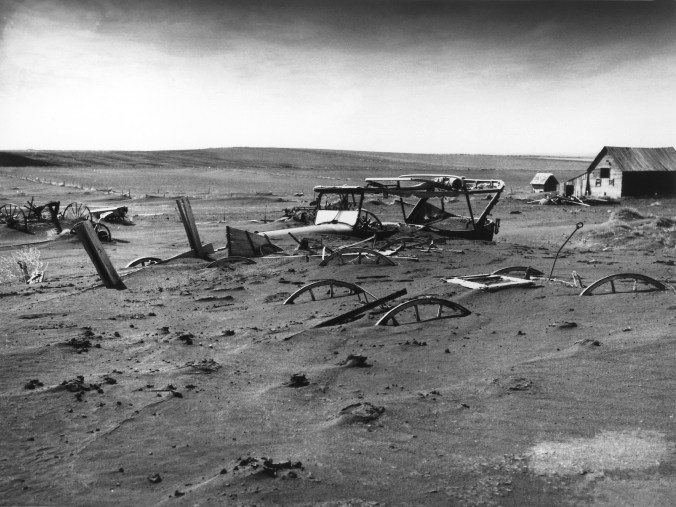
Psalm 90:3 “You turn men back to dust, saying, ‘Return to dust, O sons of men.’”

The length of our lives is affected by many influences both within us and around us. Diet and exercise, whether we drink or smoke, what combination of genes we inherited from our parents— all these things add years or take years from our lives, according to the doctors and researchers. Actions of others around us we can’t control– the drunk or reckless driver, the violent criminal, the terrorist mastermind — all may shorten our lives as well.

In the end, the Lord himself determines the length of our lives. He is the one who has set the limits. Psalm 139 reminds us, “All the days ordained for me were written in your book before one of them came to be.” Or, as he tells us in Psalm 90, he is the one who turns us from living creatures back to dust. God has decided ahead of time that none of us will live forever in this body in this place.

The time we do have is relatively short. Moses’ pictured it this way: “For a thousand years in your sight are like a day that has just gone by, or like a watch in the night. You sweep men away in the sleep of death; they are like the new grass of the morning— though in the morning it springs up new, by evening it is dry and withered” (Psalm 90:4-6). In light of the eternity God has existed, it doesn’t surprise us that a thousand years slip by like a single day, or even the dark hours of a single night, from God’s point of view.

The same sort of thing happens to us on a smaller scale. Our lives flash before us and are gone like the sweep of a broom. They seem to shoot up like new grass just after it rains, but by that same evening, the mower may have cut it off and it is dry and lifeless.

Haven’t you experienced this apparent acceleration of time yourselves? When we were three or four years old, waiting a month to our birthdays, or to Christmas, seemed like an eternity. As we approach young adulthood, our high school years or college years pick up speed and move along at brisk pace. By middle age time is moving so fast we can’t keep up with everything that is going on. By the time the honor of “senior citizen” is bestowed on us, events of our youth may seem like just last year.

Isn’t the lesson clear? The number of our days has been limited by the Lord, and even if we die a natural death, they fly by quickly. Lord teach us to appreciate and use every one, for we will run out of them, they will come to an end, more quickly than any one of us knows. Today, this hour, is the time to confess our sins and seek God’s grace. Now is the time to be reconciled to God through faith in his Son. This is the moment to find forgiveness in Jesus’ blood and unending life in his resurrection from the dead.

The Lord will turn us back into dust sooner than we think. This is the day to discover (or rediscover) his plan to reassemble that dust into living men and women again.

From Tears to Joy

teardrops

Psalm 126:4-6 “Restore our fortunes, O Lord, like streams in the Negev. Those who sow in tears will reap with songs of joy. He who goes out weeping, carrying seed to sow, will return with songs of joy, carrying sheaves with him.”

Not nearly all the tears that we shed as Christians are tears of joy. If you skip ahead in the book of Psalms to Psalm 137, you find these same people, so full of joy in Psalm 126, so full of grief on the way into captivity that they could sing no songs. “By the rivers of Babylon we sat and wept,” they lamented.

Our own tears come from many sources. But I don’t have to tell you this. You know it already. The tears are more familiar to us than the joy the psalm celebrates. There are the tears of repentance when the consequences of our sins and failures are so obvious that even we can’t pretend that they don’t exist anymore. We cry tears of grief over the inevitable losses we suffer– those we love, things for which we labored and lost. The hard work and frustration of being a faithful Christian employee, student, parent, citizen, or church member can bring us to the point of tears. “In this world, you will have much trouble,” Jesus warned. We may be saved already. We may be heaven bound. But we are not a finished product yet. As God continues to work with us and shape our Christian lives for his service, we often “sow in tears.”

Does this contradict all the promises of unbridled joy and laughter in Psalm 126? Not at all! It simply sets us up to better appreciate them. St. Augustine once observed, “Everywhere a greater joy is preceded by a greater suffering.” He illustrated this by describing sailors fighting for their lives in a storm on the verge of wrecking their ship. At one moment they all grow pale at the fear of their coming death. But then the sea calms. As great as their fear was during the storm, their joy is even greater now that they are safe–a joy they would not have even known if it weren’t for the danger.

The deeper our sorrow for the damage caused by our sins, the greater our fear for their danger, the heavier we feel the cross of following and serving Jesus in this life–the greater our joy when God delivers us with his promises of forgiveness and love. The greater our joy when we see the great things God has done for us in a manger, and on a cross, and at an empty tomb.

“He who goes out weeping, carrying seed to sow, will return with songs of joy, carrying sheaves with him.”

We Are Filled With Joy

laughing woman

Psalm 126:1-2 “When the Lord brought back the captives to Zion, we were like men who dreamed. Our mouths were filled with laughter, our tongues with songs of joy.”

Just how great are the things the Lord has done for us? We get a feel for the extent of his goodness in the reactions of God’s people when they returned from captivity in Babylon. They described the blessing they received in terms of dreaming and laughter.

I know of only one place this side of heaven where we can have life just the way we want it all the time, and that is in our dreams. We may sometimes be critical of daydreamers, but it’s no secret why we all indulge ourselves in those little fantasies. Nothing is impossible in them, and nothing ever goes wrong there.

When the captive Jews returned to Zion, to Jerusalem, they felt like they were in a dream. It’s not that their return was unreal. They really returned. But it was so far beyond what they ever hoped for anymore, it was a matter of things going so right, and having things so good, that it was the kind of pleasantness usually reserved only for dreams. What made their joy even greater was that this was a dream come true.

So great was their joy that they laughed out loud and burst into songs. Singing when you are incredibly happy and amazingly blessed isn’t hard for us to understand. I’ll bet you often find yourself humming or whistling a tune when things are going well.

But when was the last time you were so overwhelmed with joy that you laughed out loud? I’m not talking about laughing because something is comical. This definitely isn’t mocking laughter. I mean laughing because what has just happened to you is so unbelievably wonderful. I have seen people shed tears of joy. I have shed a few myself. But I have trouble remembering a time when I was so moved by the great thing that had happened that I erupted in spontaneous laughter.

That’s what happened here. The Lord had done such great things for these people by letting them go home that they had to let loose with laughter. And you know, the Lord has done even greater things for us. When we let the good news that God has sent us his own Son sink into our hearts, there is a source of source of happiness and joy unlike anything else we have known! This joy is available to you know matter who you are or what your circumstances might be. It doesn’t matter how much or little you have, what horrible experiences you may have suffered, how hard your life might be. God has sent us a Savior! God is forgiving our sins! God is blessing us with eternal life! Eternal life– not just a long life, or a better life–eternal life!

The Lord has done great things for us, and we are filled with joy.

The Timeless Good News

creaation earth

1 Peter 1:20 “He (that is Jesus) was chosen before the creation of the world, but was revealed in these last times for your sake.”

We are a pragmatic people. We like things to be practical. We don’t like to be bored with things that we already know. I know from personal interviews that this is why some don’t come to church more often. One person once told me she isn’t coming back at all if we insist on preaching about how Jesus saved us from our sins every Sunday. She feels that her time is too valuable to waste like that.

God hasn’t gotten bored with the work of our redemption for thousands of years. That God has redeemed us from our sins is not just one of many teachings found in the Bible. This is the one great work that has occupied our Lord’s attention across the great sweep of time, and even before time began. It has been the point of all human history. It is truly the alpha and the omega, the first and the last, of all Bible teachings.

It was so important to him that, even before he made our world, he had already made his plans for redeeming us and chose Jesus to carry those plans to completion. It was so important to him that Jesus did not fail to come and carry out our redemption in these last times. And these are the last of times. There is no greater revelation of God and his love to be made in this world before Jesus returns to bring this world to an end. If the careful execution of his plan to redeem us has so occupied the attention of our God throughout the ages, perhaps we can learn to value it as he does.

Generations of Christians past have learned to do so:

I love to tell the story,
For those who know it best
Seem hungering and thirsting
To hear it like the rest.
And when in scenes of glory
I sing the new, new song,
‘Twill be the old, old story
That I have loved so long.
I love to tell the story;
‘Twill be my theme in glory
To tell the old, old story
Of Jesus and his love.
(Arabella Hankey, 1834-1911)

Full

pour

1 Peter 1:18 “…you were redeemed from the empty way of life handed down to you from your forefathers…”

The first century Christians to whom Peter wrote his first letter had far more to contend with than car problems or long working hours. Christianity brought persecution. For some it was government sponsored violence. For others it was dealing with rejection and isolation from former friends, family, or fellow members of the synagogue. Peter was writing to comfort suffering people.

As Peter encouraged them to struggle on with living as people who don’t belong to this world anymore, he reminded them of the way of life from which they had been redeemed. Now, when we think of our redemption, we usually think first of the guilt of our sins and the punishment from which Jesus set us free, and rightly so. The break in our relationship with God, his anger, and the death which follows are the prime predicaments of human existence. Where these things remain, no amount of tinkering with life or adjusting our habits makes any difference in the end.

But when Jesus set us free from guilt, judgment, and death, he did not leave us under sin’s control to remain its slaves. As Peter reminds us here, “…you were redeemed from the empty way of life handed down to you from your forefathers…” For the people of Peter’s day, that empty way of life might have included the belief that a visit to the temple prostitute would somehow help the family have that boy they always wanted, or that worshiping the emperor was an honorable performance of civic duty which strengthened the community, or that working hard with your own hands was the shameful fate of inferior people who didn’t count for anything.

For the people of our day, that empty way of life might take us to the soccer fields where parents are cheering on their little athletes, or smart phone screens people stroke for hours in search of entertainment, or long hours at work pursuing a successful career. Please don’t misunderstand. Many fine Christian people who are active in their churches may find themselves doing any of these things. But if driving new cars, living in middle class neighborhoods, managing a successful career, and raising a fine, fresh-faced family is all there is to life; if there is no Jesus, no forgiveness, no life after death; then for all of its appealing appearance, these are features of the kind of empty way of life from which we have been redeemed and set free.

Perhaps we can appreciate our redemption more when we consider the fuller way of life to which we have been set free. We have been set free to handle the miraculous power of God’s word, to use it daily and see it work its wonders in the people it touches. We have been set free from a life that needs to be turned in on myself, and consumed with how I am doing. Our sins? Christ sacrificed for sins once for all. The daily necessities of life? God meets all our needs according to his glorious riches in Christ Jesus. That means that we are free to be concerned with the work of God, and concerned with the needs of our neighbor. God has given us a life that has real meaning, real purpose now, and real glory and joy forever.

We have been redeemed, not for an easy life, but for a full and blessed life of service to the one who paid with his blood to set us free.

Precious

crown thorns

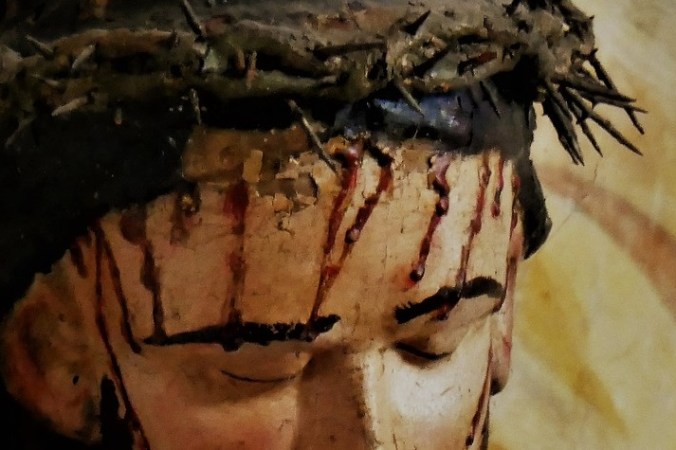
1 Peter 1:18-19 “For you know that it was not with perishable things such as silver or gold that you were redeemed from the empty way of life handed down to you from your forefathers, but with the precious blood of Christ, a lamb without blemish or defect.”

If Peter had been writing these words today, he might have chosen something more valuable than silver or gold to compare to the price Jesus paid for our redemption–platinum or diamonds, stock in Google or Apple–but it would have made little difference in the comparison. If you were to put them all together and chart their value next to that which follows, they wouldn’t even be a mathematical point sitting at the very bottom of the chart.

Perhaps that vast difference explains why it is so difficult to appreciate the price with which Jesus did redeem us. We were redeemed with the precious blood of Christ. One could go and find what hospitals charge for a unit of blood these days, but that is no help. How does one put a price on something so unearthly as the blood of God’s own Son?

Remembering that Jesus is God’s own Son, we might draw comparisons between how we value people dear to us–our parents or our children–and how God the Father must value Jesus, as I and other pastors have done in sermons. Pondering the thought of killing your own child certainly has an emotional impact. But again, can our love for family even begin to compare with the perfect love God the Father has for his perfect Son? Can we even begin to know the value that Jesus has to him?

Finally, no illustration can enable us to grasp it, and no mountains of descriptions will enable us to feel its worth. Martin Luther points out that even the tiniest drop of Jesus blood would have been so precious, so valuable, that it could have paid for the sins of the world, but God the Father is so gracious that he permitted his only Son to pour out all his blood as our innocent lamb of sacrifice. All that we can do is ponder this. All that that we can do is consider the cost. As we take the time to give it our serious attention, perhaps it will help us to value our redemption even more.

Getting God’s Will Done

Jesus embrace

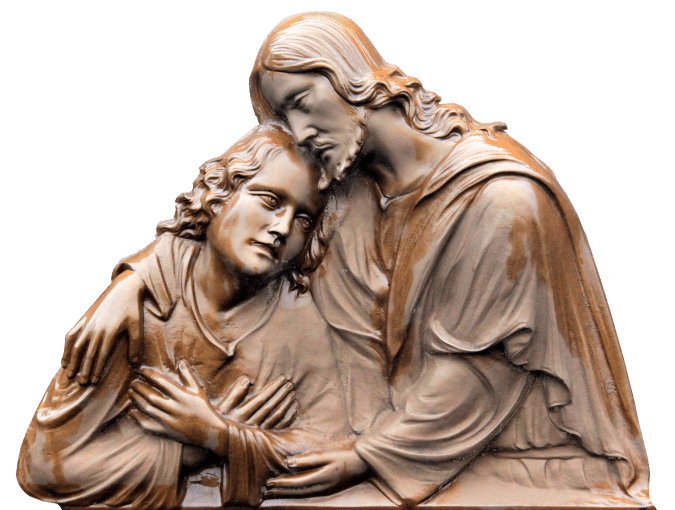
Matthew 6:10 “Thy will be done on earth as it is in heaven.”

God wants to save everyone. God wants people to love each other. Someone might be tempted to ask, “Who would want to oppose that?” But we know the sad answer to the question. Everyone does in some way or another. You don’t need the moral decline of our world detailed for you. Even the majority of the entertainment available is little more than glorifying sex and violence. A twenty-year-old survey taken in Germany asked people about the value of each of the ten commandments. Only four of the ten were considered important by the majority of those who responded. The one considered least important? “You shall have no other gods,” the very first and greatest commandment of all.

This battle between God’s will and man’s is taking place closer to home than we like to admit. Don’t we find ourselves in the same struggle with the Apostle Paul? “I know that the nothing good lives in me, that is, in my sinful nature. For I have the desire to do what is good, but I cannot carry it out. For what I do is not the good I want to do; no, the evil I do not want to do–this I keep on doing” (Romans 7:18-19). What is it that we want? Do we waste God’s gift of sexuality outside the bonds of marriage? Our Lord wants it used only in marriages to make them strong, the foundation for strong families. Surveys suggest that Christians struggle with this sin as much as the general population.

We are affluent people. How often wouldn’t we rather waste our time and money surrounding ourselves with trinkets and luxuries and pleasures instead of investing in the future of our children, the spread of the gospel, or the needs of our neighbors? If we followed God’s will in the matter, we could not only benefit society but swell the population of heaven! Too easily we get wrapped up in how others are catering to our needs, and where we fit in the pecking order of those with whom we associate. Our Lord seeks selfless servants–people whose highest joy is found in serving someone else, no matter how thankless or even hostile that person might be!

My will battles God’s. His will doesn’t come naturally to me. So Jesus must teach us to pray, “Thy will be done.” Only he can lead us to pray “thy will be done” from the heart. He does so by the gift of faith.

He starts by preaching the gospel to us. Jesus takes me by the hand and walks me through his life. He makes me see his miracles of love. As he does so, he promises me that this is not just the kindness one very good man showed to a leper, a cripple, an outcast, a grieving father and mother, a broken sinner, or a hungry crowd many years ago. This is an earthly demonstration of the love with which God in heaven still loves you and me.

He shows me that there is nothing he would spare, no cost too high for him to pay, to save us from our sins and make us his very own. There is nothing more precious in all the universe than the one and only Son of God. Yet God would literally crucify his own Son to save me. Along with this incredible love come so many promises to take care of my needs and bless my life and cover me with his protection. His goodness finally overwhelms my unbelief and transforms my stubborn will as it gives life to the miracle of faith.

That is not to say that we have already been transformed into heavenly perfection. My old will still defies God’s. But by the gift of faith God has also given us a new will. It not only agrees with God’s, and wants his will to be done. It longs for everything on earth to conform to God’s will from the heart. It can’t help but go to God in prayer and plead with him, “Thy will be done.” By faith God has changed us to want and to do what he wants us to do.

This, then, is how God gets his will done on earth: he loves his enemies into his friends, he forgives stubborn rebels into joyful servants. They, in turn, take the power of the gospel and share it with others, so that the miracle of faith can happen again and again, and more and more are transformed into willing workers. In the end, this is the only way that God’s will can be done, because only those who love and trust him from the heart are ever doing what God wants, no matter how people may behave on the outside.