The Plan

meeting

Matthew 26:4-5 “They plotted to kill Jesus in some sly way and kill him. ‘But not during the Feast,’ they said, ‘or there may be a riot among the people.'”

Caiaphas the high priest spoke these words. He and his co-conspirators were not acting as responsible leaders simply concerned about the welfare of the people.  The loss of innocent human life did not weigh on their consciences. They were plotting death, not trying to prevent it. Nor did their plans come from a deep concern that valuable property might be damaged.  A riot would mean a crack down by their Roman masters. A crack down by their Roman masters could mean loss of privileges, power and position.  They carefully planned Jesus’ death because they were looking out for themselves.

Looking out for self is still humanity’s natural religion.  Today you can find groups who teach you to find the “god within you,” but we don’t need them to practice this religion.  We practice it with every sin we commit. We try to elevate ourselves to the status of God and push God off his throne.  So much of life is lived with only this in mind––what will make life more enjoyable, more rich, and more happy for me. And so Jesus’ death was carefully planned for us. The same deceit, that same desire to get rid of God, the same selfishness that hides behind our sins, led these men to plot Jesus’ death.

“Not during the Feast,” was Caiaphas’s idea. Jesus’ own plans overruled him. “As you know, the Passover is two days away––and the Son of Man will be handed over to be crucified.” Whose plan prevailed? Jesus’ suffering and death happened during the Passover Feast, just as Jesus’ had claimed.

Jesus’ plan is an example of God’s poetic planning of history.  At the first Passover a lamb had been sacrificed, and the life and blood of that lamb saved God’s people from death. It delivered them from slavery, and in faith God’s people received all those blessings as they ate the sacrificial lamb in a memorial meal.  Through the years the repetition of this meal continued to preach to the people that our God is a God of rescue, a God of salvation, who delivers his people from slavery and death.

So it is with Jesus’ death.  It’s all there in God’s careful planning.  Jesus is the lamb of God who takes away the sins of the world. The blood of Jesus Christ, his Son, cleanses us from all sin.  Jesus’ sacrifice delivers us from death, and frees us from our slavery to sin.  And even though that sacrifice was made once for all time at the cross, the flesh and blood of our sacrificial Lamb are still eaten in a meal at which the blessings of his sacrifice are given to us.  When we celebrate Jesus’ supper, he comes to us to tell us we are forgiven, free from the slavery of sin now, and free from death forever.

All that Jesus’ enemies plotted thus becomes the instrument for our Savior’s own heavenly love. We couldn’t have planned it any better.


A Peculiar Glory

acorn

John 12:23-24 “The hour has come for the Son of Man to be glorified. I tell you the truth, unless a kernel of wheat falls to the ground and dies, it remains only a single seed. But if it dies, it produces many seeds.”

When a seed is planted, it gives up all it has, its entire existence, to support the new plant. The seed itself “dies” as the new plant emerges, and eventually the seed disappears as the plant draws its life out of the seed. But the plant, in turn, produces a whole crop of new seeds. Death leads to multiplication.

Jesus is like that seed. Like the seed he gave up everything. He gave up the privileges of Godhood to live here as a common man. He gave up his rights and freedoms as God’s Son to live in obedience under the authority of Mary and Joseph, and his local rabbis and elders, and the Roman rulers. He gave up his time to teach and heal and love the people of Judea and Galilee. He never really got a day off. His students, his disciples, even lived with him. Ultimately he gave up his Father’s love, and his special relationship as the Father’s Son, to know God’s anger at our sin, and suffer the hell which we deserved. And after he had tasted such spiritual death, he gave up his spirit, and when they took his naked body off the cross, for he had given up even his clothes to the Roman soldiers, they placed that lifeless body in a borrowed tomb, because he had nothing left to give.

He gave it all up for you. “Unless a kernel of wheat falls to the ground and dies, it remains only a single seed. But if it dies, it produces many seeds.” What if Jesus had never died? What if he had been spared all this pain, and suffering, and sacrifice? Then he would have remained only a single seed, the only one that God considered his child and Son. It certainly would have been easier for him, but you and I would have no spiritual existence– at least there would be nothing positive about us spiritually. We would have no standing as God’s children. Our sin has made that impossible without him.

“But if it dies, it produces many seeds.” In God’s heavenly system of accounting, Jesus death cancels out all the debt we owe for our sins and sets us free from death itself. While Jesus’ death looks weak, and worthless, and impotent, this great act of love actually has such power that the mere news of it miraculously takes hold of human hearts and transforms rebellious sinners into believing children of God. In all this world, there is no greater power than Christ’s own self-sacrificing love. You and I are the seeds which Jesus’ loving sacrifice has produced. We are the adopted sons and daughters of God, and we are only a small part of a family so big, a harvest so fruitful, that when the Apostle John saw it in the book of Revelation, he described it as a great multitude that no one could count. This is the glory of our Savior’s death. This brings glory to our heavenly Father’s name.

Love Builds Up

sheldon

1 Corinthians 8:1 “Knowledge puffs up, but love builds up.”

There is no virtue in being spiritually ignorant. It is God’s will that we grow in the grace and knowledge of our Lord Jesus Christ. Knowledge about God’s word helps us to get to know him better. It feeds our faith. It guides our lives. Bible knowledge is good and necessary.

But all by itself, a little knowledge can be a dangerous thing. God does not want us to study the Bible as an academic interest, or to keep us entertained. Its purpose is not to stretch our minds and challenge our intellect, though it may do so. Bible class serves a higher purpose than preparing us to be contestants on Jeopardy.

When Bible knowledge makes us feel superior to all the Biblical ignoramuses, it merely “puffs up.” It’s the same picture we use when we say someone has a “swelled head.” In that state we become no use to the people around us and absolutely intolerable to God. We need someone to let the air out, to insert a release valve, so that we channel all that knowledge in a useful direction, before we burst and spiritually destroy ourselves.

That release valve is love. Knowledge puffs up, but love builds up. Christian love is not so concerned about self. It cares for others. It is not looking for ways to be superior. It wants to be a servant. It does not seek ways to make me look good. It seeks ways to make God look good, and it seeks ways to do good to others.

Love like this also does some enlarging, but what gets bigger is not my swelled head. It’s my heart. Love builds up. It is a servant. It builds up the kingdom of God. It builds up brothers and sisters in their faith. It builds by humbly sharing knowledge about Jesus with others. It does not waste time trying to build some sort of monument to myself.

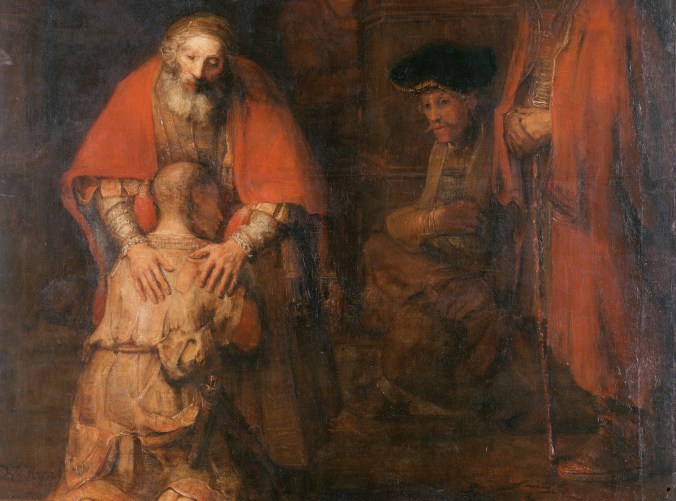
Where do we get such love? Not in that know-it-all knowledge that inflates our egos. “The man who thinks he knows something does not yet know as he ought to know. But the man who loves God is known by God.” The most important thing is not how much we have come to know about God, but that we are people God knows as his very own. And what kind of people does he know as his very own? Jesus said that he came to call not the righteous, but sinners to repentance. He told Simon the Pharisee that the sinful woman who anointed his feet loved him much, not because she was so good, but because she had been forgiven so much. Jesus called Peter to discipleship, not when Peter was the know-it-all fisherman, but after the miraculous catch when Peter fell at Jesus feet and admitted that he was a sinner. The prodigal son was welcomed home not because he had spent his inheritance so wisely, but when he came home with empty hands to a forgiving Father. Jesus says that the tax-collector, whose only prayer was “God have mercy on me, a sinner,” went home justified by God, not the super righteous Pharisee bragging about his victorious life. Those who are known by God know that they are sinners, but they also know by faith that God forgives them.

Are you ready to have your spiritual pride and puffed-up knowledge crushed under God’s holy condemnation? We are never ready, but when he does so, he also assures us he forgives our sins. He pick us up in faith. He claim us as his own. Then it can be true of us that “the man who loves God is known by God.” This is also something we know from God’s holy word. But when that word convinces us God has so loved and forgiven us, our knowledge will no longer be a dangerous thing, because knowledge will be tempered by love.

Hold On for Dear Life!

climber-4048_1920

Proverbs 4:13 “Hold on to instruction, do not let it go; guard it well, for it is your life.”

Solomon would not give us this warning if he did not know how easy for us it is to let instruction from God’s word slip away. When we have had his word for a long time it is easy to take it for granted. Over time we begin to forget that its call to repentance isn’t only for the people “out there.” It is calling you and me to repentance every day. We grow weary of studying the word, weary of hearing it. Our interest wanes, our grip on its content loosens, our hands become slack, and eventually it slips away.

As you hear the word, be on your guard so that you don’t let it go! Don’t lug it around like it is only so much baggage, and your arms ache to set it down. Don’t let it go! Embrace it like a dear friend! Hold it like the one great love of your life! Grip it like the action hero clinging to the last shreds of some rope, realizing that if he lets go a hundred foot drop and hungry alligators wait for him below.

If we let go of God’s word, there is no guarantee we will get it back again. Martin Luther once warned: “Buy while the market is at your door; gather in the harvest while there is sunshine and fair weather; make use of God’s word and grace while it is there! For you should know that God’s word and grace is like a passing shower of rain which does not return where it has once been.” If we are not diligent about learning that word and teaching it to the next generation today, we have let our guard down, and it could be lost to ourselves, our children, and grandchildren who follow forever.

Holding on means only blessing. What greater blessing can we have than life itself? Sometimes when people are are passionate about some interest, or when they really love their job, they say, “It’s my life.” “Football is my life.” “Building houses is my life.” “Raising my family is my life.”

For the believer, God’s word deserves to be just such a treasure: “God’s word is my life.”

But Solomon means much more than that God’s word is a favorite hobby. It really is our life! You and I would have no spiritual existence, no spiritual life, no relationship with God, no faith in Jesus, no forgiveness of sins, no promise of heaven without the instruction of God’s word. God’s word has breathed life into these spiritual corpses. God’s word has created a living faith in these stony hearts. In the word we eat the bread of life. In it we drink the living waters by which Jesus promises us forgiveness and grants us the Spirit who sustain our life of faith in this world. Apart from his word, it is only a matter of time before faith fades and finally fails.

There is only one textbook for the kind of instruction Solomon has in mind in this proverb. It is God’s own word in the Bible. Hold on to it for dear life!

Don’t Get Mad, Get…Forgiving

prodigal-rembrandt

Luke 17:3 “If your brother sins, rebuke him, and if he repents, forgive him.”

No part of the Christian life is harder than the part Jesus describes here. First, he asks us to rebuke sin when we see it. Do I have the moral authority? After all, I have been guilty of the same things at some time. But Jesus doesn’t want us to rebuke sin because we are better. He is not condoning a better-than-thou attitude. We rebuke sin because we love the person. Only when our rebuke comes from love is it likely to be accepted.

What if we lose our relationship with those we rebuke? That is a real possibility. But then let’s not pretend we are keeping our mouth shut because we love them too much. That kind of love isn’t love for the others. It’s only a love for what we might lose, a relationship we enjoy.  That amounts to a love for myself. Jesus’ words remain, “If your brother sins, rebuke him.”

As hard as it can be to rebuke sin, forgiveness can be even harder. When someone hurts us, we get mad. We get bitter. Our sense of justice kicks into overdrive. “That’s not fair.” “That isn’t right.” “What did I ever do to deserve this?” When someone hurts us more than once, it may be more than we can stand. “That’s it. I’m through. See if I ever talk to him again.”

To understand what a horrible sin it is to be unforgiving, it helps to review what horrible things unforgiveness does. Look at the damage it causes. How many marriages haven’t been ripped apart because a husband, or wife, or both refuse to forgive the little irritations or the inconsiderate behavior of their companion? They keep dredging the same old hurts and resentments up over and over again. How many families don’t live in perpetual bickering and complaining because brothers and sisters and in-laws turn every slight or criticism into a personal attack for which they refuse to forgive? How many churches don’t work under a cloud of gloom, tension, and suspicion when brothers and sisters in Christ won’t confront each other in love, and forgive from the heart. Perhaps they imagine their pain somehow makes holding a grudge defensible. Isn’t unforgiveness a miserable way to live? It makes us sour, sullen, short-tempered and sharp-tongued. Our sinful flesh might find some kind of twisted pleasure in it, but unforgiveness is a sin which wreaks havoc on our human relationships as well as our relationship with God.

On the other hand, is there any blessing like forgiveness? That God should make you or me a little ambassador of his grace, who can forgive my friend when he sins, because Jesus forgives him when he sins, may be the most joyful service he has given us. That others should love me so much that they will forgive me even when I have been a dunderhead, or just plain mean–because Jesus loves me so much that he forgives me, and even suffered the punishment that I deserved in my place–is one of the sweetest gifts we will know this side of heaven. When you and I are offering each other forgiveness, in our own little way we are sharing the gospel with each other. What a blessing if we should have the opportunity to assure someone, “Jesus forgives you and so do I.”

Certain of Your Sainthood

christ-mosaic

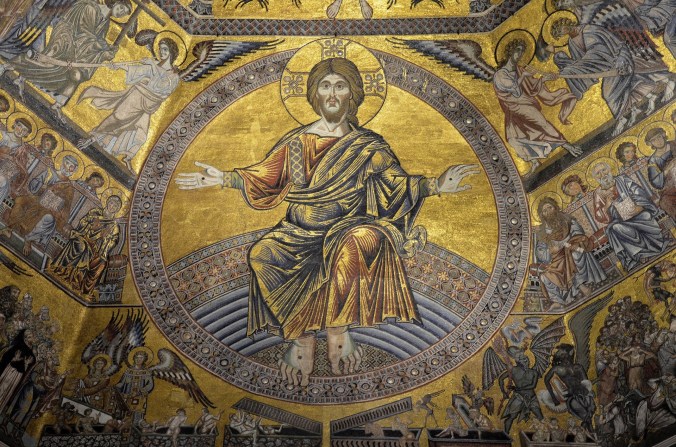
Hebrews 10:11-12 “Day after day every priest stands and performs his religious duties; again and again he offers the same sacrifices, which can never take away sins. But when this priest had offered for all time one sacrifice for sins, he sat down at the right hand of God.”

Where did the idea behind the Old Testament temple sacrifices come from, these sacrifices the priests of Israel offered? These were commanded by God himself! In the daily worship at the temple God established several kinds of sacrifices for different situations or occassions, but there was one thing they all had in common. They had to be repeated over and over again. None of them was a lasting solution for the problem of sin.

If that is true of the repeated sacrifices which God himself had commanded, what does that say about the ongoing sacrifices of service, or time, or money that people keep on offering to God, day after day after day? If even the repeated sacrifices, which God himself has invented, can’t take away sins, can all the kindnesses of a little nun do any better? Can all the charitable donations of the world’s richest billionaires? Can all the endless peacemaking of the world’s greatest humanitarians? Can all their combined busyness do more than the sacrifices prescribed by God himself?

The answer is obvious. “No, they can’t.” Sometimes Christians have been accused of a “graceless imperialism” when we say that only believers in Jesus will go to heaven. Some people view such claims as a claim that we are better than everyone else in every other religion. But is that what we are really saying? If even the Old Testament sacrifices of God’s chosen people couldn’t make them holy, if our own good deeds and our own charity, repeated day after day after day, can’t attain forgiveness, will those done by anyone else be able to? The answer must be “No.”

Only one thing can take away sins. Only one thing can make people holy. “But when this priest had offered for all time one sacrifice for sins, he sat down at the right hand of God.” If we want to be saints, if we want to be holy people, the place to look is not to ourselves. It’s not a matter of trying harder. The place to look is to Jesus and to his perfect sacrifice. Jesus’ sacrifice does make us holy. It has taken away sins, and we have good reasons to be sure.

First, there is the matter of how many times Jesus offered himself as our sacrifice. He “offered for all time one sacrifice for sins.” His sacrifice was an instant and complete success. “If it aint broke, don’t fix it,” people say. Since Jesus’ sacrifice paid for sin and repaired our relationship with God on the first try, there was no need for him to keep on offering sacrifices to fix it.

We can be all the more certain of this because Jesus has returned home. He “sat down at the right hand of God” in heaven. When Jesus came to earth, he wasn’t coming to stay. He had a job to do, and now his job is done. His work here is finished, and he didn’t stick around as though he would continue to offer sacrfices for sin. He has returned home, not for retirement, but to do his other important work: ruling and protecting us, and preparing our place with him there.

We often hear, “Nobody’s perfect.” Generally we are inclined to agree. If somebody claimed to be perfect, we would think that they are guilty of the height of arrogance. But this is not entirely true. In Jesus, everybody’s perfect. In Jesus you are perfect because by one sacrifice Jesus made us perfect forever. This is how God sees you now. Christians aren’t better than others, but Jesus’ sacrifice has made them saints.

Making Christians Great Again

pray-kneel

Proverbs 25:6-7 “Do not exalt yourself in the king’s presence, and do not claim a place among great men; it is better for him to say to you, “Come up here,” than for him to humiliate you before a nobleman.”

We all would like to claim a place among the great men. George Banks says it clearly in the movie Mary Poppins. He laments, “A man has dreams of walking with giants…” after losing his job as a bank officer.

The humble Christian knows his place. Instead of prideful self-promotion, he is content with his position. But that humble contentment is a difficult thing to practice. It’s difficult because everything around us screams at us not to be content. Every television commercial we see, whether good or bad, tries to convince us that we don’t have enough, that life could be better, that we deserve more than we have. And we tend to agree.

Its difficult because humility is something that you can’t work on by focusing on it. Pride can be pointed out and confronted. But humility is practically unaware of itself. It doesn’t want to be noticed. It’s not the sort of thing you achieve by resolving, “This year I’m going to be humble,” and then checking yourself periodically to make sure you are. If a humble person becomes truly aware of his humility, it is almost impossible to resist taking a certain pride in becoming so humble.

Someone once said, “A proud man is always looking down on things and people: and, of course, as long as you are looking down, you cannot see something that is above you.” Proud hearts don’t acknowledge God above, not sincerely. If they come to him at all, they come to him with their hands full of their own good works, their own mystical experiences, their own superior beliefs, to impress him. Pride leads us to exalt ourselves in the presence of The King of Kings. But God doesn’t have anything to offer us if our hands are already full. He certainly isn’t impressed with what we have to bring. The only proper way for me to approach him is as a beggar. The humble Christian knows that this is his place, and he is content with his position.

A humble position is not a bad place to be. There is no place to go but up. The humble Christian knows that when he is in his place, he is also in a position to be honored.

That’s not to say that humility is an absolute guarantee of earthly honor. A proverb is not the same thing as a promise. Solomon says it is better for the king to say, “Come up here.” He doesn’t say that it always happens that way. We know from experience that sometimes the wrong people get all the attention. But if humility has truly taught us our place, and if we are content with our position in life, that won’t matter. We will be happy with the status and the things God has decided to give us.

And we’ll know that when we are humble before the Lord, we are in a position in which God does promise to honor us. “Humble yourselves before the Lord, and he will lift you up,” the apostle James reminds us. There is nothing more humbling than admitting, “I have sinned and I need to be saved.” Then we are coming before God with empty hands, begging him to forgive us.

God lifts us up. Like the king in Proverbs he says to us, “Come up here.” “Come up here. My Son Jesus Christ has traded his life for yours. He lifted you out of your sins and set you free.” “Come up here. You’re one of my children now, a child of the Great King, a prince or princess in the Kingdom of God.” “Come up here. Your home and your citizenship are in heaven.” “Come up here. I have given you an honor that nothing can surpass, a position that no one can take away, a place by my side, where you will know my eternal care.”

There is no higher position than to be one of God’s humble little children.

Past Performance Guarantees Future Results

profits

Luke 16:9 “I tell you, use worldly wealth to gain friends for yourselves, so that when it is gone, you will be welcomed into eternal dwellings.”

Jesus tells us two things to consider about the future as we use worldly wealth. The first is  this: the day comes when it is gone. Jesus doesn’t say “If it is gone.” He says “When it is gone.”

We all know this is true. Not only do we know “You can’t take it with you.” So often it doesn’t even last until we are ready to leave. None of our possessions, money, hobbies, investments, titles, or offices have truly lasting value. That car you were so proud to be seen in just a few ears ago suddenly has the water pump, alternator, and transmission all go at once, and the trim on the outside is falling off. The home that was your dream house needs new shingles and paint, but the greater concern are the cracks starting to appear in the foundation. The doctor tells you they could operate, but this is a problem you probably have to live with. All the worldly wealth we throw at our problems can’t keep up with them. Some day the money is gone, too. By and large, our investments in this world and this life are an exercise in futility.

There is one investment that has lasting value. The second thing about the future to consider is that the friends we make in Christ, the people we lead into the family of faith, will some day welcome us “into eternal dwellings.” The investment of our worldly wealth we make into spreading the gospel of Jesus Christ to others is something that we can enjoy forever in heaven.

In other words, the money you put into driving through rush hour traffic Monday through Friday, and the time you put into your job through the week, gives you a little cash that isn’t going to last. But the money and time you put into driving yourselves and your children to worship and to Sunday School, and the time you put into telling them about Jesus, has benefits that last for all eternity. The money you put into mortgage payments, and the time you put into decorating and maintaining your home, may keep you safe and comfortable for a few decades–if your company doesn’t transfer you somewhere else sooner. But the money you invest in world missions, and the time you give for your church at home, make it possible for hundreds, or even thousands of people to share eternal mansions with you where there is no more danger, no more pain, and no more tears.

The gospel is forever. Forgiveness is never used up. The cross will never become obsolete. Consider what the future holds if you want to invest your Savior’s gift of wealth for returns that never end.

Better Thinking

thinker

Ephesians 4:17 “So I tell you this, and insist on it in the Lord, that you must no longer live as the Gentiles do, in the futility of their thinking.”

Ordinarily I don’t like to dwell  upon the sins of the world around us when I preach or teach. They aren’t here to be confronted. It’s more important that we hear what God’s word has to say about us. But in order to help the Ephesian Christians better understand themselves, the Apostle Paul began by describing the way of life of the non-Christian Gentiles around them.

The basis for their problem can be found in their way of thinking. Paul tells us that they live “in the futility of their thinking.” The problem of living the wrong way never starts with the things that people do. It goes back to the way they think and believe. It is a matter of the heart and mind.

Paul calls the Gentile way of thinking, the unbeliever’s way of thinking, “futile.” It is empty, worthless, and backwards. Those things which are truly valuable are eternal and spiritual–faith and forgiveness, God and heaven, worship and prayer. Yet the unbeliever values these things least of all. Instead, he gives the highest place in his life to those things which are merely material, only earthly. Jesus says of food, and drink, and clothes, “The pagans run after all these things.” The unbelieving often value most  those things which aren’t even necessary for earthly life, things which are here and gone, things which serve no one but themselves–merely pleasure, merely recreation, merely luxury. Some of these may have some small legitimate place in life, but in the long run obtaining them is only meaningless, vanity, a chasing after the wind, as the writer of Ecclesiastes says. Thinking which enthrones earthly pleasure and ignores God is futile.

The Ephesian Christians knew that unbelieving way of thinking and living well. It was their former way of life, and they still carried it with them in their old self, the sinful nature. The old self hadn’t changed. It was still full of deceitful desires. It still desired all those sinful pleasures which promise more than they can ever deliver. No matter how long you and I have been Christians, we have that old self, too. Every honest believer must admit that he struggles with him every day.

But we don’t have to live under the same cloud of darkness as the rest of the world. That is not because you and I are so smart. It is because God has been so gracious. He has shown us we are more than talented animals that can taste and touch and hear and smell and see. We are more than consumers of what life has to offer, and we do not belong to just ourselves.

God has shown us we are responsible, moral human beings he created for himself. And though we have rebelled against him with our sin, no less than the unbelieving Gentiles, he has paid an aweful price to cancel the guilt of our sin and purchase us for himself once again. God’s one and only Son has sacrificed his life in place of ours, taking our futile thinking and futile living upon himself, and making his perfect life of love our own. He did this so that he might present us to his Father without any sin, pure and holy. He set us free from the darkness and power of sin.

Since God has brought us to repentance and faith, he has replaced our futile thinking with a new outlook on life. The Greek word for repentance simply means to change your thinking. God changes our minds about sin and leads us to find our sinful desires and actions as disgusting and repulsive as he does.

Then he takes a hold of our hearts and minds through the power of his word,  especially through his words of promise and forgiveness in the gospel. Every time we go to worship, every time we sing a hymn, every time we listen to Christian music, every time we meditate on the word, every time some Christian piece of art leads us to ponder and believe in God’s forgiving love, God’s power is present to change our minds and make us new in faith and life.

Change is never easy. God’s daily call for us to change in repentance and faith is by far the hardest of all. But he has given us his gospel to get our thinking straight, and rescue us from the futility of the faithless way of life.