Everything Jesus Commands

Bible Hands

Matthew 28:20 “…and teaching them to obey everything I have commanded you.”

No part of God’s revelation comes to us on a “take-it-or-leave-it” basis. God has not set Christianity up like a cafeteria, where we have the choice to take only what suits our tastes. It is more like a carefully planned, home-cooked meal. It is intended especially for our spiritual nutrition, not for our sensory pleasure. Quite often, the less tasty portions of God’s word are the most important for us. Like regular food, much of God’s word proves to be an acquired taste.

That is why Jesus adds the word “everything” to his commission to go and make disciples. Of course, he expects us to teach the entirety of his gospel promises as well as his law’s commands. Of the two, the gospel is even more urgent for our faith and life. Nothing fortifies us more. But this has already been alluded to with his words about baptizing in the name of the Father, and of the Son, and of the Holy Spirit.

Now he reminds us that living as his disciples means walking in his commands. A changed life naturally flows from a disciple’s faith. God’s grace and forgiveness don’t cancel good works out of our lives because we don’t need them to get to heaven. It inspires them! It is the grace of God that brings salvation, Paul writes Titus, that “teaches us to say no to ungodliness and worldly passions, and to live self-controlled, upright, and godly lives in this present age” (2:11-12).

And in order that all may know what a godly life looks like, Jesus includes “teaching them to obey everything I have commanded you,” as he sends us to win the world to faith in him. We go with his word, and that word changes lives as we go.

Baptizing and Disciple-making

Baptismal Euer

Matthew 28:19 “Therefore go and make disciples of all nations, baptizing them in the name of the Father and of the Son and of the Holy Spirit.”

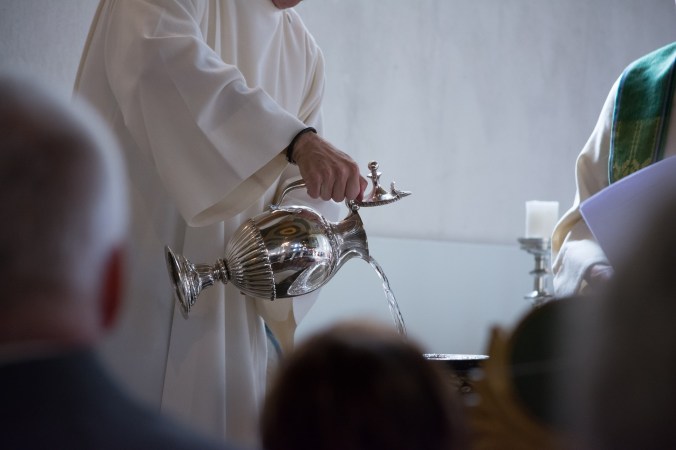
What does Baptism have to do with making disciples? Let’s start by looking closer at the formula for Baptism Jesus gives us. We are to baptize in the name of the Father, Son, and Holy Spirit. Sometimes when we say we do something in the name of someone, it means that we are doing it for them–we have been duly authorized. That is certainly the case when Jesus’ disciples use Christian Baptism. They have been sent and authorized.

But there is more to it than that. In his first letter to the Corinthians, Paul points out that none of them were baptized into his name, as though he were the Savior. In Romans he says that we have been baptized into Christ Jesus and into his death. In other words, baptism creates a connection–a connection between us and the Triune God Jesus mentions here.

He emphasizes the blessing and promise of that connection by including the word “name.” God’s name, as you know, is more than just his titles. It’s the blessings and saving truths those names call to mind. Your good name is more than just the letters of the alphabet you put down in your signature, the sounds people make when they want to get your attention. It is your reputation–the things people associate with you, whether good or bad. Baptism connects us with the names of God and all that they stand for. It soaks us not just with water, but with our Lord’s every grace and blessing.

Baptism, then, connects people to the Father, the Son, and the Holy Spirit by faith. We don’t have three Gods but one. Scripture is clear enough about that. We don’t baptize in the name of three unequals, one God and two other things. You wouldn’t name a law firm Williams, Smith, and Young if Williams were an attorney, Smith his secretary, and Young the maintenance man. You don’t name Father, Son, and Holy Spirit like this, and baptize in their name, if they don’t stand on equal footing. Yet the distinction between each of these three persons in our one God helps us understand even more the invaluable benefits of being connected to him.

Jesus’ disciples enjoy God as their Father. Like all people, they owe their very existence to him. But unlike the rest of our world, they are sure of his faithful, parental love and providence. They live in the security of his protection. My children never worried day to day whether we would feed them. There was no question in their mind that we would do everything in our power to protect them. They were secure in knowing this is so. In baptism Jesus’ disciples have the promise that God is not merely the Father. He is our Father– a God who doesn’t want to scare us, but take care of us and make us secure.

In Baptism Jesus’ disciples are also connected to God the Son, who became one of us and stood by us and died as one of us to save us. Doesn’t that make the truth that Jesus, the Son, is God in human flesh more than a fact that we learn and defend, but a beautiful, winsome thing we want to believe?

God lovingly made the world, and made mankind, only to have his creation rebel against him. In response he didn’t destroy them and start over. He joined them as a man without joining their rebellion. He let them kill him, so that by his death he could pay the due penalty for their rebellion. God made himself so lowly, and suffered so much, so that forgiveness would be more than a nice sentiment. It would be founded on his sacrifice. He came to us so that he could make a way for us back to him. You will not find a god who loves like that described in any other holy book or any other world faith. It is the unique understanding of those who are baptized as Jesus’ disciples.

All of this is brought to us by the quiet work of the Holy Spirit. He comes to us in our baptisms as he came down in Jesus’ baptism. When Jesus comes knocking on our heart’s door, the Holy Spirit is standing next to him with the key.  And he unlocks it and gently pushes it open for Jesus to enter. All of these blessings of Father, Son, and Holy Spirit come pouring over us in the waters of our baptisms. That is why it plays such an important part when we go to make disciples.


All Nations

All Nations

Matthew 28:19 “Therefore go and make disciples of all nations…”

I know of no place on the planet where people don’t believe in a god, or gods. I have watched and listened to dozens of missionaries home to show their slides and tell their stories. Inevitably, they get to the part about the native religions of the people they are trying to evangelize–the Shinto shrines of Japan, the witch doctors and spirit worship of Central Africa, Voodoo religions of the Carribean, Buddhist temples in Thailand, nature worship among Native American tribes, militant Islam in Indonesia.  In no case have they been sent to a people to whom “religion” or “god” is a new concept.

For this reason, some have questioned the need or propriety of trying to bring our God and our faith to them. Ernst Wendland served many years as a missionary in Zambia. He told my seminary class about a conversation he had on a flight back to Africa after a little time off in the U.S. The man sitting next to him challenged the need for mission work. “Here is the simple native with his simple religion. He has his little altar and leaves gifts of food for the spirits of his ancestors. He is sincere and pious in the way he practices his faith. Why would you want to come and disturb all that?” he asked.

“The reason,” Professor Wendland said, “is that that man lives in mortal fear of those spirits. Every day he wonders what they are going to do to him. He has no peace. He knows no Savior.” Realizing that there is some kind of god or gods is not the same thing as knowing that there is Father in heaven who made you and loves you, a Son who gave his life to save you from sin, and a Spirit who brings this peace to your heart. That is why Jesus said, “Go and make disciples of all nations,” no exceptions. Our disciple-making mission is to all nations. He wants every kind of people. He is not just our God. He is the only God for everyone.

Not only does “all nations” remove all race discrimination from our disciple-making mission. It removes all age discrimination as well. Within Christianity, some question the necessity of making disciples of the youngest–our children and infants. “They are too young to understand it, too innocent to need it, and we have no Biblical example to support it,” they claim.

But faith is not first about knowledge. It’s about trust. You think an infant doesn’t trust its mother? Try taking it from her arms. If they are completely innocent, then why do even the youngest sometimes die? The wages of sin is death. And though we have no story in the Bible about the baptism of an infant, we have no story in the Bible of the baptism of an American, either. That hasn’t stopped us from making them disciples, baptizing them, and teaching them the word. “All nations,” Jesus says. Our disciple-making mission is also to the very youngest. “From infancy, you have known the Holy Scriptures which are able to make you wise for salvation through faith in Christ Jesus,” Paul wrote Timothy.

So Jesus tells us “Go.” Go to your agnostic neighbor with the Ph.D. whose skepticism seems impregnable. Go to the scowling high school drop outs with their bling and their baggy pants hanging half way down to their knees. Go to the people whose political views make you wonder if they come from another planet. And where you can’t go, send others. Go to the remote tribes who would rather eat the missionaries than listen to them. We go to all nations, because Jesus is the Savior of them all.

How Firm a Foundation

House Rock

Matthew 7:24-25 “Therefore, everyone who hears these words of mine and puts them into practice is like a wise man who built his house on the rock. The rain came down, the streams rose, and the winds blew and beat against that house; yet it did not fall, because it had its foundation on the rock.”

Jesus’ picture of the storm beating against the house isn’t hard to understand, is it? Our faith is constantly under attack in this life from a number of different sources. All of them beat against us and try to make our faith fall.

You know the kinds of storms of life that stretch your faith to the limits–health problems, financial worries, families that are falling apart. Sometimes the crisis comes from a more directly spiritual attack. The Apostle Paul once said that God “was pleased to save us through the foolishness of what was preached.” And that is how our human reason is tempted to see so much of what our Lord reveals about his grace–foolishness. No one is immune. Storms of doubt and skepticism rage against our souls.

But the faith that is planted squarely on the words and promises of Christ does not fall, “because it had its foundation on the rock.” We stand on a word that supports us. Sometimes that’s because the word is like a road map, pointing us along the roads we ought to take as we react to the storms that beat on our faith. Some paths of action are more like escape routes for us. Some will only take us deeper into the storm. Jesus’ words help us see the difference.

The bedrock of this foundation for our faith always takes us back to the changeless and faithful love we know best from the simple truth of the gospel. God so loved the world that he gave his one and only Son, that whoever believes in him will not perish but have everlasting life. This is love: not that we loved God but that he loved us and sent his Son as an atoning sacrifice for our sins. God demonstrates his own love for us in this: while we were still sinners, Christ died for us. No greater love has anyone than this, that he lay down his life for his friends.

It is this that led the apostle Paul to conclude: “Who shall separate us from the love of Christ? Shall trouble or hardship or persecution or famine or nakedness or danger or sword? As it is written, ‘For your sake we face death all day long; we are considered as sheep to be slaughtered.’ No, in all these things we are more than conquerors through him who loved us. For I am convinced that neither death nor life, neither angels nor demons, neither the present nor the future nor any powers, neither height nor depth nor anything else in all creation will be able to separate us from the love of God that is in Christ Jesus our Lord.”

We stand on a word that supports us, a firm foundation our faith can trust.

Where to Stand

Luther Bible

Matthew 7:24 “Therefore, everyone who hears these words of mine and puts them into practice is like a wise man who built his house on the rock.”

Today we take the opportunity to hear God’s word for granted. A European friend who had been to the United States once commented on how many churches there are here. It seemed to him that there were church buildings all over the place. He is right. But it’s not just the churches. There are entire television networks devoted to making God’s word available. Not only are Bibles and Christian literature available from Christian bookstores, but you can also pick them up at any Barnes and Noble, or even Sams, Walmart, or Target. Many churches just give them away.

It hasn’t always been like that. When I was attending a Lutheran elementary school, I remember studying the Reformation and seeing pictures of a Bible chained to a stand in a Medieval library. No one could check the Bible out. In 1229 the Council of Toulouse put the Bible on the list of banned books. Lay people were not allowed to read it. That decision was reconfirmed by the Council of Trent some 300 years later. As late as the 1890’s Pope Leo XII allowed the lay people to read the Bible only if they read it in Latin, and only if they got personal permission from their priest first.

After Martin Luther learned from Scripture that Jesus had paid the full penalty for his sins, that forgiveness of sins is something God gives to his people for free, and that we receive this gift by faith, not because of our good works, he knew that the Bible had to be made available to everyone. In 1521 he began translating the New Testament into German. By 1522 it was done. By 1533 the entire Bible was available. Hundreds of thousands of copies were printed. During this period William Tyndale was emboldened to translate the Bible into English. Others translated it into the native language of their own countries. God’s word was available to God’s people once again. Today we take the opportunity to hear and read it for granted.

And maybe that is just our problem: we take it for granted. It’s not just that so few people actually read one of the Bibles sitting on their shelves at home. Fewer and fewer come to hear it. For all our churches, attendance on Sundays hovers around 20%. I realize Jesus is emphasizing hearing the word and putting it into practice in these words from the end of the Sermon on the Mount. But how can we put a word into practice we don’t even hear or read?

In the context of the Sermon on the Mount, putting this word in to practice means that we don’t rationalize our sins. When his word corrects some unbiblical idea we have, we don’t go looking for reasons why I am right and the Bible is wrong. We don’t chalk it up to a difference in interpretation. Jesus’ words are as plain and easy to understand as a Dick and Jane book from 1st or 2nd grade. So the child of God lays aside his or her false sense of sophistication and prideful skepticism and repents. He doesn’t let there be a wide gap between the word he hears at church or reads at home, and the life he lives in public.

Even more, hearing Jesus’ words and putting them into practice means living life like you believe his promises. Those promises give us the courage to live life fearlessly. “If God is for us, who can be against us? He who did not spare his own Son , but gave him up for us all, how will he not also, along with him graciously give us all things?” That kind of faith gave Luther the confidence to stand up to the pope, the emperor, and all his critics. Convinced by the word that Jesus was on his side, forgiveness and grace were his constant possessions, and heaven was his certain destination, he was not afraid to proclaim his faith even under the threat of death.

When we take our stand on a word we practice because we believe its promises, we find our courage, too.

Paradise. Truth.

stairs heaven

Luke 23:43 Jesus answered him, “I tell you the truth, today you will be with me in paradise.”

When God’s people agree they say, “Amen.” For us, that word is usually a response, a conclusion, the end of the matter. For Jesus, “Amen” was an introduction. We say “Amen,” we are certain, after we have heard. Jesus tells us we can be certain even before he has spoken. “Verily, verily,” “Truly I say to you,” “I am telling you the truth” are all ways of translating the word Jesus used to introduce so many of his sayings in the Aramaic, “Amen.”

So it is here. “Amen–I tell you the truth” Christ calls to the criminal crucified on the cross next to him. “You can believe what I am about to say to you. What I am about to share with you is no joke.”

And if ever there was a time to be serious and truthful, this was it. In just a few hours, these men on Jesus’ right and left would be ending their earthly journey and facing their eternal destiny. As the author of Hebrews reminds us, “It is given to man once to die, and then to face the judgment.” That isn’t a joking matter for people like us whose lives are stained with sin.

And so Jesus gives the man words that can also sustain our faith on the day of our deaths, and assure us that we have not misplaced our trust. “Today you will be with me in paradise.” Jesus himself would die just an hour, maybe two, before this man died. Jesus’ death was opening a door to another life, the Paradise of God–back to a world like the one at the far edge of all human memory, hardly more than a rumor now, yet hungered and longed for in the deep places of every human soul. Jesus’ death was opening the door to another world where there is no crime or criminal, no pain or punishment, no death or judgment. Jesus’ death provides the payment that opens the door to God’s own garden of delights, the Paradise of heaven.

And later, when this man’s legs were broken, and after a few minutes he hobbled through death’s door, there was Jesus himself waiting for him, receiving him, just as he had promised. “Today you will be with me in paradise.”

Someday he will be waiting on the other side of that door for you, too. That very day you will be with him in paradise. He is telling you the truth.

Bigger Than You Think

seeds

Mark 4:30-32 “Again he said, ‘What shall we say the kingdom of God is like, or what parable shall we use to describe it? It is like a mustard seed, which is the smallest seed you plant in the ground. Yet when planted, it grows and becomes the largest of all garden plants, with such big branches that the birds of the air can perch in its shade.”

Sometimes God’s people worry about the numbers. That is nothing new. Do you remember the prophet Elijah? He became so depressed by how weak and small the congregation of believers had become in Israel in his day, that he ran off into the wilderness, hid in a cave, and asked God to take his life. “The Israelites have rejected your covenant, broken down your altars, and put your prophets to death with the sword. I am the only one left, and now they are trying to kill me, too.” The situation was 7000 times better than Elijah thought, but he couldn’t get past the fact that the Word of God seemed so unsuccessful, and the number of believers so few.

Look at Jesus and his disciples. “Have no fear, little flock,” Jesus assured them at one point in his ministry, and a little flock they were. Beyond Jesus and the twelve, there were perhaps 500 believers by the time Jesus returned to heaven. That may seem like a healthy size for one congregation, but that was it for the entire planet. It was these 500 little souls in a sea of millions. The beginnings were rather small.

“The kingdom of God is like a mustard seed, which is the smallest seed you plant in the ground.” Small beginnings are nothing new for God’s kingdom. Nor are they a reason to worry or a reason to give up. “Yet when it is planted, it grows and becomes the largest of all garden plants, with such big branches that the birds of the air can perch in its shade.” We are in the business of planting the seeds of God’s kingdom. God makes those seeds grow into something far grander than we can see now.

But like the mustard seed, God’s kingdom grows into something far larger, far more grand than we might have expected. That’s his promise. About one out of four people in the world are nominally Christian. Those who possess a genuine saving faith may be far fewer. But you know that the kingdom of God is far bigger than your little congregation, or church body, or even all of the visible Christian churches in the world. It includes the whole population of heaven waiting for us to join them.

If you want a little glimpse of what the mustard tree looks like in the end, then, you have to turn to the last book of the Bible. There the Apostle John shares his brief view of it, “After this I looked and there before me was a great multitude that no one could count, from every nation, tribe, people and language, standing before the throne and in front of the Lamb. They were wearing white robes and were holding palm branches in their hands. And they cried out in a loud voice: ‘Salvation belongs to our God, who sits on the throne, and to the Lamb’” (Revelation 7:9-10). In the end God’s kingdom grows to such a grand size that no one can count its members.

Judging by what we see happening in his kingdom today, maybe that exceeds our expectations. Judging by the love and the power of the God who gives us this kingdom, this is no real surprise.

In the meantime, don’t judge God’s kingdom by the numbers you see today. There is power in the gospel seed, and far more believers than you know.

The Power Is in the Word

seedlings

Mark 4:26-27 “This is what the kingdom of God is like. A man scatters seed on the ground. Night and day, whether he sleeps or gets up, the seed sprouts and grows though he does not know how.”

The seed that makes God’s kingdom grow is God’s Word. You and I have a rather narrow and specific role here. We are like the man who scatters the seed on the ground. All we can do is scatter God’s word around. Actually, there is enough work there to keep us occupied our entire lives. There are about seven and a half billion people living on planet earth. More than five billion of them do not follow Jesus yet. Two hundred and fifty more people are born every minute–about 360,000 every day. That is enough to keep us busy just getting the seed spread around, just trying to make sure that everyone has heard the gospel.

Sometimes we don’t like our role very well. We aren’t satisfied to stick to the business God has given us. We grow impatient, because the seed of God’s Word doesn’t sprout and grow as quickly as we want. Then we get the idea that we are more than sowers. We think we are also genetic engineers. Perhaps we can create some hybrid seed that will grow even faster. We start tinkering with the message to make it more appealing. If we could just leave some part out, people would find it easier to believe. We might remove unpopular parts, like those that teach us God’s design for human sexuality. We might ignore the seemingly unreasonable parts, like the teaching about a God who is one and three all at the same time. We might tone down the scary parts, like the eternal torments of hell. People don’t want to talk about these things. It doesn’t make them feel uplifted.

The problem when we tinker with God’s Word, and produce our own hybrid seed, is that we don’t get what we think we will get. At best, we have introduced a weakness into God’s kingdom that threatens the life of the new sprouts. At worst, we don’t produce Christians at all. All that new life we think we see is just weeds. New people may be present, but they have no faith.

It is for our faith and comfort that Jesus has placed all the power to grow in his Word, and not given that responsibility to us. “All by itself the soil produces grain–first the stalk, then the head, then full kernel in the head (Mark 4:28).” This is good news, and we have all benefitted from it ourselves. You have felt the power of God’s law cutting your heart open, exposing your pride, your selfish choices, your mean-spirited way of treating others, your cowardly giving in to sin. You know the power of the law to make you look over the cliff’s edge at the river of fire your sins deserve, and to know that God has every right to give you that final shove.

Even more, you know the power of forgiveness. God’s grace has overwhelmed your hearts with peace. When you have looked at the cross, your eyes aren’t stopped by the violence, the cruelty, the pain, the injustice, the seeming uselessness of it all, able to look no further. You see salvation. You see the love of God that is so big it made this sacrifice to set you free from your sins. You trust the promise that this death is your death, his life is your life, because he made your guilt his guilt. Now God considers you guilty no longer. You believe, because the seed of God’s word sprouted and grew in your heart all by its own power.

There is no reason to think that this same seed will lack the power to grow when we plant it in others. You know the promises. “My word…will not return to me empty, but will accomplish what I desire and achieve the purpose for which I sent it (Isaiah 55:11).” This is how it works, Jesus says. You plant the seed. Then your work is done. The power is in the word.

More Than We Need

Market

John 6:12-13 “When they had all had enough to eat, he said to his disciples, ‘Gather the pieces that are left over. Let nothing be wasted.’ So they gathered them and filled twelve baskets with the pieces of the five barley loaves left over by those who had eaten.”

I remember a line from the movie Mary Poppins, “Enough is as good as a feast.” Every one of the thousands of people here had enough to eat, we are told. John even says they had as much as they wanted. Our Lord is not stingy with his gifts.

Jesus revealed just how generous he had been when he had the disciples gather the leftovers, and they came back with 12 baskets full–conveniently one basket of bread for each of them. The situation that began as a crisis of need ended with a bountiful surplus.

I don’t want to minimize anyone’s struggle to make ends meet, but we still live in a land of plenty by and large. Most of us can easily say that we have been given more than enough for our body and life.

And what if we were more careful about picking up the scraps? I have seen the things you can find in a college campus dumpster at the end of a school year–perfectly useful furniture, electronics, even flat panel TV’s! Drive through my neighborhood when people put their bulk trash on the curb. There is furniture sitting in my house right now that came off someone else’s front curb. Think of the food that goes into your refrigerator only to be thrown away later because it spoiled before you thought to eat it. You didn’t really need it for the week or two it spent in cold storage.

Jesus’ words “Gather the pieces that are left over. Let nothing be wasted,” expose our sometimes careless way with his bounty. More than that, they expose the surplus he has given us when we take a closer look. And like everything else about this miracle, they teach us you can trust Jesus to provide.

We live in worrisome times for many. The economy may change, companies may struggle, and the banks may fail. But neither Jesus’ power nor his love for you changes, or struggles, or fails. You can trust him to provide, even more than we need.