Strengthen Our Hearts

Heart Muscle

1 Thessalonians 3:13 “May he strengthen your hearts so that you will be blameless and holy in the presence of our God and Father when our Lord Jesus comes with all his holy ones.”

Do you like to exercise? I have reached the age where the more I do something that uses muscles I don’t use while sitting at my desk or walking around, the more I feel it in my back, or shoulders, or legs the next day. In order to get into better shape I need to expand what I do. But in order to stay in shape I also need to repeat what I do. Exercise those muscles just one time, and they won’t become so strong. But they will be sore.

Doesn’t the strengthening of the faith in our hearts call for a similar plan? We need to expand our exposure to God’s word, and hear facets of the gospel we hadn’t heard before, and gain new insights into his great love for us. As Paul wrote the Ephesians, “May (you) have power together will all the saints to grasp how wide and long and high and deep is the love of Christ, and to know this love that surpasses knowledge…” Then our faith grows broader.

But we also need to drive it deeper. We need to repeat those things we already know about God’s love. Using the same muscle over and over makes it strong. Hearing the same gospel over and over makes faith strong. This is how God answers our prayer to strengthen our hearts.

Even a little, wavering, struggling faith is a saving faith. But Paul didn’t want the Thessalonians to stagger to the finish line with a faith that barely got them through life. He wanted them to have a strong faith that lived in full confidence of God’s grace. He wanted there to be no doubts that they would stand before God on the day of Jesus’ return, and that they would be “blameless and holy,” washed from every spot of sin by Jesus’ blood received by faith.

I would like you to accomplish great things for God. I would like you to be shining examples of Christian faith to the people around you. But more than anything, I pray that God will strengthen your hearts so that you will make it all the way, and you will be blameless and holy in the presence of our God and Father when Jesus comes with all his holy ones.

New York Jets running back Curtis Martin used to prepare for every game by reading Psalm 91. It’s a prayer for God to “give his angels charge over thee to keep thee in all thy ways.” Football is just game. Christ’s return is not. Let’s ask God to give us strong hearts, ready when Christ returns.


Increase Our Love

Heart tree

1 Thessalonians 3:12 “May the Lord make your love increase and overflow for each other and for everyone else, just as ours does for you.”

You can’t read Paul’s letters to the churches he founded, like this letter to the Thessalonians, and miss the passion this pastor felt for his people. He genuinely cared. But the love he wanted to see increase and overflow is more than warm feelings.

Our world’s idea of love often has less to do with what is good for someone else, and more to do with possessing the person or thing that I desire for myself. It is a selfish and self-serving thing to which we may become addicted, and it often moves us to take complete leave of our senses.

Paul prayed that the Lord would make a genuine Christian love increase and overflow among these people, but what does that look like? How is it different? A quick walk through the New Testament gives us a rather lovely picture of this love. Jesus’ example of washing his disciples’ feet shows us that it does not balk at performing some of the most menial tasks for others. Later that evening he tells us that it lays down its life for a friend. Among other things Paul’s description in 1 Corinthians 13 reveals that it is not self-seeking. It carries each other’s burdens he writes the Galatians. According to John, it will give up material possessions to help a brother in need. It is in every way epitomized by the sacrifice God has made for us in Christ.

Such a love grows only where faith grows. You can’t separate them. Luther’s rather famous description of faith in his preface to the book of Romans jumps quickly to the way faith reveals itself in love: “Faith is a living, daring confidence in God’s grace, so sure and certain that a man would stake his life on it a thousand times. This confidence in God’s grace and knowledge of it makes men glad and bold and happy in dealing with God and all His creatures; and this is the work of the Holy Ghost in faith. Hence a man is ready and glad, without compulsion, to do good to everyone, to serve everyone, to suffer everything, in love and praise to God, who has shown him this grace.”

And such faith and love grow only where the gospel feeds them. “We love because he first loved us.” “This is love, not that we loved God, but that he loved us and sent his Son as an atoning sacrifice for our sins.” God’s love in sending his Son and offering him for my sins doesn’t shame me into a more loving life. It changes me. Again, Luther on the difference faith makes: “It changes us and makes us to be born anew of God; it kills the Old Adam and makes altogether different men, in heart and spirit and mind and powers.”

A prayer to increase our love is at the same time a prayer for our Lord to flood us with his grace, for Christ to come to us in his word and sacrament, and increase our faith. Then our love will overflow to the blessing of others.

Clear the Way

Road block

1 Thessalonians 3:11 “Now may our God and Father himself and our Lord Jesus clear the way for us to come to you.”

This was more than just a sentimental request Paul was making. It flowed from his concern for the spiritual well-being of these people. Paul had established this church on his second missionary journey. As was so often the case, his time to instruct these people and build them up in their faith was cut short by an outbreak of persecution in that city. He had to flee in the middle of the night to avoid arrest and imprisonment.

That gave Paul a number of doctrinal and moral concerns for these people. They lived in a Gentile environment, and a Greek harbor town, where the idea of sexual purity was a complete novelty. They were having difficulty maintaining sexually godly behavior in that setting. The Thessalonians suffered from some rather serious misunderstandings about Christ’s second coming. Some thought they could quit their work and just sit around and wait for Jesus to re-appear. Others didn’t quite understand the resurrection and lost hope for their believing friends and family who died. It seems these people came from a culture that practiced a certain amount of deceit and craftiness in its business dealings with others. They struggled to give up practices that used to seem normal and prudent.

So Paul prayed for God to clear the way. It was the prayer of a pastor for his people. In verse 10 he says, “Night and day we pray most earnestly that we may see you again and supply what is lacking in your faith.” It was a prayer the people could pray for their pastor. Then Paul could come and better prepare their faith and life for Christ to come.

Could you pray for the Lord to clear the way for your pastor to come to you? “But,” you may think, “we already see him often enough. He lives nearby. Why do we need to pray for the Lord to clear the way for our pastor to come to us?”

Aren’t we also bombarded with wrong ideas from a culture that considers sexual purity a novelty, and is losing its way on matters of ethical business practice? For that we need to pray. Already 10 years ago an article in Newsweek revealed one out of four Americans in this so-called “Christian” nation embraces the concept of reincarnation. We, too, are losing our grip on a faithful Biblical understanding of what happens to people after death as we wait for Christ to come. For that we need to pray. Like Lot, who lived in the godless city of Sodom, our environment causes our own beliefs and morals to slip. Our own sinful natures are all-too-happy to embrace the slide. Like Paul, we need to pray that the Lord will clear the way for pastor and people to see each other again and again, because of the many challenges to our faith.

Most of all, we need the Lord to clear the way so that those who preach can bring us the gospel. The main thing my faith lacks is the same thing that your faith lacks–an unwavering trust in the grace and love of God. That is supplied only in the good news about Jesus. I pray that God will clear the way for pastors to lead people to the side of the manger–not to see an adorable little baby who makes you smile; nor an impoverished little baby who makes your heart break; but to see the God you worship reduce himself to a ordinary, fragile, human baby so that he could suffer what you suffer, and struggle with your struggles, and even shoulder the sins that you have sinned as your substitute.

I pray for pastors to lead people to the foot of the cross, where we can see that same immortal God taste human mortality, and die the death our sins deserve, and pay the price that sets us free from them. God sent this holy child to make you his holy child. By his justifying grace and forgiveness that is who you now are.

Join Paul in praying for Christ to come and clear the way for this good news and those who bring it to us.

Power Over Satan, Not From Him

Jesus vs Devil

Mark 3:22 “The teachers of the law who came down from Jerusalem said, ‘He is possessed by Beelzebub! By the prince of demons he is driving out demons.’”

The teachers of the law were the Bible scholars of their day. They were the experts to whom people turned when they had a question about God. They had rejected the good news and already decided that Jesus was bad news. So when they saw Jesus loving his neighbors by freeing them of demon possession, they needed some way to explain Jesus’ power that didn’t make him look like a hero. Driving out demons was an act of love on Jesus part, but they said it was a trick to cover up the fact that he got his power from prince of demons himself. In essence, they said that Jesus was evil.

People say a lot of things about Jesus today, much of it false. But the circle of people willing to say that Jesus is evil is very small–at least those willing to say it in so many words. Still, there are more subtle ways in which the accusation gets thrown at him. When people call Bible believers mean and intolerant because they hold traditional moral positions, because they don’t approve of various perversions, because they insist Jesus is the only way to heaven, in an indirect way they are saying that Jesus is evil. Why? Because Bible believers haven’t come by their beliefs on their own. They are simply following their leader.

Neither you nor I would say that Jesus was possessed by a demon. We wouldn’t call him evil. But each sin we commit shows that we are not completely convinced of his goodness. When the devil tempted Adam and Eve to sin for the first time, he gave them the implication that God was not good. If God were good, would he set limits on them? Would he forbid them to eat from any tree they wanted? And when we sin, aren’t we suggesting that he is not good in this case, to set this sin off limits for us? We don’t say, “God is evil,” but our actions betray such an attitude lurking around inside of us. We are not immune from criticizing Christ in subtle and indirect ways, either.

When Jesus’ love inspired his enemies to call him evil, to say that he was possessed by a demon, Jesus dismissed the accusation easily enough. First he used a couple of similar illustrations or parables. “So Jesus called them and spoke to them in parables: “How can Satan drive out Satan? (One) If a kingdom is divided against itself, that kingdom cannot stand. (Two) If a house is divided against itself, that house cannot stand. (And three, the interpretation) And if Satan opposes himself and is divided, he cannot stand. His end has come” Mark 3:23-26).

It’s just simple, easy to understand logic that Jesus uses here, isn’t it? Armies don’t win wars by killing their own troops, especially armies that are grossly undermanned and over-matched to start with. Families don’t stay together and prosper if they are constantly battling each other and don’t work together as a team. Satan, frankly, has no chance of winning, but he only makes his final defeat come faster by fighting his own allies and driving demons out of the people they have possessed.

Then Jesus shows them what his power to cast out demons really reveals about himself. “In fact, no one can enter a strong man’s house and carry off his possessions unless he first ties up the strong man. Then he can rob his house” (Mark 3:27). Satan is the strong man in this last little parable. You don’t march into Satan’s kingdom and start taking away the souls he has possessed unless you have first asserted your power over him. Long ago Christ threw Satan out of heaven. At the beginning of his ministry he defeated the devil’s temptations in the wilderness. At the cross he would do more than rob Satan of the souls he had tried to take. He would crush his head. Already Jesus’ power over the demons, his ability to drive them out and take back these people, showed that he is divine, that he is our Savior, and that through Jesus’ work God has broken the power of Satan to control us.

Satan hasn’t stopped trying to collect souls for himself, and he still tempts us to fall, but with Jesus our souls remain safe.

Who Is Jesus’ Family?

Jesus Points

Mark 3:31-35 “Then Jesus’ mother and brothers arrived. Standing outside, they sent someone in to call him. A crowd was sitting around him, and they told him, ‘Your mother and brothers are outside looking for you.’ Who are my mother and my brothers?’ he asked. Then he looked around him and said, ‘Here are my mother and my brothers! Whoever does God’s will is my brother and sister and mother.’”

A greater question than, “What do people think of Jesus?” is “What does Jesus think of us?” His natural family thought he had lost his mind. Not true. Now Jesus reveals whom he really regards as his family. Jesus claims as members of his own family “whoever does God’s will.”

This is not salvation by works. This is not keeping the 10 commandments so faithfully and so perfectly that our love and perfection rival Jesus’ own. Jesus describes doing God’s will this way in John 6, “The work of God is this: to believe in the one he has sent.”

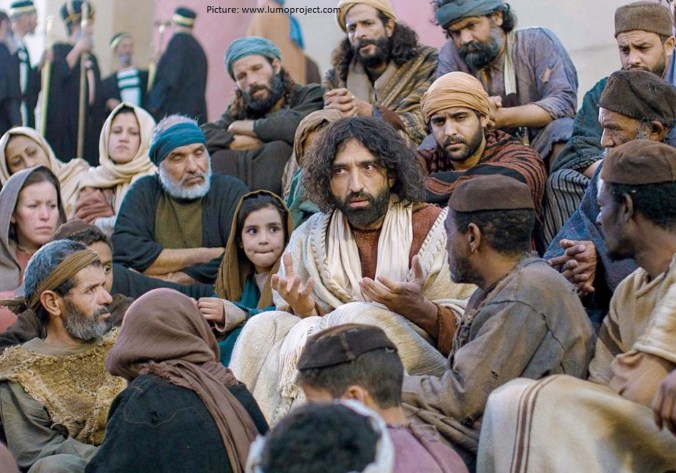
And what are the people around him doing, the ones about whom he says, “Here are my mother and my brothers!”? They aren’t out turning the world upside down with their charity and kindness, at least not yet. They are sitting around Jesus and listening to his words. They are letting him serve them. They hear Jesus and they believe the good news.

They are Jesus’ family, his mother and brothers and sisters, because the good news is that Jesus came to take away our sins. He lived the perfect life of love and mercy to fulfill God’s law for us. He came to give his life in place of ours as the payment for our sins. By declaring us not guilty, by so removing our sin, he makes for himself a people who are qualified to be claimed as his own family.

Who are his mother and brother and sisters today? They are still the people who are gathered around to hear his words and believe them. They are the people who let Jesus serve them with the gospel. At church, studying the Scriptures, or even reading this little meditation on his words, they are you and me.

Not a Crazy Love

Jesus Crowd

Mark 3:20-21 “Then Jesus entered a house and again a crowd gathered, so that he and his disciples were not even able to eat. When his family heard about this, they went to take charge of him, for they said, ‘He is out of his mind.’”

Can you love your neighbor too much–not romantic love or selfish desire, but true, self-sacrificing love that only does what is best for others? Is it possible to love others that way beyond the bounds of sanity? Some members of Jesus’ own family thought so. They thought Jesus was crazy for spending so much time with the crowds.

Why did they think Jesus had gone too far? He was working so hard that he didn’t even have time to eat. But he wasn’t a workaholic addicted to his job, the kind of person who gets the jitters if he isn’t doing something productive. He wasn’t a slave to money or gadgets or the finer things who never stops working because he never has enough.

Jesus understood, like no one else ever has, that life is serving. In this case, Jesus was fasting not for some mystic religious exercise to bring him closer to God. He skipped meals because his neighbor needed him. We aren’t told specifically on this occasion, but when crowds surrounded Jesus, that usually meant he was doing one of two things: either he was showing mercy by healing their diseases and driving out demons, or he was proclaiming the love of God in the gospel of grace.

When Jesus saw the crowds, we read in Matthew’s gospel, he had compassion on them, because they were harassed and helpless, like sheep without a shepherd. They suffered all the physical misery and pain that is common to people who live in the world. And in Jesus’ day, all their religious leaders were far more interested in burdening them with huge lists of rules to keep than offering the smallest drop of God’s forgiveness. Jesus gave these people the time they needed, so that he could give them the grace they needed, even if that meant skipping dinner more than a few times.

For this, his family decided he was out of his mind. Do our own sympathies sometimes lie with their point of view? What is the point of sacrificing my time, my convenience, my energy, my comfort, or even my health for others when there is no obvious benefit for me? Why help someone else when it makes my own life less pleasant? The answer: that’s what love is.

In Paul’s great description of love in 1 Corinthians 13, he says among other things, “Love is kind…it is not self-seeking.” Parents do it for their children–sacrifice with no immediate benefit to themselves–at least much of the time. Why should it stop there? “As we have opportunity, let us do good to all men, especially to those who belong to the family of believers.” Any other view is just another version of worldly selfishness.

Our criticism of sacrificial love at work, our refusal to practice it ourselves, only exposes our selfish nature. The world knows only a “love” that expects something in return. I know of a celebrity fund raiser that once raised $100,000 dollars for underprivileged children. That’s wonderful. But nearly $800,000 was spent entertaining the celebrities in attendance to raise the $100,000. I don’t want to be critical of the good. But Jesus shows us a better way. Jesus shows us love. And love should not be criticized.

Jesus’ love is always first a love to be received. That’s what the crowds were doing who came to him. That is why we have placed our faith in him. He has loved us no less sacrificially. He has given us more than his time. He has given us his very life. That’s not crazy. That’s what God’s love looks like.

The Value of the Same Old Thing

football stadium

Philippians 3:1 “Finally, my brothers, rejoice in the Lord. It is no trouble for me to write the same things to you, and it is a safeguard for you.”

You are all intelligent people. Seventy years from now you will still know that the cross is the place where Jesus died; that he died on that cross as our substitute; that he satisfied everything God demanded for our salvation; that God forgives our sins as a result; that all of this is a gift–not something we earn or pay for ourselves. You will remember this even if you never hear it mentioned again.

But what if we don’t keep talking about this same old thing like it is our greatest treasure, the most important thing in our lives, the one thing that always makes a difference? Will the gospel become little more than facts we learned a long time ago, something that we used to believe?

Let me illustrate with an example from sports. You know a large number of people who are fans of football. They never tire of watching their teams or talking about them. If you asked them whether they were going to watch their team on a Saturday or Sunday afternoon, they would never say, “Nah, it’s always just the same old thing. They throw some passes. They run some running plays. I don’t need to see that again.” When the game is over, some of them will spend far more time than it took to play the game talking about the great plays and the bad plays, questioning the coach’s decisions, accusing the referees of criminal incompetence.

What happens if you move some of those people someplace where they can’t see their favorite teams play anymore? What if they can’t listen to the games on the radio, and no one else cheers for their team? Neither the newspapers nor the evening news ever make mention of them. What if they move half way around the world, where not only has no one ever heard of their favorite team, but the sport they call “football” is played with a round ball and a goalie?

Some of them may remain fans until the very end. But many of them will begin to lose interest. Their tastes will change. They will remember that there was a time when they thought that watching football and pulling for their team was important, but not so much anymore. Not only might they be cheering for a different team. They might be following an altogether different sport.

You and I are more than Jesus’ fans. We have trusted him with our lives and our eternal destinies. The things that Jesus has done to save us, the grace and love that you have come to know from going to church and studying the Bible, deserve your ongoing attention. They are worthy of your interest and fascination. They call for your unending exploration and discussion.

Then not just your knowledge, but your faith will stay in place as long as you live. It is a joy for those who preach, as it was a joy for Paul, to give you these same old things, because this is a safeguard for you.

The Joy of the Same Old Thing

Joy Waterfall

Philippians 3:1 “Finally, my brothers, rejoice in the Lord. It is no trouble for me to write the same things to you, and it is a safeguard for you.”

Contrary to what some people think, the Christian faith is not mostly about rules and restrictions. It is not mostly about obedience or sacrifice. These things have their place, it is true. We have no right to ignore them or throw them out. But those are not the things that make us rejoice.

Nor is the Christian faith just an empty emotion of joy. There is a hollow, temporary joy some people get from drugs or entertainment. There is a shallow, undependable kind of joy some people get from having the money or the things that they want. There are even churches that try to give people joy by giving them money or keeping them entertained. One I know even uses drugs. That’s not what Paul means when he says, “Rejoice.”

“Rejoice in the Lord.” In the Lord Jesus God has blessed us with every spiritual blessing. In the Lord Jesus we find God’s mercy and grace. In the Lord Jesus our sins are forgiven, because in the Lord Jesus our sins were all punished and disposed of by his death on the cross. In the Lord Jesus God sees us as his holy children and loves us as though we were only innocent and pure. In the Lord Jesus we will live forever and heaven is our home. In the Lord Jesus everything that happens in life must serve us. Even the devils cannot hurt us. In the Lord Jesus we have the strength to resist sin and love each other. In the Lord Jesus we have a real reason to rejoice.

There is nothing I would rather do than spend long hours each week studying and thinking about this grace. I will get far more out of my sermons than any of my listeners ever will. That is no trouble for me. It is the joy of preaching the same old thing.

But it is also a joy because I know what it will do for those who hear. As Paul says, “…it is a safeguard for you.”

The same old thing is a safeguard. It continues to steady our faith and put it on sure and certain ground. And we need that in the years ahead, because Christian faith makes us something of a target. The devil has put a bounty on our heads because we believe the gospel. The world is all too ready to assassinate our faith. They would be happy if we were to believe almost anything except the gospel.

That’s why preaching and teaching the same things is a safeguard. An emphasis on the gospel keeps our spiritual compasses pointing north. In the face of competing ideas about God and sin and salvation; in the world’s wilderness of ideas about priorities and truth and spirituality; familiarity with the simple Bible truths makes sure that we can find our way home to grace. There, our joy in the Lord will always be waiting.

The Challenge of the Same Old Thing

Bored

Philippians 3:1 “Finally, my brothers, rejoice in the Lord. It is no trouble for me to write the same things to you…”

You like new things. But you like some old things, some favorite things, too. I don’t think that you would like to have something new, something you have never tried before, for each meal every day for the rest of your life. Think of all your favorite foods, your favorite recipes, that you would never get to taste again. Some foods always taste good.

I don’t think that you want every song you ever hear for the rest of your life to be something you never heard before. Once you like a song, you want to hear it again. You might grow tired of some. But there are others you will enjoy hearing for the rest of your life.

Often, the things we like the most, the things we really enjoy, are the things we know the best, things with which we have become most familiar. The old things make us feel comfortable, sometimes even safe.

When Paul wrote this letter to the Christians in Philippi, he had many reasons for joy, and many circumstances in which he urged it. But most of what he wrote was nothing new to these people. They were the same things he had taught them when he lived with them in the past. He was repeating himself. “And that’s okay,” he says, “because it is no trouble for me to do so.”

“Of course not,” you might think. “It’s easy to write about the same things over and over. It takes less work. It takes less thought.” But that is not necessarily true.

If a pastor cares at all for the people for whom he preaches, writes, and teaches, he doesn’t want his sermons to become a substitute for sleeping pills. He knows that your spiritual health needs constant reinforcement in the foundational truths of the gospel. He works hard, then, at presenting the same old truths in a fresh and interesting way.

The message at Christmas is always going to be about God loving us so much that he left heaven, became one of us, did so in a poor family as a helpless little baby without even a decent place to be born, and put up with it all to save us. But how does one say that in a way that captures your attention, and helps you see why it still makes a difference? The message at Easter is always going to be about God loving us so much that let himself be crucified to pay for our sins and rose again to promise eternal life. But where can I find the words that will help you appreciate the peace and joy of that promise again?

I know the temptation for you here, because I have wrestled with it myself. It is the temptation to say, “I’ve heard this. I know this. I want something else, something new.” It is the temptation to decide that the gospel is just boring.

There is hardly a more dangerous temptation you will face your whole life. The same old gospel is what keeps your faith alive. Without it, your faith will die. The same old gospel isn’t boring. It is more like the title of one movie about Jesus, The Greatest Story Ever Told. It is more than entertaining. It is life giving. Like Paul, faithful pastors want to give this message to you in a way that stays fresh, even while it stays the same old thing. It is no trouble for me, then, to give you the same old thing, but not because that is easy an easy thing to do.