Jesus’ Mercy Never Tires

Hands black and white

Mark 1:29-31 “As soon as they left the synagogue, they went with James and John to the house of Simon and Andrew. Simon’s mother-in-law was in bed with a fever, and they told Jesus about her. So he went to her, took her hand, and helped her up. The fever left her and she began to wait on them.”

This day was a Sabbath, and Jesus had already spent a full day teaching in the synagogue. From my own experience, I know that after a full morning of preaching and teaching, there is nothing I want more than a nap on Sunday afternoon. On this day, you might expect that Jesus was ready to hang it up.

But Jesus’ mercy never tires. When they tell him about Peter’s mother-in-law, he doesn’t hesitate. He goes to her and makes her fever disappear. And it’s not like it is when your fever breaks, and you feel lazy and listless for another day. She gets up and serves the meal. In his mercy, Jesus relieved her pain, immediately and fully.

Do you note that her condition was a fever? Luke tells us it was a high fever, but he was not raising her from the dead, or curing an incurable disease, or restoring sight or crippled hands or feet–the kind of life altering or life ending conditions that generally cannot be changed. She had a fever. Have you ever had a fever? Didn’t come and go?  Yet, this family didn’t consider her condition too unimportant to ask for Jesus’ help, and Jesus didn’t consider himself too busy or too tired to help. He made the fever go away. His mercy never tires.

Do you remember when the mothers brought the babies and children to Jesus for his blessing, and the disciples tried to shoo them away? They thought that Jesus was too busy. They considered these children too insignificant for Jesus to give them his attention. Do we do to ourselves what those disciples tried to do to those children? We consider our troubles too small, ourselves too insignificant, and Jesus too busy to bother him with our little pains, heartaches, and concerns. Then we are stunting our prayer life. We are letting Satan use a false sense of humility to place an obstacle between us and Jesus’ love. We are standing in the way of our own faith, and denying ourselves the help he wants to give us in his mercy. “Ask…seek…knock,” Jesus says. He doesn’t put any conditions or qualifiers on how much, how serious, or how often.

Jesus’ mercy for us never tires. But maybe you are thinking, “Then why doesn’t he? Why doesn’t he give me some relief? My heart is broken. My body is falling apart. My life is miserable. Where is his mercy?” To which I say: “Trust him.” This is not the place to let your experience be the judge. His word, the example we see here from his life, is a better indicator of his love than what you feel. Trust his promises.

If today it seems as though he is not relieving your pain, then remember that he always gives us what we ask for, or he gives us something better. Hasn’t he promised that his Father gives only good gifts to those who ask? Maybe your present pain contains a gift that you haven’t discovered yet. Hasn’t he promised that no one who gives up houses or family or fields for his sake will fail to receive a hundred times as much or to inherit eternal life? Hasn’t he promised that you will have much trouble in the world, but take heart; he has overcome the world? Hasn’t he promised that the gift of his kingdom alone–the gift of living under him as your Lord and Savior by faith now and by sight in the life to come–is like the treasure hidden in a field, or the one pearl of great price that is worth giving up everything else in order to possess?

Jesus has not grown tired of showing mercy to you. Sooner or later, whether in this life or the life to come, he will relieve your pain, too.

More than Amazing

Surprised

Mark 1:27 “The people were all so amazed that they asked each other, ‘What is this? A new teaching– and with authority! He even gives orders to evil spirits and they obey him.’”

Do you detect something missing here? After Jesus performed the miracle of turning water into wine at Cana, we read, “He thus revealed his glory, and the disciples put their faith in him” (John 2:11b). When Jesus drives out this demon, the people are amazed. They are entertained and interested. These captivated listeners couldn’t ignore him. But it would be better if we heard, “They believed in him.”

Are we sometimes guilty of lacking even that–amazement? Do Jesus’ words stop captivating our hearts and minds, and inspire only a yawn? Or do we become like these people, and treasure Jesus’ words only for entertainment value: we like it if they give us a little tingle, if we get a little spiritual rush or buzz, and we will go where the preaching is polished and passionate, but by Monday morning, or even Sunday afternoon the message will make little difference for what we believe or how we live?

Dear friends, Jesus wants you to know that these words are true, that his words are true. These things really happened. He did them for you. He applies them to you. He still speaks with power to open the Scriptures to your mind, to open God’s grace to your heart, and you can be certain that God loves and forgives you today. He still wields authority over every enemy of our souls, and you can be confident that he will rescue us from every evil attack until he brings us safely into his heavenly kingdom. Be amazed, but more than that, believe him when your Savior speaks. Then you will know his power and authority. More than that, then you will ever be captivated by his love.

The Power of Six Simple Words

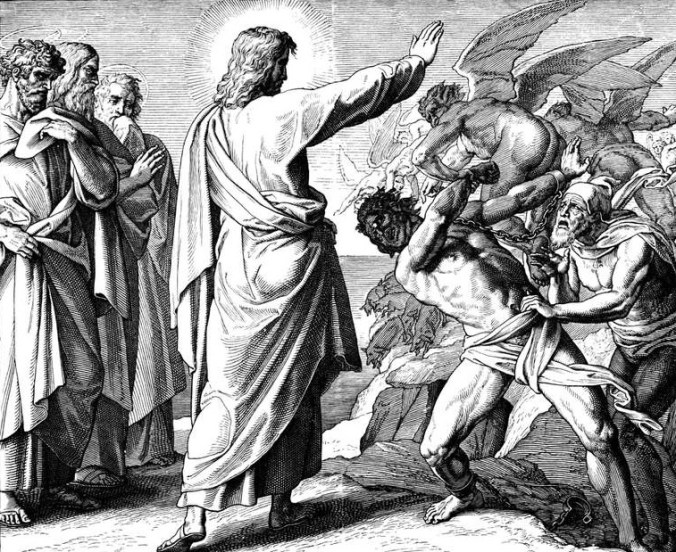
exorcism

Mark 1:23-26 “Just then, a man in their synagogue who was possessed by an evil spirit cried out, ‘What do you have to do with us, Jesus of Nazareth? Have you come to destroy us? I know who you are–the Holy One of God!’ ‘Be quiet!’ said Jesus sternly. ‘Come out of him!’ The evil spirit shook the man violently and came out of him with a shriek.”

Demons are not creatures to trifle with. Though the devil and his demons are less powerful than God’s good angels, we can see how superior their strength is to ours when we look at the story of Job. There we see what the devil did to destroy his property, his family and his health. We can see frightening power in the way they invaded the bodies of unsuspecting people in Jesus day and took control of them.

One of these sworn enemies of God even had the gall to enter a house of God and challenge God’s Son. “What do you want with us, Jesus of Nazareth? Have you come to destroy us?” With his questions he is staking out this territory for himself, asserting his right to this place and this body. It implies that Jesus is the unwelcome intruder, the one who is out of place, the one who is sticking his nose in where it doesn’t belong.

You see, so long as the devil and his demons can lull the people to sleep and poison their minds with false teachings, so long as they can use a house of God to puff people up with pride and divert their faith from God’s grace to their own goodness, they are willing to let peace prevail and keep silent. But nothing stirs them up like Christ and his gospel. There is nothing they fear more than people coming to believe that Jesus is their Savior, and that salvation is God’s free gift. The demon had to speak.

Now, see the power Jesus exerts over it: “‘Be quiet!’ said Jesus sternly. ‘Come out of him!’ The evil spirit shook the man violently and came out of him with a shriek.” Jesus spoke just six words. He performed no fancy rituals. He didn’t struggle with the demon for days, or hours, or even minutes. Six calm, simple, powerful words force the fiend to flee.

“Be quiet!” Jesus commands, and we hear no more from the demon. “Put a muzzle on it!” is a little more literal. Jesus doesn’t engage it in a conversation or initiate a discussion about the issues the demon has raised. He certainly isn’t going to get into a debate about its “right” to the body it has possessed. The demons, like their boss, are nothing but cheats and liars. You can’t reason with them. If only Adam and Eve had taken this approach thousands of years earlier. If only we would refuse to get into conversations with tempters today, whether spiritual or human.

“Come out of him!” We need the demons’ presence even less than we need their words. And though this demon is something of a drama queen, shaking the man’s body and screaming as it goes, it has no choice but to obey. The amazing authority with which our Savior speaks even applies to them. Demonic enemies can’t oppose him.

Twenty-First Century Americans don’t see much of this kind of open activity by the evil spirits. That’s not because they have gone away. Rather, they get more faith-destroying mileage out of giving people the impression that there is no spirit world in our context. If they can create the illusion that there are no spirits, then it is a short step to convincing people there is no God.

Whether we see them or not, the authority with which our Savior speaks, even to them, is still a comfort. Jesus’ words have the power to deliver us from their temptations and their lies as well as from their control. Jesus can deliver, and he can have any soul he wants any time, and there is nothing the enemy can do about it.

Jesus’ assault on the demonic powers is ongoing. The Book of Revelation depicts it like this: “Now have come the salvation and the power and the kingdom of our God, and the authority of his Christ. For the accuser of our brothers, who accuses them before our God day and night, has been hurled down. They overcame him by the blood of the Lamb and by the word of their testimony” (Revelation 12:10-11).

The devil and his demons would like nothing more than to accuse us, to pin our sins on us, and to get God to condemn us. They want you and me to despair. But the blood of Jesus promises that every sin has been covered and washed away. It silences every accusation. It still speaks a word even the demons can’t oppose.

With Authority

The Sermon on the Mount
Carl Bloch, 1890

Mark 1:21-22 “They went to Capernaum, and when the Sabbath came, Jesus went into the synagogue and began to teach. The people were amazed at his teaching, because he taught them as one who had authority, not as their teachers of the law.”

The teachers of the law, also known as the Scribes, should have been unmatched authorities on the Old Testament Scriptures. They copied them by hand, word for word, letter for letter, for a living. They followed precise rules to ensure their accuracy, even counting the number of individual letters of the alphabet in the manuscript they had just copied, and in the copy they had just made, and making sure they came out exactly the same. As a result, they went through the Old Testament with a fine-toothed comb over and over again. As a result, they became quite knowledgeable about the contents of the Old Testament books.

Unfortunately, most of them were interested in the wrong things about God’s word. The prevailing religious theory of the time was that God gave the Bible primarily as an instruction manual for holy living. They believed that if you followed its rules closely and carefully, you could actually live a life that would make God pleased with you. They gleaned the pages of Scripture for better laws, for hidden principles of holiness. They tended to overlook those passages that promised God’s grace.

Maybe you can guess where that emphasis led them. A sober and honest study of God’s law always confronts us with how impossibly hard it is for us to keep it the way God demands. If we think that we can and must keep all those commands for God to love us, then it won’t be long before our study of Scripture becomes a search for every loophole to excuse our bad behavior. That’s what happened to the Scribes. Instead of listening to what God said about loving your wife and being faithful to her, they tried to squeeze every excuse for divorcing her out of Moses and the prophets that they could. Instead of loving and forgiving the people who got under their skin, they tried to develop a list of acceptable insults and unacceptable insults. They became closet relativists. As they debated how far you could go, how much you could get away with, and developed lists of man-made applications, they spoke with less and less certainty. They referred to God’s word, but they no longer actually spoke it with authority.

Don’t we become guilty of doing the same thing? Don’t we go on spiritual and biblical searches for how much we can get away with in an attempt to justify ourselves? Christian teens debate “how far is too far” with members of the opposite sex before marriage. Is there some virtue in pushing that line? Christian young adults may define and redefine what it means to be “drunk.” Scripture does not prohibit alcoholic beverages altogether, but is it ever good to drink a six pack an hour? Would you down six baked potatoes like that? I have heard Christian adults try to defend a home-made definition of “personal income” that differs from the IRS when doing their taxes, or talk about figuring their “tithe” for church as though they were following some spiritual version of form 1040, complete with deductions and credits. What does that have to do with “God loves a cheerful giver”? That kind of unprincipled rummaging around in Scripture to justify ourselves may make us experts in a theology of loopholes and excuses, but it hardly makes a people who speak God’s word with authority.

The people who heard Jesus, on the other hand, noted that our Savior speaks with authority. What made his preaching and teaching different? Certainly he was more knowledgeable than anyone else about the contents of the Old Testament. It was all his word to start with. But it also had to do with how he used it. If we back up a few verses, we get a little summary of how Jesus preached. “The time has come. The kingdom of God is near. Repent and believe the good news.”

When Jesus preached God’s law, he didn’t preach so that people could justify their behavior. He didn’t debate loopholes and excuses. He called a spade a spade. He preached with certainty. And he called people to repent. He laid God’s word on their hearts, and exposed the shortcomings of us all, like John the Baptist did, and the Old Testament prophets before him.

But that would have been nothing but a theology of hopelessness and despair without, “Believe the good news.” Jesus preached the love of God with certainty–no “if you do this” first. God loves you and wants to make you his own today. He proclaimed the forgiveness of sins to the prideful and the pitiful. Like the psalmist said, “If you, O Lord, kept a record of sins, O Lord, who could stand? But with you there is forgiveness. Therefore you are feared.” Jesus could and did point to himself as living proof that God keeps all his promises to us. God had promised a Savior to rescue his people. Jesus could say, “I am the Good Shepherd. The Good Shepherd lays down his life for the sheep.” God had promised his people eternal life and victory over death. Jesus could say, “I am the resurrection and the life. Whoever believes in me will live, even though he dies.” Our Savior speaks the good news with certainty that human authorities did not and cannot match.

The Bible’s Bad Examples

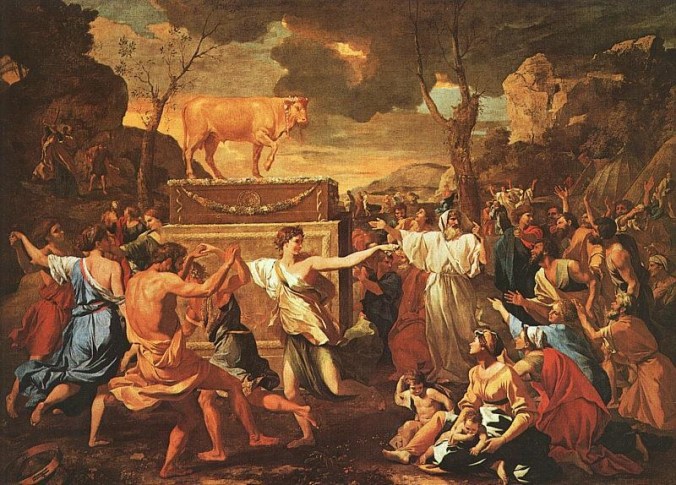
Golden Calf

1 Corinthians 10:11-13 “These things happened to them as examples and were written down as warnings for us, on whom the fulfillment of the ages has come. So if you think you are standing firm, be careful that you don’t fall! No temptation has seized you except that which is common to man. And God is faithful; he will not let you be tempted beyond what you can bear. But when you are tempted, he will provide a way out so that you can stand up under it.”

So often the examples the Bible provides to help us are not positive, but negative. Few of the families we read about give us good examples to follow. They behave more like characters in a soap opera. But when we see the results of their bad behavior, we have a good idea about the kind of behavior to avoid.

God’s interaction with the nation of Israel often worked the same way. “These things happened to them as examples,” Paul says. The examples he cites describe tens of thousands of them falling into sin and paying with their lives.

Still, the examples can help us. First, they serve as a warning: “If you think you are standing firm, be careful that you don’t fall!” Don’t be like the overconfident child who says to his father, “Don’t worry about me, dad, I can take care of myself.” Given the right set of circumstances, there is no sin that is beyond the capability of my own sinful flesh. The potential is always there for me to fall. I must always turn away from myself to find my strength.

The second help comes in the form of a reminder. “No temptation has seized you except that which is common to man.” God does not allow even a single person to be attacked by superhuman, unique temptations that surpass what other people have to bear. Don’t despair. Don’t give up. Don’t assume that we are doomed to fail, so there’s no use in trying. We shouldn’t underestimate the power of temptation, but we shouldn’t overestimate its power, either.

Now come a handful of God’s promises that are a bright light of hope among all these warnings. “God is faithful.” Here is where our focus belongs. We cannot be trusted. God can. How can we know this? Look at those same gracious gifts we are tempted to overlook. Hasn’t he been devoted to us from the very beginning of time? He made the world a perfect paradise in which we might live. He created our first parents in perfect innocence, and when they fell into sin and made a mess of his creation, he picked up the pieces himself. He came to them when they tried to hide from him. He still finds those who aren’t looking for him. He brought them to repentance. He promised a Savior.

He built and expanded on that promise through thousands of years of history. Generation after generation turned away from him, but he never wavered on his promise. Keeping it cost him everything. If that meant letting creatures he had made, and for whom he provided every day, look down upon him and mistreat him, still he would keep it. It did. If that meant suffering the hell these creatures deserved, and dying like a dangerous criminal, still he would keep it. It did. God is faithful, and he has never wavered on the promise to save us, or any other promise he has given as well.

In light of such unwavering faithfulness, Paul’s next promise might not seem so shocking, but it is no less good news: “he will not let you be tempted beyond what you can bear.” How could he? After literally dying to have us, after giving his life to own us, how could he sit on his hands while wave after wave of temptation washes over us and eventually drowns us in a sea of sin and despair? Our Savior still keeps Satan on a short chain. He still decides that temptation may go this far, but no farther.

And even though temptations still come, he promises, “But when you are tempted, he will also provide a way out so that you can stand up under it.” Notice that the way out he promises doesn’t make the temptation disappear. Usually that may be what we want, but God has a different way of dealing with us. The temptation isn’t good, but it has served to expose our human weakness. Now God’s way out is to give us the divine ability to stand up under it. And how can that be found? By focusing on the love of a Savior, whose love changes our hearts and sets us free from the power of sin to control us.

When you are feasting on filet mignon, ground beef loses some of its appeal. When you are watching a golden sunset transform into a brilliant symphony of light, the cheesy sitcoms playing on the TV inside the house aren’t much of a distraction. And when our hearts are being captivated by the tender expressions of Jesus’ love, then the petty promises of this world’s perverse pleasures haven’t disappeared, they just can’t compete with our true love.

No Place To Be Casual

casual

1 Corinthians 9:27 “I beat my body and make it my slave so that after I have preached to others, I myself will not be disqualified for the prize.”

Our country is becoming a more casual place. Etiquette, formality, and seriousness are out. “Do what feels comfortable” is in. We dress casual, almost everywhere. We interact casual, on a first-name basis with everyone.

Whether you find this trend towards the casual refreshing or regressive, there is one place we must agree it does not belong: A casual approach to Christianity will not do. You can no more be casual about your Christian faith and life than you can be casual on a battlefield. But we are all tempted to try.

Paul was taking his faith and life seriously when he confessed, “I beat my body and make it my slave.” He understood the serious consequences for failing to do so: “so that…I myself will not be disqualified for the prize.” He recognized a basis for his concern in Israel’s history: “For I do not want you to be ignorant of the fact, brothers, that our forefathers were all under the cloud and that they all passed through the sea. They were all baptized into Moses in the cloud and in the sea. They all ate the same spiritual food and drank the same spiritual drink; for they drank from the spiritual rock that accompanied them, and that rock was Christ” (1 Corinthians 10:1-4).

Look at the advantages God gave to the people who came out of Egypt. They all traveled under the shadow of the cloud of God’s special presence. You remember that cloud that led them, that appeared as a pillar of cloud by day and a pillar of fire by night. They themselves had walked on dry ground through the middle of the Red Sea. They personally experienced the most important act of deliverance and demonstration of God’s saving love for his people in world history before the coming of Christ!

God’s special graces didn’t stop on the eastern shore of the Red Sea. They all ate the same spiritual food, the manna God gave them in the wilderness. It’s not hard to understand how the manna took care of their bodies. But in what sense did it feed them spiritually? Moses gives us the answer in Deuteronomy 8:3, “He humbled you, causing you to hunger and then feeding you with manna, which neither you nor your forefathers had known, to teach you that man does not live on bread alone, but on every word that comes from the mouth of the Lord.” The gift of manna taught Israel a lesson in faith: Every day they must trust God to take care of their needs. They could not save manna for a month ahead, or a week ahead, or even a day ahead. If they tried it turned rotten. And every day God kept his promise, confirming that he was still thinking about them and loved them. This message behind the manna became food for their souls.

And then what happened? “They served God wholeheartedly as his obedient children and marched through the wilderness from victory to victory until they all reached the promised land.” No. “Nevertheless, God was not pleased with most of them; their bodies were scattered over the desert” (1 Corinthians 10:5). Israel took a casual approach to all the good things God had done. They overlooked God’s gracious gifts, turned against the Lord, and they died in the desert for their sin.

It shouldn’t be difficult to see the point of Paul’s little historical review: Beware of casual approach to God’s grace! We haven’t walked between walls of water, but we have seen God himself die on a cross to free us from sin. We know how he broke through the walls of his own tomb when he rose on the third day. Do you think those Israelites who walked through the Red Sea ever forgot the experience? But somehow it lost its impact on their souls. I don’t believe any of us will forget that Jesus sacrificed himself for us on a cross and took his life back three days later. But somehow we lose our sense of wonder at it. We stop marveling. It doesn’t seem so important anymore.

Israel got used to the idea that the miracle of manna would be there day after day. They even got tired of it. We get used to the idea that there is church this week, and next week, and every Sunday after that as far as we can tell. And dare I say it–sometimes we even get tired of it? Such a loss of appreciation for God’s saving grace, such a casual disinterest in the sacrifices God has made to rescue from the eternal night of death, is death to our faith. It is dangerous to overlook God’s gracious gifts!

Unconditional Surrender

Surrender

1 Corinthians 15:25-26 “For he must reign until he has put all his enemies under his feet. The last enemy to be destroyed is death.”

When I was in grade school, someone gave me a model of the Battleship Missouri to build. In the box was a picture of the signing of the terms of surrender that brought WW II to an official end. Members of the Japanese delegation are dressed in their dress uniforms, or even suits with top hats. They stand dignified at the table quietly signing the documents. Though they were signing terms of unconditional surrender, there is no trace of humiliation apparent from the old photograph. Their emperor Hirohito retained his life and his title, continuing as a symbolic leader of Japan until 1989, forty-five years after the surrender.

Contrast that picture of those defeated with the one here. Ancient kings stood on the necks of their defeated enemies, literally putting them under their feet, usually before having them executed. For the ancients it communicated to people on both side the absolute powerlessness of those who lost. It signaled the utter end of their resistance, unconditional surrender. Jesus rules until he achieves just this end–all his enemies absolutely powerless, unable ever to raise any opposition, unconditional surrender.

Do you see why Jesus does not stop short of such an end? Our life in this world has been a struggle. It is a struggle caused by great opposing powers. Every physical pain we suffer, every indication that we are slowly aging toward death, is the result of the first sin introduced to our first parents by the devil. Every strained relationship in which we are involved–every broken friendship or disintegrating marriage–is the result of clashing sinful natures, unable to lay aside self to serve and love.

And how often isn’t the world right there throwing gasoline on the fire? If the devil, the world, or our own sinful nature continued on in any capacity after the Last Day, could heaven possibly be heaven? So long as some vestige of these defeated dominions might rise to power and authority again, could eternity possibly be secure? Jesus secures unconditional surrender from his enemies so that he might truly be king. Then heaven can provide all the freedom and joy he has promised. Then our faith can be confident the world to come will not be a repeat of the sin and heartache we know now.

For all of this to be so, there is one last enemy Jesus must destroy. “The last enemy to be destroyed is death.”

Contrary to a growing body of opinion, death is not your friend. Death is an enemy. That’s what the Bible says. I read a humorous and imaginary interview with death in a magazine once. Death said that it was trying to remake its image. It didn’t want to be seen as scary, gloomy, or depressing anymore. It was getting a new wardrobe, taking up some new interests, apologizing for some of its past bad behavior. Sometimes it seems like death has actually hired a marketing firm to fix its broken reputation. People champion the “right to die,” as though you had to be afraid that somehow you might miss out on the opportunity. Believe me, you don’t have to fear that you are not going to die. It’s going to happen. Sometimes death is advertised as part of the great “circle of life,” as oxymoronic as such a statement is. Becoming dinner for something else on the food chain is not a part of living. It is the end of living. Death is not your friend. It’s your enemy, because it is the enemy of Jesus.

Sometimes even Christians become a confused about this. Christians don’t live in fear of death, not because death isn’t scary, but because we can overcome fear with faith. We believe that Jesus’ own death and resurrection have defeated death. We believe that death opens up the door to the life to come. That doesn’t make death itself your friend. You wouldn’t want to take it with you to heaven. It is still the wages of sin. It still takes some people away before we have the chance to lead them to faith. It still creates pain and loneliness. It still deprives us of the love and presence of friends and parents and siblings, and sometimes even children, if only temporarily. Death doesn’t play nice.

But Jesus rules until the end, when he will destroy even this enemy: death. Already his saving work at the cross and in our hearts has placed in us a new life death can’t touch. Already he has transformed death from a permanent and incurable condition to a temporary one. Soon, his rule will banish death from existence altogether, and everything he set out to do for us will be complete. That is Jesus’ end, his goal, his purpose.

Then the end will come. Then begins a new life that knows no end.

A Simple Place to Start

Friends

John 1:45 “Philip found Nathanael and told him, ‘We have found the one Moses wrote about in the Law, and about whom the prophets also wrote–Jesus of Nazareth, the Son of Joseph.”

Many people hear “evangelism” today, and it makes their blood run cold to think of standing on some stranger’s doorstep hoping they aren’t going to be insulted as the door is slammed in their face. Most of you aren’t going to be finding others to tell that way. The early Christians looked for opportunities among their family and friends. They followed the social networks that were already in place. They spoke about Jesus to people they already knew, people who were already in the habit of talking to them.

Isn’t that what Philip does? Nathanael was a fellow Galilean, from the nearby village of Cana. Philip has found something too good to keep to himself, so he wants to tell others. He doesn’t start by chasing down strangers. He could find a way to reach them in the future. He starts by looking for someone he knows, and he finds Nathanael, a friend, to tell him Jesus is the Messiah God had promised.

I could share statistics with you that tell us more people are won for Christ in this way today than by any other kind of mission work. But my point isn’t to discourage other ways of spreading the gospel. The point is this: After Jesus finds you, a good way to start finding others is to start with those you already know.

And a good place to start the discussion is to tell them what you already know. None of the Twelve Disciples were rabbis when Jesus found them. At most, some of them were active laymen in their synagogues, men who took the Old Testament Scriptures seriously and were waiting for the Lord to fulfill his promises. At worst, some of them were irreligious social outcasts like Matthew the tax collector, or anti-government terrorists like Simon the Zealot. None of them were academic theologians.

As a result, Philip’s presentation to Nathanael is relatively simple. He starts with what he knows. God promised to send the Messiah, the Christ, the Savior in the Old Testament. Now God has kept that promise. Jesus of Nazareth, the son of Joseph, the carpenter’s son, is the one. He doesn’t delve into deep theology. He doesn’t even make a systematic presentation of sin and grace. He simply tells Nathanael, “You need to know Jesus.”

One of the most common reasons people give for not talking about their faith is, “I don’t know what to say.” But you do know what to say. Start with what you know. Can you remember the Apostle’s Creed? That’s a nice summary of Christian faith. Do you know that sin condemns us and we can’t pay for it ourselves? Do you know that Jesus took it all away at the cross? The core of the Christian faith is nothing more than that. It’s a start. Can you do what Philip did, and tell someone, “You need to know Jesus”? You can talk about your faith.

Just keep the focus on Jesus himself. “‘Nazareth! Can anything good come from there?’ Nathanael asked. ‘Come and see,’ said Philip.” Nathanael was a skeptic, and so are many of the people we run into today. They have doubts and objections about all kinds of things found in Scripture. As much as we try to prepare ourselves, we may not have an answer for every objection every time.

But Philip didn’t get into a debate about a side issue. In his head he may not have had the answer to every question. But in his heart he knew what he knew. Jesus is the Savior. He didn’t respond with an explanation. He responded with an invitation. “Come and See.”

You can still do that. After Jesus has found you, you can find others and tell them to come and see. He can take it from there.

Where Jesus Leads

Hiking

John 1:43 “The next day Jesus decided to leave for Galilee. Finding Philip, he said to him, ‘Follow me.’”

My previous congregation had an elementary school. Sometimes I watched the children in the lower grade classrooms be the leader for the day. They love to be the first in line, to have everyone stop when they stop and everyone go when they go. It’s the following that is the hard part. And if I heard dissension in the ranks when they were out in the hall on the way to or from recess, if someone wasn’t happy with what was happening, it almost always came from the followers.

We adults shouldn’t pat ourselves on the back. Ever serve on a committee? As people sometimes joke, if you have four people on it, you have five opinions. They can’t all get their way, and that can get tense. When it comes to what we believe and how we live, Jesus doesn’t even make it a committee of two–him and me– as though we could work out some compromises between us along the way. “Follow me,” he says. That means giving up the lead, even over my own life–even over my own heart and mind! And that’s something we don’t naturally want to do.

Why not? Why isn’t following Jesus easier? Following him means going where he goes, experiencing what he experienced, living like he lived. When Philip was younger, I doubt he said to himself, “When I grow up, I am going to join a persecuted little minority, give up my desires and comforts to love others and spread the gospel, and die by execution thousands of miles from home.” But that is what following Jesus, and living a life of love, led to in Philip’s case if we can trust the writings of early church fathers like Eusebius.

That’s not to say that following Jesus is all pain and unpleasantness–not by far! The blessings are immeasurable. But following Jesus in love is less about self-fulfillment, self-promotion, or self-realization, and more about self-giving, self-denial, and self-control. Following Jesus is a life lived for others. Following Jesus is a life of service and sacrifice. That’s where he went.

It’s no secret why many refuse to follow him, many stop following him, and we are tempted to go our own way. My sinful nature doesn’t like where Jesus is leading me in this world. It doesn’t like the things he lets me suffer. It doesn’t want to give up what he asks me to give up. It doesn’t want to see others have it all while I seem to be falling behind. It doesn’t want to follow him in faith.

Following someone means one other thing. It means staying close and keeping them in sight, so that we don’t lose our way. For three years Philip walked where Jesus walked, slept where Jesus slept, ate where Jesus ate. Think of what he witnessed! The sick healed, the dead raised, the greatest sermons ever preached, violent storms stopped in their tracks, vile demons forced to retreat, a cross with God’s Son hanging on it, a tomb with God’s Son lying in it, an empty grave with God’s Son overcoming it.

Following Jesus still means never letting him out of our sight. We don’t see him with our physical eyes, but he is near us in his word and in the sacraments. We hear and read the same things Philip saw in the sermons we hear and the Bible classes we attend. We come to the same table at which Philip once ate, and we receive the same body and blood given for the forgiveness of our sins. In God’s word, in God’s house, gathered in Jesus’ name, he is still in our sights, leading us closer to our heavenly home each day.

In this sense, “Follow me” is as much a special invitation, a blessed gift, as it is a command. From that blessed spot right behind Jesus you can peer into his manger to see God becoming weak, and little, and human so that he could live with you and be your Savior. Just behind Jesus, following him, you can look up to the cross where every sin we ever committed drains his life away, while he drains sin of every penalty and all its power. Following Jesus from the grave you can see the shades of your own empty tomb in his.

When Jesus finds you, follow where he leads, and you will never regret it as long as you live…which will be forever.