A Meal with a Message

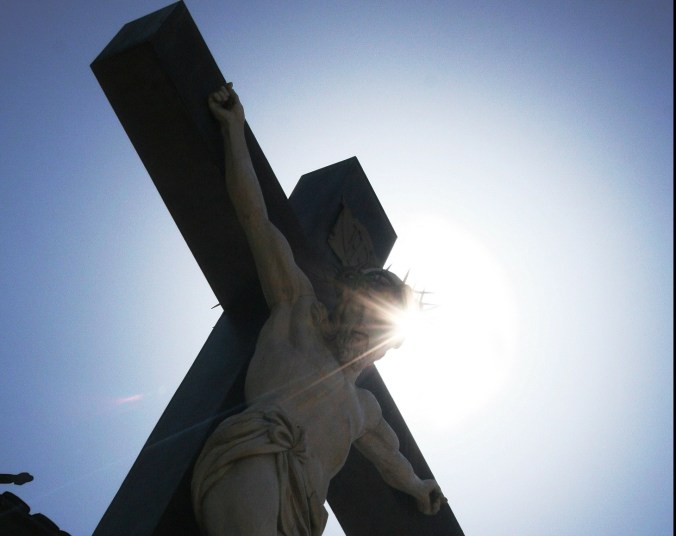
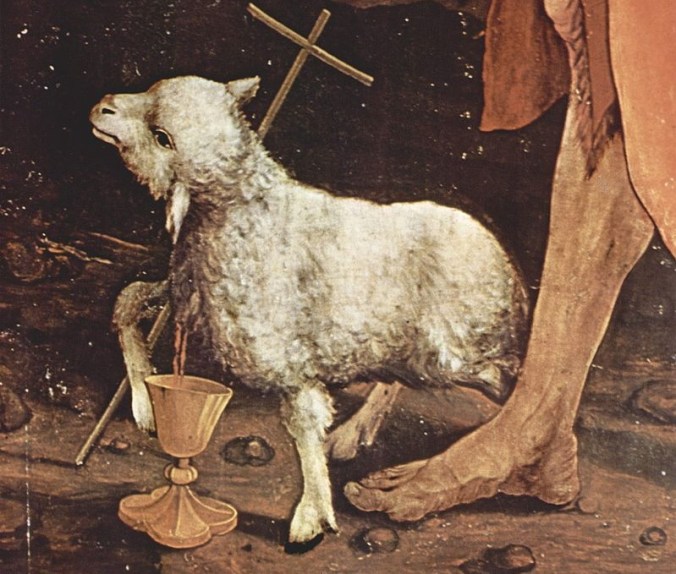
Grunewald Crucifixion

1 Corinthians 11:26 “For whenever you eat this bread and drink this cup, you proclaim the Lord’s death until he comes.”

“Do this in remembrance of me,” Jesus says. There are many things to remember about his thirty three years of life. It takes four books of the Bible to tell the story. But Paul makes clear the thing to remember here: “You proclaim the Lord’s death until he comes.”

On the west side of Goodhue County Road 6, in the cemetery of St. John’s Lutheran Church, there is a tombstone with the name “Vieths” on it. My grandparents are buried there. My grandfather delayed buying his lot in that cemetery until that one became available, because it was on top of the hill. Down the hill it is somewhat swampy, and he didn’t think he wanted to lay in that swamp until Jesus returns. I had a hand in laying both of these dear people to rest. The funeral services were comforting. But the stone that marks their resting place proclaims just one thing. “Marvin and Mildred Vieths are dead. This is the year they were born. This is the year they died.”

Jesus’ Supper is a memorial that proclaims so much more. It proclaims his death, yes, but not the sad departure of someone we have lost, someone whose body will decay until the end of time. His was not the death of another mortal whose death is all the evidence we need that he was a sinner, because the wages of sin is death.

His was the body given “for you,” – in your place and in mine. He died for sins, it is true, but the sins were ours. Peter says in his first letter, “Christ died for sins once for all, the righteous for the unrighteous, to bring you to God.” The death this supper proclaims is the death that satisfies God’s justice for all sins for all time. It’s the death that righteous Jesus died in the place of unrighteous humanity. Because Jesus’ death fully and finally deals with all the penalty for sin, it brings us to God. There is nothing standing between us anymore. All past issues, even all future issues, have been settled. This supper helps us remember, and promises it is true.

Isn’t this message also preached by the real presence, instead of the real absence, of Jesus’ body and blood with this bread and wine? Why is sin such a big problem? It is because it separates. It turns person against person, and God against people, and people against God. Why do marriages come apart, and friendships collapse, and families blow up? The specific causes form a list that would take me all night to recite. But they all have this in common–by their behavior, someone is sinning against someone else. So it goes with God. Through the prophet Isaiah he warned, “Your iniquities have separated you from your God; your sins have hidden his face from you, so that he will not hear.”

What if there were a way to remove those sins and repair the relationship? There is, by the Lord’s death remembered in this Supper. And what better way for Jesus to express that the separation is over, and every offense has been removed, and the relationship has been completely restored, than by taking a few moments to come to us really, personally, with the body and blood that fixed it all? For these few moments at his altar, in a taste and a sip, he is here assuring us that no matter what we have done, he isn’t holding it against us. It doesn’t come between us, because he himself is actually here to love us. That is the message if we will taste the gifts, and see the miracle, and listen with hearts of faith.

“If you ever need to get away for a few days, you can always stay at our place on the lake,” some friends offered us many years ago. A couple years later I called them and asked them if the offer were still good. “Of course, why wouldn’t it be?” Well, some time had passed, and I didn’t know if things had changed. I hadn’t forgotten the offer. I just hadn’t heard it for a while.

Some time has passed since Jesus died for our sins and rose to life. Some time has passed since he gave us this supper. Free forgiveness for our sins–is the offer still good? Of course, why wouldn’t it be? Take and eat, take and drink, and refresh your memory.


The Great Conspiracy

Shadows

Psalm 2:1-2 “Why do the nations conspire, and the peoples plot in vain? The kings of the earth take their stand and the rulers gather together against the LORD and against his Anointed One.”

Think of the futility. What the Jewish leaders, Herod, and Pilate conspired to do to Jesus was futile. How can you oppose an almighty God? Even if he has become a human being, opposing him is futile. Even if he chooses not to resist you or fight back, opposing him is futile. Even if he let’s you kill him, what is that to the Lord of life and death? He takes back his life whenever he chooses. A little like the mythological Hydra, which grew its head back as soon as it was cut off, or the mythological Antaeus who regained his strength every time he was knocked to the ground, Jesus may look defeated when he dies. But he comes back to life again. The difference is that Jesus is not merely a mythological creature. And he has no undiscovered weakness that makes his defeat possible.

Kings and Commoners still conspire against the Lord and his Anointed One. Now deceased atheist Jon Murray said of Jesus, “There was no such person in the history of the world as Jesus Christ. There was no historical, living, breathing, sentient human being by that name. Ever. The Bible is a fictional, non historical narrative. The myth is good for business.” He conspires and plots in vain. Closing your eyes and pretending he doesn’t exist cannot defeat Christ. When fanatical governments or terror organizations support the murder of Christians, they conspire and plot in vain. Mistreating Jesus’ followers will not erase his memory or his name. Killing them only sends them to glory sooner. Their death often serves as a powerful testimony and seeds of faith for more believers. When people like you and me decide that we are going to become “the master of our fate” and the “captain of our souls,” we conspire and plot in vain. If we presume to set our own standards of right and wrong, or adopt those of our decadent society, we conspire and plot in vain. When we consider ourselves such shining moral examples that we hardly need a Savior, we conspire and plot in vain. Neither our self-deceptions nor our self-flattery will enable us to usurp Christ’s rightful place.

Why would Pilate and Herod and heathen religions and disobedient disciples of Jesus embark on a doomed assault against the Lord and against his Anointed? Jesus constantly confronts us with what God is really like. He threatens to overturn the comfortable little world in which people convince themselves they have all the answers to pleasing God, that their system for saving yourself works. Christ’s call to repentance, humbling self under God’s offer of forgiveness, confines us. The sooner Jesus is out of the way, the sooner people believe they can get control of their fate again; the sooner we can be pleased with ourselves just the way we are.

Thank God that all such plots are in vain, because this King is still the Savior King. The goal of his rule and reign is not to destroy the rebels. It is to win them as allies and citizens by his self-sacrificing love and his forgiving grace. The very death these kings conspired to impose against Christ has become our means for being reconciled to him. It has become the power by which he conquered our hearts and continues to rule in our lives. Jesus’ death for our sins is the reason we no longer want to be free of him. Let me “be his own, and live under him in his kingdom, and serve him in everlasting righteousness, innocence and blessedness.”

Authority to Speak for Jesus

Badge

Mark 6:7 “Calling the Twelve to him, he sent them out two by two and gave them authority over evil spirits.”

Nothing stops us from opening our mouths and sharing our faith so much as a simple lack of courage. Jesus, however, wants to supply everything our hearts need to speak up. Why should these twelve men believe they had any business talking to other people as God’s spokesmen? Isn’t it because they were sent out by Jesus, God’s own Son? They had been commissioned for this work by God himself. They had every reason to believe Jesus was backing them all the way.

You and I have not been sent in exactly the same way these men were. Most who are reading this have not been called to the full time preaching ministry like they were. We haven’t been given the same leadership role in God’s Church. Jesus didn’t come to us directly and tell us to go and preach.

That doesn’t mean Jesus won’t back us up just the same. Jesus called you to faith. He led you to the light of the gospel. You did not see him with your physical eyes, but you saw him in his word through eyes of faith. Now you are the kind of people he is describing when he says, “You are the salt of the earth…. You are the light of the world…. Let your light shine before men” (Mat 5:13-16). You are the “royal priesthood,” the “holy nation,” the “people belonging to God” that the Apostle Peter describes in his first letter, “that you may declare the praises of him who called you out of darkness into his wonderful light” (1 Peter 2:9). If you believe in Jesus as your Savior, then you have been deputized. You have official standing as one of his ambassadors. He is standing behind your words and commissioning you to go and speak.

Have you ever noticed that policemen have a certain air of command and confidence about them? When the officer comes up to my car window and asks to see my license, I am the one who is nervous and unsure. He is brimming with authority and confidence. Why? He is wearing the badge. He doesn’t represent himself. The whole legal system stands behind him. He has been commissioned by a higher authority. He speaks for a higher power.

Jesus has given you a badge, so to speak, the badge of faith you wear inside your heart. You have been commissioned by a higher authority. You speak for a higher power. You have every reason to speak with courage and confidence, because you have Jesus on your side, and you are speaking for him.

For the disciples, that authority was demonstrated in a dramatic way. Jesus gave them authority over evil spirits. No doubt that was a powerful confidence booster. In the past they had seen these same spirits force human beings to live like wild animals, to perform superhuman feats of strength, to throw themselves into the fire or cut themselves on rocks and stones. Now the spirits had to do what the disciples said. How could their hearts help but take courage as they traveled and preached their message?

Does that mean that we are missing something? Does our witness have less authority? I have never seen a demon driven out, though I’m sure it must be an impressive sight. But I have sat in a room where people didn’t really know Jesus and watched the gospel lead them to profess their faith in him. I have seen that word soften the hearts of skeptics and open them up to God’s love for them. I have watched the word grow people up in their faith and love through years of exposure. The Apostle Paul says that the Gospel is the power of God for the salvation of everyone who believes. The gospel you and I speak is still powerfully changing hearts and lifting them from hell to heaven. That is a great encouragement for our hearts, the essential part of what we need to be Jesus’ witnesses.

Your Savior, Not a Sideshow

Magic

Luke 23:8-9 “When Herod saw Jesus, he was greatly pleased, because for a long time he had been wanting to see him. From what he had heard about him, he hoped to see him perform some miracle. He plied him with many questions, but Jesus gave him no answer.”

Sometimes, we like to be the center of attention. Generally speaking, we don’t like to be ignored. We want people to value us enough to listen, and to share with us what is important to them.

At other times, we don’t want people to look at us at all. When my son used to do something cute, and we looked at him and smiled, he became embarrassed: “Don’t look at me, daddy.” In public, we know that it is impolite to stare. When we catch someone staring at us, we immediately suspect that there is something odd about our appearance. Do I have food hanging from my chin? Is there something in my hair?

It makes a difference why we are getting the attention. It did to Jesus, too. That is why he did not respond to the kind of attention King Herod was giving him.

Herod had wanted to see him for a long time. To say that Herod was “greatly pleased” is a rather mild way of translating his reaction to finally meeting Jesus. Herod was overjoyed. He wanted to celebrate the opportunity in front of him. What a wonderful thing, it might seem, the lone bright spot in this darkest day in Jesus’ life.

Can we imagine that a desire to see Jesus would ever be anything but good? Though our Savior wants to be known to all people and be their source of joy, Herod reveals the human heart is so twisted that, yes, even the desire to see and know Jesus can be evidence of evil, and not good.

What did Herod want from Jesus? “From what he had heard about him, he hoped to see him perform some miracle.” Here is Jesus, the Son of God, Creator of the Universe, Redeemer of the World, standing in front of Herod at last, and what is Herod thinking? “Hey, I’ve got Harry Houdini here.” He wanted to see a miracle, not because he was coming to Jesus in desperate need of his mercy. Not even because he was looking for a sign to bolster his faith. Herod wanted nothing more than a magic trick, something to entertain him, a pleasant diversion from the pressures of palace life.

Herod’s reasons for seeking Jesus still appeal to some today. God still can and does work miracles in the lives of his people. But recognize the danger when people make them the center of attention in Christian life and worship. Jesus easily becomes a sideshow. In our own more sober circles, we may ask ourselves why we value our worship time. Do we recognize it as the source of our spiritual life? Or do we desire to be entertained for a little while–whether at church, or in our reading, or in the music we listen to. Humor in our lives is good, but is Jesus an appropriate subject of our jokes? Or is that a vain misuse of his name? Do we have irreverent reasons for the time we seek with him?

Jesus’ answer to Herod’s irreverence is powerful. “Jesus gave him no answer.” Jesus would not perform for the king. How easy it would have been for Jesus to do just one quick trick and put an end to the humiliation. Maybe he could have even so endeared himself to Herod that he could have been set free!

But for us, Jesus’ silence is golden. Jesus displays his perfect love, even for Herod, by not giving in to his childish desires. He will not reinforce this kooky king in his sin, but he treats him with silent respect, even when that respect was not returned.

And here’s the point that Jesus is making to us: Not that he is someone we should pity for being made a sideshow, but that he is someone we revere, and love, and trust, because he has no other reason to put up with this than that it was necessary to save us from our sins. This is another stop on his trip to the cross. It is his love for us that keeps him silent and makes him willing to endure these blasphemies. He let them treat him like someone with absolutely no value, so that he could share his priceless value with us, and so that God might consider us his most dear and precious possessions.

In suffering such irreverence and dishonor, Jesus pays us the highest respect and the greatest honor, because he is revealing just how much you and I are worth to him.

Like One Who Serves

Footwashing

Luke 22:24-26 “Also, a dispute arose among them as to which of them was considered to be the greatest. Jesus said to them, ‘The kings of the Gentiles Lord it over them; and those who exercise authority over them call themselves Benefactors. But you are not to be like that. Instead, the greatest among you should be like the youngest, and the one who rules like the one who serves.’”

This was not the first time the disciples had this little fight. James and John had tried to become Jesus’ right and left hand men in the past. It earned them the resentment of the other ten.

Maybe the events of Palm Sunday, the cheers of the crowd and Hosannas to the King, stirred the whole thing up again. Like most of the Jews, Jesus’ disciples had trouble understanding just what kind of a Kingdom Jesus runs. When they heard “Kingdom” they thought of armies, palaces, land, and power. They wanted wealth. They wanted authority. They wanted power.

They needed a good spanking. Their understanding of God’s kingdom was childish. Their thirst for worldly greatness was sinful. Jesus provided the necessary chastisement verbally. “The kings of the Gentiles Lord it over them; and those who exercise authority over them call themselves Benefactors. But you are not to be like that.” That might sound rather mild and gentle to us today. But don’t forget that these men were Jews. For them the Gentiles had always been “unclean.” To be compared to them was a shame. Jesus made it clear that controlling other people’s lives to serve yourself was not the way for his followers. Complimenting yourself with fancy, boastful titles like “Benefactor” was NOT a sign that you were one of God’s children. As the cross drew near, the disciples had better things to be concerned about.

Ungodly ambition has not disappeared from the church. Anytime someone wants to build a huge church or ministry, there is a danger of wanting to use it to display how wonderful, successful, or influential WE are instead of using it to display the self-sacrificing love and forgiveness of our Savior. Though God expects us to be responsible, concerned, active citizens of our country, sometimes Christian fascination with political power is born of this same sort of spirit. Concern for personal or worldly greatness does not serve our Savior.

The disciples’ concern even plays into the account of Jesus’ suffering for sin. While Jesus is preparing to face beatings, crucifixion, and the horrible wrath of God at sin, does he have the sympathy and support of his closest friends? No, they are too busy arguing about who’s the best. Later, when Jesus asks for their prayers in the garden, they take care of their own comfort by falling asleep. Together with these men, didn’t our own selfish concerns make the cross necessary in the first place?

Jesus was with them as one who served. He healed people, touched people, forgave people. He touched the leper before healing him. He forgave the adulteress. He fed the unappreciative crowds and would not let them make him king. He stayed up all night for these people. He skipped meals all day for these people. In just a few hours, he was going to give his life for these people. He didn’t do it because he had so much to gain. Love led him to serve. That is how Jesus exercised his Lordship, and power, and authority. For us, he lived the life we could not live. For us he died the death we could not die.

In such service, we know how truly great he is. Jesus offers his disciples such service despite their ambitions for glory and power, despite how little they value service and love to others. His service made our discipleship possible. His service shows the disciple what true greatness is like.

Defended!

Pointing finger

Romans 8: 33-34“Who will bring any charge against those whom God has chosen? It is God who justifies. Who is he that condemns? Christ Jesus, who died–more than that, who was raised to life–is at the right hand of God and is also interceding for us.”

You know that you are constantly being accused and condemned. Job was a man famous for the terrible tragedies he suffered. The Bible tells us that behind those tragedies were the Devil’s accusations. “Job’s faith is shallow and untested. Job is a fair-weather Christian. Job loves God out of selfish interest, but make his life a little uncomfortable and he will curse you to your face,” he told the Lord. He wanted to turn Job against the Lord, and the Lord against Job, and he picked on the weakest thing he could find in the man to do so.

The last book of the Bible, Revelation, says that the devil is still “the accuser of our brothers.” He is still trying to turn God against us by reminding him of our sins. And when he gets no satisfaction with God, then he turns on us and goes after our own consciences. He plays on our guilt. He whispers in our ears, “Look at what you have done.” Remember The Lion King? The young lion Simba is playing in the canyon where he doesn’t belong. His jealous uncle Scar starts a stampede of wildebeests that threatens to trample the future king of the beasts. When Simba’s father Mufasa rescues his son, Mufasa barely escapes the canyon himself, only to be thrown back in by the evil Scar to be stampeded to death. But Mufasa’s murder all takes place beyond Simba’s view. Scar then goes to play on Simba’s guilt. “What have you done, Simba?” Look, it’s all your fault that your father died rescuing you.

That’s what the devil does to your heart. “What have you done? Look at the mess you have made. You can’t fix this. And God certainly isn’t going to love you anymore.” He charges you with sin. He condemns. He does everything he can to drive us away from God.

But look at the way God defends us. “It is God who justifies.” It would be one thing if we weren’t really guilty of our sins. Then it would make sense for God to defend us. But our guilt is real. It would be one thing if our sin were really only a matter of ignorance. But more often than not, we knew what we were doing. It would be one thing if our sin were really only directed at other people, and didn’t involve God. But no matter whom we hurt, the commands we break are always God’s. Still, he justifies. Still, he defends. Still, he does not hold our guilt against us. How can he defend us this way?

“Christ Jesus, who died–more than that, who was raised to life–is at the right hand of God and is also interceding for us.” God justifies us because justice for our every sin has already been carried out in the death of Jesus Christ, our substitute. God has raised him from the dead as proof that he accepts Jesus’ death in place of ours. God justifies because he cannot escape the evidence that our debt to heaven has been paid. Two thousand years may have passed since the cross, but there in glory, at the Father’s side, is the living Lord Jesus with all power and authority. He is a little hard to miss, the one who paid for our sin, in that condition. We may continue to sin, but Jesus continues to intercede, to plead, to go to his Father on our behalf. He demands that our sins not be held against us because of the price he paid. Now you can ignore the devil’s accusations. Your God in heaven certainly does. He continues to defend us, because God is on our side.

The Switch

Gavel

Romans 4:25 “He was delivered over to death for our sins.”

While Pontius Pilate fumbled around with the case against Jesus in front of him, God’s court of law passed down a very clear verdict of guilt. It was a verdict Jesus had not earned, but a verdict to which he willingly bowed. God declared him guilty of the sins of the world. In God’s court of law, Jesus was the guiltiest man alive.

That means Jesus was guilty of the very sins his enemies committed against him–the betrayal of Judas, the denial of Peter, the cowardice of the disciples, the injustice of Pilate, the hatred of the Jewish leaders. The suffering they imposed on his body was at the same time being laid on Jesus’ account, and he became guilty of committing the same cruel acts he had to bear.

Even more, Jesus became guilty of the worst atrocities ever committed. In God’s eyes, Jesus was personally responsible for the death of millions of people in two world wars. Jesus raped and murdered helpless women and children in war-torn Syria. Jesus designed and carried out terrorist attacks across Western Europe and the United States: The Boston Marathon, Brussels, Paris, San Bernardino, the Parliament building in London. Jesus deceived people into believing in Baal, Buddha, Mormonism, atheism, and the New Age movement. Jesus is guilty of drug abuse, acts of prostitution, thieving, torture, and cannibalism.

It’s hard to think about him that way, isn’t it. But the guilty verdict he received strikes much closer to home than that. As far as God is concerned, it is Jesus who glanced in the rear view mirror for a second look at the lady in the short skirt on your way home from work today. It is Jesus who lost control of his tongue and vented his emotions when you screamed at your parents after school. It is Jesus who trusts God so little and worries himself into ulcers or heart palpitations when life scares you so much. It is Jesus who is holding the grudge when you are refusing to forgive. That is what Paul means when he says, “God made him who knew no sin to be sin for us.” That is what Isaiah had in mind when he wrote, “The Lord has laid on him the iniquity of us all.” God said Jesus was guilty of our sins–a verdict he did not deserve.

But because he does, God promises us his grace, a gift of love and forgiveness that we have not deserved, either.

Jesus Knew

Hiding

Matthew 26:21-24“When evening came, Jesus was reclining with the Twelve. And while they were eating, he said, ‘I tell you the truth, one of you will betray me.’ They were very sad and began to say to him one after the other, ‘Surely not I, Lord?’ Jesus replied, ‘The one who has dipped his hand into the bowl with me will betray me. The Son of Man will go just as it is written about him. But woe to that man who betrays the Son of Man! It would be better for him if he had not been born.’”

Sin never makes sense, and no one ever truly gets away with it. Sometimes this is demonstrated clearly, as in the case of the bank robber who handed a teller a note claiming he had a gun and demanding money. But he wrote the note on one of his own bank deposit slips, with his name, address, and phone number clearly printed on the other side. The police were waiting for him in his own house before he got home.

Judas should have known better than to think he could hide his sin. Any Jewish boy knew what the Old Testament Scriptures said about the all-seeing, ever-watchful eyes of God. Psalm 139 asks, “Where can I flee from your presence? If I go up to the heavens, you are there; if I make my bed in the depths you are there.” God asked through Jeremiah, “Am I only a God nearby,” declares the Lord, “and not a God far away? Can anyone hide in secret places so that I cannot see him?” declares the Lord. “Do not I fill the heaven and the earth?” declares the Lord.”

As one of Jesus’ followers, Judas had seen those all-knowing, ever-watchful eyes in action. How many times hadn’t Jesus known the thoughts of his enemies and answered their complaints even before they spoke? This very week, Jesus had told his disciples exactly where to find the donkey on which he would ride into Jerusalem. This very day, he had told two disciples that a man carrying a jar of water would lead them to the house where they could prepare the Passover. Jesus knew. Could Judas really believe that Jesus would not know his betrayer? Does this not reveal the foolishness of Judas’s sin?

Judas has been villainized and criticized for his sin. He has become an easy target. But don’t our sins betray our Savior, too? Are we less foolish when we think we are acting in secret? The man traveling on business who chooses to watch the adult programming available on his hotel room TV is no less known to Jesus than Judas was. The teens who think they are sneaking the booze past their parents aren’t sneaking it past their Savior. The unmarried couple who feel that what they do in private is no one else’s business should know that the heavenly Father has still made it his. The malicious gossip and nasty tales people tell may go no farther than the next person, but that doesn’t mean that our Lord doesn’t hear.

Ask yourself this question: Why did Jesus reveal that he knew what Judas was going to do? What purpose could it possibly serve? Jesus wasn’t going to change his own plans that night. “The Son of Man will go just as it has been written about him.” The other disciples were in no position to make use of this information. What Jesus said, he said especially for the sake of Judas. Jesus was giving Judas a chance to repent.

The full implications about our Savior’s grace do not strike us until we realize Jesus fully knew that Judas would not repent. Judas kept up his hypocritical charade until the very end. Judas followed through with his plan by betraying Jesus with a kiss. Jesus knew. Still, Jesus gave him a chance. Forgiveness was there, waiting for Judas to repent, even though Jesus was certain Judas would not. Aren’t we right to conclude that such a Savior would never give up on you or me, either?

Jesus knew his betrayer, but he knew so much more. He knew the price he would pay in the coming night and the coming day. He knew about the scourging and the crucifixion. He knew that he would be forsaken by his Father in heaven. Still, “The Son of Man will go just as it is written about him.” Betrayer, or no betrayer, Jesus was willing. He was determined, on this night, to offer his life in place of ours as the atoning sacrifice for our sins. The determination we hear in these final warnings to Judas reveal the graciousness of our Savior to you and me, too.

Living Light

Jesus Light

Ephesians 5:8 “For you were once darkness, but now you are light in the Lord. Live as children of light.”

Every proud parent has high expectations for his offspring. In the Disney movie The Lion King there is that scene in which the hero Simba is confronted by the ghost of his father Mufasa. Mufasa tells him that he is disappointed in him, because “You are more than what you have become.” The point is: Simba is living his life as a goof-off instead of assuming the responsibilities he should be performing as the rightful king. Perhaps your parents played on a sense of family-pride to get you to live up to their expectations. “A Jones doesn’t give up when things don’t go your way.” Or maybe you’ve seen parents try to blame the other side of the family tree when Junior started showing character flaws.

Our Lord also has high expectations of us when we become his children and members of his family by faith. But he doesn’t rely on New Age psychology, or guilt trips, or family pride to encourage us to reach toward his goals. He takes us back to his grace. He helps us understand who we are, what he has made us.

At one time you were darkness. For the Christians in the city of Ephesus, people who grew up Gentiles worshiping the ancient Greek and Roman gods, this had been their condition for the majority of their lives. They grew up worshiping the wrong god. They grew up learning to excuse or accept behaviors that were sinful and destructive. They grew up in fear, never certain that their gods cared for them now, or where they were going when they died.

For some of us, our time in darkness may have been relatively short. But all of us were once darkness, if only from birth to Baptism. Even now, the darkness lurks within. And so today, things that should be condemned and fill people with disgust or horror are insisted upon as rights. Filthy talk is called a sense of humor. Greed is called healthy ambition or a good work ethic. Self-righteous, self-promoting busybodies are described as pious or devout. God condemns it all as darkness.

And that is what we were. But now, Paul says, you are light in the Lord. Now the light of God’s love, and the light of God’s truth, is shining on us and shining in us. The light of God’s word has shown us that God is not some moody, vicious monster we must constantly pay off to make him like us. He is the God who freely gives. He freely gave his own Son in payment for our sins. He freely gives forgiveness no matter how great the sin, no matter how poor the sinner. He freely makes us his own children. He freely invites us to receive and enjoy all the blessings of our home with him. The light of such love and truth change the way everything looks to us. That light pierces into our own hearts, making them the home of our Savior and his light by faith.

That truth has highest importance for eternity. It means that after we die, we will rise again to live with God forever. We will ever bask in the beautiful, warming, joy-giving light of his love in heaven.

But it also means something for us right now, which is more to Paul’s point in these verses. You are light in the Lord. That light of God’s love and truth, light which showed you how all your sins were taken away and why God considers you holy and precious, that light also lives in you. You have something new that you didn’t have before. You have the power of God’s love in Christ living in you, a new source of life and strength, so that you can live as children of the light, starting today.